
Career Change to Teaching:B.Ed Guide for Working Professionals
Table of Contents
Part 1: Understanding Career Change to Teaching
Introduction
You’ve spent 5-15 years in corporate. You’ve climbed the ladder, earned decent salary, attended countless meetings. Yet something’s missing. You wonder: Could I teach instead? Would I be happier? Is it too late to switch?
The answer: It’s never too late. Teaching welcomes career changers. In fact, your corporate experience is an asset, not liability. You bring maturity, real-world experience, communication skills, and professional perspective that fresh B.Ed graduates lack.
But career change requires strategic planning. You can’t just quit and start B.Ed. You need distance education options, financial planning, and clear timeline. This guide provides exactly that—a realistic roadmap for professionals transitioning to teaching.
Why Corporate Professionals Switch to Teaching
Real reasons (not romantic notions):
- Meaningful Impact
After years of “increasing quarterly revenue” or “optimizing processes,” many professionals want work that directly helps humans. Teaching offers that daily. Students’ lives visibly change because of you. - Better Work-Life Balance
Corporate: 50-60 hour weeks, weekends working, high stress
Teaching: Fixed hours, meaningful summers off, lower stress
Trade-off: Lower salary. But balance matters at certain life stage. - Job Security
Corporate: Layoffs, contract uncertainty, restructuring
Teaching (Government): Permanent job, pension, lifetime security
Appeal: After precarious corporate years, security feels valuable. - Alignment with Values
Some professionals (especially parents) shift priorities. Money becomes less important; shaping young minds becomes priority. - Late Career Shift
At 45-50, some realize they don’t want to work until 65 in corporate. Teaching offers respectable exit—secure government job for remaining 15-20 years. - Entrepreneurial Fulfillment
Teachers design curriculum, shape culture, lead initiatives. These entrepreneurial elements appeal to corporate leaders wanting autonomy.
Hard Truths About Switching to Teaching
Before idealizing teaching, understand realities:
❌ Salary cut is real and significant
- Corporate manager (10+ years): ₹15-25 lakhs/year
- Government teacher: ₹5-8 lakhs/year
- Difference: 60-75% salary reduction
- This is not small. Budget accordingly.
❌ Credential starting over
- Your 10 years corporate experience doesn’t accelerate teaching career
- You start as junior teacher regardless of seniority in previous field
- Takes 5-10 years to reach equivalent income/respect
❌ Physical and emotional demands
- Managing 40-50 students daily is emotionally exhausting
- Different stress than corporate (student discipline, parent complaints vs. metrics)
- Some find it harder, not easier
❌ Limited flexibility in teaching
- While hours are fixed, they’re rigid (must be there 8am-3pm daily)
- Less flexibility than senior corporate roles often had
- Surprises: Parent meetings, student issues, urgent school needs
❌ Student issues are complex
- Dealing with learning disabilities, trauma, behavioral problems
- Not just teaching content; also parenting, counseling, intervening
- Emotionally draining sometimes
Who Should Switch to Teaching?
Ideal candidates:
✅ You’ve been corporate 5+ years (so not impulsive)
✅ You have financial cushion (salary cut is real)
✅ You’re naturally patient and empathetic
✅ You genuinely enjoy explaining concepts
✅ You want security over wealth
✅ You’re willing to invest 2 years in B.Ed
✅ You won’t resent the salary cut
✅ Family is supportive
Who Should NOT Switch (Yet)
❌ You’re escaping corporate problems
If you’re switching to escape bosses, stress, unfair situation—you might regret it. Teaching has its own challenges. Don’t escape to; move toward.
❌ You need high income
If you need ₹20+ lakhs, teaching won’t provide it (teaching caps at ₹12-15L without leadership).
❌ You’re unsure about teaching
Spend a year volunteering, tutoring, or substitute teaching first. Make sure you actually like it before investing 2 years.
❌ You’re at peak earning years
If you’re 45-50 and haven’t saved enough, teaching’s lower salary is risky. Plan retirement before switching.
Part 2: Distance B.Ed Options for Working Professionals
Understanding Distance B.Ed
What is distance B.Ed?
B.Ed degree earned through correspondence/online study rather than full-time classroom attendance. You balance job + studies.
How it works:
- Study materials mailed or available online
- Attend workshops/contact sessions (typically weekends, 1-2 per month)
- Take exams at study center
- Complete internship (practice teaching) over 2 years
- Earn same B.Ed degree as full-time students
Duration: 2 years (same as full-time)
Time commitment: 15-25 hours/week (vs. 40+ hours for full-time)
Cost: Similar to full-time (₹1-3 lakhs for 2 years)
Top Distance B.Ed Universities in India
Tier 1: Central Government Universities (Best Quality)
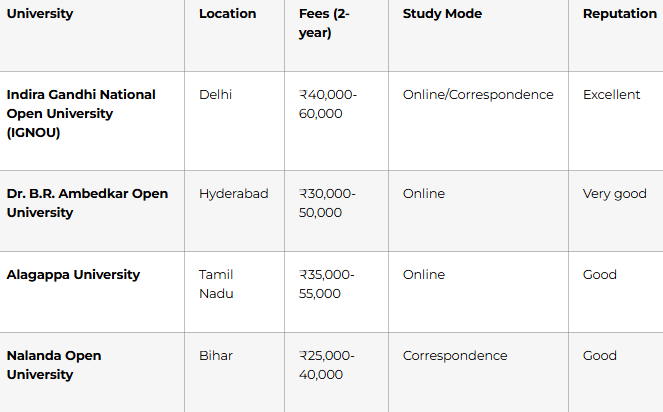
Tier 2: State Open Universities
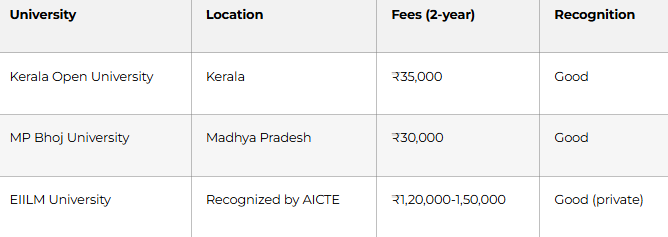
Tier 3: Private Distance B.Ed
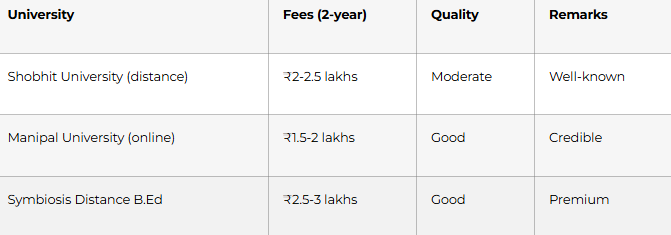
My recommendation for professionals: IGNOU (Best value—recognized, affordable, quality)
IGNOU Distance B.Ed: The Practical Guide
Why IGNOU for professionals:
✅ Affordable (₹40-60K for 2 years = ₹2-3K monthly)
✅ Flexible (no fixed class timings)
✅ National recognition (accepted for government jobs)
✅ Online + offline options (study online, attend workshops weekends)
✅ Large student base (peer support available)
✅ Quality content (government-designed curriculum)
IGNOU B.Ed admission process:
Step 1: Check eligibility
- Bachelor’s degree with 50%+ marks
- You qualify if you have corporate degree + Bachelor’s
Step 2: Online registration
- Register on IGNOU website (ignou.ac.in)
- Upload documents
- Pay admission fee (~₹1,000)
Step 3: Await admission
- Processing takes 2-4 weeks
- Admission confirmation email sent
- Download study materials
Step 4: Begin studying
- Study materials mailed (or download online)
- Access online learning platform
- Join virtual classes (optional but helpful)
Step 5: Attend workshops
- Compulsory workshops: 2-3 per semester (usually weekends)
- 1-2 days duration
- Practice teaching guidance provided
Step 6: Take exams
- Semester exams at designated study centers
- Usually 3-4 hours per paper
- Two exam windows yearly (January and July)
Step 7: Practice teaching (internship)
- 4-6 weeks internship in school
- Can be done at your current school if principal permits
- Or arrange in nearby school
Step 8: Graduate
- After 2 years, passing all papers + internship = B.Ed degree
- Certificate issued (takes 1-2 months after completion)
Distance B.Ed Timeline for Working Professional
Real-world schedule example (Working professional, full-time job):
Month 1-2 (Semester 1, First month):
- Job: Regular 8-10 hour workdays
- B.Ed: 5 hours/week study
- Total: 13-15 hours/day
- Challenge: Initial load high, adjusting to studying while working
Month 3-6 (Semester 1, remaining):
- Job: Regular hours
- B.Ed: 8-10 hours/week (assignments due)
- Weekend: 1 workshop (2-3 days, take leave)
- Exam prep: 10-15 hours/week in final month
- Take exam in January
Month 7-8 (Semester 2, first half):
- Job: Regular
- B.Ed: 5 hours/week (lighter semester)
- Internship prep: Planning practice teaching
Month 9-12 (Semester 2, second half):
- Job: Regular
- B.Ed: 8-10 hours/week
- Internship: 4-6 weeks (negotiate with employer for leave)
- Exam in July
Repeat for Year 2 (Semesters 3 & 4):
- Similar pattern
- By Year 2, you’re experienced; easier to manage
Total time commitment: 15-25 hours/week = 1.5-3 hours daily
Balancing Job and Distance B.Ed: Practical Tips
Time management:
- Study early morning: 5-6 AM for 1-1.5 hours (before job starts)
- Evenings: 2-3 hours after job (but not exhausting)
- Weekends: 4-5 hours for assignments and review
- Avoid studying all evening (leads to burnout)
Negotiating with employer:
Approach your boss: “I’m pursuing B.Ed through distance learning to grow professionally. I’ll complete all work on time. I’ll need 2-3 days leave yearly for workshops and 4 weeks for internship. Is this feasible?”
Most progressive companies support this. They see it as employee development.
Leave usage:
- Use 2-3 leaves/year for workshops (1-2 days each)
- Use vacation (annual leave or unpaid leave) for internship (4 weeks)
- Plan ahead so work isn’t disrupted
Financial management:
- B.Ed fees: ₹2-3K/month (manageable from salary)
- Books: ₹5,000-10,000 one-time
- Transport for workshops: ₹1,000-2,000
- Internship costs: Minimal (use current school if possible)
- Total: ₹30-50K over 2 years (small for working professional)
Stress management:
- Accept you’ll be busy for 2 years
- Don’t overcommit (no extra projects at work)
- Build support system (family understanding is critical)
- Self-care: Exercise, sleep, healthy eating (non-negotiable)
- You’ll get through; it’s temporary
Part 3: Leveraging Corporate Experience in Teaching
How Corporate Skills Enhance Teaching
Your corporate background isn’t wasted—it’s an asset. Here’s how to leverage it:
- Communication Skills
- Corporate honed: Presentations, public speaking, clear writing
- Teaching application: Explain concepts clearly, engage audiences
- Advantage: You’ll be better at explaining than fresh B.Ed graduates
- Leadership Experience
- Corporate honed: Managing teams, delegating, motivating
- Teaching application: Classroom management, leading student groups
- Advantage: Students respect mature, organized leadership
- Professional Presence
- Corporate provided: Professional demeanor, professionalism
- Teaching application: Parent meetings, school events, authority
- Advantage: Parents and colleagues take you seriously
- Technology Comfort
- Corporate likely: You use tech daily
- Teaching application: Learning management systems, online teaching, digital tools
- Advantage: You’ll adopt educational tech quickly
- Real-world Perspective
- Corporate experience: You know how business/industry works
- Teaching application: Explain concepts with real-world examples
- Example: Former financial analyst teaching math—can explain compound interest from banking perspective
- Project Management
- Corporate honed: Planning, timelines, resource allocation
- Teaching application: Curriculum planning, course design, managing school projects
- Advantage: You’ll be organized, systematic
How to Highlight Corporate Experience
In resume:
“Experienced Finance Manager transitioning to teaching. Bring 8 years of corporate experience plus B.Ed qualification. Excellent at explaining complex financial concepts, project management, and professional communication.”
In interview:
“My corporate background gives me maturity and real-world perspective. I can teach economics with authentic business examples. I’m also comfortable with technology and can quickly adopt school’s systems.”
In classroom:
“Class, we’re learning about profit and loss. In my corporate days, companies used this to determine viability…”
Corporate Professionals Who Became Excellent Teachers
Type 1: Finance professional → Economics teacher
- Brings authentic knowledge of markets, business, investments
- Can explain concepts through real business cases
- Students learn “how real world works”
Type 2: IT professional → Computer Science teacher
- Already understands programming, technology
- Can teach with industry perspective
- Students get authentic tech insights
Type 3: HR professional → Social Studies teacher
- Understands psychology, human behavior, organizational dynamics
- Can connect concepts to real workplace scenarios
- Brings maturity to discussions of social issues
Type 4: Marketing professional → English teacher
- Understands communication, persuasion, media
- Can teach writing with marketing examples
- Makes English relevant and practical
Part 4: Real Transition Stories
Story 1: Priya - Finance Manager to Government Teacher
text
Background:
– Role: Finance Manager at multinational company
– Years: 12 years corporate experience
– Salary: ₹20 lakhs/year
– Reason for switch: Wanted more meaningful work, work-life balance
DECISION POINT (Age 38):
“I was good at my job but unfulfilled. I worked 60 hours weekly.
One day, I tutored my nephew for exam. Watching him understand
concepts I explained—it was more satisfying than closing a business deal.
I realized: I want to teach.”
JOURNEY:
Year 1 (Corporate + Distance B.Ed):
– Continued working full-time
– Enrolled in IGNOU B.Ed (distance)
– Studied 15 hours/week (early mornings + weekends)
– Attended 2 workshops (took leave)
– Passed Semester 1 exams with 72% (good score)
– Challenged but manageable
Year 2 (Continued job + B.Ed completion):
– Same routine
– Did 6-week internship in school (negotiated with boss—took leave)
– Passed Semester 2
– Graduated with B.Ed (June)
– Total investment: ₹50,000 over 2 years
TRANSITION (Age 40):
– Resigned from corporate job
– Took 6 months sabbatical
– Prepared for CTET exam
– Passed CTET (her management background helped!)
– Applied for government teaching jobs
OUTCOME (Age 41):
– Secured government secondary mathematics teacher position
– Salary: ₹6.5 lakhs/year (down from ₹20L)
– Financial: Tight, but manageable (husband’s income helps)
– Satisfaction: “I’m finally doing what I love”
– Hours: 8am-3pm (vs. 60+ hour corporate weeks)
– Feedback: School’s best new teacher (students love her organization)
5-YEAR REVIEW:
– Still teaching (now senior teacher)
– Salary: ₹8 lakhs
– Leadership: Head of Math department
– Happy: “Best decision of my life”
– Regrets: None. Salary never bothered her again.
Story 2: Rahul - IT Professional to International School Teacher
text
Background:
– Role: Senior software engineer
– Years: 10 years in IT
– Salary: ₹25 lakhs/year
– Reason: Realized he loved mentoring junior developers more than coding
PIVOT:
“I was mentoring 5 junior developers. Watching them grow,
understanding coding through my explanations—that was most
satisfying part of my job. I realized teaching was my calling.”
JOURNEY:
Distance B.Ed + Full-time IT job (2 years):
– Enrolled IGNOU B.Ed
– Studied 20 hours/week (mornings + weekends)
– Had advantage: Tech-comfortable, comfortable with online learning
– Completed easily (72% average)
– Simultaneously did Google Educator certification
After B.Ed:
– Passed CTET (used tech background for advantage)
– BUT wanted international school (not government)
– International schools prefer CELTA/IB
Another investment:
– Took 1-month CELTA course (₹70K)
– Left job temporarily (took leave)
– Completed CELTA certification
Job search:
– Applied to international schools
– Interview was strong (IT background + B.Ed + CELTA)
– Offered position: International school in Delhi
OUTCOME (Age 33):
– Position: Computer Science teacher + Tech coordinator
– Salary: ₹15 lakhs (down from ₹25L, but with benefits—housing, healthcare)
– Hours: 8am-4pm (similar to IT job)
– Happiness: “Perfect balance of teaching + technology”
– Unique: He designs curriculum using AI, teaches programming deeply
LONG-TERM:
– 5 years later: Head of IT department
– Salary: ₹22 lakhs
– Leading tech initiatives at school
– Consulting: Teaches online (₹3 lakhs/year extra)
– Income recovered to corporate level, with better work-life balance
Story 3: Anjali - HR Manager to Online Educator
text
Background:
– Role: HR Manager
– Years: 8 years
– Salary: ₹16 lakhs/year
– Reason: Liked employee development, wanted to teach full-time
CAUTIOUS APPROACH:
“I didn’t jump immediately. I first started tutoring 5 students
online, 1 hour each per week. I did this for 6 months to confirm
I actually liked teaching. I did. Then I pursued B.Ed.”
STRATEGY: HYBRID PATH
“I didn’t resign immediately. Instead, I:
1) Enrolled distance B.Ed (IGNOU)
2) Took HR job with flexible hours (startup, 9am-5pm strict)
3) Started online tutoring on evenings/weekends (₹2L/year extra income)
4) Balanced: Job + B.Ed + tutoring for 2 years”
OUTCOME (After 2 years):
– Completed B.Ed (66% average—okay, not stellar)
– Built tutoring business: 30 students, ₹5 lakhs/year income
– Decided: “I prefer online teaching to government school”
– Made choice: Leave HR, focus full-time on online education
CURRENT SITUATION (Age 35):
– Left corporate job 3 years ago
– Full-time online educator
– Income: ₹8 lakhs/year (tutoring)
– Plus: Sells courses (₹2 lakhs/year)
– Plus: Content creation (₹1 lakh/year)
– Total: ₹11 lakhs (less than corporate, but own boss)
– Happy: Freedom + meaningful work
– Lesson: She tested before jumping; smart approach
Key Lessons from These Stories:
- Priya’s lesson: Conservative transition (work while studying) works well. Salary cut was manageable because she prepared.
- Rahul’s lesson: Corporate background is asset. IT experience enabled him to reach premium international school salaries quickly.
- Anjali’s lesson: Test before committing. She tutored first, proved she liked it, then invested in B.Ed. Smart risk management.
Part 5: Financial Planning for Career Change
Budget Reality: Corporate to Teaching Transition
Scenario: Finance Manager → Teacher
text
BEFORE (Corporate):
Monthly income: ₹1.67 lakhs (₹20L annually)
Expenses: ₹1.25 lakhs (housing, food, transport, utilities)
Monthly savings: ₹42,000
Lifestyle: Comfortable, restaurant dinners, vacations, luxury
AFTER (Teaching):
Monthly income: ₹54,000 (₹6.5L annually)
Expenses: ₹50,000 (must reduce)
Monthly savings: ₹4,000
Lifestyle: Budget-conscious, home cooking, local vacations
DIFFERENCE:
Salary decrease: ₹1.13 lakhs/month (67% cut!)
Savings decrease: ₹38,000/month
This is REAL and SIGNIFICANT. Not romantic. Hard numbers.
Financial Preparation Checklist
Before switching, ensure:
✅ Emergency fund: ₹5-10 lakhs (for 6-12 month buffer)
✅ Debt cleared: No education loans, car loans pending
✅ Home mortgage: Manageable on new teaching salary OR paid off
✅ Family support: Spouse’s income can absorb gap
✅ Children’s education funded: School fees for kids already planned
✅ Retirement planning: Already investing (can’t rely on teaching pension early)
✅ Health insurance: Set up before leaving corporate (post-resignation harder)
If you don’t have these: Wait 2-3 more years, save aggressively, then transition.
Sample Transition Timeline: Financially Smart
Year 1-2: Aggressive saving phase
- Continue corporate job
- Enroll distance B.Ed (cost: ₹500/month)
- Save ₹30,000/month aggressively
- Target savings: ₹7 lakhs by end of Year 2
- Also: Invest in children’s education, health insurance
Year 2-3: Decision phase
- Complete B.Ed
- Pass TET/CTET
- Secure teaching job offer (lined up before resigning)
- Final 6 months: Do internship (take sabbatical or leave)
Year 3: Transition
- Resign from corporate job
- Join government teaching position
- Use emergency fund for salary adjustment period
- Adjust lifestyle gradually
Year 4+: Settled
- Teaching salary covers normal expenses
- No more drawing from emergency fund
- Rebuild savings on teaching salary
Part 6: Distance B.Ed Challenges & How to Overcome
Common Challenges
Challenge 1: Isolation
Distance learning is lonely. You’re studying alone, no classmates, no peer support.
Solution:
✅ Join online WhatsApp groups (most universities have them)
✅ Attend workshops even if not mandatory (great for networking)
✅ Form study group with 2-3 other distance B.Ed students
✅ Participate in university forums
Challenge 2: Self-discipline
Without classroom structure, studying is hard. Easy to procrastinate.
Solution:
✅ Set fixed study time (e.g., 5-6am daily)
✅ Create study space (dedicated, quiet)
✅ Join online study groups (accountability)
✅ Use calendar to track deadlines
✅ Don’t binge study last-minute (spread over weeks)
Challenge 3: Quality concerns
Distance B.Ed reputation is lower than full-time. Some worry: Will employers recognize it?
Reality:
✅ IGNOU is nationally recognized
✅ Government jobs accept IGNOU B.Ed equally
✅ International schools sometimes prefer full-time B.Ed (check beforehand)
✅ For most jobs, distance vs full-time doesn’t matter (just pass B.Ed + TET)
Challenge 4: Internship logistics
Finding school for practice teaching can be hard.
Solution:
✅ If still employed in school, arrange internship at your school
✅ Or ask principal of local school (most accommodate)
✅ University often helps arrange
✅ 4-6 week commitment is negotiable
Challenge 5: Feeling behind compared to full-time students
Full-time students complete faster, you’re juggling job + studies.
Reframe:
✅ You’re not in a race
✅ Your maturity is advantage
✅ Slow and steady beats rushing
✅ You’ll be better teacher than many full-time graduates (due to experience)
Part 7: Action Plan - Your Transition Roadmap
12-Month Pre-Transition Plan
Months 1-3: Exploration
- ✅ Volunteer teach or tutor (confirm you like teaching)
- ✅ Talk to 5 teachers about their career
- ✅ Research distance B.Ed options (IGNOU, others)
- ✅ Talk to working professionals doing distance B.Ed
- ✅ Calculate financial impact (detailed budget)
- ✅ Discuss with family (get buy-in)
Months 4-6: Planning
- ✅ Decide: Full transition or hybrid path?
- ✅ Select distance B.Ed university
- ✅ Plan leaving date (after B.Ed completion likely)
- ✅ Start saving aggressively
- ✅ Inform employer: “I’m pursuing B.Ed for career development”
- ✅ Research teaching jobs (what salary to expect?)
Months 7-12: Execution
- ✅ Enroll in distance B.Ed (IGNOU or chosen university)
- ✅ Get approved for leave/flexibility at work
- ✅ Begin studies (establish routine)
- ✅ Continue aggressive saving
- ✅ Build emergency fund (goal: ₹5-10 lakhs)
24-Month During B.Ed Plan
Months 1-12 (Year 1 of B.Ed):
- ✅ Complete Semester 1 & 2
- ✅ Maintain job excellence (don’t let work quality slip)
- ✅ Study 15-20 hours/week consistently
- ✅ Attend workshops
- ✅ Continue saving
Months 13-24 (Year 2 of B.Ed):
- ✅ Complete Semester 3 & 4
- ✅ Negotiate 4-week leave for internship
- ✅ Do practice teaching
- ✅ Pass final exams
- ✅ Receive B.Ed degree (usually within 2-3 months of final exam)
6-Month Post-B.Ed Plan
Month 1-3 (After B.Ed, before resignation):
- ✅ Register for CTET or TET
- ✅ Prepare exam (3-4 months)
- ✅ Pass TET/CTET
- ✅ Apply for government teaching jobs
- ✅ Attend interviews
- ✅ Get job offer letter
Month 4-6 (Before joining teaching):
- ✅ Resign from corporate job (after securing teaching offer)
- ✅ Serve notice period (if applicable)
- ✅ Adjust finances to new salary
- ✅ Prepare for first day of teaching
Part 8: Decision Checklist - Should You Transition?
Answer honestly:
- Have you actually taught or tutored?
- NO → Do this first before B.Ed investment
- YES → Continue
- Can you afford 60-70% salary cut?
- NO → Wait, save more first
- YES → Continue
- Is family supportive?
- NO → Address this first (transition needs support)
- YES → Continue
- Do you have emergency fund (₹5L+)?
- NO → Save first (transition is risky without buffer)
- YES → Continue
- Can you invest 2 years in B.Ed while working?
- NO → Wait for life circumstances to stabilize
- YES → Continue
- Are you switching toward teaching (not away from corporate)?
- NO → Address motivation (escape vs. purpose)
- YES → Go ahead!
If you answered YES to all 6: You’re ready to transition to teaching.
Complete Transition Summary
Timeline for career change to teaching:
text
Months 1-3: Explore and confirm passion
Months 4-12: Prepare financially and plan
Months 13-36: Pursue distance B.Ed while working
Months 37-42: Pass TET/CTET
Months 43-48: Secure job and transition
Month 48+: Teaching career begins
Total time: 4 years from decision to teaching job
Investment: ₹50-100K (B.Ed) + ₹5-10K (TET/CTET) = ₹60-110K
Payoff: ₹5-8 lakhs/year teaching job for 30-year career = ₹1.5-2.4 crores total earning + lifetime security