
Blockchain Security Career : Smart Contract Auditing Guide
Table of Contents
Introduction: The Most Financially Critical Job in Tech
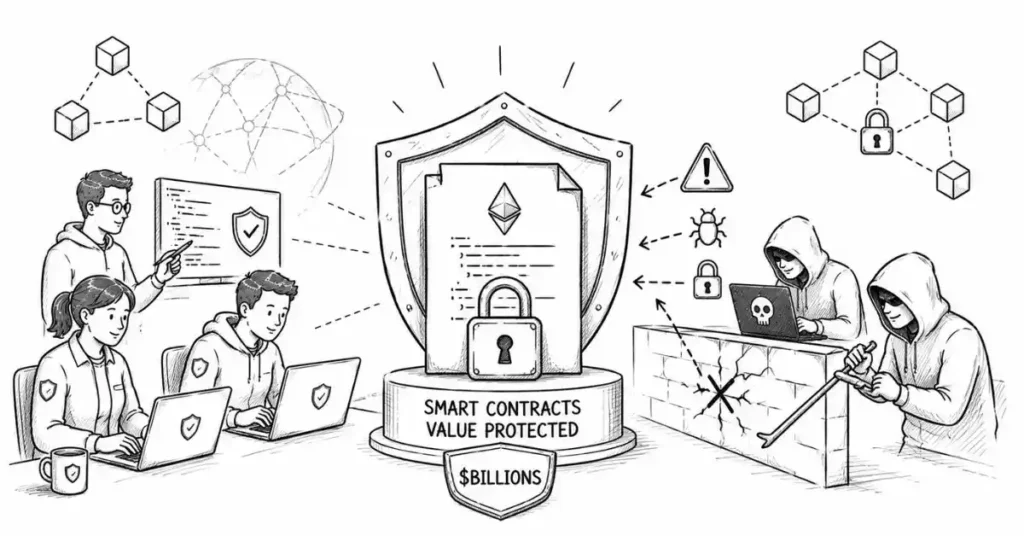
Every second, decentralized finance protocols hold billions of dollars in smart contracts code running autonomously on blockchains with no human intermediary to stop a theft in progress. When a vulnerability exists, attackers move fast and funds disappear permanently. In 2023 alone, over $1.8 billion was lost to blockchain exploits. In this high-stakes environment, blockchain security professionals are the last line of defense between functioning protocols and catastrophic financial loss.
This responsibility makes blockchain security one of the highest-paying and most respected specializations in the entire technology industry. In India, smart contract auditors earn ₹12–25 lakhs annually, with senior auditors at top firms commanding ₹25–35 lakhs. Independent auditors working on a project basis earn even more charging ₹2–8 lakhs per audit engagement, with multiple projects possible simultaneously. International security positions pay $80,000–200,000+ annually, reflecting the critical nature of the work.en-in.whatjobs+2
More importantly, blockchain security is a career where ethical impact genuinely matters. Security professionals protect ordinary people’s savings, pension funds, and investments from theft. Finding a critical vulnerability before attackers do and helping patch it creates real-world protection that goes beyond typical software security work.
This guide explains what blockchain security professionals do, the technical skills required, how to build expertise from scratch, how to break into auditing careers, and what to expect at different career levels with specific focus on opportunities for Indian professionals in this globally in-demand field.
Understanding Blockchain Security: The Landscape
Why Blockchain Security Is Uniquely Challenging
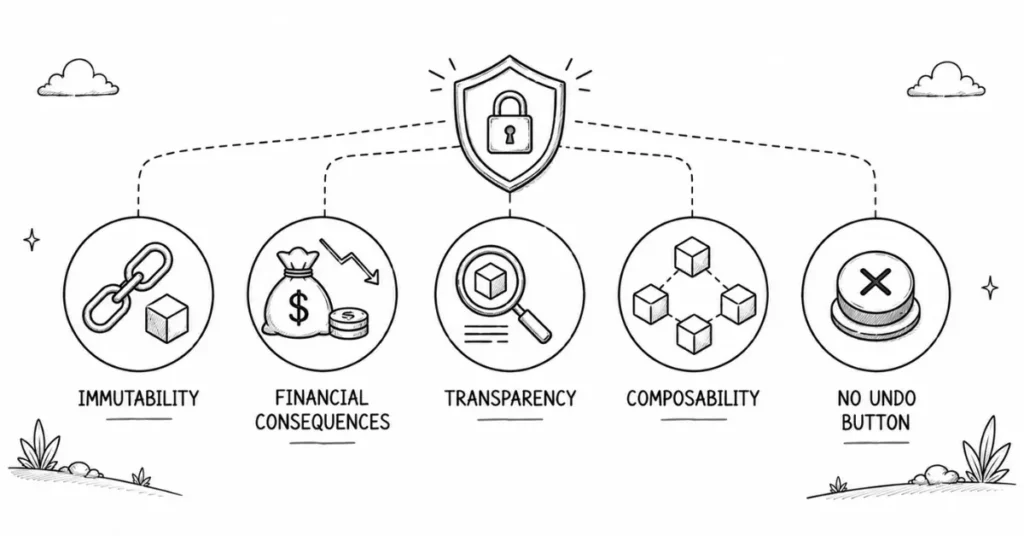
Traditional software security is challenging, but blockchain security operates under additional constraints that make it uniquely demanding:
Immutability: Once a smart contract deploys to mainnet, it typically cannot be changed. Unlike web applications where you push a fix, a deployed smart contract with a bug either requires an expensive migration or complex upgrade mechanism—if upgrade capability was built in advance.
Financial Consequences: Web application bugs might expose user data. Smart contract bugs directly steal money. The stakes are categorically higher.
Transparency: All smart contract code is public on blockchain. Attackers have unlimited time to analyze code for vulnerabilities before attempting exploits.
Composability: DeFi protocols interact with each other—a vulnerability in one protocol can cascade through connected protocols. Auditors must understand not just the target contract but its entire ecosystem of interactions.
No Undo Button: Once funds are stolen from a smart contract, they’re gone (with rare exceptions like hard forks). There’s no bank dispute resolution or chargeback.
These constraints explain why professional smart contract audits cost ₹2–10 lakhs per engagement and why companies willingly pay this price.
Types of Blockchain Security Roles
Smart Contract Auditor: Reviews smart contract code systematically to identify security vulnerabilities, logic errors, and economic attack vectors. The most common blockchain security role.en-in.whatjobs+1
Penetration Tester (Blockchain): Actively attempts to exploit vulnerabilities in smart contracts and blockchain infrastructure. More hands-on than auditing—you’re simulating real attacks to validate security.
Blockchain Security Researcher: Develops new attack methodologies, discovers vulnerability classes, contributes to academic research. Works at universities, security firms, or blockchain foundations.
Security Engineer: Builds security tools, develops automated vulnerability scanners, creates security infrastructure for blockchain companies. Combines engineering with security.
Bug Bounty Hunter: Freelance security professionals who find vulnerabilities in exchange for bounty payments. Major protocols offer bounties from $1,000 to $1,000,000+ for critical vulnerabilities.
Incident Responder: Manages aftermath of blockchain security incidents—tracking stolen funds, coordinating protocol shutdowns, communicating with communities during crises.
Core Technical Skills for Blockchain Security
Solidity and Smart Contract Deep Knowledge
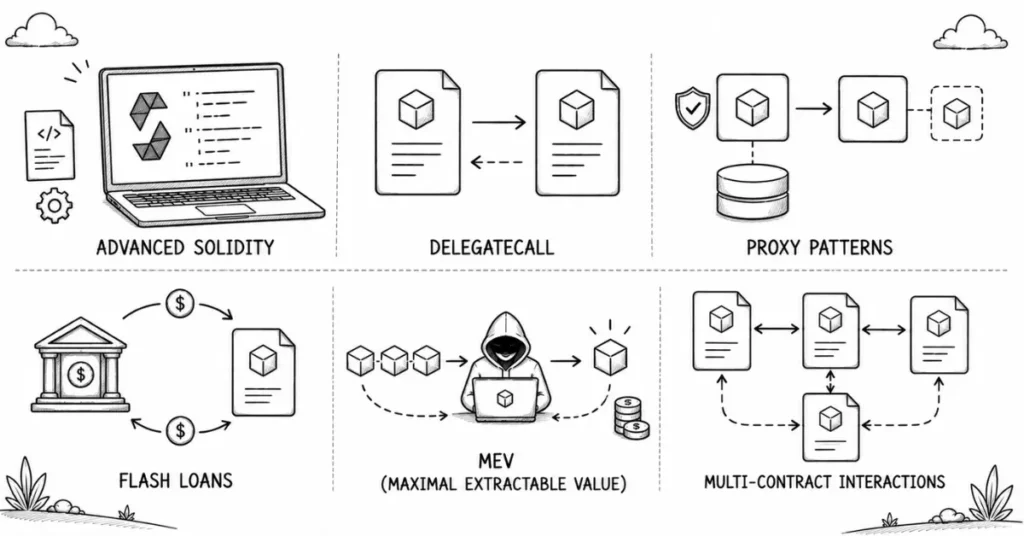
You cannot audit what you don’t deeply understand. Security professionals need advanced Solidity knowledge beyond writing basic contracts:en-in.whatjobs+1
Advanced Language Features:
- Assembly and low-level EVM operations
- Delegatecall mechanics (common source of proxy vulnerabilities)
- ABI encoding and decoding edge cases
- Integer arithmetic at EVM level
- Memory layout and storage collision risks
Contract Patterns:
- Proxy patterns and upgrade mechanisms
- Access control implementations
- Reentrancy guards and pull payment patterns
- Oracle integration patterns
- Flash loan mechanics
Multi-Contract Interactions:
- How contracts call each other
- Reentrancy across multiple contracts
- Price oracle manipulation in cross-contract context
- Sandwich attacks and MEV (Maximal Extractable Value)
The Vulnerability Taxonomy
Critical Vulnerabilities (Direct Fund Loss):
Reentrancy: Malicious contract calls back into victim before state updates. Classic example: attacker deposits, calls withdraw, withdraw sends ETH triggering attacker’s fallback which calls withdraw again before balance decrements. Led to $60M DAO hack.
Integer Overflow/Underflow: Pre-Solidity 0.8, arithmetic wraps around. Token balance of 0 minus 1 = maximum uint256—infinite tokens. Now mitigated by default but still present in older contracts.
Access Control Flaws: Missing or incorrect permission checks allow unauthorized users to call privileged functions—minting unlimited tokens, draining treasury, changing contract owner.
Flash Loan Attacks: Borrowing massive amounts in a single transaction to manipulate prices or voting power, then repaying before transaction ends. Attacker needs zero capital upfront.
Oracle Manipulation: Using flash loans or market manipulation to distort price feeds, then exploiting protocols relying on these prices for liquidations, collateral calculations, or swaps.
High-Severity Vulnerabilities:
Front-Running: Seeing profitable pending transactions and submitting competing transaction with higher gas fee. Particularly harmful in DEXs and auction mechanisms.
Timestamp Dependence: Using block.timestamp for randomness or critical timing—validators can manipulate timestamps within bounds.
Denial of Service: Making contract permanently unusable—filling dynamic arrays to hit gas limits, forcing failed external calls that prevent execution.
Signature Replay: Valid signatures accepted multiple times, allowing attackers to replay authorized operations repeatedly.
Logic Errors: Complex business logic bugs—accounting errors, incorrect fee calculations, rounding exploits—that drain funds slowly or in specific conditions.
Security Analysis Techniques
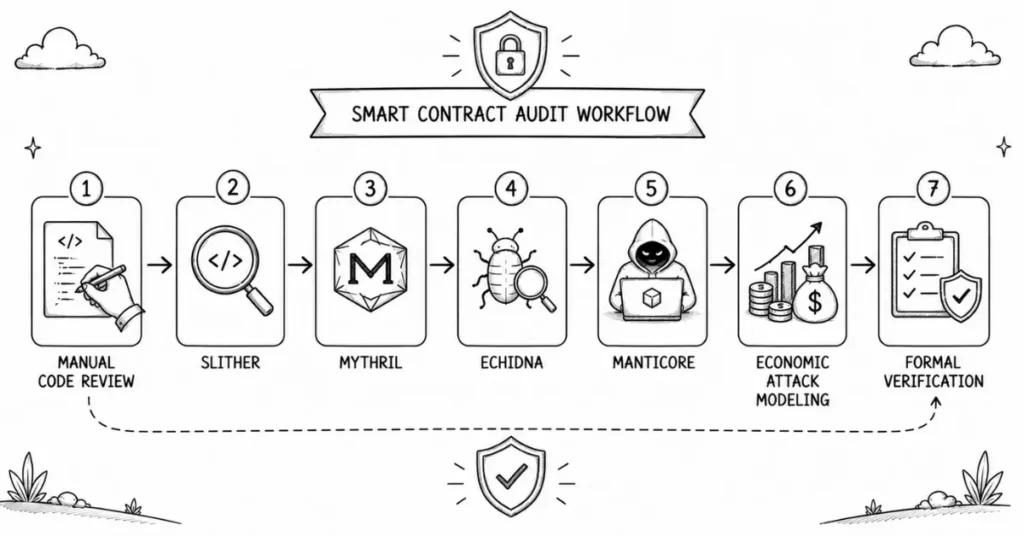
Manual Code Review: Systematic line-by-line analysis understanding exactly what each function does and how it can be exploited. The foundation of all auditing.
Automated Analysis Tools:
- Slither: Static analysis tool detecting known vulnerability patterns. Fast first-pass screening.
- Mythril: Symbolic execution tool exploring code paths systematically.
- Echidna: Fuzzing tool generating random inputs to find edge case failures.
- Manticore: Dynamic symbolic execution for detailed analysis.
- 4naly3er: Report generation tool for common issues.
These tools find obvious vulnerabilities but miss complex logic errors. Manual review remains essential.
Economic Attack Modeling: Think like an attacker with significant capital. What happens if you flash loan $100M? Can you manipulate this price oracle? Can you force liquidations and profit? Security professionals must model attacks financially, not just technically.
Formal Verification: Mathematically proving contract correctness. Advanced technique using tools like Certora Prover or K framework. Rare expertise commanding premium rates.
How to Build a Blockchain Security Career
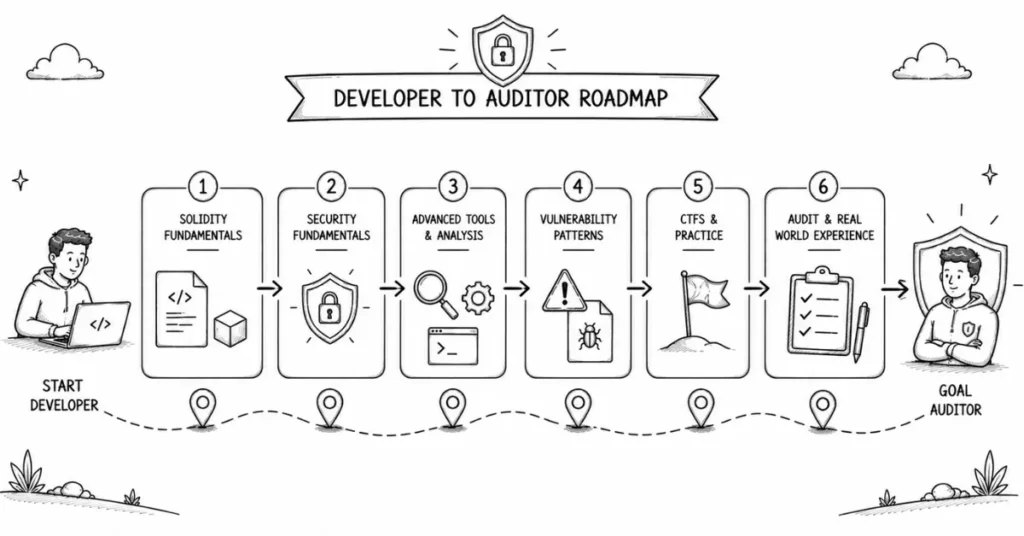
The Learning Path: From Developer to Auditor
Most successful blockchain security professionals come from smart contract development backgrounds. You need to understand how to build contracts before you can effectively break them.
If You’re New to Blockchain (6–9 Months to Foundation):
Phase 1: Solidity Fundamentals (2–3 Months)
- Complete CryptoZombies and Cyfrin Updraft’s Solidity course
- Build 5–8 practice contracts: tokens, NFTs, simple DeFi
- Deploy to testnets and test thoroughly
- Learn Hardhat development environment deeply
Phase 2: Security Introduction (2–3 Months)
- Study “Smart Contract Security” by Trail of Bits (free resource)
- Complete Ethernaut CTF challenges (Capture The Flag—exploit vulnerable contracts)
- Study Damn Vulnerable DeFi challenges (DeFi-specific attack scenarios)
- Read postmortems of famous hacks: The DAO, Parity, Poly Network
Phase 3: Advanced Security and Tools (2–3 Months)
- Learn automated tools: Slither, Mythril, Echidna
- Study advanced attack vectors: flash loans, oracle manipulation, MEV
- Complete more advanced CTF challenges (CodeHawks First Flights)
- Begin contributing to public audit contests
If You’re Already a Smart Contract Developer (3–4 Months to Security Focus):
Month 1: Complete Ethernaut and Damn Vulnerable DeFi. Study all major hack postmortems from Rekt.news. Learn Slither and run on your existing code.
Month 2: Practice identifying vulnerabilities in open-source contracts. Read professional audit reports from Trail of Bits, OpenZeppelin, ConsenSys Diligence—understand their methodology.
Month 3: Participate in CodeHawks, Sherlock, or Code4rena audit contests. Even partial findings demonstrate capability.
Month 4: Submit first formal audit findings. Build portfolio of identified vulnerabilities. Apply to security firms or begin independent auditing.
Building Your Auditor Portfolio
CTF (Capture the Flag) Achievements:
Completing and scoring well on CTF challenges demonstrates hands-on security skills:
- Ethernaut: OpenZeppelin’s smart contract hacking game—complete all levels
- Damn Vulnerable DeFi: DeFi-specific attack scenarios—complete all challenges
- CodeHawks First Flights: Real audit contests for beginners
- Paradigm CTF: Prestigious international competition
Document each challenge solved—what the vulnerability was, how you exploited it, what the fix should be.
Public Audit Participations:
Competitive auditing platforms where multiple auditors review the same codebase:en-in.whatjobs+1
- Code4rena: Community audit contests with cash prizes for findings
- Sherlock: Protocol-focused audit platform
- CodeHawks: Newer platform with structured learning pathways
Even low-severity findings in public contests demonstrate legitimate security skills. Many successful auditors started here.
Personal Research Findings:
Audit open-source contracts and write public reports on your findings:
- Analyze recently deployed protocols
- Write detailed vulnerability reports (even if you find no critical issues)
- Publish findings on Medium or personal blog
- Share analysis with protocol teams (responsibly disclosed)
Responsible disclosure—reporting vulnerabilities privately to teams before publishing—builds reputation and sometimes earns bounties.
Career Paths and Salary Structures
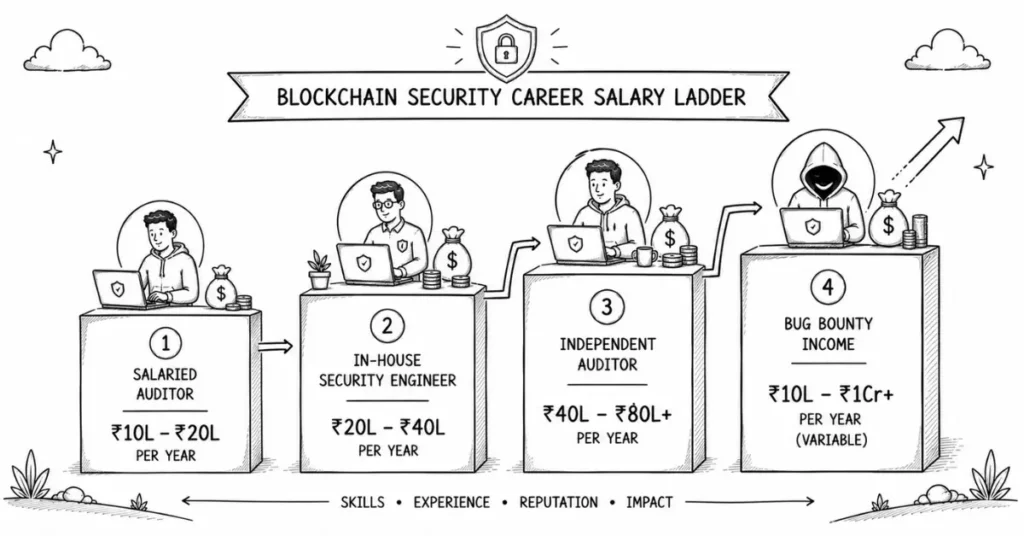
Salaried Auditor at Security Firms
Major blockchain security firms like Trail of Bits, ConsenSys Diligence, Halborn, and Quantstamp hire full-time auditors.en-in.whatjobs+1
Indian-Based Opportunities:
Companies actively posting smart contract auditor roles in India on platforms like WhatJobs and Indeed:shine+1
- Entry-Level Security Analyst: ₹8–14 lakhs
- Smart Contract Auditor: ₹14–22 lakhs
- Senior Smart Contract Auditor: ₹22–35 lakhs
- Security Lead: ₹30–45+ lakhs
International remote security positions from Indian talent pay $60,000–150,000 depending on experience.
Advantages of Security Firms:
- Structured learning from senior auditors
- Exposure to diverse codebases across industries
- Established methodology and reporting standards
- Network building with security community
- Steady income regardless of audit market cycles
In-House Security Roles
DeFi protocols and blockchain companies hire full-time security engineers and internal auditors.
Typical In-House Roles:
- Security Engineer: Build security testing infrastructure, automated tools, CI/CD security checks (₹12–22 lakhs)
- Internal Auditor: Review all code before deployment, establish security standards (₹14–25 lakhs)
- Security Architect: Design security-first systems, make architectural security decisions (₹25–40 lakhs)
Advantages of In-House Roles:
- Deep familiarity with one codebase
- Ability to influence security culture proactively
- Often includes token compensation with significant upside
- Direct impact on product security posture
Independent/Freelance Auditing
Experienced auditors often go independent, charging per-project fees:
Audit Pricing (Typical Range):
- Simple contract (under 500 lines): ₹1–2.5 lakhs
- Medium complexity (500–2000 lines): ₹2.5–6 lakhs
- Complex DeFi protocol: ₹6–15 lakhs
- Large protocol with multiple contracts: ₹15–50+ lakhs
Annual Earning Potential:
A skilled independent auditor handling 8–12 projects annually: ₹20–60 lakhs
A renowned auditor with track record of critical finds: ₹60 lakhs–1 crore+
Bug Bounty Income:
Major protocols (Uniswap, Aave, Compound) offer bounties for found vulnerabilities:
- Low severity: $500–5,000
- Medium severity: $5,000–30,000
- High severity: $30,000–100,000
- Critical: $100,000–1,000,000+
In India, critical finds in major protocols can be life-changing income events.
Important Certifications and Learning Resources
Certified Ethereum Security Professional (CESP): Validates smart contract security knowledge for Ethereum specifically.
Certified Smart Contract Auditor (CSCA): Blockchain Council certification recognizing auditing competency.
OpenZeppelin Security Courses: Free and paid courses directly from the company that wrote the most-used smart contract security library.
Trail of Bits Publications: Free blog posts and guides from one of blockchain’s most respected security firms—excellent technical depth.
Academic Resources:
- IC3 (Initiative for Cryptocurrencies & Contracts) research papers
- IEEE and ACM blockchain security papers
- Formal verification resources from Runtime Verification
Community Resources:
- Rekt.news: Postmortems of major hacks
- Blockchain Threat Intelligence newsletter
- Security Alliance (SEAL) community
Challenges in Blockchain Security Careers
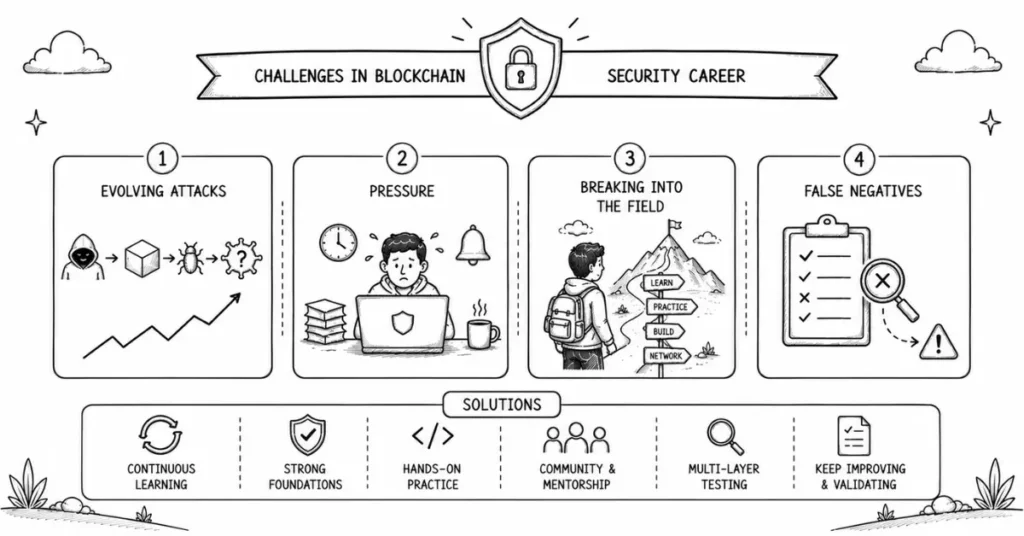
Challenge 1: Constantly Evolving Attack Landscape
New protocols introduce new attack surfaces. Flash loans didn’t exist as an attack vector until 2020. Cross-chain bridges introduced entirely new vulnerability classes. Security professionals must continuously learn.
Solution: Treat learning as non-negotiable. Dedicate 10+ hours weekly to studying new protocols, reading postmortems, and practicing on CTF challenges. Follow security researchers on Twitter.
Challenge 2: Pressure and Responsibility
Missing a critical vulnerability before protocol launch means real financial losses for real people. This pressure is significant, especially for independent auditors whose reputation depends on thoroughness.
Solution: Develop systematic methodology. Use checklists. Use multiple analysis approaches (manual + automated). Set realistic timelines—rushed audits miss vulnerabilities. Be transparent about audit scope and limitations.
Challenge 3: Breaking Into the Field
Security firms prefer hiring experienced auditors, but experience requires someone giving you audit opportunities. Classic chicken-and-egg problem.
Solution: Break in through competitive audit platforms (Code4rena, Sherlock). Even small findings demonstrate real skill. Contribute to security research. Many senior auditors today started with zero experience—persistence pays off.
Challenge 4: False Negatives (Missed Vulnerabilities)
No audit finds everything. Protocols audited by top firms have still been exploited. This limitation creates reputational risk for auditors.
Solution: Set clear expectations about audit scope. Document what was and wasn’t covered. Recommend ongoing security monitoring, bug bounties, and multi-auditor reviews for high-value protocols.
Conclusion: Becoming the Guardian of Blockchain
Blockchain security careers offer some of the highest compensation in technology, the deepest intellectual challenges, and genuine ethical impact. You stand between protocols and attackers—protecting real people’s money using skill, methodology, and continuous learning.
India is developing a strong blockchain security ecosystem. Companies are actively posting auditor roles with competitive salaries, and remote international opportunities pay even more substantially. The path from curious beginner to working security professional takes 6–12 months of focused effort.beincrypto+2
Start tonight: Install MetaMask, complete your first Ethernaut challenge, read the postmortem of one major DeFi hack. These small actions build toward a career where your expertise protects billions of dollars—and where your compensation reflects that extraordinary responsibility.