
Blockchain Consultant Career : Enterprise Solutions Guide
Table of Contents
Introduction : Bridging Business and Blockchain
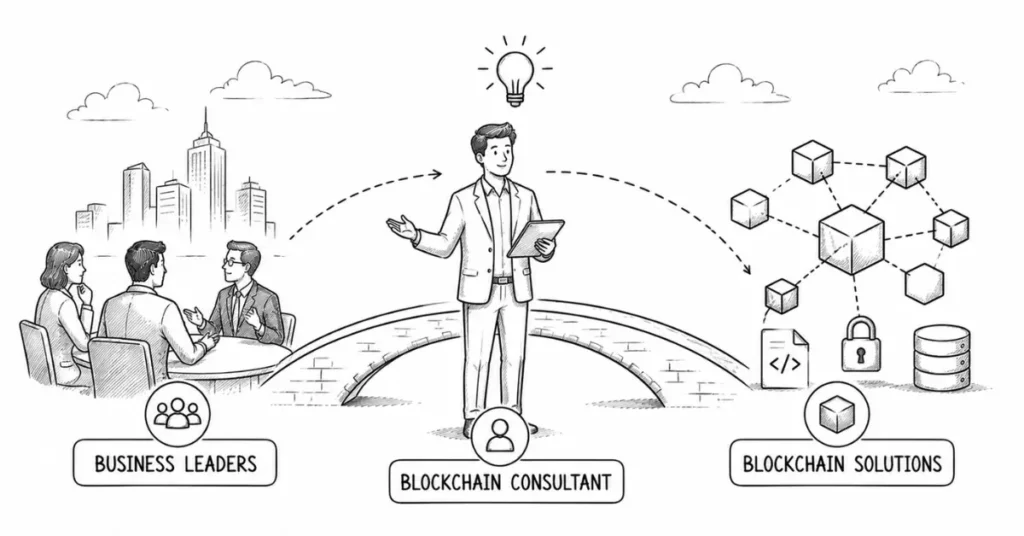
Not everyone entering blockchain careers needs to write a single line of code. Blockchain consulting is living proof of this one of the highest-paying blockchain careers in India, demanding business acumen far more than technical expertise. Blockchain consultants earn an average of ₹32.5 lakhs annually, with some experienced consultants at major firms earning ₹34+ lakhs. That’s significantly higher than the average for most technical blockchain roles.
What do blockchain consultants do? They help traditional businesses banks, manufacturers, retailers, hospitals, logistics companies understand how blockchain can solve their specific problems, reduce costs, improve efficiency, and create new revenue streams. They bridge the gap between blockchain’s technical capabilities and business realities. Instead of building blockchain systems, they identify when blockchain should be built, what problem it should solve, whether it’s worth the investment, and how implementation should proceed.
This career path suits professionals with backgrounds in management consulting, business analysis, IT consulting, or domain expertise in industries adopting blockchain. Professionals with finance backgrounds consulting for banking blockchain projects, supply chain managers consulting on logistics blockchain, or healthcare administrators advising hospital blockchain implementations bring domain expertise that pure technologists lack creating highly differentiated value.
This guide explains what blockchain consultants do, required skills, how to transition into consulting from various backgrounds, how to build your practice, and what different consulting environments look like from major IT consulting firms to independent boutique practices.
What Blockchain Consultants Actually Do
Core Consulting Activities
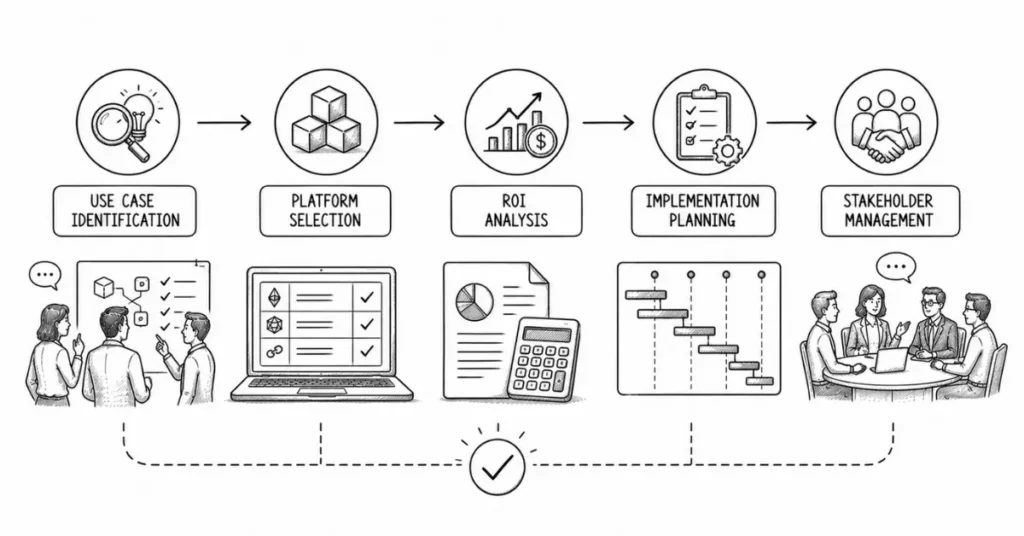
Use Case Identification and Assessment:
The most common consulting engagement is helping companies figure out whether blockchain is right for their specific problem. Most problems don’t need blockchain—a regular database works fine and costs less. Blockchain makes sense when:
- Multiple untrusted parties need to share and verify data
- Immutable audit trail is required by regulation or business need
- Intermediary can be eliminated to reduce costs significantly
- Automated enforcement of rules adds value over manual processes
Consultants analyze client processes, identify potential blockchain applications, and provide honest assessments—sometimes concluding blockchain isn’t the right solution (which excellent consultants recommend when appropriate, building long-term trust).
Platform Selection and Architecture Guidance:
When blockchain is appropriate, clients need guidance on which platform to use:
- Ethereum: Best for applications requiring composability with DeFi ecosystem
- Hyperledger Fabric: Best for enterprise private/permissioned blockchain where participants are known
- R3 Corda: Designed specifically for financial services use cases
- Polygon: Good for public-facing applications needing low fees
- Quorum: JPMorgan’s enterprise Ethereum variant for financial applications
Each choice involves trade-offs between decentralization, performance, cost, regulatory compliance, and ecosystem support.
ROI Analysis and Business Case Development:
Executives need to justify blockchain investments. Consultants build financial models quantifying:
- Current process costs (time, labor, error rates, dispute resolution)
- Implementation costs (development, infrastructure, training, change management)
- Expected benefits (cost reduction, revenue from new capabilities, risk reduction)
- Payback period and net present value
- Non-financial benefits (regulatory compliance, customer trust, ESG positioning)
This business case work requires financial modeling skills and industry domain knowledge more than technical blockchain expertise.
Implementation Planning and Vendor Selection:
Once approved, consultants help plan implementation:
- Define project scope, phases, and milestones
- Select technology partners and development vendors
- Define governance structure for multi-party consortiums
- Establish data standards and interoperability requirements
- Plan change management and user training programs
Stakeholder Management and Communication:
Blockchain projects often involve multiple companies in consortium arrangements. Consultants facilitate:
- Governance design—how decisions get made in multi-party systems
- Data sharing agreements—what information participants share
- Dispute resolution mechanisms
- Onboarding of new participants over time
- Communication between technical teams and business leadership
Key Industries for Blockchain Consulting in India
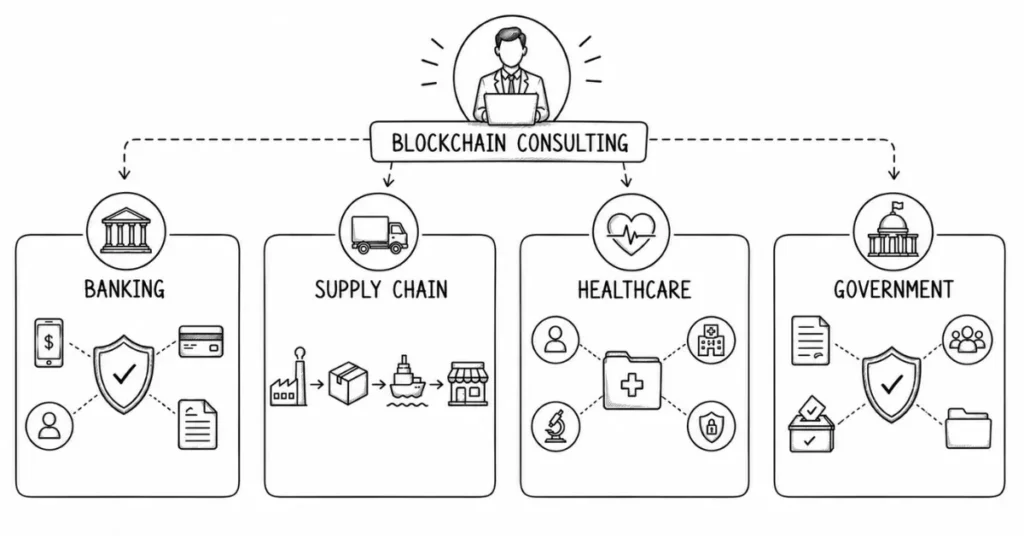
Banking and Financial Services
India’s banking sector is the largest adopter of blockchain technology. ICICI Bank, HDFC Bank, Axis Bank, and State Bank of India all have active blockchain initiatives.
Common Banking Use Cases:
- Trade Finance: Digitizing letters of credit using blockchain, reducing fraud and processing time from days to hours
- Cross-Border Payments: Using blockchain to reduce correspondent banking fees and settlement time
- KYC/AML: Shared blockchain for customer verification, eliminating duplicate checks across banks
- Settlement Systems: Real-time gross settlement using blockchain tokens
Consultant Value: Banking blockchain consultants need understanding of banking regulations (RBI guidelines, SWIFT, correspondent banking), trade finance processes, and risk management—knowledge most blockchain developers lack.
Salary Range: ₹18–35 lakhs at IT consulting firms, ₹32+ lakhs at senior levels
Supply Chain and Logistics
India’s complex supply chains face challenges with product authenticity, transparency, and coordination across hundreds of participants.
Common Use Cases:
- Food Safety Traceability: Tracking produce from farm to consumer, enabling rapid recall when contamination occurs
- Pharmaceutical Authenticity: Combating counterfeit drugs estimated to cost India $3+ billion annually
- Export Documentation: Digitizing phytosanitary certificates, certificates of origin, and customs documents
- Cold Chain Monitoring: Combining IoT sensors with blockchain for temperature-sensitive goods
Consultant Value: Supply chain consultants need domain knowledge: understanding of Incoterms, customs procedures, warehouse management, and logistics operations—plus ability to translate these to blockchain solutions.
Salary Range: ₹15–28 lakhs depending on experience and firm
Healthcare and Pharmaceuticals
India’s healthcare sector needs blockchain for medical records, drug traceability, and clinical trial integrity.
Common Use Cases:
- Patient Data Management: Cross-hospital medical records patients control
- Drug Supply Chain: DSCSA-equivalent for India’s pharmaceutical market
- Clinical Trial Integrity: Immutable trial data preventing selective reporting
- Health Insurance Claims: Streamlining fraud-prone claims processing
Consultant Value: Healthcare consultants need understanding of clinical workflows, hospital administration, HIPAA-equivalent regulations, and insurance processes—extremely specialized knowledge.
Salary Range: ₹16–30 lakhs for experienced healthcare-blockchain consultants
Government and Public Sector
Several Indian states are piloting blockchain for land records, identity management, and voting.
Common Use Cases:
- Land Registry: Immutable land records preventing fraudulent transfers
- Digital Identity: Self-sovereign identity systems
- Government Procurement: Transparent bidding and contract management
- Academic Credentials: Tamper-proof certificate verification
Consultant Value: Government blockchain requires understanding of public sector processes, bureaucratic decision-making, and regulatory frameworks unique to government contexts. Public sector experience is highly valuable.
Skills Required for Blockchain Consulting
Business and Consulting Skills
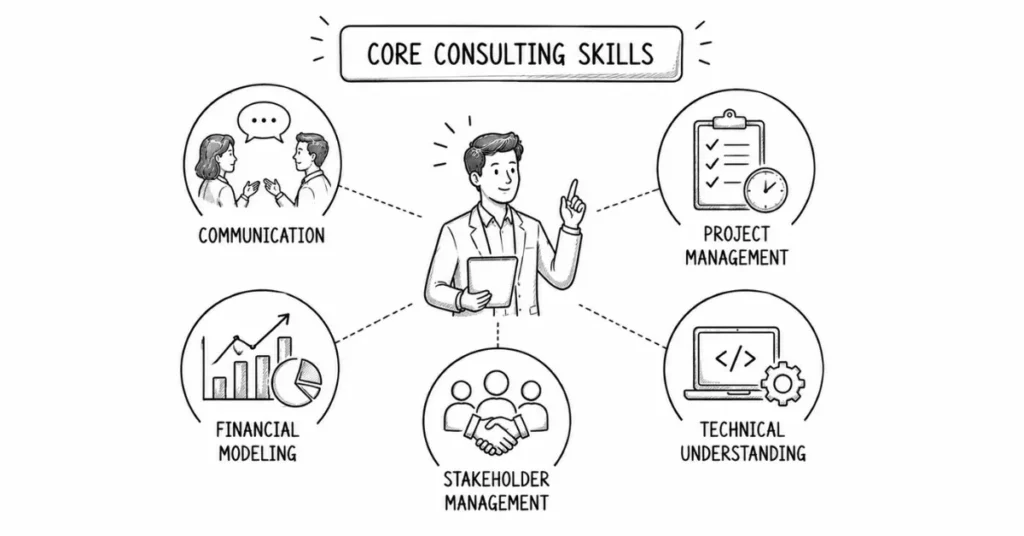
Communication and Presentation:
Blockchain consulting requires translating technical concepts for non-technical executives. You must explain blockchain value propositions in business terms—not technical jargon.
Practice: “Blockchain creates a shared record that multiple parties trust without needing to verify each other independently, eliminating the need for expensive intermediaries and reducing reconciliation costs by up to 40%.”
NOT: “Blockchain is a distributed ledger using cryptographic hashing and consensus mechanisms.”
Project Management:
Blockchain implementations are complex multi-stakeholder projects. Strong PM skills—scope management, risk identification, status reporting, stakeholder communication—are essential.
Financial Modeling:
Building ROI models for blockchain investments requires spreadsheet proficiency, understanding of NPV/IRR calculations, and ability to quantify process improvement benefits.
Stakeholder Management:
Consortium blockchain projects involve multiple companies, each with different interests. Managing these relationships diplomatically while keeping projects on track is a critical consulting skill.
Technical Understanding (Not Deep Expertise)
Consultants don’t write code but need sufficient technical knowledge to:
- Explain blockchain capabilities and limitations accurately
- Evaluate vendor technical proposals intelligently
- Ask probing questions that reveal implementation risks
- Understand when technical challenges threaten business outcomes
- Read and understand high-level architecture diagrams
Recommended Technical Foundation:
- Complete a blockchain fundamentals course (not coding-focused)
- Understand consensus mechanisms and their trade-offs
- Know differences between Hyperledger, Ethereum, and private blockchains
- Understand smart contract capabilities without needing to code them
- Familiarity with blockchain development timelines and costs
Domain Expertise
Your domain expertise—banking, healthcare, supply chain, government—combined with blockchain knowledge creates the unique value proposition of blockchain consultants. Deep industry knowledge is what differentiates excellent consultants from those who simply read blockchain whitepapers.
If you have 5 years of banking experience and learn blockchain fundamentals, you’re more valuable to bank blockchain consulting than someone with 5 years of blockchain development and zero banking experience.
Building Your Blockchain Consulting Career
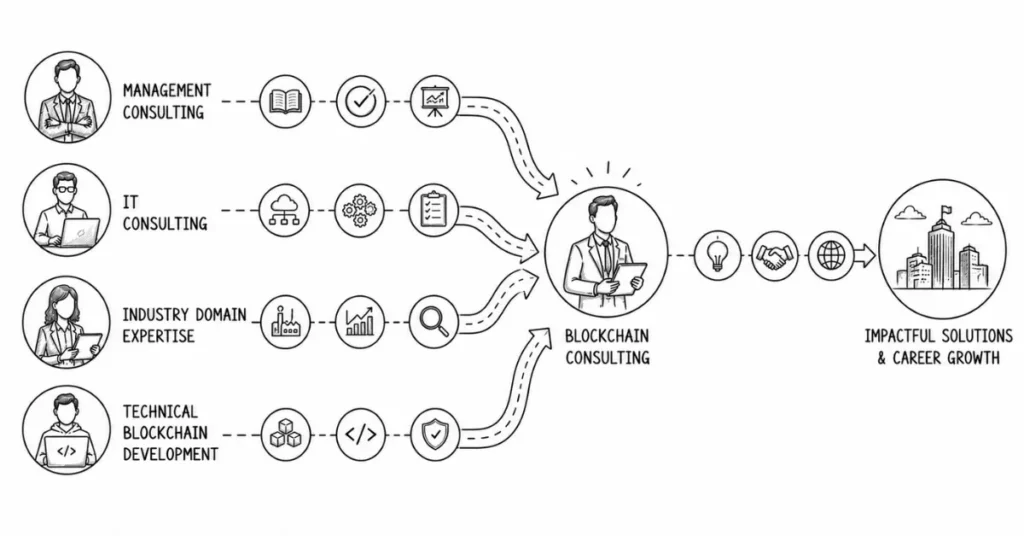
Transition Path from Various Backgrounds
From Management Consulting (McKinsey, BCG, Accenture, Deloitte):
You already have consulting skills—add blockchain technical knowledge. Timeline: 2–3 months of focused learning. Join your firm’s blockchain practice. Immediate premium compensation leveraging existing consulting credential.
From IT Consulting (TCS, Infosys, Wipro):
You understand enterprise technology implementation. Learn blockchain specifically and highlight projects where you drove technology adoption. IT consulting firms have active blockchain practices needing domain experts.
From Industry Domain (Banking, Healthcare, Supply Chain):
You have the domain expertise clients value most. Add blockchain fundamentals learning (3–4 months). Position as “healthcare executive who understands blockchain” rather than “blockchain consultant who learned healthcare.”
From Technical Blockchain Development:
Add business skills—financial modeling, presentation, stakeholder communication. MBA programs or business communication courses help. Transition from building blockchain to advising clients on blockchain builds on your technical credibility.
Building a Consulting Portfolio
Case Studies:
Document every blockchain engagement—problem statement, approach, recommendations, outcomes. Even hypothetical case studies (analyzing a published blockchain implementation and what you would have recommended) demonstrate consulting thinking.
Thought Leadership:
- Write articles on LinkedIn about blockchain applications in your domain
- Speak at industry conferences (NASSCOM, CII, FICCI blockchain events in India)
- Contribute to industry working groups and standards bodies
- Build a reputation as the go-to expert in your specific niche
Professional Network:
Consulting is relationship-driven. Build connections with:
- Potential clients (CIOs, CTOs, CDOs at target companies)
- Other consultants for referrals and joint projects
- Technology vendors for partnership opportunities
- Industry associations for speaking and visibility
Certifications:
- Certified Blockchain Professional (CBP) – Blockchain Council
- Certified Blockchain Expert (CBE) – Blockchain Council
- Hyperledger certifications for enterprise blockchain
- PMP (Project Management Professional) for overall consulting credibility
Consulting Career Environments
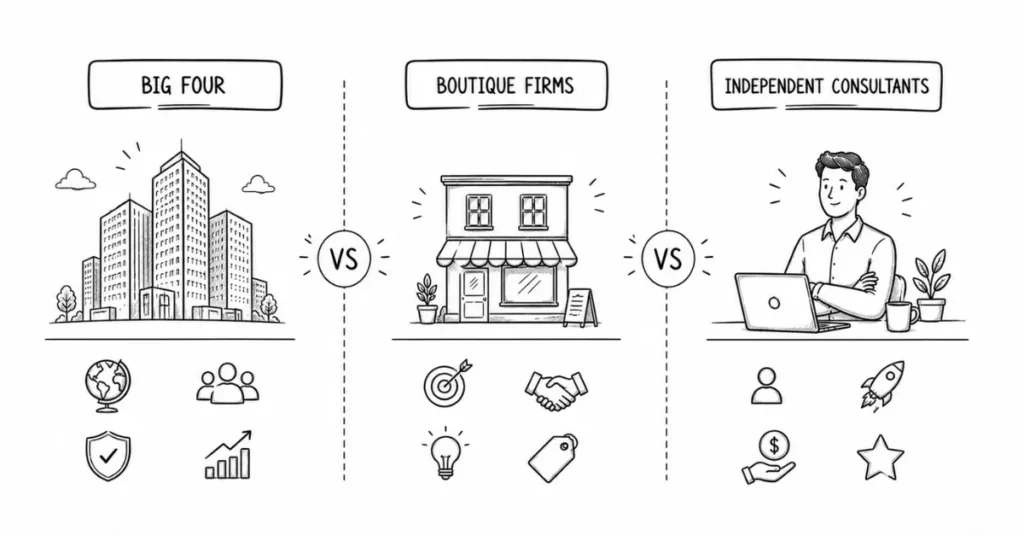
Big Four and IT Consulting Firms
Deloitte, PwC, EY, KPMG, TCS, Infosys, Wipro, and Accenture all have established blockchain practices serving enterprise clients across banking, healthcare, supply chain, and government. These are among the most stable entry points for blockchain consulting careers.
What Working Here Looks Like:
- Assigned to client engagements typically lasting 3–12 months
- Work on diverse projects across multiple industries
- Access to proprietary blockchain frameworks and accelerators
- Mentorship from senior consultants and partners
- Clear career progression: Analyst → Consultant → Senior Consultant → Manager → Partner
Salary Structure:
- Analyst/Associate Consultant (0–3 years): ₹8–14 lakhs
- Consultant (3–5 years): ₹14–20 lakhs
- Senior Consultant (5–8 years): ₹20–28 lakhs
- Manager (8–12 years): ₹28–40 lakhs
- Director/Partner: ₹40–80+ lakhs
Advantages:
- Brand credibility that opens doors throughout career
- Exposure to diverse industries and blockchain use cases
- Structured learning programs and formal training
- International rotation opportunities to global blockchain centers
- Stable income regardless of crypto market cycles
Considerations:
- Long working hours common during client engagements
- May work more on private/permissioned blockchain than public chains
- Career progression follows structured timelines
Boutique Blockchain Consulting Firms
Smaller specialized firms focus exclusively on blockchain consulting. Examples in India include dedicated blockchain advisory firms and Web3 strategy consultancies.
What Working Here Looks Like:
- Work exclusively on blockchain projects—deep specialization
- Faster responsibility growth than large firms
- Closer client relationships and direct impact visibility
- Less structured career path but faster advancement if you perform
Salary Range: ₹12–25 lakhs depending on firm size and your experience level
Advantages:
- Deep blockchain specialization builds faster
- Greater autonomy and ownership of engagements
- Closer to cutting-edge blockchain developments
- Potential equity if joining early-stage firm
Considerations:
- Less brand recognition than Big Four
- Revenue dependent on blockchain market enthusiasm
- May have fewer formal mentoring and training programs
Independent Blockchain Consultant
Experienced consultants with established reputations often go independent, serving multiple clients simultaneously and commanding significantly higher rates.
Engagement Models:
- Project-Based: Fixed fee for defined deliverables (strategy report, implementation plan, vendor evaluation)
- Retainer: Monthly fee for ongoing advisory services
- Interim Executive: Acting as temporary CTO or Chief Blockchain Officer for companies building practices
- Expert Witness: Legal proceedings involving blockchain disputes—highly paid specialist work
Typical Rate Structure:
- Entry-Level Independent (1–3 years consulting experience): ₹25,000–60,000 per day
- Experienced Independent (3–7 years): ₹60,000–1.5 lakhs per day
- Senior Expert (7+ years, recognized thought leader): ₹1.5–5 lakhs per day
Annual Earning Potential:
Working 150–200 consulting days annually:
- Experienced independent: ₹90 lakhs–3 crores annually
- International consulting rates in USD further multiply this for India-based consultants accepting global engagements
Building Independent Practice:
- Requires strong reputation built through firm-based consulting or industry roles first
- Network is everything—most independent work comes through referrals
- Personal brand through LinkedIn thought leadership, speaking, and publications critical
- Start part-time consulting while employed to build client relationships before going fully independent
Day in the Life: A Blockchain Consultant's Week
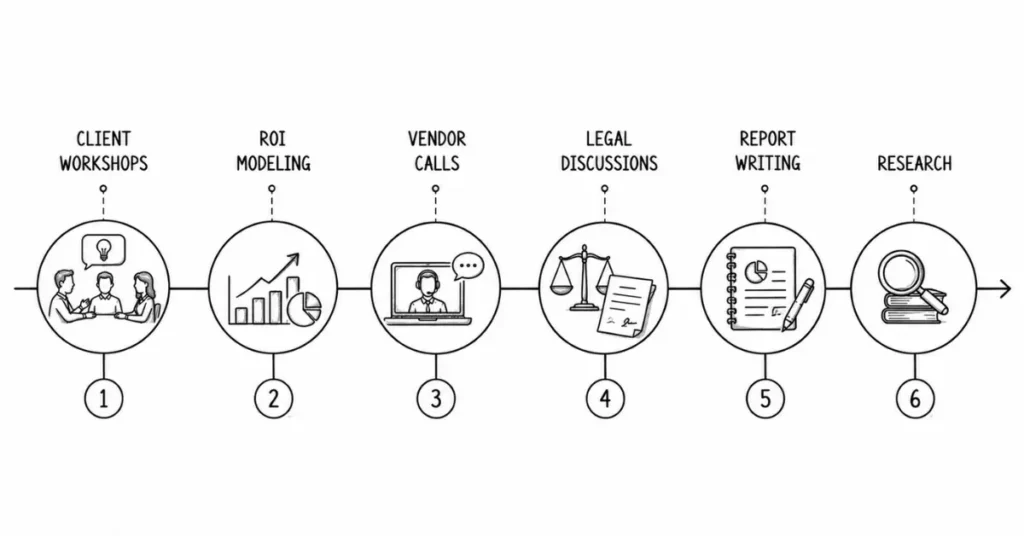
Understanding what the work actually looks like day-to-day helps set realistic expectations:
Monday: Client discovery workshop with HDFC Bank trade finance team. Facilitate 3-hour session mapping current letter of credit process—documenting pain points, timelines, costs, and stakeholder touchpoints. Evening: document findings and prepare gap analysis.
Tuesday: Internal analysis day. Build current-state vs. future-state comparison for bank’s trade finance blockchain ROI model. Research competitor implementations (HSBC, Standard Chartered blockchain trade finance). Prepare preliminary findings deck.
Wednesday: Video call with Hyperledger Fabric solutions team to understand platform capabilities for this specific use case. Follow-up call with client’s IT team to understand existing infrastructure and integration constraints.
Thursday: Travel to client office for working session with legal and compliance team. Blockchain implementations require understanding regulatory implications—AML, data privacy, counterparty validation. These conversations require both blockchain knowledge and banking regulation understanding.
Friday: Write 15-page blockchain strategy recommendation report. Quantify ROI: current process costs ₹2.8 crores annually in labor and error resolution; blockchain implementation costs ₹1.2 crores; projected annual savings ₹1.9 crores from Year 2 onwards. Prepare executive presentation for Monday.
Weekend: Research for next engagement—a pharmaceutical company wanting blockchain for drug supply chain. Read India’s pharmaceutical distribution regulations, study existing implementations by MediLedger and TraceLink, prepare scoping questions.
This variety—different industries, different problems, constant learning—is what makes consulting intellectually stimulating and why experienced consultants often prefer it to narrow technical roles.
Career Challenges and How to Navigate Them
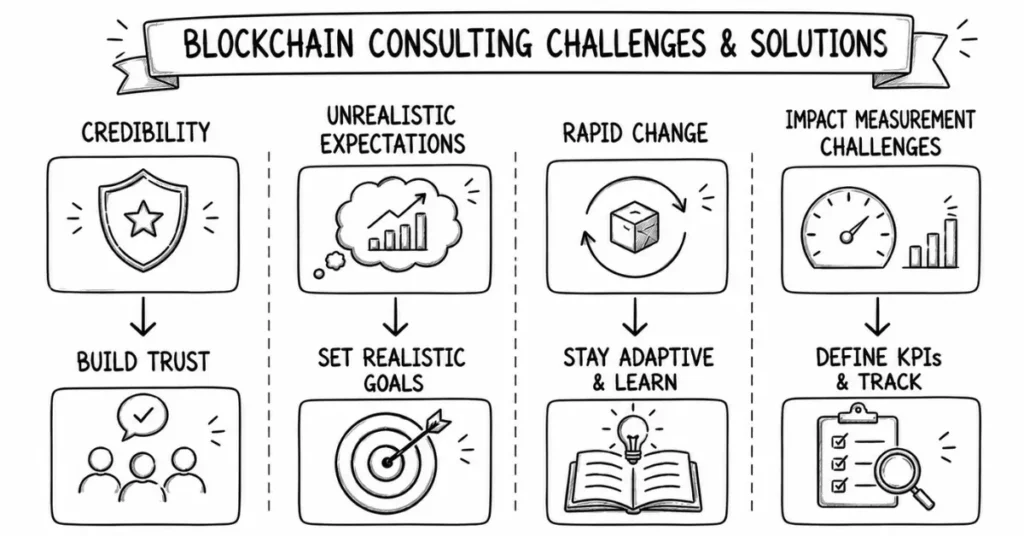
Challenge 1: Credibility Without Technical Depth
Clients sometimes question whether non-technical consultants truly understand blockchain. Technical teams may push back on recommendations.
Solution: Build sufficient technical literacy to have credible conversations. Understand trade-offs between platforms. Know enough to ask probing technical questions. Partner with technical co-consultants or subcontractors for implementations requiring deep development expertise.
Challenge 2: Unrealistic Client Expectations
Many clients arrive believing blockchain will magically solve all data management problems, create instant competitive advantage, and justify enormous investment. Managing these expectations is delicate—you risk losing the engagement if you’re too bearish.
Solution: Establish honest assessment frameworks early. Case studies of both successful and failed blockchain implementations demonstrate balanced perspective. Pilot projects before full commitment protect both client and consultant reputation.
Challenge 3: Rapidly Evolving Technology
What was cutting-edge blockchain advice in 2023 may be outdated in 2026. Technology evolves faster than most consulting frameworks.
Solution: Maintain active learning habits. Subscribe to Hyperledger, Ethereum Foundation, and major blockchain platform updates. Attend industry conferences annually. Participate in professional communities where practitioners share latest developments. Build relationships with technical developers who keep you current.
Challenge 4: Measuring Consulting Impact
Blockchain implementations take years to deliver measurable ROI. Consultants who advised on projects may not still be engaged when outcomes manifest, making performance measurement challenging.
Solution: Define clear success metrics at engagement start. Structure engagements with measurable milestones. Build long-term client relationships that allow following projects through implementation to outcomes.
Conclusion: The Strategist Behind Blockchain Transformation
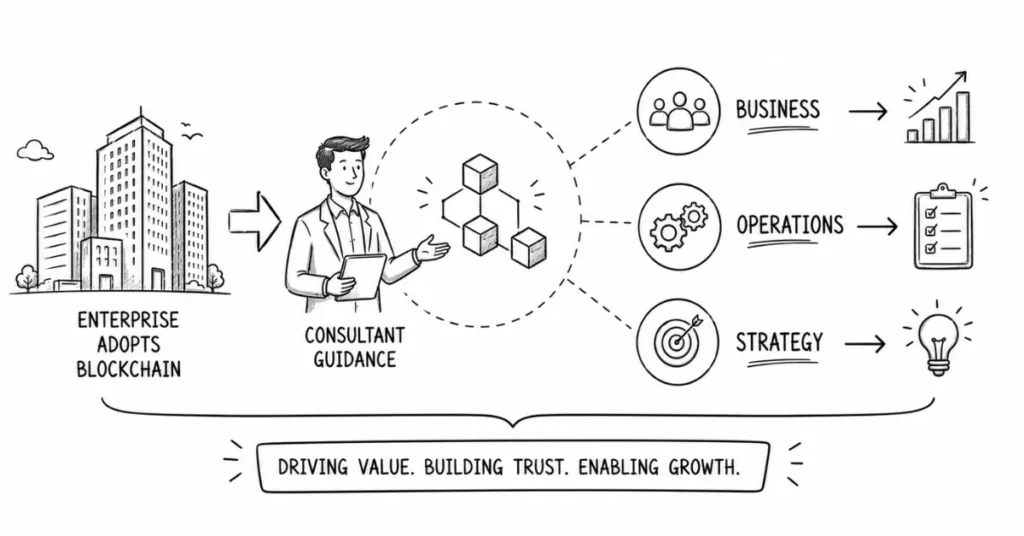
Blockchain consulting offers what many technical roles don’t: the opportunity to shape strategy, influence decisions, and see the business impact of blockchain adoption rather than just building it. The combination of highest-average salaries in Indian blockchain careers, intellectual variety across industries, and genuine business impact makes this an exceptional career path.
The key differentiator is domain expertise. Whatever industry you come from—banking, healthcare, logistics, government—your insider knowledge combined with blockchain understanding creates value that pure technical consultants cannot replicate. Start where you are: deepen blockchain knowledge in your current domain, build your network, develop your communication skills, and begin positioning yourself as the bridge between your industry and blockchain technology.
The enterprises of India are beginning their blockchain journeys. They need consultants who understand both worlds—business and blockchain—to guide them successfully. That consultant could be you.