
Best Degrees for Telecommunications Career in India
Table of Contents
What Actually Gets You Hired
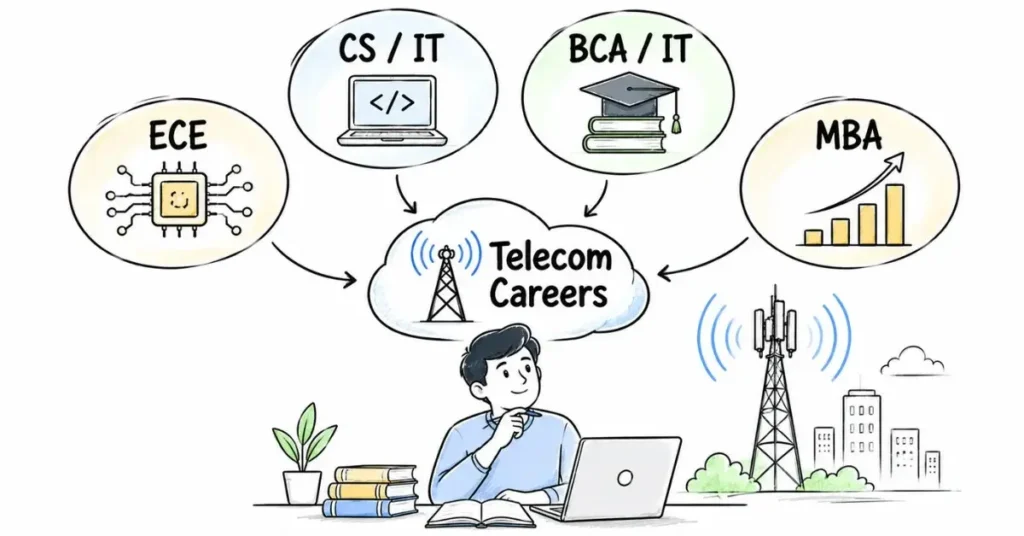
Every year, thousands of Indian students finishing Class 12 or finishing their undergraduate degree ask the same question: which degree is best for a telecom career?
The honest answer is more complicated than most college brochures let on.
Your degree matters. But it is not the only thing that matters, and in telecom specifically, it is often not the deciding factor in whether you get hired. This post tells you what each degree path actually leads to, where each one has limitations, and what you need to add to any degree to make it work in the telecom job market.
The Degree Landscape for Telecom in India
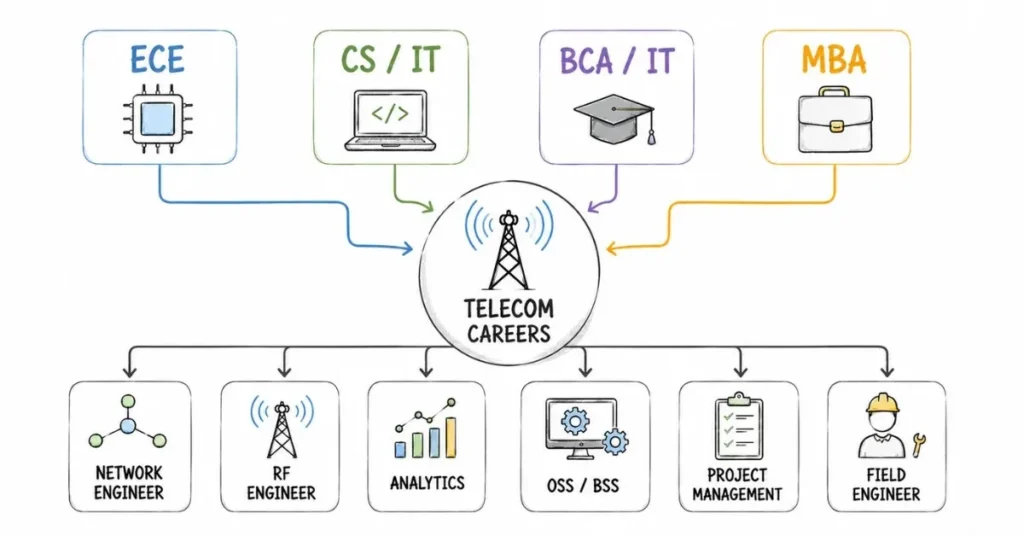
Indian telecom employers hire from four main degree categories. Each has a natural fit with certain roles and a harder path into others.
Degree | Best-fit Telecom Roles | Works With Effort | Does Not Fit Well |
B.Tech ECE | RF engineer, 5G deployment, RAN optimization | Network engineer, core network | BSS/OSS analyst, pure IT |
B.Tech CS / IT | NOC analyst, core network, automation | OSS/BSS analyst, cloud telecom | RF engineering, drive testing |
BCA / B.Sc. IT | OSS/BSS analyst, NOC support | Telecom analyst, project support | RF, core network engineering |
MBA (Telecom/IT) | Project manager, product manager, sales | Business analyst, strategy | Hands-on technical roles |
Diploma (ECE / Electronics) | Field technician, NOC trainee, drive test | Entry-level deployment | Senior engineering roles (without upskilling) |
There is no single “best” degree. There is a best degree for each role type, and within that, the skills you build on top of your degree determine how far you go.
B.Tech ECE - The Most Direct Path Into Core Telecom
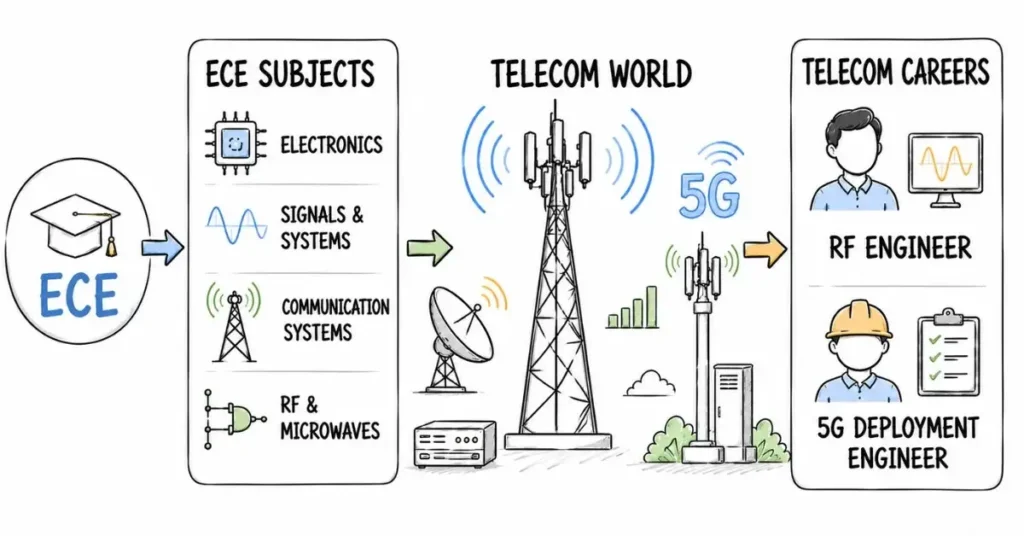
Electronics and Communication Engineering (ECE) is the degree most aligned with telecom at its most technical level. The subjects you study in ECE — signals and systems, analog and digital communication, electromagnetic theory, antenna design, microprocessors — directly map to what telecom employers expect you to know.
What ECE graduates learn that is genuinely useful in telecom:
- Communication theory: how signals are modulated and demodulated, the physics behind wireless transmission
- Antenna and RF fundamentals: how antennas work, radiation patterns, gain, and impedance matching
- Digital signal processing: relevant for 5G’s OFDM modulation technique
- Microprocessors and embedded systems: relevant for IoT and base station hardware
Where ECE graduates go in telecom:
- RF engineers at Ericsson, Nokia, or operators like Airtel
- 5G deployment engineers at vendors or managed services companies
- Drive test and optimization engineers
- RAN (Radio Access Network) support engineers
- Hardware engineers at telecom equipment companies
The gap ECE graduates need to fill:
ECE colleges in India teach theory well but often give limited exposure to actual networking concepts — IP addressing, routing protocols, how data moves across a network. A fresh ECE graduate who cannot explain what a router does or configure a basic network in Cisco Packet Tracer is at a disadvantage for the networking-heavy roles. The fix is straightforward: CCNA. Six months of CCNA preparation gives ECE graduates the networking layer that their degree likely did not cover adequately.
Starting salary for ECE graduates in telecom: ₹3 lakh to ₹6 lakh at entry level for most private colleges. IIT and NIT ECE graduates see higher packages — ₹6 lakh to ₹12 lakh — particularly when joining global vendors like Ericsson or Nokia directly from campus.
B.Tech CS / IT- A Strong Path, With the Right Additions
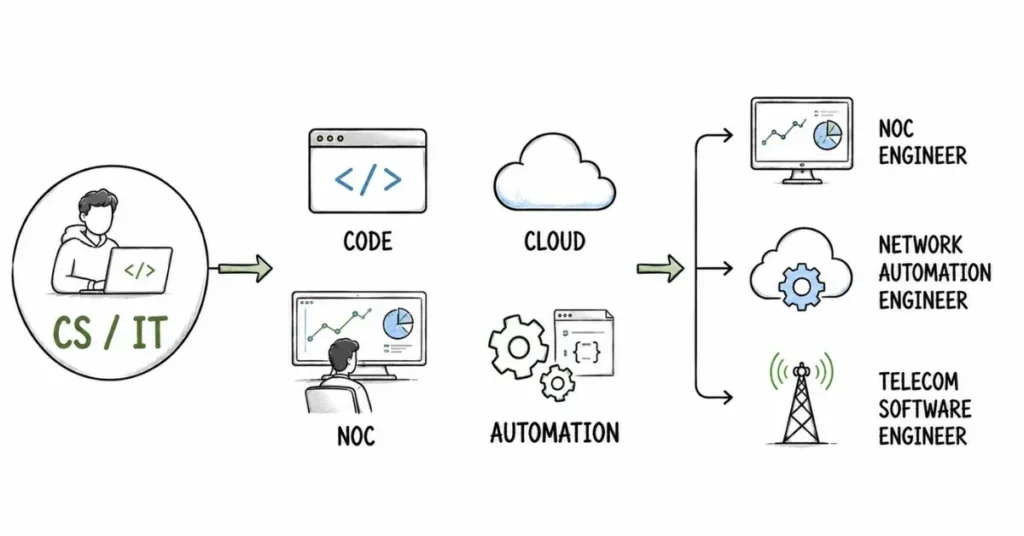
Computer Science and IT graduates are not the first profile telecom companies think of when they hire for radio or RF roles. But for a large and growing portion of telecom jobs — NOC operations, core network engineering, cloud-native telecom, network automation, OSS/BSS software — CS and IT graduates are a strong fit.
What CS / IT graduates bring to telecom:
- Solid programming fundamentals Python, Java, C directly applicable to network automation and telecom software roles
- Understanding of operating systems, databases, and software architecture — useful for OSS/BSS and cloud telecom work
- Comfort with Linux and command-line environments
- Familiarity with cloud platforms (AWS, Azure) if the curriculum covers it
Where CS / IT graduates go in telecom:
- NOC analyst (strong entry point — monitoring tools are software-heavy)
- Cloud-native / 5G core engineer (the highest-growth area right now)
- Network automation engineer
- OSS/BSS developer or analyst at IT companies like TCS, Infosys, Amdocs
- Telecom software testing / protocol testing
The gap CS / IT graduates need to fill:
The mirror image of the ECE problem. CS graduates understand software but often have zero exposure to how networks actually work at the physical and protocol level — what a packet looks like on the wire, how routing works, what a cell site is. Without this, they struggle in telecom-specific interviews.
The fix here is also CCNA — it bridges the two worlds. A CS graduate who adds CCNA and a basic understanding of 4G/5G architecture is immediately more competitive for telecom roles than one who applies with only software skills.
Starting salary for CS / IT graduates in telecom: ₹3.5 lakh to ₹8 lakh at entry level, with IIT / NIT graduates seeing ₹8–15 lakh at top companies. CS graduates who go into cloud-native telecom or automation roles generally see faster salary growth than those in traditional networking support.
BCA and B.Sc. IT - Underestimated, Underused Degrees in Telecom
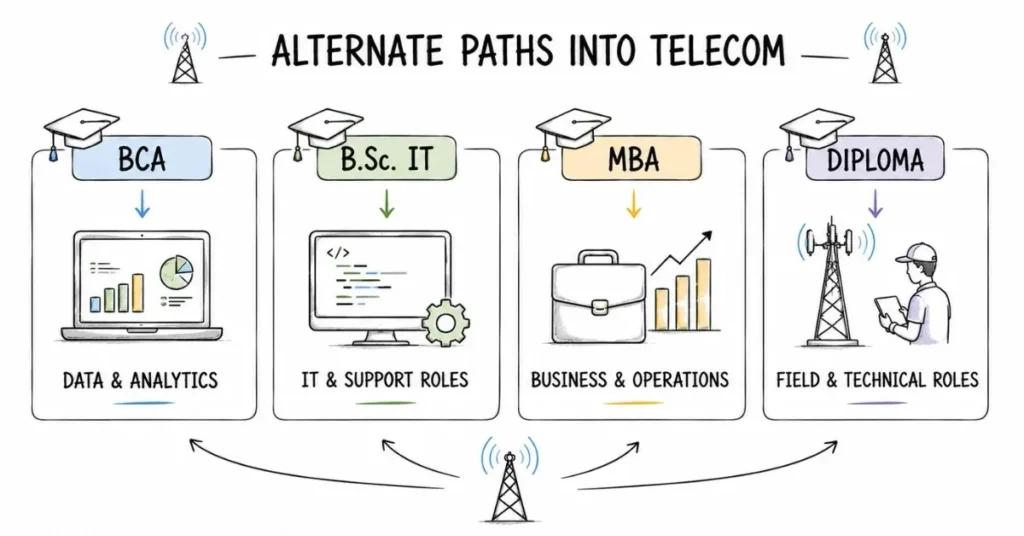
BCA (Bachelor of Computer Applications) and B.Sc. IT graduates often assume telecom is closed to them because they do not have an engineering degree. That assumption is wrong — for the right roles.
Telecom operators and IT services companies actively hire BCA and B.Sc. IT graduates for:
- OSS/BSS support analyst roles
- Network operations support
- Telecom billing and revenue assurance
- Customer experience analytics
- Junior project coordination
The honest limitation: BCA and B.Sc. IT graduates will not be shortlisted for RF engineer or 5G deployment engineer roles. Those roles consistently require engineering degrees in practice, even where job descriptions technically say “any graduate.” But for the analyst and operations track — which is a large and legitimate segment of telecom jobs — these degrees work.
What BCA / B.Sc. IT graduates need to add:
- SQL (genuinely non-negotiable for any analyst role)
- CompTIA Network+ or CCNA (shows networking awareness even without a full engineering background)
- Exposure to at least one OSS or BSS platform — Amdocs has publicly available training resources; Oracle Communications has documentation worth studying
Starting salary: ₹2.5 lakh to ₹4.5 lakh for telecom-adjacent roles at IT services companies. Grows meaningfully with SQL skills and domain knowledge — senior OSS/BSS analysts with 6–8 years earn ₹14–22 lakh regardless of undergraduate degree.
MBA - The Business Track Into Telecom
An MBA opens telecom roles that pure engineering degrees do not. The catch: it works best when there is either prior telecom experience or a strong technical undergraduate degree underneath it.
MBA roles in telecom:
- Telecom product manager — defining what services to build, for whom, and at what price. Requires understanding both technology and customer needs. Companies like Jio, Airtel, and telecom IT vendors hire MBAs for this.
- Business development / enterprise sales — selling 5G or private network solutions to corporate clients. Technical knowledge combined with business communication skills is the package companies pay well for.
- Project manager — managing large deployment or transformation projects. PMP certification alongside MBA strengthens this profile significantly.
- Strategy and planning — operators hire MBAs in corporate strategy roles that shape network investment decisions, market entry plans, and regulatory positioning.
MBA without technical background: Possible, but slower. An MBA from a tier-2 college with no technical background entering telecom will likely start in a sales or support role at ₹3–5 lakh. The growth depends on how quickly they build domain knowledge on the job.
MBA with prior engineering experience: A much stronger profile. An ECE or CS engineer with 3–5 years of telecom experience who completes a good MBA — particularly from IIM, XLRI, or SP Jain — can target ₹12–20 lakh roles in product management or strategy within telecom.
Diploma in Electronics / Communication - The Overlooked Entry Point
A 3-year diploma in Electronics or Communication Engineering is not a dead end in telecom. It is a different starting point — one that leads to specific roles at lower starting salaries, but with clear paths upward.
Diploma holders in telecom typically enter as:
- Field technicians (installing and maintaining tower equipment)
- NOC trainee or support analyst
- Drive test technician
- Tower operations and maintenance staff
Starting salaries for diploma holders are lower — ₹2 lakh to ₹4 lakh per year at entry level — compared to ₹3–6 lakh for degree holders. But the salary gap narrows with experience. A diploma holder with 4–5 years of field deployment experience and a Nokia or Ericsson vendor certification earns comparably to a fresh degree holder.
The practical upgrade path for diploma holders:
Many diploma holders in India pursue a B.Tech through lateral entry (direct second-year admission). This is offered by most state technical universities and AICTE-approved colleges. Completing a B.Tech through lateral entry while working in telecom — studying part-time or through distance education — gives you both the hands-on experience and the formal degree that senior roles require.
Does College Brand Name Matter in Telecom?
For campus placements at companies like Ericsson, Nokia, and Jio — yes, IITs and NITs get priority slots and higher package offers. That is a real advantage that top college graduates have.
But telecom is also one of the sectors where off-campus hiring is significant. The reason: the skills shortage means companies cannot afford to hire only from premier institutions. A candidate from a tier-3 college in Hyderabad with CCNA, Nokia 5G Associate certification, and a well-documented lab project regularly gets interviews at the same companies that recruit from NITs — just through a different channel.
The college brand gets you through certain doors faster. Skills get you through the doors that brand alone does not open. The candidates who combine both — a decent degree plus verified, demonstrable skills — consistently outperform peers who rely on either alone.
What Employers Actually Look at Beyond Your Degree
This is the part most college career cells do not tell you.
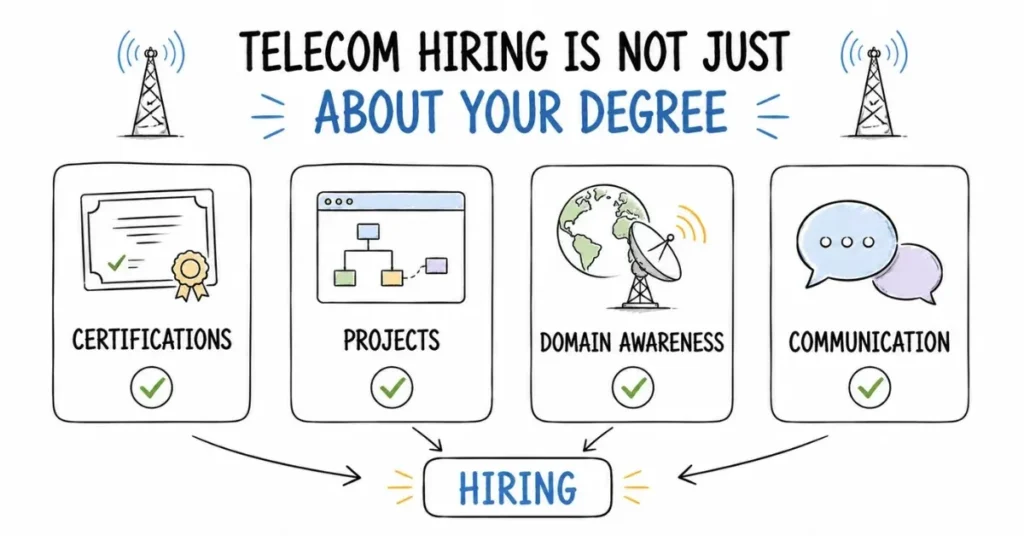
Telecom hiring managers at companies like Tech Mahindra, Ericsson, and TCS consistently say the same things in interviews and LinkedIn posts: degree is a filter to get into the screening pile, but it is not what gets you an offer. What gets you an offer is:
Certifications with a number attached. “I have CCNA” is more useful than “I studied networking.” The certification shows you sat an exam and passed a standardized assessment. Employers trust it.
A project you can explain in detail. Not a college project you barely remember. A simulation, a lab build, a small automation script — something you built, something you understand completely, something you can walk through step by step when asked.
Domain awareness. Knowing that Jio uses Nokia equipment in some circles and Ericsson in others. Knowing what a gNodeB is. Knowing what ARPU means (Average Revenue Per User — a core business metric every telecom company tracks). These details signal that you actually want to work in telecom, not just get any job.
Communication that matches the role. Telecom roles involve documentation, reporting, and cross-team coordination. Candidates who can write a clear email, explain a technical problem simply, and present a data table coherently get promoted faster than those who can only do the technical work.
The Bottom Line: Which Degree Should You Choose?
If you are still in school and deciding what to study:
- Choose ECE if you like how wireless systems work, are comfortable with electronics and physics, and want to work with the radio or hardware side of networks
- Choose CS / IT if you prefer software, programming, and data — and want to enter the cloud-native or automation side of telecom
- Choose BCA / B.Sc. IT if engineering entrance was not your path but IT interests you — and pair it aggressively with SQL and a networking certification
- Choose MBA as a second degree, ideally after 3–5 years of technical experience, to move into product, strategy, or senior management in telecom
If you are already holding a degree and wondering whether it is “the right one” — stop worrying about the degree and start building the skills. No one in a telecom interview has ever been turned down because their degree was BCA instead of B.Tech. They get turned down because they could not explain what an IP address is or had no certification to show.
The degree gets you in the door. What you build on top of it gets you the job.