
Aptitude & Reasoning Guide
Table of Contents
What Are Aptitude and Reasoning Tests?
Aptitude and reasoning tests are standardized assessments designed to measure your cognitive abilities, problem-solving skills, logical thinking, and mental agility. Used extensively in campus placements, competitive exams, government recruitments, and corporate hiring processes, these tests evaluate candidates on dimensions beyond academic qualifications or technical knowledge.
Major IT companies like TCS, Infosys, Wipro, Cognizant, Accenture, and consulting firms like Deloitte, EY, and PwC use aptitude tests as primary screening mechanisms. Studies show that nearly 70% of candidates fail at the aptitude stage, making it the most critical barrier in recruitment processes.
🔍 Explore structured learning resources created to enhance reasoning, clarity, and performance →
Why Organizations Conduct Aptitude Tests
Employers use aptitude assessments to predict job performance and identify candidates who can handle complex workplace challenges. These tests provide objective, standardized metrics for comparing hundreds or thousands of applicants efficiently. Unlike interviews where biases can influence decisions, aptitude tests measure pure cognitive capabilities.
Aptitude tests also assess learning potential—your ability to acquire new skills, adapt to changing environments, and solve unfamiliar problems quickly. In fast-evolving industries like technology, finance, and consulting, this adaptability determines long-term success more than current knowledge alone.
Core Components of Aptitude Tests
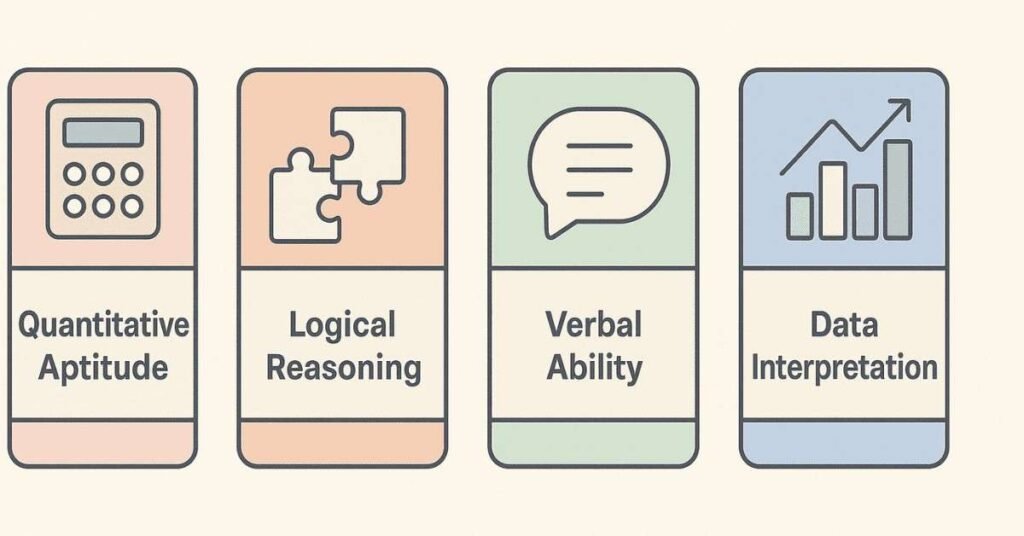
Quantitative Aptitude – This section tests your mathematical and numerical reasoning abilities. Topics include arithmetic operations, percentages, profit and loss, time and distance, ratios and proportions, averages, algebra, geometry, number systems, data interpretation, and probability. Questions require both conceptual understanding and calculation speed.
Logical Reasoning – Logical reasoning evaluates your ability to analyze patterns, draw valid conclusions from given premises, and solve problems through systematic thinking. Question types include syllogisms, blood relations, coding-decoding, series completion, analogies, classifications, direction sense, seating arrangements, and puzzles.
Verbal Ability – This component assesses language proficiency, comprehension skills, vocabulary range, and grammatical accuracy. Common question types include reading comprehension passages, sentence correction, synonyms and antonyms, sentence completion, para jumbles, idioms and phrases, error spotting, and fill in the blanks.
Data Interpretation – DI questions test your ability to extract, analyze, and interpret information from charts, graphs, tables, and datasets. You must quickly identify trends, calculate percentages, compare values, and draw conclusions from visual data representations.
📘 Discover more preparation-focused content designed to strengthen problem-solving and analytical skills →
Major Aptitude Test Types
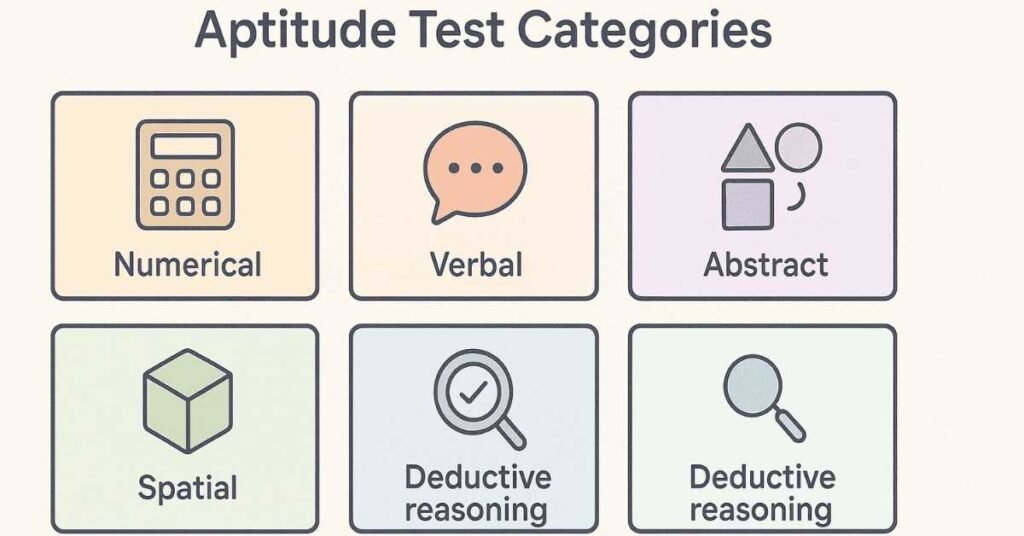
Numerical Reasoning Tests – These assess your ability to work with numerical data, perform calculations, and interpret quantitative information. Questions involve analyzing data tables, comparing percentages, calculating ratios, and identifying numerical patterns. Time pressure is significant—typically 1 minute per question.
Verbal Reasoning Tests – Verbal reasoning evaluates your language comprehension and logical interpretation of written information. You read passages and determine whether statements are true, false, or cannot be determined based on the given text. This tests both reading speed and critical analysis.
Abstract Reasoning Tests – Also called diagrammatic or inductive reasoning tests, these present patterns of shapes, symbols, or figures where you must identify the underlying rule and determine the next item in the sequence or the odd one out. These measure pure logical thinking independent of language or mathematical knowledge.
Spatial Reasoning Tests – Spatial tests assess your ability to visualize and mentally manipulate 2D and 3D objects. Questions involve mental rotation (identifying how objects look from different angles), mental folding (predicting how flat patterns fold into 3D shapes), and mirror images. These are crucial for technical, engineering, and design roles.
Deductive Reasoning Tests – Deductive reasoning requires drawing specific conclusions from general statements or premises. Syllogism questions are most common—you receive 2-3 statements and must determine which conclusions logically follow. These tests measure formal logical thinking abilities.
Understanding Test Formats and Timing
Most aptitude tests are computer-based and conducted online or at assessment centers. Tests typically last 30-90 minutes covering 30-60 questions, though timing varies by organization and test publisher. Major test providers include SHL, Aon (formerly cut-e), Kenexa, Saville, and Criteria Corp, each with distinct formats.
Negative Marking – Many tests, especially for Indian companies and competitive exams, include negative marking where incorrect answers deduct 0.25 to 0.33 marks. This penalizes random guessing and rewards accuracy over speed. Understanding whether your test has negative marking fundamentally changes strategy.
Adaptive Testing – Some modern aptitude assessments use adaptive algorithms where question difficulty adjusts based on your performance. Answering correctly yields harder questions; mistakes trigger easier ones. Your final score reflects both accuracy and the difficulty level you reached.
Sectional Timing – Certain tests impose time limits on individual sections, preventing you from spending extra time on stronger areas to compensate for weaker ones. Others provide overall time limits allowing flexible time allocation across sections.
Common Question Patterns
Quantitative Aptitude Patterns – Number series and pattern recognition questions appear frequently, requiring you to identify the mathematical rule governing a sequence. Time and work problems test your ability to calculate combined efficiencies and completion rates. Percentage-based profit/loss and discount calculations assess commercial mathematics understanding.
Data sufficiency questions provide statements and ask whether the given information is sufficient to answer the question—testing analytical thinking without requiring actual calculations. Age-based problems involve setting up algebraic equations from word problems about relative ages.
Logical Reasoning Patterns – Coding-decoding questions present words or numbers encoded using specific rules you must decipher. Blood relation problems describe family relationships requiring you to determine connections between individuals. Direction sense questions involve tracking movements in different directions and determining final positions or distances.
Seating arrangement puzzles provide constraints about how people sit in linear or circular arrangements, requiring systematic elimination and logical deduction. Calendar problems test your understanding of days, dates, and cyclical patterns.
Verbal Ability Patterns – Reading comprehension passages span 300-500 words on diverse topics from science to business to social issues, followed by 4-6 questions testing understanding, inference, vocabulary in context, and author’s purpose. Sentence correction questions present grammatically incorrect sentences requiring you to identify errors or select corrected versions.
Para-jumble questions provide 4-5 sentences in random order that you must logically sequence to form coherent paragraphs. Vocabulary questions test synonyms, antonyms, and appropriate word usage in context.
Difficulty Levels and Scoring
Aptitude tests typically have three difficulty tiers within the same test. Easy questions test basic concepts and simple applications, designed for 80-90% accuracy if you know the topic. Medium difficulty questions involve multi-step solutions or combine multiple concepts, with expected accuracy around 60-70%. Hard questions feature complex scenarios, require creative problem-solving approaches, or involve tricky calculations, targeting 30-40% accuracy.
Scoring systems vary by organization. Percentile-based scoring compares your performance against all test-takers—scoring in the 80th percentile means you outperformed 80% of candidates. Absolute scoring simply counts correct answers, while weighted scoring assigns different points to questions based on difficulty.
The 60-Day Mastery Timeline
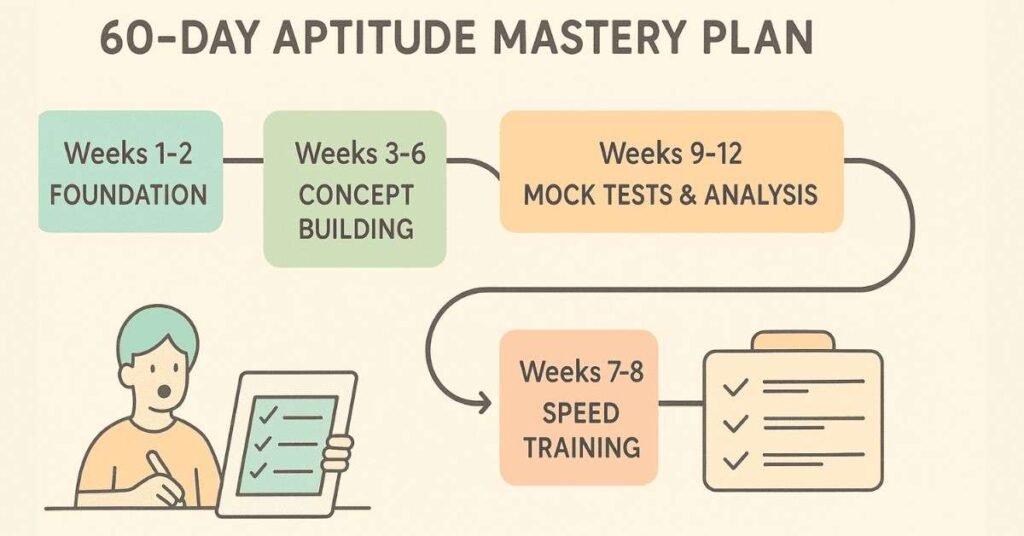
Weeks 1-2: Foundation & Diagnosis – Begin with diagnostic tests identifying your current baseline and revealing strengths and weaknesses across sections. Take at least 2-3 full-length mock tests without preparation to establish honest benchmarks. Don’t be discouraged by low initial scores—they simply identify improvement areas.
Create a detailed analysis sheet noting which question types you struggled with, time spent per section, and accuracy rates. This diagnostic phase determines your customized study plan prioritizing weak areas while maintaining strengths.
Weeks 3-4: Concept Building – Quantitative Aptitude – Study core mathematical concepts systematically. Start with fundamentals—percentages, ratios, averages, and time-distance-speed. Master the formulas and understand the underlying logic rather than just memorizing. Work through 20-30 practice problems per topic, starting with easy difficulty and progressing to medium.
Learn shortcut techniques and mental math strategies that reduce calculation time. Practice square roots, percentage calculations, fraction simplifications, and multiplication tricks. These speed-boosting techniques save precious seconds per question, accumulating to significant time advantages.
Weeks 5-6: Concept Building – Logical Reasoning – Focus on pattern recognition by practicing series completion, analogies, and classification questions daily. Train your brain to spot relationships quickly—whether numerical, alphabetical, or visual patterns. Work through 50+ series questions to internalize common progression types (arithmetic, geometric, square/cube numbers, alternating patterns).
Master systematic approaches to complex reasoning questions. For seating arrangements, learn to draw diagrams and use elimination methods. For blood relations, practice converting word problems into family trees. For syllogisms, understand Venn diagram techniques and validity rules.
Weeks 7-8: Concept Building – Verbal Ability & DI – Improve reading speed and comprehension by reading diverse materials daily—newspapers, magazines, online articles, and practice passages. Time yourself reading 500-word passages and answering questions within 3-4 minutes total. Practice identifying main ideas, author’s tone, and inference-based answers.
For data interpretation, practice extracting information from various chart types—bar graphs, pie charts, line graphs, and complex tables. Learn to quickly identify relevant data points without reading entire datasets. Practice percentage calculations and comparison techniques mentally.
Weeks 9-10: Speed Building & Integration – Shift focus from accuracy to speed. Set aggressive time limits—solve quantitative problems in 60-90 seconds, logical reasoning in 45-60 seconds, and verbal questions in 60 seconds. Initially, you’ll feel rushed and make mistakes, but this trains rapid decision-making.
Take sectional tests timing each section strictly. Identify question types that consume disproportionate time and either develop faster techniques or learn strategic skipping. Not every question deserves equal time—develop triage skills recognizing which questions to attempt versus skip.
Weeks 11-12: Mock Tests & Error Analysis – Take full-length mock tests under strict exam conditions—proper timing, no breaks, realistic environment. Complete at least 10-15 comprehensive mocks during this period. Your mock test scores should steadily improve by 15-20% from initial diagnostics.
Spend equal time on error analysis as test-taking. For every mock, review all questions—not just incorrect ones. Understand why right answers are correct and analyze your incorrect approaches. Categorize errors into conceptual mistakes, calculation errors, time pressure mistakes, or careless reading. Address each category with targeted practice.
📂 Access complete learning materials that support measurable growth and exam readiness →
Essential Resources and Practice Platforms
Free Practice Websites – IndiaBIX provides comprehensive aptitude questions with detailed explanations across all topics. GeeksforGeeks offers topic-wise practice with difficulty levels and company-specific question collections. PrepInsta features company-wise test patterns and previous year questions.
Aptitude-Test.com and PracticeAptitudeTests.com offer free diagnostic tests and section-wise practice with timer features. These platforms simulate real test environments helping you build exam temperament.
Books and Study Materials – R.S. Aggarwal’s “Quantitative Aptitude” remains the standard textbook covering all mathematical topics with progressive difficulty. Arun Sharma’s “How to Prepare for Quantitative Aptitude” provides CAT-level preparation useful for challenging corporate tests. M.K. Pandey’s “Analytical Reasoning” comprehensively covers logical reasoning patterns.
For verbal ability, Norman Lewis’s “Word Power Made Easy” builds vocabulary systematically, while Wren & Martin’s “High School English Grammar” addresses grammatical concepts thoroughly.
Company-Specific Preparation – Research your target company’s test pattern. TCS uses TCS NQT with specific weightage to numerical ability and programming logic. Infosys focuses heavily on puzzles and logical reasoning. Wipro’s WILP test emphasizes verbal ability alongside quantitative skills. Accenture includes pseudo-code questions testing algorithmic thinking.
Access previous year question papers or experiences shared by candidates on platforms like PrepInsta, GeeksforGeeks, and company-specific forums. Understanding the exact pattern, difficulty level, and time constraints helps you prepare precisely rather than generically.
Quantitative Aptitude Mastery Techniques
Number System & Series – Master divisibility rules for 2 through 11 enabling quick factor identification. Memorize perfect squares up to 30 (900) and cubes up to 15 (3375) for instant recognition in problems. Practice identifying arithmetic progressions (constant difference), geometric progressions (constant ratio), and special sequences like Fibonacci or prime numbers.
For missing number problems, check differences between consecutive terms first, then ratios, then squared/cubed relationships. Most series follow one of these patterns. If simple patterns don’t work, examine alternate terms independently—odd and even positioned numbers might follow different rules.
Percentage, Profit & Loss – Convert common fractions to percentages instantly: 1/2=50%, 1/3≈33.33%, 1/4=25%, 1/5=20%, 1/6≈16.67%, 1/8=12.5%, 1/10=10%. This eliminates calculation time for standard conversions.
For profit/loss problems, remember key formulas: Profit% = (Profit/Cost Price) × 100, Selling Price = Cost Price × (100 + Profit%)/100. When successive discounts are given (say 20% and 10%), don’t add them—apply sequentially. A 20% discount followed by 10% discount equals 28% total discount, not 30%.
Time, Speed & Distance – Memorize the fundamental relationship: Distance = Speed × Time. All variations derive from this. For relative speed problems, when objects move in the same direction, relative speed = difference of speeds; in opposite directions, relative speed = sum of speeds.
Convert units mentally: 1 km/hr = 5/18 m/s. To convert km/hr to m/s, multiply by 5/18; for m/s to km/hr, multiply by 18/5. Practice these conversions until automatic.
For train problems, remember that when a train crosses a pole or standing person, distance = train length; when crossing a platform or bridge, distance = train length + platform/bridge length.
Time & Work – Understand work in terms of efficiency. If A completes work in 10 days, A’s one day work = 1/10. If B completes work in 15 days, B’s one day work = 1/15. Working together, their combined one day work = 1/10 + 1/15 = 5/30 = 1/6, so they complete work together in 6 days.
For pipes and cisterns (filling/emptying tanks), use the same logic. Inlet pipes fill (positive work), outlet pipes empty (negative work). Combined efficiency = sum of individual efficiencies with appropriate signs.
Ratio & Proportion – When a ratio is given as a:b and total quantity is known, individual shares = (a/(a+b)) × Total and (b/(a+b)) × Total. For three-way ratios, ensure denominators match. If A:B = 2:3 and B:C = 4:5, convert to common B term: A:B:C = 8:12:15.
For mixture and alligation problems, use the visual cross-method. When mixing two quantities at different prices/concentrations, the ratio in which they should be mixed = (difference between second price and mean price):(difference between mean price and first price).
Simple & Compound Interest – Simple Interest = (Principal × Rate × Time)/100. The total amount = Principal + SI. For compound interest, Amount = Principal × (1 + Rate/100)^Time. The difference between CI and SI becomes significant over longer periods.
Quick approximation: For compound interest over 2 years, CI ≈ SI + (SI for 1 year)²/(200 × Principal). This provides reasonably accurate estimates without full calculations.
Logical Reasoning Mastery Techniques
Coding-Decoding Strategies – Identify the transformation pattern quickly. Common patterns include: position shift (A→C means +2 shift), reverse alphabets (A→Z, B→Y), consonant-vowel swaps, or mathematical operations on letter positions.
For number coding, check if it’s based on alphabetical position (A=1, B=2), sum of letter positions, or digit reversal. Once you identify the rule from the example, apply consistently to decode the question.
Blood Relations Systematic Approach – Draw quick family trees using symbols: ♂ for male, ♀ for female, = for marriage, — for sibling relationship, | for parent-child relationship. This visual representation clarifies complex relationships instantly.
Memorize relationship chains: Mother’s or father’s brother = Uncle, Mother’s or father’s sister = Aunt, Brother’s or sister’s daughter = Niece, Brother’s or sister’s son = Nephew, Spouse’s father/mother = Father-in-law/Mother-in-law.
For multi-step relations, work backwards from the person you’re asked about, tracing the relationship chain step by step.
Direction Sense Problems – Draw quick diagrams. Start with a point representing the initial position. As the problem describes movements (North, South, East, West), mark arrows showing direction and distance. The final position relative to start becomes visually obvious.
Remember: North-South movements change latitude (vertical), East-West movements change longitude (horizontal). For distance calculations between two points, use Pythagoras theorem: Distance = √(horizontal distance² + vertical distance²).
Master right-turn and left-turn logic. Starting facing North: right turn → East, right turn → South, right turn → West, right turn → North. Left turns follow reverse sequence.
Seating Arrangement Techniques – For linear arrangements, draw a straight line with numbered positions. For circular arrangements, draw a circle and mark positions around it. Remember: In circular arrangements, there’s no absolute left/right—it depends on reference person.
Use elimination method systematically. Start with the most restrictive conditions (exact positions) first, then apply relative positions (next to, opposite, two places away). Cross out impossible combinations as you progress.
Develop notation: Use initials for people, arrows for directions, and symbols for relationships (~ for not next to, ↔ for opposite). This shorthand speeds up complex puzzles.
Syllogism Mastery – Learn Venn diagram approach thoroughly. Each statement translates to a Venn diagram relationship: “All A are B” means A circle inside B circle, “Some A are B” means overlapping circles, “No A is B” means separate circles.
For multiple statements, combine diagrams respecting all conditions. Test each conclusion against your combined diagram—if it’s always true regardless of diagram variations, it follows; if sometimes true, it doesn’t definitively follow.
Master the negative statement logic: “All A are not B” is different from “Some A are not B.” The first means no A is B; the second means at least one A is not B.
Calendar Problems – Memorize odd days concept. An ordinary year has 365 days = 52 weeks + 1 day (1 odd day). A leap year has 366 days = 52 weeks + 2 days (2 odd days). To find the day of a date, calculate total odd days from a reference point and apply modulo 7.
Remember month codes: January=0, February=3, March=3, April=6, May=1, June=4, July=6, August=2, September=5, October=0, November=3, December=5 (for non-leap years).
Quick check for leap years: Divisible by 4 (but century years must be divisible by 400). So 2000 was a leap year but 1900 wasn’t.
Verbal Ability Mastery Techniques
Reading Comprehension Speed Strategy – Don’t read the entire passage first. Instead, quickly skim the passage (10-15 seconds) identifying the topic, structure (cause-effect, comparison, chronological, problem-solution), and tone (positive, critical, neutral).
Read questions first, then locate relevant sections in the passage. Most questions are inference-based or detail-specific—you don’t need to understand every sentence deeply. Mark key lines as you read questions, then return to those marked sections.
For “main idea” questions, focus on first and last paragraphs plus topic sentences (first sentence of each paragraph). For “author’s tone,” notice adjectives and value judgments. For “inference,” eliminate extreme options—correct inferences are usually moderate extensions of stated facts.
Vocabulary Building Systematic Approach – Learn word families and roots. If you know “ben” means good, you understand benefit, benign, benevolent, benefactor. “Mal” means bad: malevolent, malicious, malady, malfunction. Root knowledge multiplies vocabulary exponentially.
Create context-based memory. Don’t memorize isolated words—learn them in sentences. “The politician’s mendacious speech deceived voters” is more memorable than “mendacious = lying.”
Use spaced repetition. Review new words after 1 day, 3 days, 7 days, and 21 days. This spacing pattern transfers words from short-term to long-term memory effectively.
Grammar Error Spotting – Focus on high-frequency error types. Subject-verb agreement errors are most common: “The team are playing” should be “The team is playing” (collective nouns are singular). Pronoun-antecedent agreement: “Everyone should bring their book” should be “Everyone should bring his/her book” (everyone is singular).
Tense consistency errors occur when sentences switch tenses inappropriately. “He went to the store and buys milk” should maintain past tense: “bought milk.”
Preposition errors are subtle but frequent. Memorize correct prepositions: different from (not different than), consists of (not consists in), capable of (not capable to).
Para-Jumble Strategy – Identify the opening sentence—usually introduces a topic broadly without referring to previous information. Eliminate options starting with pronouns (he, she, it, they) or connectives (however, moreover, therefore) as these refer to prior context.
Find mandatory pairs—sentences that must be consecutive due to pronoun reference, cause-effect, or continuation. If sentence B says “This discovery” or “He then,” find the sentence immediately before establishing what “this” refers to or who “he” is.
Check the flow: opening (topic introduction) → explanation/elaboration → examples/evidence → conclusion/consequence. Most passages follow this logical structure.
Data Interpretation Advanced Techniques
Chart Reading Efficiency – Don’t read every data point. Questions ask about specific comparisons, maximums, minimums, or trends. Read the question first, identify exactly what data you need, then locate only those values.
For bar graphs and line graphs, focus on highest/lowest points if questions ask about extremes. For trend questions, observe overall direction without calculating every point.
For pie charts, remember that percentages must sum to 100%. If a question provides total value and one segment’s percentage, quickly calculate that segment’s value: (Percentage/100) × Total.
Approximation Skills – Master rounding techniques. For addition/subtraction, round to nearest 10 or 100 based on number magnitude. For multiplication/division, round one number up and one down for balanced approximation.
When comparing ratios or percentages, convert to common denominators mentally or use cross-multiplication. To compare 3/7 and 5/11, cross-multiply: 3×11=33 vs 5×7=35, so 5/11 is larger.
For percentage increases, use the formula: New Value = Old Value × (1 + Percentage Increase/100). For decreases: × (1 – Percentage Decrease/100).
Test-Taking Strategic Approaches
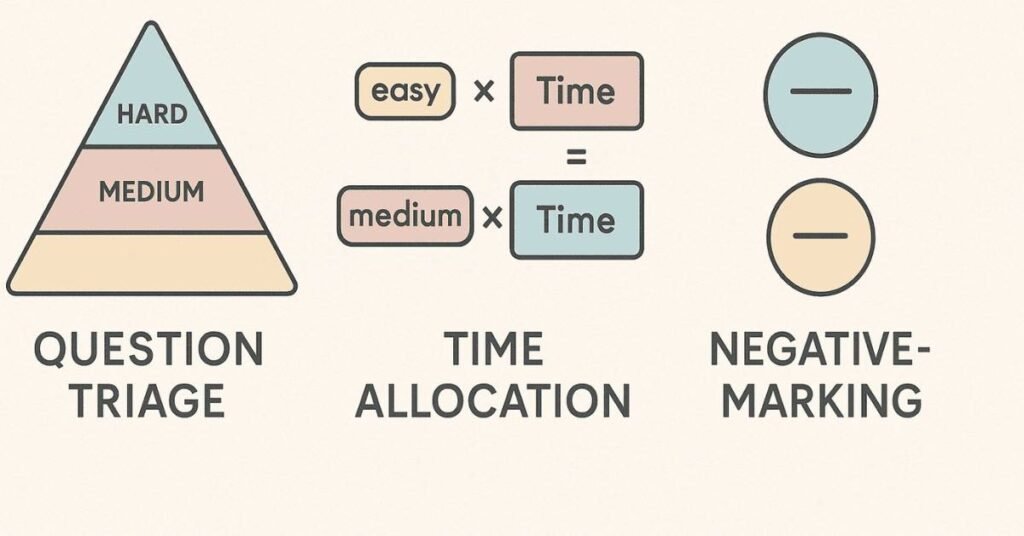
Question Triage System – When you begin a section, quickly skim all questions in 30-60 seconds categorizing them mentally: Easy (can solve in <60 seconds), Medium (need 90-120 seconds), Hard (require >150 seconds or uncertain approach).
Attack easy questions first, securing those marks quickly and building confidence. Then tackle medium questions. Hard questions should be attempted only if time permits—don’t let single difficult questions consume 5 minutes when you could solve 3 easy questions instead.
Mark difficult questions for review if the system allows, or note question numbers on scrap paper. Return to these only after completing all easier questions.
Time Allocation Formula – For 60 questions in 60 minutes with three sections, don’t simply divide equally. Allocate time based on your strengths. If you’re strong in quantitative but weak in verbal, spend 25 minutes on quantitative, 18 on logical, 17 on verbal.
Within each section, spend no more than 90 seconds per question initially. If you haven’t made significant progress by 90 seconds, mark and move on. Better to attempt all questions briefly than solve 60% perfectly while leaving 40% blank.
Reserve final 3-5 minutes for marked questions and random guessing (if no negative marking). Even educated guesses have 20-25% success probability in multiple-choice formats.
Negative Marking Strategy – With negative marking (typically -0.25 or -0.33 per wrong answer), guess only when you can eliminate 2+ options, bringing probability in your favor. If completely unsure between all 4 options, leave blank—random guessing is statistically disadvantageous.
Without negative marking, never leave questions blank. Even wild guesses provide 25% success probability at no cost. In final minutes, quickly mark answers for all remaining questions.
Calculator Efficiency – If calculators are permitted, use them strategically for complex multiplications, divisions, and multi-step calculations. However, for simple operations (multiplication by 10, 100, addition, basic percentages), mental math is faster than calculator input.
Learn calculator shortcuts: Use memory functions (M+, M-, MR) for multi-step problems. Practice with the specific calculator model you’ll use in the test—familiarity saves precious seconds.
🧭 Continue your learning journey with more insights, frameworks, and improvement-focused guidance →
Test Day Optimization
Pre-Test Preparation – Get 7-8 hours of quality sleep the night before. Sleep deprivation significantly impairs numerical processing and logical reasoning—studies show even one night of poor sleep reduces cognitive performance by 20-30%.
Eat a balanced breakfast with complex carbohydrates (oats, whole grain) and protein (eggs, nuts) providing sustained energy. Avoid excessive sugar causing energy spikes and crashes. Stay hydrated but don’t overdrink immediately before to avoid restroom disruption.
Arrive 20-30 minutes early, allowing buffer time for traffic, security checks, or registration. Rushing increases anxiety and impairs performance.
During Test Execution – Read instructions extremely carefully. Note section timing, negative marking policies, and navigation rules (can you return to previous questions or is it sequential?).
Maintain steady pace throughout. Don’t celebrate solving hard questions or despair over confusion—maintain emotional equilibrium. Anxiety consumes mental energy needed for problem-solving.
If you feel stuck or panicked, take three deep breaths. Oxygenate your brain and reset focus. Remember: every candidate faces difficult questions—the winner is who maintains composure.
Post-Section Strategy – If the test has breaks between sections, use them wisely. Stand, stretch, and walk briefly to re-oxygenate your brain. Avoid discussing questions with other candidates—their answers might be wrong but create doubt.
Don’t dwell on previous sections. Whether it went well or poorly, focus completely on the upcoming section. Mental energy spent on past performance is wasted energy.