
Telecom Resume Guide : Get Shortlisted for Jobs in India
Table of Contents
What Hiring Managers Actually Look For in 2026

Most telecom resumes in India have the same problem: they look complete but say very little.
They list a degree, a certification, a few generic skills like “good communication” and “team player,” and a work history that describes responsibilities without a single number or outcome. A hiring manager at Ericsson or Tech Mahindra reads dozens of these every week and skips past them in seconds.
This guide tells you exactly what separates a resume that gets ignored from one that gets a call. It covers structure, keywords, ATS optimization, how to write each section, and critically what to do differently depending on whether you are a fresher or an experienced professional.
Why ATS Is the First Filter You Need to Beat
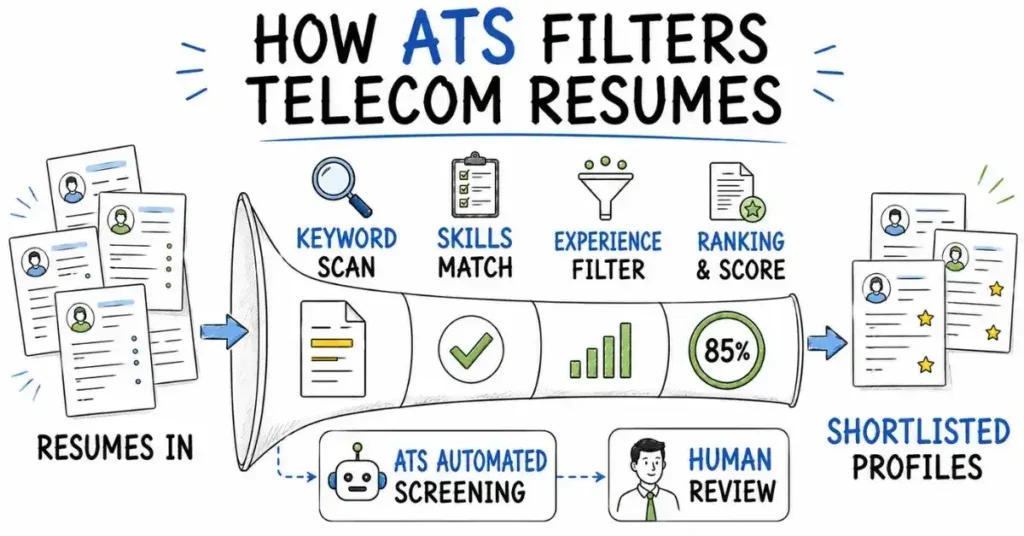
Over 97% of large tech and telecom companies in India now use Applicant Tracking Systems (ATS) to screen resumes before a human reads them. An ATS scans your resume for specific keywords — job titles, technologies, protocols, certifications — and scores it against the job description. Resumes that do not score high enough never reach a recruiter.
This means two things practically:
First, a beautifully formatted resume with tables, columns, text boxes, and logos often fails ATS scans because the system cannot read text inside graphics or complex formatting. Keep your resume in a clean, single-column format when applying through portals.
Second, generic resumes fail. A resume that says “knowledge of networking technologies” scores far lower than one that says “Cisco IOS, BGP, OSPF, MPLS, VLAN configuration, Wireshark troubleshooting.” The ATS needs exact keywords — not paraphrases of them.
The Right Structure for a Telecom Resume
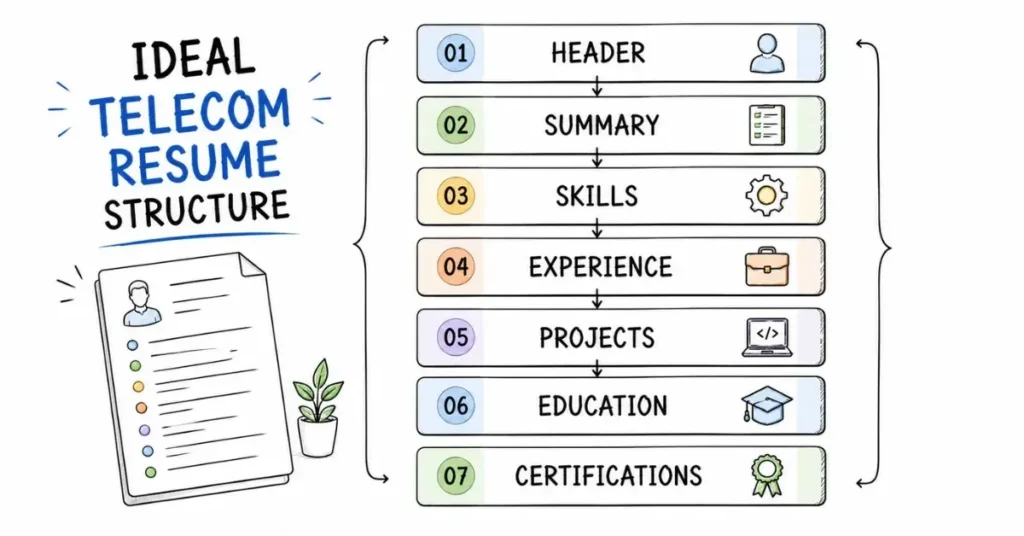
A telecom resume in India should follow this order — every section earning its place:
- Header — Name, phone, professional email, LinkedIn URL, city
- Professional Summary — 3–4 lines summarizing who you are and what you bring
- Technical Skills — a clean, scannable list of technologies, tools, protocols, and certifications
- Work Experience — bullet points focused on outcomes, not responsibilities
- Projects — especially important for freshers; lab projects count
- Education — degree, institution, year, percentage/CGPA
- Certifications — name, issuing body, date obtained or expected
Notice what is not here: a “Career Objective” paragraph that says “seeking a challenging role where I can utilize my skills and contribute to the organization’s growth.” Hiring managers do not read these. Replace it with a Professional Summary that communicates specific value in 3–4 concrete lines.
Section 1: Professional Summary - Write It Last, Put It First
The professional summary sits at the top of your resume but should be written after you have completed every other section — because it summarizes what is below.
For a fresher:
B.Tech ECE graduate with hands-on network lab experience in Cisco Packet Tracer — OSPF, BGP, and VLAN configuration across multi-router topologies. Currently pursuing CCNA (exam scheduled Q2 2026). Targeting NOC analyst or network support roles in telecom or managed services.
What this does right: it mentions the degree, the hands-on experience (even if it is lab-based), the certification in progress with a timeline, and the specific role type. A recruiter scanning this in 6 seconds knows exactly who you are and whether to keep reading.
For an experienced professional (4 years, network engineering):
Network Engineer with 4 years of experience managing IP/MPLS networks for telecom operators. CCNA certified; hands-on with Cisco IOS, Nokia SR OS, and Ericsson ENM. Reduced mean time to resolution (MTTR) for network incidents by 22% through process automation. Targeting senior network engineer or 5G transport roles at a global vendor or operator.
What this does right: years of experience, specific technologies, one quantified achievement, and a clear career direction.
Section 2: Technical Skills - The ATS Battleground
This section is where your ATS score is largely determined. The goal is to include every relevant keyword that appears in the job descriptions you are targeting — without padding, without lying.
Organize it into subcategories for readability:
Networking Protocols: BGP, OSPF, IS-IS, MPLS, Segment Routing, VLAN, STP, TCP/IP, IPv4/IPv6
Telecom Technologies: LTE, 5G NR, VoLTE, gNodeB configuration, O-RAN, NB-IoT
Vendor Platforms: Cisco IOS, Nokia SR OS, Ericsson ENM, Nokia NetAct, Huawei U2000
Tools: Cisco Packet Tracer, GNS3, Wireshark, TEMS (drive testing), NEMO, Ansible, Python (basic)
OSS/BSS (if applicable): Amdocs, Oracle BRM, IBM Netcool, ServiceNow
Cloud (if applicable): AWS EC2, Azure Fundamentals, Kubernetes basics, Docker
Certifications: Cisco CCNA (200-301) — Certified [date]; Nokia NRS I — In Progress
The highest-priority keywords that appear in 80%+ of network engineer job descriptions in India are: Cisco, Routing, Switching, Firewalls, BGP, OSPF, VLAN, VPN, Network Security. These should appear in your skills section if they genuinely apply to your background.
Only list technologies you can speak to in an interview. Listing “Kubernetes” because it sounds good, and then not being able to explain what a pod is, actively hurts you.
Section 3: Work Experience - Stop Describing, Start Achieving
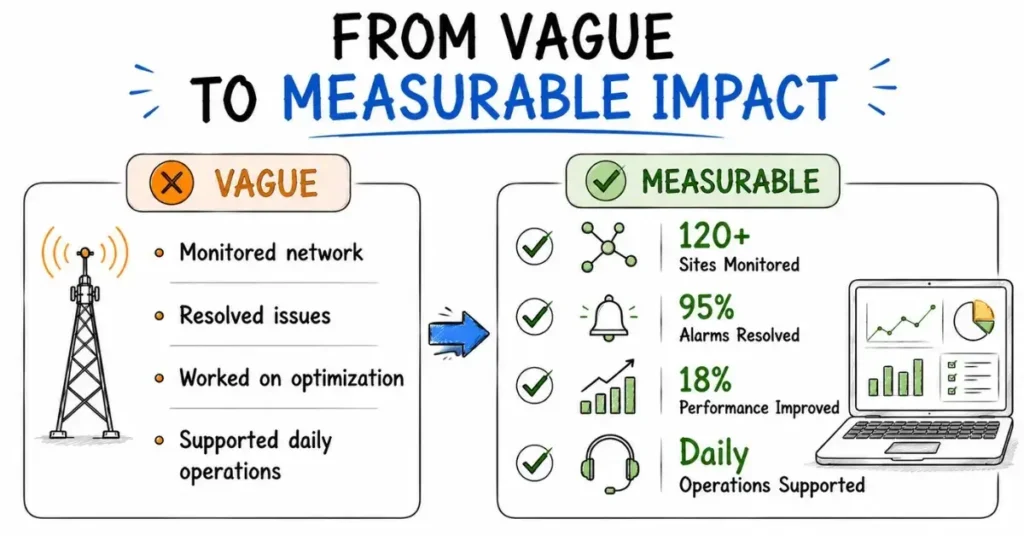
This is the most commonly miswritten section in Indian telecom resumes. Most candidates write responsibilities:
“Responsible for monitoring network performance and resolving issues.”
This tells a hiring manager nothing meaningful. Monitoring is the minimum expectation of any NOC engineer. What matters is what you achieved, how fast you resolved issues, what you improved, and what scale you worked at.
Write achievements instead:
“Monitored 450+ network nodes across 3 operator networks using IBM Netcool; reduced average alarm-to-resolution time from 47 minutes to 31 minutes by implementing a priority escalation workflow.”
That bullet says: scale (450+ nodes), tools (IBM Netcool), measurable outcome (47 minutes down to 31 minutes), and method (escalation workflow). A hiring manager reading this knows this engineer did real work — not just watched screens.
The formula for every bullet point:
[Action verb] + [what you did] + [tool or technology] + [measurable outcome]
- Configured OSPF on 12 Nokia SR OS routers for a new enterprise customer, reducing provisioning time from 4 hours to 90 minutes
- Deployed 5G gNodeB configuration scripts across 85 sites using Ericsson ENM, completing acceptance testing 3 days ahead of project schedule
- Built Python script to automate daily performance report extraction from Nokia NetAct, saving 2 hours of manual work per day
If you do not have numbers yet — you are a fresher — use scale and context:
- Simulated a 5-router OSPF network in Cisco Packet Tracer, configured redistribution between OSPF and BGP, and documented failover behavior across 3 link failure scenarios
Not as strong as real-world numbers, but far better than “studied networking protocols.”
Section 4: Projects - Your Proof of Hands-On Knowledge
For freshers, the projects section is the most important section after technical skills. It is your evidence that you can apply what you studied — not just pass exams about it.
What counts as a project:
- A network you built in Cisco Packet Tracer or GNS3
- A 5G NR simulation using tools like Amarisoft or MATLAB
- A Python script that automates a network-related task
- A SQL analysis of a public telecom dataset
- A final year project involving any networking, signal processing, RF, or IoT work
How to write a project entry:
Multi-Site OSPF Network — Cisco Packet Tracer
Built a 5-router enterprise network across 3 simulated sites. Configured OSPF area routing, implemented route summarization, and tested traffic rerouting during link failures. Documented topology, IP addressing scheme, and failover behavior.
Three things every project entry needs: what you built, what technologies you used, and what you tested or proved.
ATS Keywords by Role Type
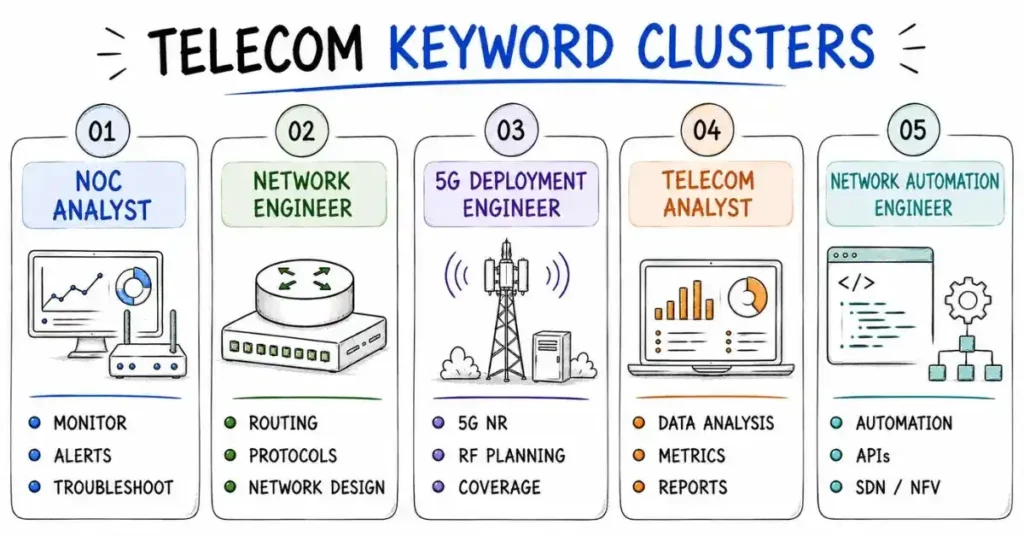
Different telecom roles need different keyword sets. Use this as a quick reference when tailoring your resume to a specific job description:
For NOC Analyst roles:
Network Monitoring, Incident Management, SNMP, Wireshark, ServiceNow, IBM Netcool, Ericsson ENM, Nokia NetAct, SLA, MTTR, L1/L2 Support, Alarm Management, Fault Management
For Network Engineer roles:
BGP, OSPF, IS-IS, MPLS, VLAN, VPN, STP, TCP/IP, Cisco IOS, Nokia SR OS, Juniper Junos, GNS3, Network Design, Troubleshooting, Routing Protocol, Switching
For 5G Deployment Engineer roles:
5G NR, gNodeB, gNB Configuration, 3GPP, Site Acceptance Testing, Ericsson ENM, Nokia NetAct, Drive Testing, TEMS, RF Planning, NR Commissioning, O-RAN
For Telecom Analyst / BSS-OSS roles:
OSS, BSS, Amdocs, Oracle BRM, SQL, Revenue Assurance, Billing, Mediation, Order Management, Churn Analysis, Power BI, Tableau, KPI Reporting
For Network Automation roles:
Python, Ansible, YANG, NETCONF, REST API, Git, CI/CD, Network Automation, Cisco DevNet, Infrastructure as Code
Tailoring for Each Application - The Step Most Candidates Skip
Over 97% of large tech and telecom companies use ATS. Sending the same resume to 50 different job postings is far less effective than sending a slightly tailored resume to 20 carefully chosen ones.
The tailoring does not need to be extensive. For each application:
- Read the job description carefully
- Identify 5–8 specific keywords or technologies mentioned that you have genuine experience with
- Make sure those exact words appear in your resume — in your skills section, in your experience bullets, or in your summary
- Adjust your professional summary to reflect the specific role type (NOC analyst vs. 5G deployment engineer vs. telecom analyst)
This process takes 10–15 minutes per application. Candidates who do this consistently report significantly higher interview call rates than those who mass-apply with a static resume.
Common Mistakes on Indian Telecom Resumes
These appear on a large share of resumes that hiring managers dismiss quickly:
Listing soft skills in the technical skills section. “Good communication,” “team player,” and “hard-working” do not belong in a skills section on a technical resume. Move them to your cover letter or remove them entirely.
Using a photo. Indian resume culture historically included photos, but most global telecom companies (Ericsson, Nokia, Cisco) and their HR systems actively prefer photo-free resumes to avoid unconscious bias in screening. Leave the photo out.
Career objective instead of professional summary. “Seeking a challenging role to grow professionally” tells a hiring manager nothing and wastes the most valuable space on your resume. Replace it with a 3-line summary that states your experience, your strongest technical skills, and your target role.
Vague technology mentions. Writing “knowledge of networking” instead of specific protocols and tools. Writing “familiar with cloud” instead of “AWS EC2, S3 basics, Azure Fundamentals certification.” Specificity is what the ATS — and the human behind it — is looking for.
Listing every subject you studied in college. Your resume is not your marksheet. Drop the list of semester subjects. Replace that space with the projects section.
Two-page resumes for freshers. If you have less than 3 years of experience, your resume should be one page. Hiring managers read hundreds of resumes — they appreciate conciseness. The two-page rule applies from 5+ years of experience onward.
The LinkedIn Profile as Resume Extension
Your resume and LinkedIn profile should tell a consistent story — but LinkedIn has room for more detail, and recruiters often check it before calling you.
Three things that matter on LinkedIn specifically for telecom:
Headline: Use specific keywords, not your job title alone. “Network Engineer | CCNA | Cisco IOS | Nokia SR OS | 5G” appears in recruiter searches. “B.Tech ECE Graduate” does not.
Skills section: LinkedIn allows up to 50 skills. Add every relevant telecom keyword — protocols, tools, certifications, vendor platforms. Connections can endorse these skills, which increases your profile’s visibility.
Featured section: Pin your best project, a certification badge, or a LinkedIn article you wrote about a telecom topic. Recruiters who click through to your profile notice this within the first 10 seconds.
One Final Test Before You Submit

Before sending any resume, do this:
Copy your resume text (no formatting) into a plain text document. Read it as if you are a recruiter who has 30 seconds. Ask three questions:
- Within 10 seconds, is it clear what this person does and at what level?
- Within 20 seconds, can I see at least three specific technologies they have worked with?
- Within 30 seconds, can I find one concrete outcome or achievement?
If the answer to any of these is no — revise before submitting. A resume that passes this test gets read. One that does not, does not.