
AgriTech Startups in India: Careers at DeHaat, Ninjacart, AgroStar & Others
Table of Contents
Introduction
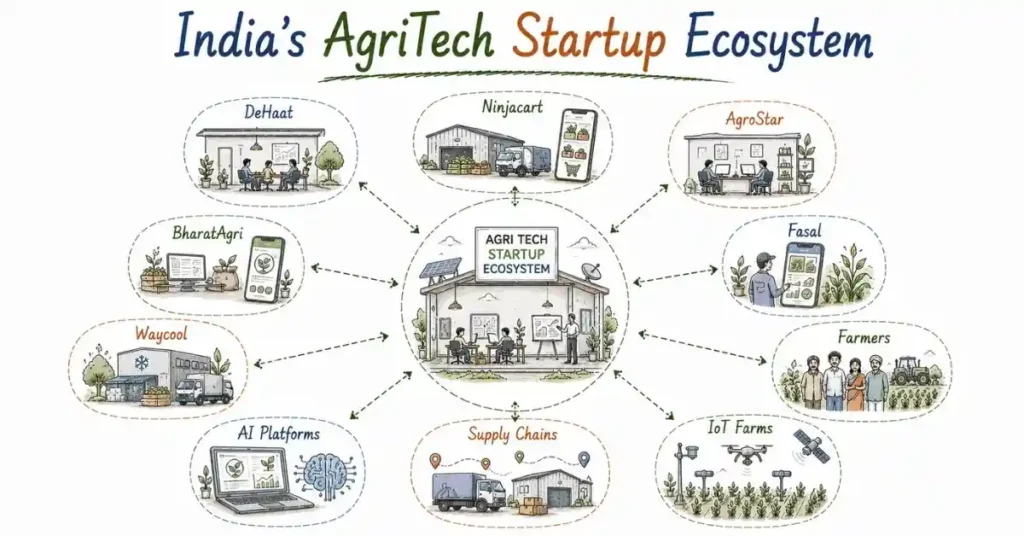
Working at a startup is not for everyone. Working at an AgriTech startup is not for everyone who works at startups.
That is not a discouragement. It is a calibration. Because the people who thrive at AgriTech startups who grow fast, contribute meaningfully, and build careers that would take a decade elsewhere share specific traits that have nothing to do with grades, pedigree, or city of origin.
This guide is honest about what startup AgriTech careers involve, who genuinely fits, and how to get hired at the companies that matter.
What Makes AgriTech Startups Different From Other Startups
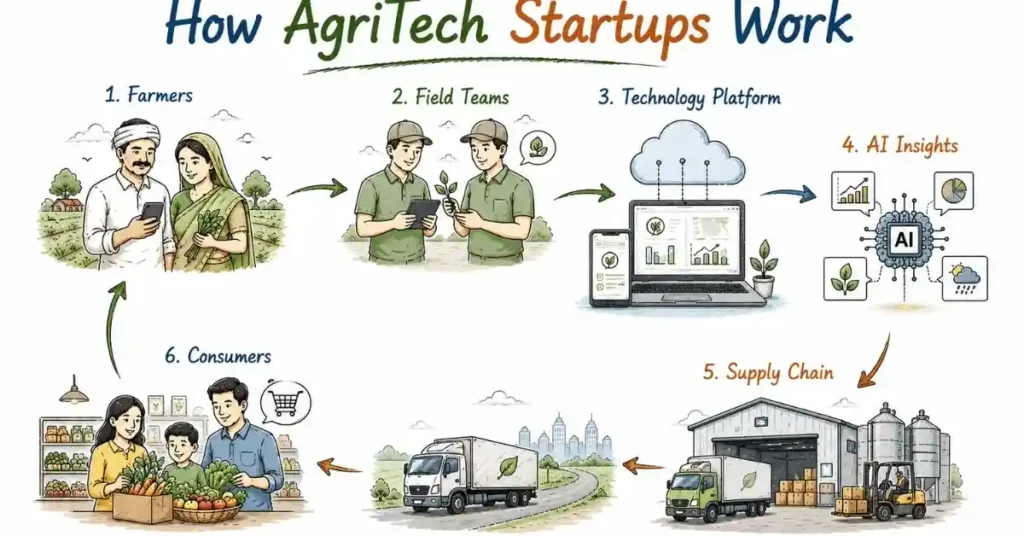
Most startup career advice is written for consumer tech apps, fintech, edtech. AgriTech startups operate differently in three fundamental ways.
The customer is harder to reach. Your end user is often a farmer in a Tier 3 district with a low-cost Android phone, patchy connectivity, limited digital literacy, and deep scepticism of anything that sounds too good to be true. Building for this user and actually reaching them requires skills and empathy that Bengaluru-trained product teams often lack. Companies that solve this problem grow fast. Those that do not, do not survive.
The problem is physical, not just digital. Most consumer startups are pure software plays. AgriTech startups deploy hardware in fields, build cold chain infrastructure, manage grain procurement across mandis, and send agronomists to farms. The operations complexity is real. People who can navigate both the digital and physical sides of this are genuinely rare.
The mission is concrete. When a crop advisory platform gives a farmer the right pest management advice and he saves his kharif crop that outcome is not abstract. People who want to see the direct consequence of their work find AgriTech startups unusually motivating. This matters because the pay at early-stage companies is sometimes lower than what a comparable role in fintech or e-commerce would offer. Mission alignment is what keeps strong people from leaving.
The Indian AgriTech Startup Landscape: A Clear Map
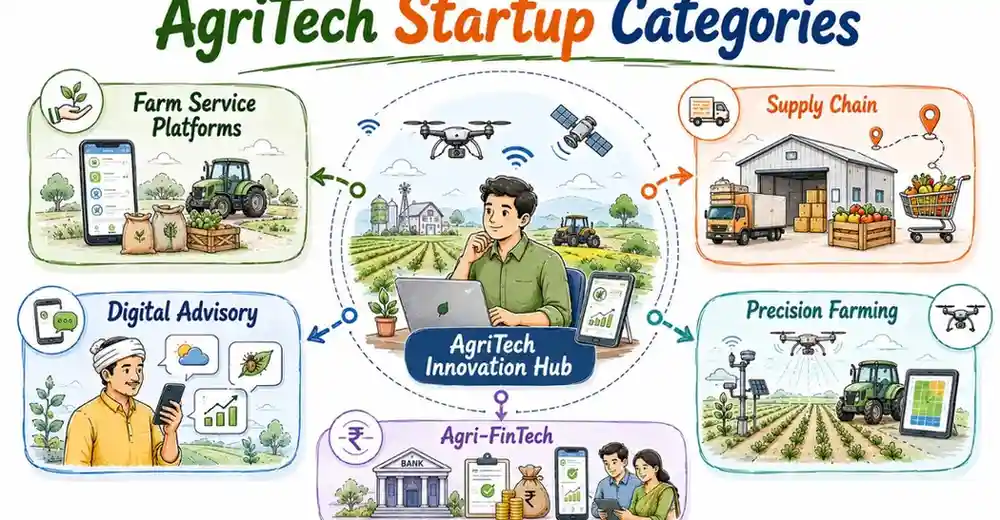
Understanding the ecosystem before you apply is the difference between a targeted job search and a scattered one. Indian AgriTech startups cluster into five business model categories:
Full-stack farm service platforms: Companies that provide farmers with inputs, advisory, credit, and market access through a single platform. DeHaat is the primary example. High operational complexity, large field teams, and fast growth in tier 2 and tier 3 markets.
B2B agri supply chain: Companies that replace traditional mandi middlemen with technology-enabled direct farm sourcing. Ninjacart and Waycool are the main players. Operations-intensive, data-driven, and time-sensitive.
Digital agri-input and advisory: Companies selling seeds, fertilisers, and crop advice through mobile platforms. AgroStar, BharatAgri, and Jai Kisan fall here. Strong product, content, and vernacular language requirements.
Precision farming and data intelligence: Companies using satellite, drone, and IoT data to provide analytics for farms, insurance companies, and governments. Cropin, SatSure, and Fasal lead this category. High technical hiring bar, strong data science culture.
Agri-fintech: Companies providing credit, insurance, and financial products specifically to farmers and agri-businesses. Samunnati, Jai Kisan, and Arya.ag operate here. Intersection of agriculture domain knowledge and financial services.
Knowing which category your target company sits in tells you immediately what skills they value most and what your day-to-day work will look like.
What Startup Life in AgriTech Actually Looks Like
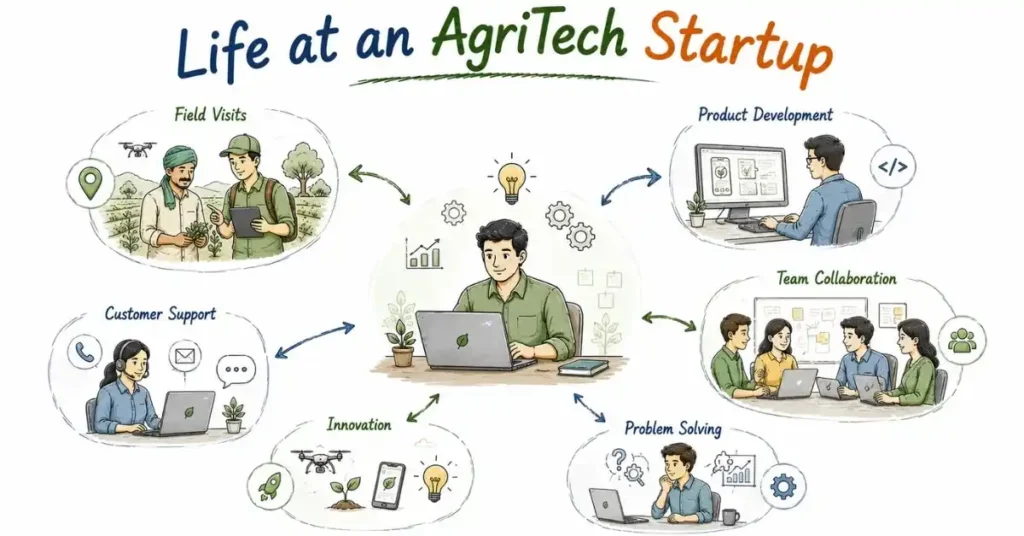
The Good
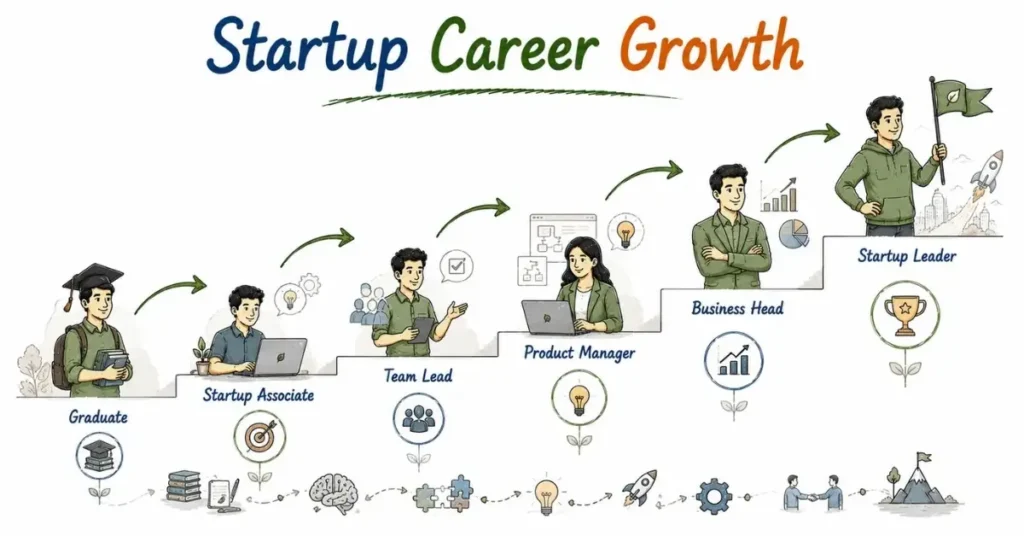
You own more, faster. At a 50-person AgriTech startup, a second-year agronomist can own an entire state’s field advisory programme. A junior backend developer can own a core API used by 100,000 farmers. The scope of responsibility is disproportionate to your years of experience which is how careers accelerate.
You see the whole business. Startup teams are small enough that you understand how your work connects to sales, operations, product, and finance. This cross-functional exposure is compressed learning that takes 10 years to accumulate in a large corporate.
The problems are genuinely hard. Building an app that works reliably on a 2G connection in rural Bihar is technically harder than building the same app for urban 5G users. Making a supply chain profitable when you are sourcing tomatoes from 500 small farmers and delivering to 2,000 retailers within 12 hours is operationally harder than most corporate supply chain problems. The difficulty is the education.
The Hard
Structure is minimal. Onboarding programmes, mentorship structures, and clear promotion criteria are luxuries most AgriTech startups cannot afford in their early years. You are expected to figure out a lot independently. People who need clear direction and regular feedback struggle here.
Stability is not guaranteed. Indian AgriTech saw significant funding slowdown in 2023–2024 as global venture capital tightened. Several startups that were hiring aggressively in 2021–2022 ran layoffs or shut down. This is the honest reality of startup careers in any sector and AgriTech is not immune.
Field work is non-negotiable at many roles. This has been said throughout this series and it applies here again with extra emphasis. At AgriTech startups, even people hired for supposedly office-based roles often end up doing field visits, farmer interactions, and rural travel. If you genuinely cannot do this, certain companies are not a fit regardless of how strong your other skills are.
Startup-by-Startup Career Profile
DeHaat: For People Who Want Scale and Mission
DeHaat is building the most ambitious full-stack agricultural platform in India. They are present in Bihar, UP, Odisha, Rajasthan, and West Bengal geographies where agricultural development challenges are the sharpest and the farmer impact is the most significant.
Who thrives here: People with genuine comfort in Tier 2 and Tier 3 environments, regional Hindi fluency, and a tolerance for operational complexity. DeHaat is not a polished Bengaluru tech company. It is a ground-level agricultural services company that happens to run on technology.
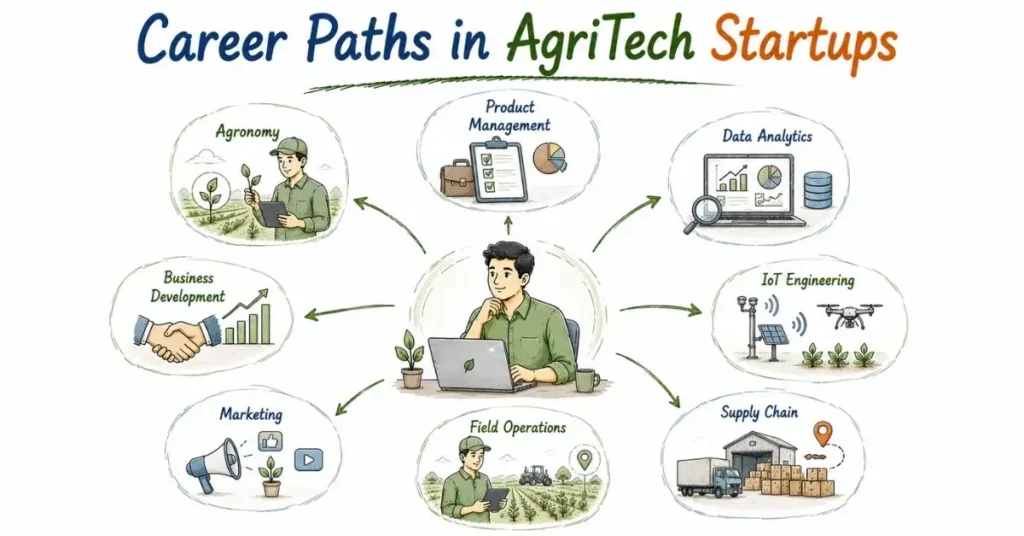
Career tracks available: Agronomy and extension, supply chain and procurement, technology (product, engineering, data), and business development with FPOs and government bodies.
Growth reality: DeHaat promotes fast internally field officers who demonstrate strong farmer relationships and operational reliability move into district and regional management within 2–3 years. The trajectory is real but requires genuine field commitment first.
Ninjacart: For People Who Want Operations at Speed
Ninjacart runs a 24-hour supply chain. Fresh produce moves from farms at dawn, through sorting and grading through the day, to retailer shelves before the next morning’s opening. Everything is time-sensitive and everything is measurable.
Who thrives here: Analytically strong, operationally oriented people who make good decisions under pressure with incomplete information. If you enjoy watching a complex system run well and fixing it when it does not Ninjacart is satisfying work.
Career tracks available: Supply chain operations, procurement, data analytics, technology (logistics platform), and enterprise sales to retail and quick-commerce clients.
Growth reality: Ninjacart’s operations team runs on performance data. People who hit procurement quality targets and logistics efficiency benchmarks consistently move up quickly. The meritocracy is genuine.
AgroStar: For People Who Think Like Marketers
AgroStar is fundamentally a consumer company one whose consumer is a farmer. Their strength is building farmer trust through digital content, quality inputs, and responsive service. The team culture reflects this: product-forward, marketing-conscious, and attentive to user behaviour data.
Who thrives here: People who combine agricultural knowledge with consumer product thinking. If you understand why a farmer in Pune makes input purchase decisions differently from a farmer in Saurashtra and you want to build products that serve both AgroStar is worth targeting.
Career tracks available: Agronomy and content, product management, e-commerce category management, field sales, and data analytics.
Growth reality: AgroStar has a structured product and marketing team that provides more mentorship than most startups of its size. Good entry point for people who want startup pace with slightly more process than earlier-stage companies.
BharatAgri: For Agronomists Who Want to Go Digital
BharatAgri’s entire product is expert crop advisory, delivered through an app. Every recommendation their AI makes is ultimately grounded in agronomy. This means their agronomists are not support staff they are core product builders.
Who thrives here: B.Sc. Agriculture graduates who want to apply their domain knowledge in a technology context without needing to learn to code. If you know crops deeply and communicate clearly in Marathi or Hindi, BharatAgri will value you significantly.
Career tracks available: Field agronomy, content creation (vernacular crop advisory content), product, and data science.
Growth reality: Small, focused team. Growth is real but limited in absolute role count. The learning is excellent you will understand how agricultural domain knowledge translates into product features and AI training data in ways that no other career path teaches as directly.
Fasal : For IoT Engineers Who Want Agricultural Depth
Fasal deploys sensor networks on high-value crop farms grapes, pomegranate, strawberry and uses the data to automate irrigation and predict disease risk. It is a technically sophisticated company working on a genuinely hard problem in a resource-constrained environment.
Who thrives here: Embedded systems and IoT engineers who want to work on real-world deployments, not simulations. Field implementation engineers who want to grow into product or technical roles. Agronomists specialising in horticulture who want to integrate technology into their expertise.
Career tracks available: Embedded engineering, backend and cloud engineering, field implementation, and horticulture agronomy.
Growth reality: Small team means high visibility and fast learning, but also limited headcount for vertical growth. Lateral growth into more senior technical ownership is more common than title changes in the early years.
Waycool: For Supply Chain Professionals in South India
Waycool is building an end-to-end fresh produce supply chain focused on South India Tamil Nadu, Karnataka, Andhra Pradesh, and Telangana. They have moved beyond just supply chain into processed food products and private label branded produce.
Who thrives here: Supply chain professionals with South India regional knowledge, operations managers comfortable with fast-moving perishable goods, and business development people who can build institutional client relationships with restaurants and retail chains.
Career tracks available: Supply chain operations, procurement, logistics, product (supply chain tech platform), and branded foods business development.
Equity and Compensation Reality at Indian AgriTech Startups
This is a topic most career guides avoid. Here is the honest picture.
Cash salaries at AgriTech startups are generally competitive with mid-size IT companies at the junior level ₹4–₹8 LPA for entry technical and field roles, ₹10–₹20 LPA for mid-level tech and product roles. They are typically lower than top-tier product companies like Flipkart or Swiggy for equivalent technical roles.
ESOPs (Employee Stock Ownership Plans) are offered at most funded AgriTech startups. The honest reality: ESOP value at most Indian startups does not materialise into significant cash unless the company achieves a large exit IPO or acquisition. Do not join a startup primarily for ESOP value. Join for the learning, the mission, and the career acceleration. If an exit happens, the ESOPs are a bonus.
Performance bonuses are increasingly common at operations and sales roles particularly at Ninjacart, AgroStar, and DeHaat where individual performance is measurable.
How to Navigate Your AgriTech Startup Job Search
Build a Targeted List of 8–10 Companies
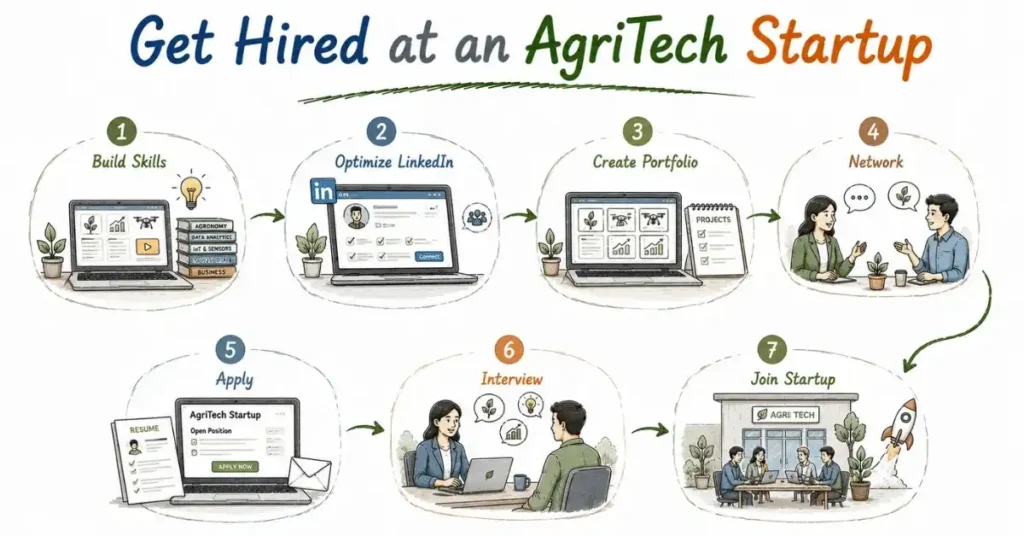
Do not apply to every AgriTech startup on LinkedIn simultaneously. Research each company’s stage seed, Series A, B, C their operating geography, and their primary business model. Apply to companies where your specific background maps to a genuine need. A well-researched application to Fasal will outperform 20 generic applications to every IoT company on the list.
Use LinkedIn as Your Primary Channel
AgriTech startup hiring is LinkedIn-heavy more so than most sectors. Recruiters at DeHaat, BharatAgri, and AgroStar actively search for candidates with agriculture-related keywords in their profiles. Make sure your LinkedIn headline, summary, and skills section explicitly mention your domain “precision farming,” “crop advisory,” “supply chain operations,” “embedded IoT” not just your degree.
Reach Out to People, Not Just Job Postings
Many AgriTech startup roles especially at Series A and B companies are filled before they reach public job boards. A direct LinkedIn message to a hiring manager or team lead, referencing specific work their company does and explaining concisely what you bring, is a legitimate and effective job search approach in this sector. Keep it under 100 words. Make it specific. Do not send a copy-paste message.
Treat Your First Startup Role as a Two-Year Investment
The first year at an AgriTech startup is often disorienting less structure than expected, more responsibility than comfortable, and slower progress than hoped. The second year is where it pays off you understand the business deeply, your contribution is visible, and your market value as someone with real AgriTech startup experience has increased significantly. Give it two genuine years before evaluating a move.
One Final Thought on AgriTech Startup Careers
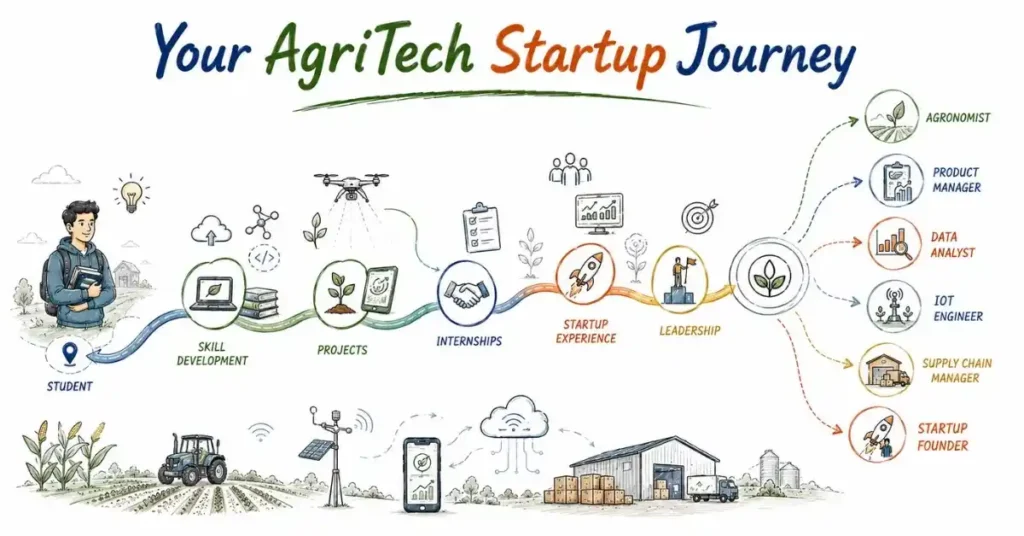
India’s agricultural sector is going through a transformation that will take two decades to complete. The startups building that transformation today are early in the journey. Some will fail. Several will succeed at significant scale. A few will become the agricultural infrastructure companies of the next generation the equivalent of what HDFC Bank became for housing finance or what Flipkart became for retail.
The people building those companies right now the field officers, the engineers, the agronomists, the product managers are not just building careers. They are building the systems that feed 1.4 billion people more efficiently, more sustainably, and more equitably.
That is worth something beyond a salary number.