
Wireless Technology Jobs in India : IoT, Satellite & 5G
Table of Contents
Wireless Technology Jobs Beyond 5G : IoT, Satellite & Private Networks
Most people looking at telecom careers have their eyes fixed on one thing: 5G.
That makes sense. 5G is the biggest infrastructure investment happening in India right now, and it dominates job postings, news coverage, and career advice. But if you only look at public 5G deployments by Jio and Airtel, you are looking at one part of a much larger picture.
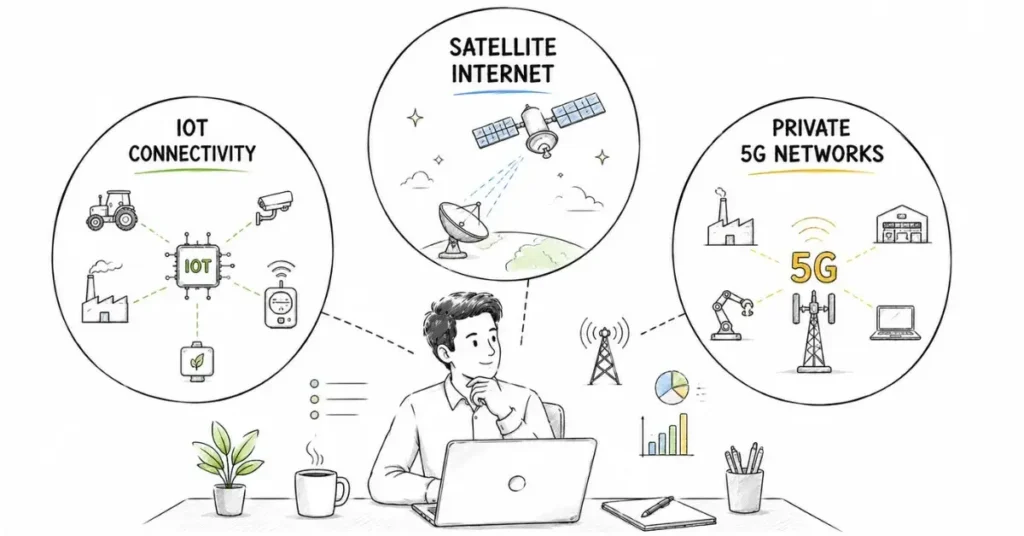
The wireless technology industry in India is expanding in three directions simultaneously IoT networks, satellite internet, and private 5G. Each of these creates its own job market, with its own required skills and its own hiring companies. Understanding them now puts you ahead of the majority of students and professionals who will only discover these markets two or three years from now, when they are already competitive.
Direction 1: IoT - The Internet of Things
What IoT Actually Means
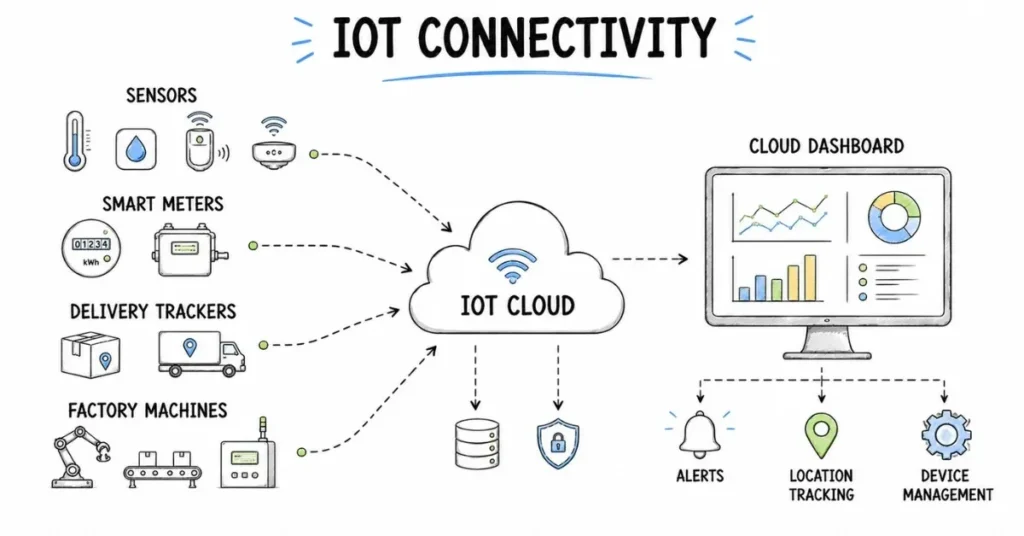
IoT stands for Internet of Things. The “things” are physical devices — temperature sensors in a factory, GPS trackers on delivery trucks, water meters in a city, medical devices in a hospital — that connect to the internet and send data.
You use IoT every day without thinking about it. The app that shows you real-time traffic uses IoT sensors in roads. The smart electricity meter in your building sends usage data automatically. The Swiggy delivery partner’s phone tracking is IoT at the consumer level.
At the industrial level — called IIoT (Industrial IoT) — the scale is enormous. A single modern automobile manufacturing plant can have 50,000+ sensors monitoring temperature, pressure, vibration, and production output in real time.
Why IoT Is a Separate Career Space From 5G
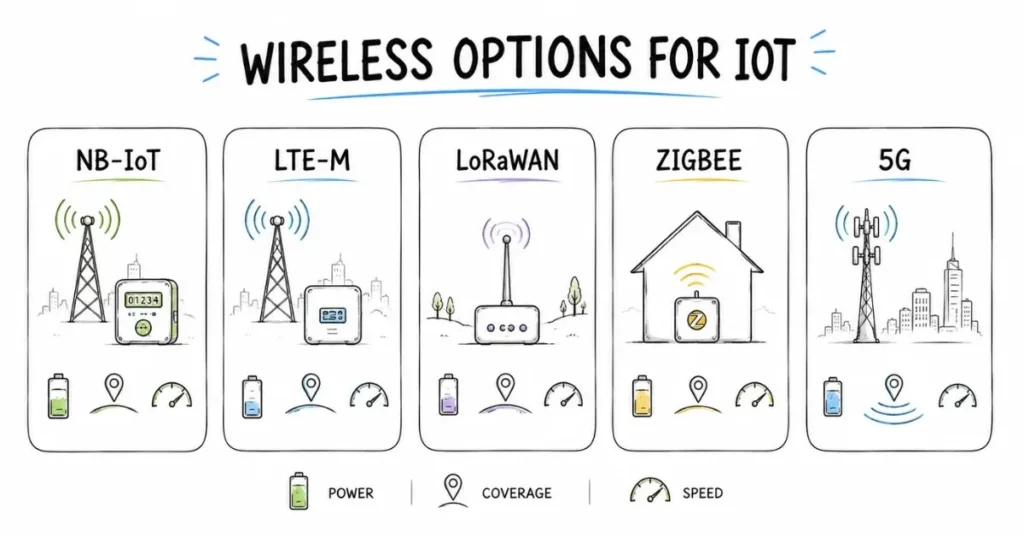
IoT does not always use 5G. It uses a range of wireless technologies depending on the use case:
- NB-IoT (Narrowband IoT) and LTE-M — low-power cellular technologies designed for devices that send small amounts of data infrequently (smart meters, asset trackers). Both run on existing 4G infrastructure and are already deployed by Airtel and Jio.
- LoRaWAN — a long-range, low-power wireless protocol used in smart city and agricultural IoT. Does not use cellular networks at all.
- Zigbee and Z-Wave — short-range protocols used in smart home and building automation.
- 5G (specifically, the mMTC — massive Machine-Type Communications slice) — for dense, high-volume IoT deployments where thousands of devices need to connect in a small area.
Understanding these different protocols is what separates an IoT specialist from someone who just knows 5G.
IoT Job Roles in India
IoT Solutions Architect
Designs the end-to-end IoT system — choosing the right connectivity technology for the use case, designing the data pipeline from device to cloud, and ensuring the system is secure and scalable. This is a senior role requiring both wireless networking and cloud knowledge. Salaries range from ₹15–35 lakh at mid-to-senior level.
IoT Connectivity Engineer
Focuses specifically on the wireless communication layer — configuring NB-IoT or LTE-M modules, testing connectivity in field conditions, and troubleshooting devices that fail to connect. This is accessible to engineers with a telecom or electronics background.
IoT Platform Engineer
Works on the software platforms (AWS IoT Core, Azure IoT Hub, Google Cloud IoT) that receive, process, and store data from thousands of devices. This role requires cloud skills alongside IoT knowledge.
IoT Field Engineer / Deployment Specialist
Installs and commissions IoT infrastructure — gateways, sensors, edge computing devices — at customer sites. Similar in some ways to 5G deployment work but focused on enterprise and industrial environments.
IoT Data Analyst
IoT generates enormous volumes of data. Analysts who can process, clean, and derive actionable insights from IoT sensor data are needed at every company running a serious IoT deployment.
Companies Hiring for IoT in India
- Tata Communications — has an active IoT practice connecting industrial clients globally
- Airtel — offers IoT connectivity services to enterprise customers; has an internal IoT team
- Jio — building IoT connectivity on its network; also developing smart city solutions
- Bosch India — one of the largest IIoT employers in India; Bengaluru is a major hub
- Honeywell India — industrial IoT and building automation
- L&T Technology Services — engineering services company with a strong IoT practice
- Sterlite Technologies (STL) — building connected infrastructure including IoT backhaul
Direction 2: Satellite Internet — The LEO Revolution
What Changed in Satellite Communication
Satellite internet is not new. VSAT (Very Small Aperture Terminal) technology has been connecting remote businesses and government sites in India for decades. But the economics were always harsh — high latency, high cost, low speeds.
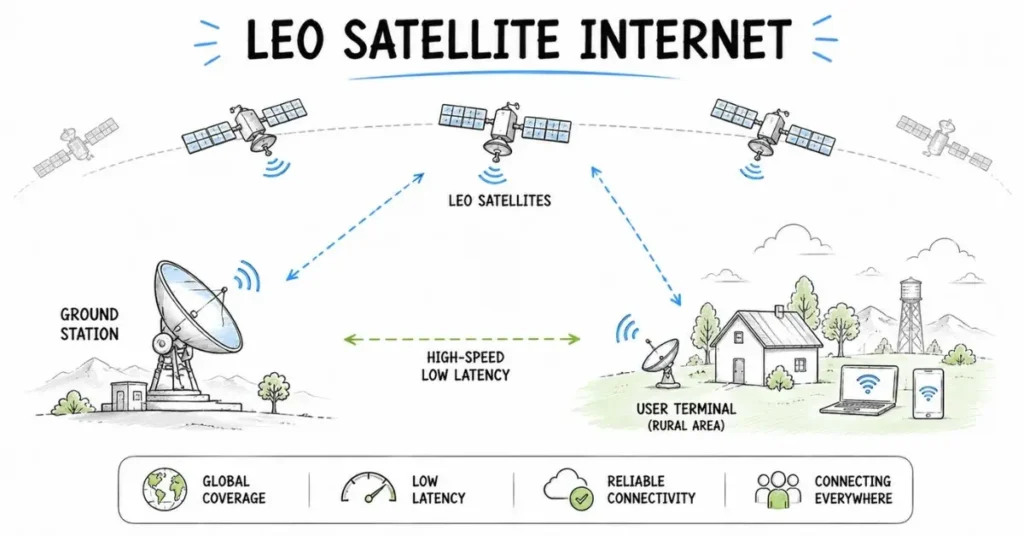
What changed is Low Earth Orbit (LEO) satellites. Traditional satellites orbit at 35,786 km above Earth (geostationary orbit). LEO satellites orbit at 500–2,000 km — close enough to deliver latency of 20–40 milliseconds, which is comparable to a decent fixed broadband connection.
Companies like SpaceX (Starlink), Amazon (Project Kuiper), and OneWeb (now Eutelsat OneWeb, in which the Indian government through Bharti Enterprises holds a stake) are deploying LEO satellite constellations. Starlink was approved for commercial operations in India in 2024. Amazon Kuiper’s India services are expected within the next two years.
This creates an entirely new connectivity layer — one that can reach places where fiber will never go and where 5G towers are not economically viable.
What This Means for Careers
Satellite internet in India is still in an early phase, but it is moving fast. The job categories emerging from it are:
Satellite Network Engineer
Manages the ground infrastructure — gateway stations, antenna systems, network operations — for satellite internet services. Requires knowledge of both RF (satellite signals use specific frequency bands like Ka-band and Ku-band) and IP networking. Currently, most hiring is with companies operating VSAT or LEO ground infrastructure.
Satellite RF Engineer
Satellite communication has its own RF characteristics — link budget calculations, rain fade analysis (satellite signals are affected by heavy rain), polarization, and antenna pointing. This is a specialized discipline within RF engineering.
Ground Station Operations Engineer
LEO constellations need large numbers of ground stations to manage handoffs as satellites pass overhead. Operations engineers monitor ground station performance, manage capacity, and troubleshoot connectivity issues.
Rural Connectivity Project Manager
Given India’s specific need to connect rural areas — BharatNet’s mission — there is growing demand for project managers who understand satellite technology and can manage government or private rural connectivity projects.
Companies to Watch in India's Satellite Space
- OneWeb India (Eutelsat OneWeb) — Bharti Enterprises-backed; already hiring for India operations
- Hughes Communications India — long-established VSAT provider; expanding into LEO
- ISRO (Indian Space Research Organisation) — for those interested in the government/research side of satellite communication; hires engineers through ISRO Centralised Recruitment Board
- Tata Advanced Systems — defence and space communication systems
- Nelco (Tata Group) — VSAT services; recently received approval for satellite broadband
Direction 3: Private 5G Networks
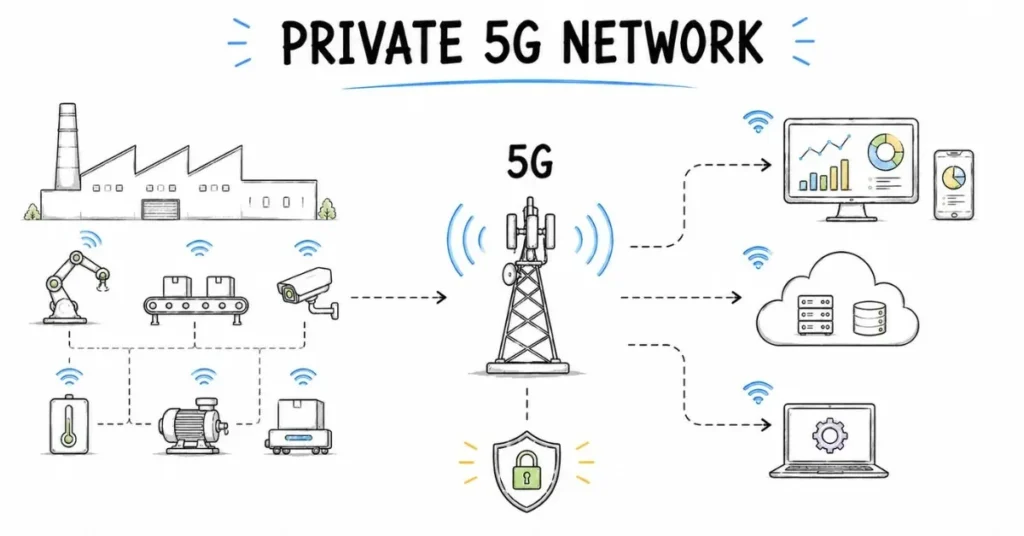
What a Private 5G Network Is
When Jio or Airtel deploys 5G, they build a shared public network that millions of subscribers use. A private 5G network is different — it is a dedicated 5G network built for one organization, inside their facility.
Think of a car manufacturing plant in Pune. They need reliable, low-latency wireless connectivity for 200 autonomous guided vehicles, 10,000 sensors on the production line, 500 AR-assisted maintenance workers, and a real-time quality inspection system. They cannot rely on a public network — the traffic from their facility alone would overwhelm it, and they cannot afford the security risks of shared infrastructure.
So they build their own private 5G network. Dedicated spectrum, dedicated equipment, dedicated management — all inside the factory.
This is happening right now across Indian industries: manufacturing, ports, airports, mining, logistics, and healthcare are the leading adopters.
The Private 5G Job Market
Private 5G is growing so fast that many companies struggle to find qualified engineers. The reason: private 5G requires skills that sit across wireless networking, enterprise IT, and industry-specific domain knowledge. That combination is rare.
Private 5G Solutions Engineer
Designs private 5G systems for enterprise clients — choosing the right spectrum (licensed, unlicensed, or shared), designing the network layout, specifying equipment, and creating the integration plan with existing enterprise IT systems. Requires understanding of both 5G and enterprise networking (LAN, firewall, cloud integration).
Private 5G Deployment Engineer
Similar to public 5G deployment but inside enterprise facilities. The challenge is different — indoor RF planning is complex, and the network must integrate with industrial systems (PLCs, SCADA, ERP) that require specialized knowledge.
Industrial IoT + Private 5G Specialist
The most valuable emerging profile: someone who understands private 5G connectivity and can also design the IoT application layer on top of it. Salaries for this combined profile start higher than either IoT or 5G separately.
Private 5G Network Operations Engineer
Manages the ongoing operations of deployed private 5G networks. Unlike public networks, private 5G clients often need a dedicated person or small team managing their specific deployment.
Companies Building Private 5G in India
- Tata Communications — enterprise private 5G offerings; hiring for delivery and pre-sales
- Sterlite Technologies (STL) — building private 5G infrastructure; strong hiring pipeline
- Tech Mahindra — has a private 5G practice for manufacturing and logistics clients
- Ericsson India — global leader in private 5G; India delivery centre involved in private network projects
- Nokia India — strong private wireless portfolio; hiring for enterprise solutions roles
- C-DOT — India’s government telecom R&D body working on indigenous private 5G solutions
- Tejas Networks (Tata Group) — building India-made 5G and private network equipment
How These Three Areas Connect to 5G
It helps to see these not as separate from 5G but as built on top of it.
5G is the foundation that makes all three of these areas work better:
- IoT at scale needs 5G’s ability to connect a million devices per square kilometer
- Private networks use 5G radio and core technology
- Satellite internet is increasingly being integrated with 5G — the 3GPP standards already define how 5G and satellite networks can work together (called Non-Terrestrial Networks, or NTN)
An engineer who understands 5G and also builds knowledge in any one of these three areas — IoT, satellite, or private networks — creates a career profile that is genuinely hard to replace. You are not competing with every 5G engineer on Naukri. You are the person they search for specifically.
Skills to Build for These Emerging Areas
Area | Core Technical Skills | Tools to Learn | Good Starting Certification |
IoT | NB-IoT, LTE-M, LoRaWAN, MQTT protocol | AWS IoT Core, Node-RED | AWS IoT or Azure IoT certification |
Satellite | RF link budgets, Ka/Ku-band, VSAT basics | iDirect NMS, SkyEdge | Hughes or iDirect technical training |
Private 5G | 5G NR, enterprise networking, CBRS spectrum | Nokia Digital Automation Cloud, Ericsson Private 5G | Nokia 5G Professional, CCNP Enterprise |
Where to Start If These Areas Interest You
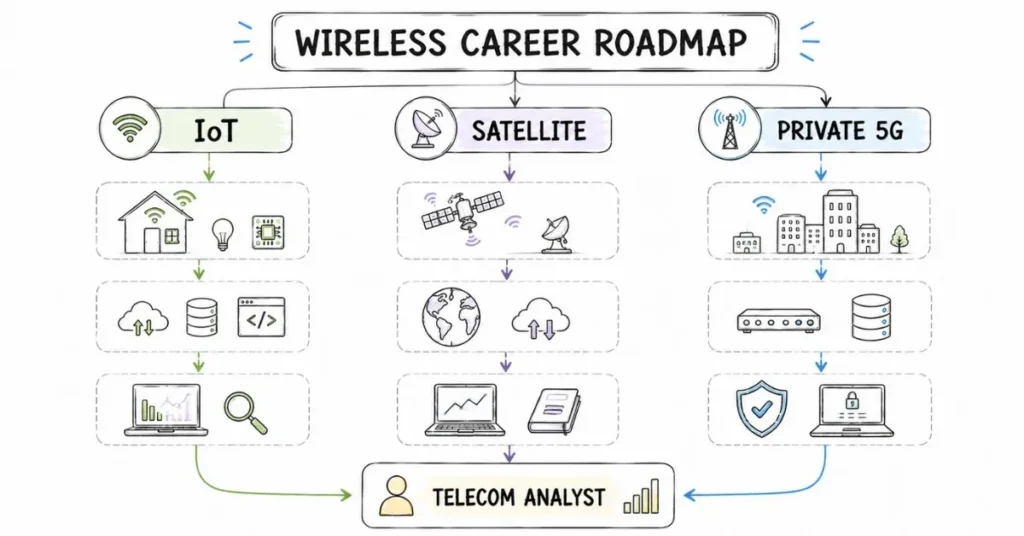
These markets are early enough that you do not need years of experience to enter — but you do need to show initiative.
For IoT: Build a small IoT project at home. A Raspberry Pi connected to a temperature sensor, sending data to AWS IoT Core, with a simple dashboard displaying readings. This costs under ₹3,000 in hardware and uses free cloud tiers. It gives you a genuine project to discuss in interviews — something most candidates applying for IoT roles do not have.
For satellite: Start with VSAT fundamentals. Hughes and iDirect both have publicly available technical documentation. Understanding how a VSAT link works — uplink, downlink, rain fade, link budget — puts you ahead of 90% of candidates who have never looked at this area.
For private 5G: Combine your 5G knowledge (from Post 2 in this series) with enterprise networking basics. CCNA + Nokia’s Digital Automation Cloud training gives you a strong starting foundation. Then target IT services companies with private 5G practices as your entry point.
The wireless technology industry is not standing still. The engineers who build skills beyond the obvious 5G deployment path now will find themselves in the most interesting — and most valuable — roles by the end of this decade.