
Network Engineer Career Path
in India : Complete Guide
Table of Contents
Network Engineer Career Path in India: From Entry Level to Senior Roles

Network engineering is one of the most stable, well-paying, and consistently in-demand careers in India’s technology sector. It is also one of the most misunderstood.
Most students either think it is too niche, too hardware-focused, or only relevant if you work at Jio or Airtel. None of that is true. Network engineers work at banks, hospitals, IT companies, cloud providers, government agencies, and telecom companies. Every organisation that moves data — which is every organisation — needs someone who understands how that data travels.
This post maps the full career path: where you start, how you grow, what you earn at each stage, and how long it realistically takes to get there.
What a Network Engineer Actually Does — Day to Day
Before the career path, understand the job itself.
A network engineer designs, builds, configures, and maintains the infrastructure that carries data — routers, switches, firewalls, and the protocols that connect them. In telecom specifically, that infrastructure connects millions of users and devices across cities and countries.
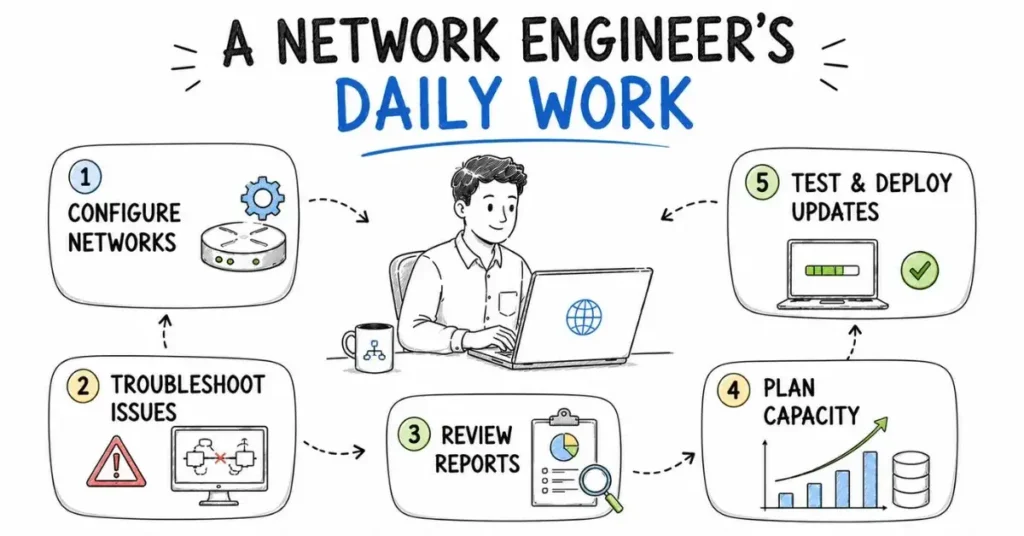
On a typical day, a network engineer might:
- Configure a new router or switch for a site that is being upgraded
- Troubleshoot a connectivity issue reported by a business customer
- Review network performance reports and identify a congested link
- Plan capacity expansion for a section of the network that is approaching its limits
- Test a new software version on network equipment before pushing it live
The work is methodical. You follow logical steps to isolate problems. You document everything. You work with other teams — operations, security, vendors — regularly. It is collaborative, not solitary.
In a telecom company, the scale is larger. You are not managing the network for one office building. You are managing infrastructure that serves thousands of towers or millions of subscribers. The stakes are higher, the tools are more specialized, and the salary reflects that.
The Network Engineer Career Ladder — Step by Step

Step 1: NOC Analyst / Junior Network Engineer (0–2 Years)
This is where most people start. Do not skip this stage trying to get a “better” title — it is where you learn the most, fastest.
What you do: Monitor live networks using dashboards and alarm management tools. When something breaks — a link goes down, a device loses connectivity, a performance metric drops — you are the first to know. You raise tickets, escalate to the right team, and track the resolution.
What you learn: How real networks behave under real conditions. The difference between a network diagram in a textbook and a network that serves millions of people is enormous. NOC work gives you that ground-level understanding no certification can replicate.
Where you find these roles: IT services companies like TCS, Tech Mahindra, Infosys, and Wipro hire NOC analysts in large numbers. Telecom operators (Jio, Airtel) have their own NOC teams. Third-party network management companies also hire for this role.
Typical salary: ₹2.5 lakh to ₹4.5 lakh per year. Contract-based NOC roles in telecom pay an average of ₹16,484 per month, with the sector’s average contractual wage having grown significantly in recent years.
What to have before applying:
- CCNA (strongly preferred) or CompTIA Network+ (minimum)
- Basic understanding of the OSI model, IP addressing, VLANs, and routing protocols
- Familiarity with ticketing systems (ServiceNow is common)
Step 2: Network Engineer / L2 Support Engineer (2–4 Years)
After 2 years in NOC, you know how networks behave. Now you start building and fixing them, not just watching them.
What you do: You handle escalated issues that NOC cannot resolve. You configure devices, implement changes, review network designs, and participate in new site deployments. You start owning specific technologies — maybe routing protocols, maybe firewall management, maybe WAN links.
The shift that happens here: You move from reactive (responding to alarms) to proactive (identifying problems before they become alarms). This is a meaningful professional shift, and employers value it.
Where you find these roles: Network teams at IT companies, managed service providers (MSPs), enterprise IT departments, and telecom vendors.
Typical salary: ₹5 lakh to ₹10 lakh per year. Network engineers with 2–5 years of experience in India average ₹8–12 lakh when working at established companies like Ericsson or Nokia’s managed services arm.
Certifications that help at this stage:
- CCNP Enterprise or CCNP Service Provider (the Service Provider track is specifically relevant for telecom)
- Nokia NRS I (if you are working with Nokia IP routing equipment — common at Airtel and Vi)
- Juniper JNCIS-SP (if your company uses Juniper — relevant at many ISPs and carriers)
Step 3: Senior Network Engineer / Network Specialist (4–7 Years)
This is where specialization pays off — literally.
What you do: You own complex network problems. You design solutions, not just implement them. You review junior engineers’ work, participate in vendor discussions, and contribute to network architecture decisions. At this level, your knowledge of a specific technology — MPLS routing, BGP peering, 5G transport, network security — becomes your market value.
The most important decision at this stage: Choose your specialization. The engineers who remain generalists at the 5-year mark grow slower in salary and career visibility than those who go deep on one technology. The high-demand specializations in Indian telecom right now are:
- IP/MPLS and Segment Routing — The backbone technology of large telecom networks; Nokia NRS II or Cisco CCNP SP is the recognized certification path
- 5G Transport and Backhaul — Moving data from 5G towers to the core; involves microwave, fiber, and IP transport
- Network Automation — Writing Python scripts and using tools like Ansible to automate repetitive network tasks; this specialization is attracting engineers from both networking and software backgrounds
- Network Security — Firewalls, intrusion detection, DDoS mitigation; relevant across every industry, not just telecom
Typical salary: ₹10 lakh to ₹20 lakh per year. Verified salary data shows experienced network engineers in India averaging ₹19.1 lakh, with specialists earning above ₹22 lakh at top companies.
Step 4: Lead Network Engineer / Network Architect (7–12 Years)
At this level, you stop being primarily a hands-on engineer and start being the person others come to when they do not know the answer.
What you do: You design large-scale network architectures. You evaluate new technologies and make recommendations on whether the company should adopt them. You lead technical teams, manage vendor relationships, and represent the network function in cross-functional planning. Some people at this level move toward pre-sales — working with the sales team to design technical solutions for enterprise customers.
The two paths that split here:
- Deep Technical Path (Principal Engineer / Distinguished Architect): You stay technical, going deeper into architecture and design. These roles exist at Ericsson, Nokia, Cisco, and large operators. They are fewer in number but can pay ₹30–50 lakh.
- Management Path (Network Manager / Director of Network Engineering): You move toward managing people and budgets. Your technical knowledge is the foundation, but your day-to-day work is about decisions, planning, and leadership.
Typical salary: ₹18 lakh to ₹35 lakh per year for lead/architect roles at established companies. Nokia NRS II, CCIE (Cisco Certified Internetwork Expert), or equivalent specialist certifications are common at this level.
Step 5: Principal Architect / CTO Track (12+ Years)
This is the senior end of the career. Roles at this level — VP of Network Engineering, Head of Network Architecture, CTO at a mid-size telecom company — are rare, well-compensated, and require a combination of deep technical expertise and strong business leadership.
Salary at this level in India ranges from ₹40 lakh to well above ₹1 crore for senior positions at large operators or global vendors. The international market — Middle East, Europe, Southeast Asia — pays even more for Indian telecom professionals with this depth of experience.
What the Timeline Looks Like — Realistically
Here is an honest timeline for someone starting from scratch with an engineering degree:
Stage | Years of Experience | Typical Salary (India) | Key Milestone |
NOC Analyst | 0–2 | ₹2.5L–₹4.5L | First real job; learn how networks behave |
Network Engineer L2 | 2–4 | ₹5L–₹10L | First independent configuration work |
Senior Engineer | 4–7 | ₹10L–₹20L | Pick a specialization |
Lead / Architect | 7–12 | ₹18L–₹35L | Design decisions, team leadership |
Principal / Director | 12+ | ₹40L–₹1Cr+ | Business + technical leadership |
These are not guarantees. Engineers who get certifications, build hands-on projects, and take on stretch assignments move faster. Engineers who stay passive in one company doing the same work for years move slower.
Skills That Separate Good Network Engineers From Great Ones
Technical skills get you the job. These skills determine how fast you grow after that.
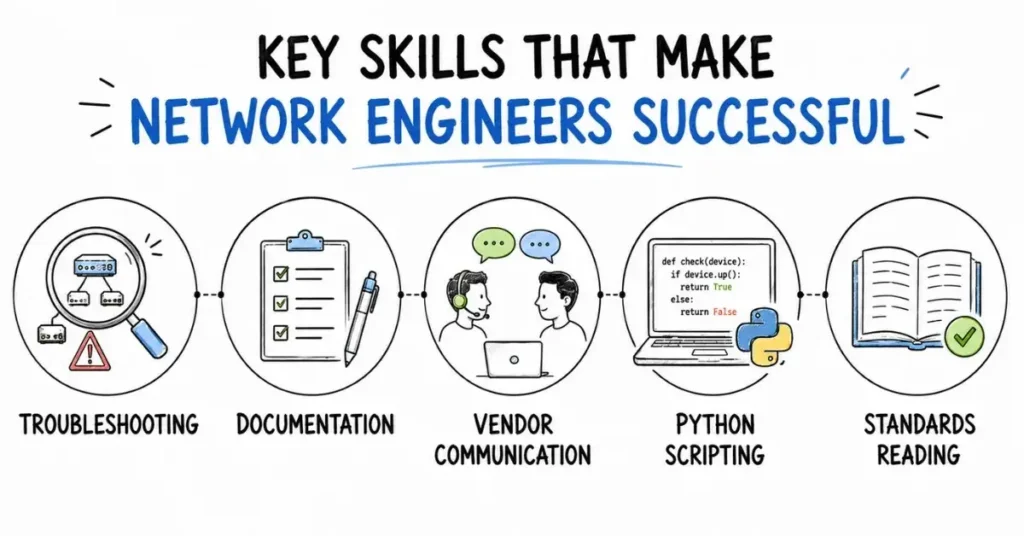
Troubleshooting methodology. The best network engineers have a systematic approach to problems — they isolate variables, test hypotheses, document what they tried, and know when to escalate. This is a thinking skill, not just a technical one.
Documentation habits. Network changes that are not documented become disasters six months later when someone else touches the same equipment. Engineers who document well are trusted with more responsibility.
Vendor communication. When you have a critical outage and need Cisco or Nokia TAC (Technical Assistance Centre) to help, your ability to describe the problem precisely — logs, timestamps, topology diagrams — determines how fast you get a resolution.
Python scripting. This does not mean becoming a software developer. It means being able to write a script that pulls performance data from 100 routers, or automatically generates a report, or pushes a config change to multiple devices. This skill is listed in a growing share of network engineer job descriptions in India, and engineers who have it command noticeably higher offers.
Reading 3GPP and IETF standards. At the senior level, the ability to go directly to the standards documents — and understand what they actually say, not just what a vendor’s marketing brochure says — is a real differentiator.
Remote Work Reality for Network Engineers in India
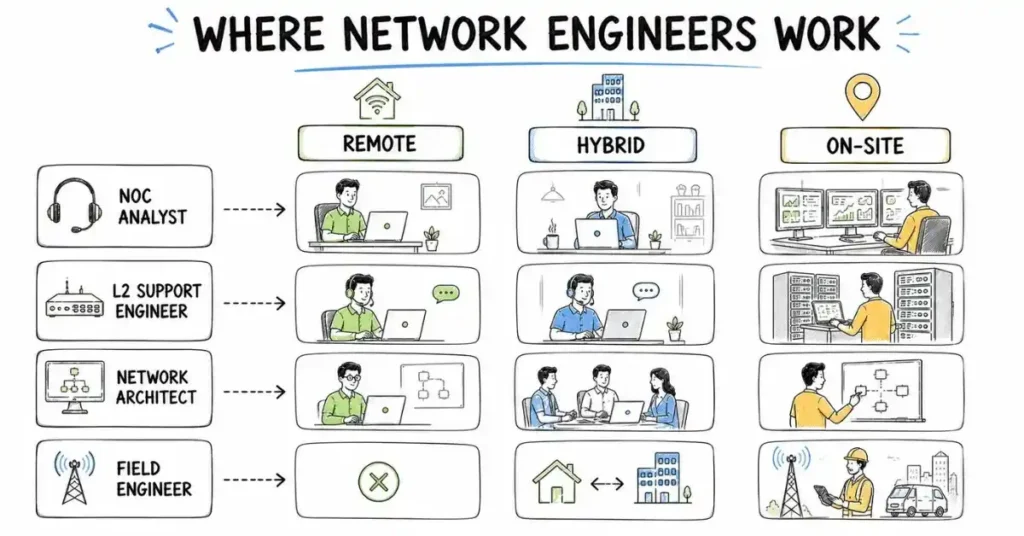
This comes up a lot. The honest picture: network engineering is less remote-friendly than software development, but more remote-friendly than field roles.
- NOC roles are often shift-based and on-site, or in a company NOC centre. Remote NOC work exists but is less common.
- L2/L3 support and configuration work can often be done remotely — you SSH into devices from anywhere. Many companies post these as hybrid roles.
- Architecture and design roles are mostly office or hybrid — they require regular meetings with internal teams and vendors.
- Field deployment roles are always on-site by definition.
If remote flexibility is important to you, target IT services companies (TCS, Wipro, Tech Mahindra) over operators — they tend to have more flexible work policies for network support roles.
How Long Does CCNA Take, and Is It Worth It?
CCNA is the standard entry-level certification for network engineers worldwide, and it is specifically worth it for India because Cisco equipment is widely deployed here.
Time to complete: 3–5 months of self-study if you put in 1–1.5 hours daily. Some focused students finish in 8 weeks. Full-time courses (classroom or online) typically run 2–3 months.
Cost: The CCNA exam costs approximately ₹27,000–₹30,000 as of 2025 (USD prices converted at current rates). Prep material ranges from free (Cisco NetAcad) to paid courses on Udemy (₹500–₹2,000 when discounted).
ROI: A fresher without CCNA applying for NOC roles starts at ₹2–3 lakh. A fresher with CCNA applying for the same roles often starts at ₹3–5 lakh and is taken more seriously in shortlisting. At the L2 level, CCNA holders consistently get called faster than non-certified candidates on Naukri and LinkedIn.
The certification is worth it. Do not overthink it — start.
The International Angle

India produces excellent network engineers — but many of them do not realize how much demand exists internationally.
The Middle East (Saudi Arabia, UAE, Qatar) is aggressively deploying 5G and smart city infrastructure. Network engineers with 4+ years of experience and a CCNP or Nokia certification regularly receive offers in the range of AED 12,000–20,000 per month — roughly ₹28–46 lakh equivalent per year, tax-free.
Southeast Asia (Malaysia, Singapore, Indonesia) and the UK also hire Indian telecom engineers, particularly for 5G deployment and managed services roles.
If an international career is part of your long-term plan, start building a LinkedIn profile that is visible to recruiters outside India — use English job titles, mention international standard certifications, and connect with recruiters at global companies like Ericsson and Nokia who have multi-country practices.
One Practical Step Before You Apply
Before sending out your first application, build a network lab. Not a physical one — a virtual one.
Download Cisco Packet Tracer (free from Cisco’s NetAcad). Spend two weekends building a network with multiple routers, configure OSPF and BGP routing protocols, simulate a link failure and watch traffic reroute, and take a screenshot of your topology. Then put that project — the topology diagram and what you configured — on your LinkedIn profile and resume.
That one project, done properly and explained clearly, gets you more shortlists than a degree certificate from most colleges.
Network engineering rewards people who actually build things, not just people who study about building things. Start building.