
Telecommunications Career in India : Roles, Scope & Jobs
Table of Contents
What Is a Career in Telecommunications? Roles, Scope & Outlook for Indians
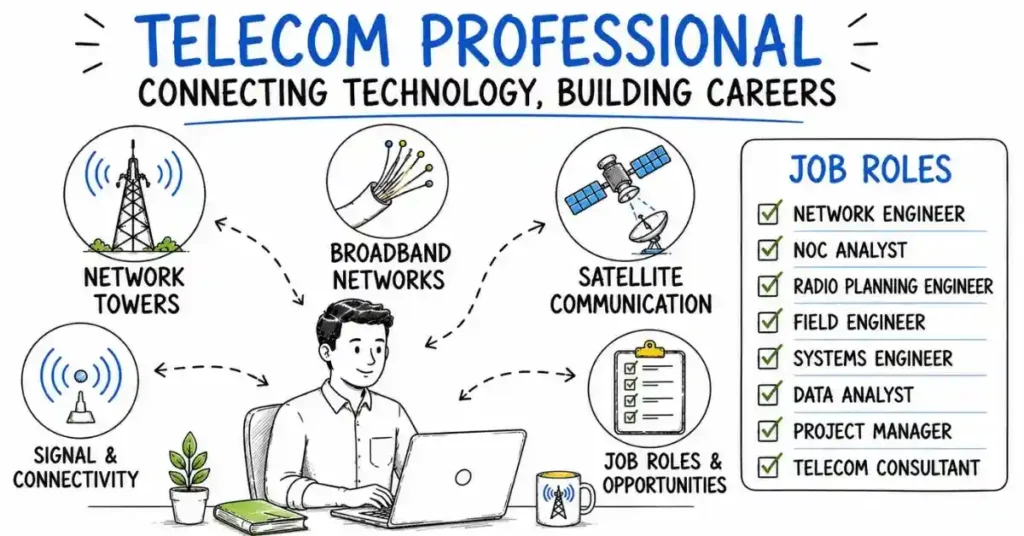
Let us start with a question most career guides skip: what exactly is telecom, and why should a student in India care about it right now?
Telecom is not just mobile networks and Jio SIM cards. It is the entire system that moves voice, data, and signals from one place to another across cities, across oceans, and increasingly, through the air using 5G towers. Every time you make a video call, open Instagram, or use Google Maps, a telecom network is working behind the scenes. Someone built that. Someone maintains it. Someone is getting paid to make sure it keeps working.
That someone could be you.
The Size of the Opportunity
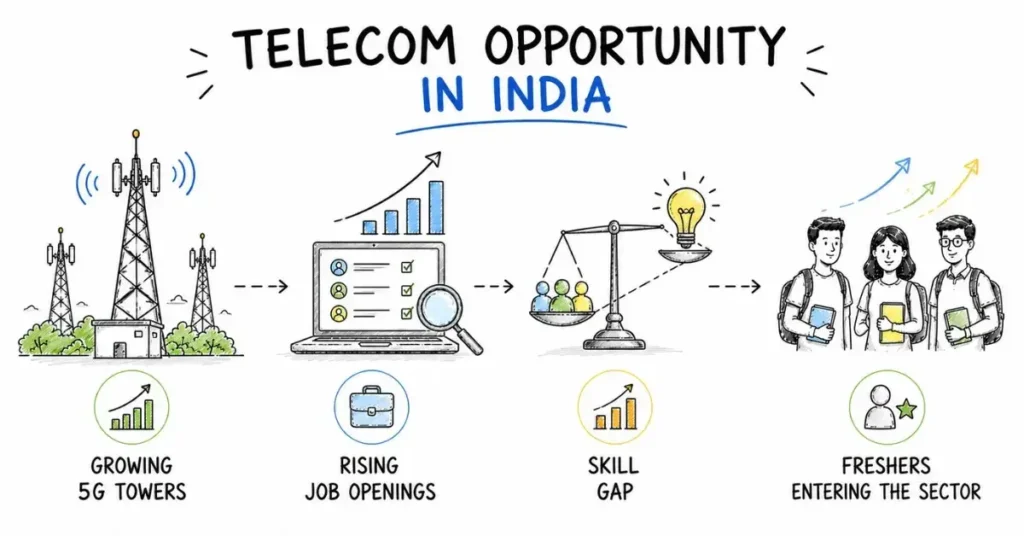
India’s telecom sector does not have a small job market. It has one of the largest skill requirements of any industry in the country right now.
The Telecom Sector Skill Council (TSSC) estimated that India needs 22 million skilled workers in 5G-focused industries. That number includes everyone from engineers building networks to analysts managing data to technicians maintaining towers. To put it simply, there are far more jobs being created than there are qualified people to fill them.
The sector’s technology workforce alone — people in engineering, cloud, AI, and security roles within telecom — is around 1.8 million professionals as of 2024 and is expected to grow to 2.4 million by 2030, at a CAGR of 4.8%. Telecom-specific technology roles grew 45–60% annually between 2020 and 2023.
The India Employer Forum puts it plainly: India’s 5G deployment alone is expected to create 2.3–2.8 million direct and indirect jobs by 2025.
If you are a student looking for a sector where demand is real, not just hype — this is one of them.
What "Telecom" Actually Means as an Industry
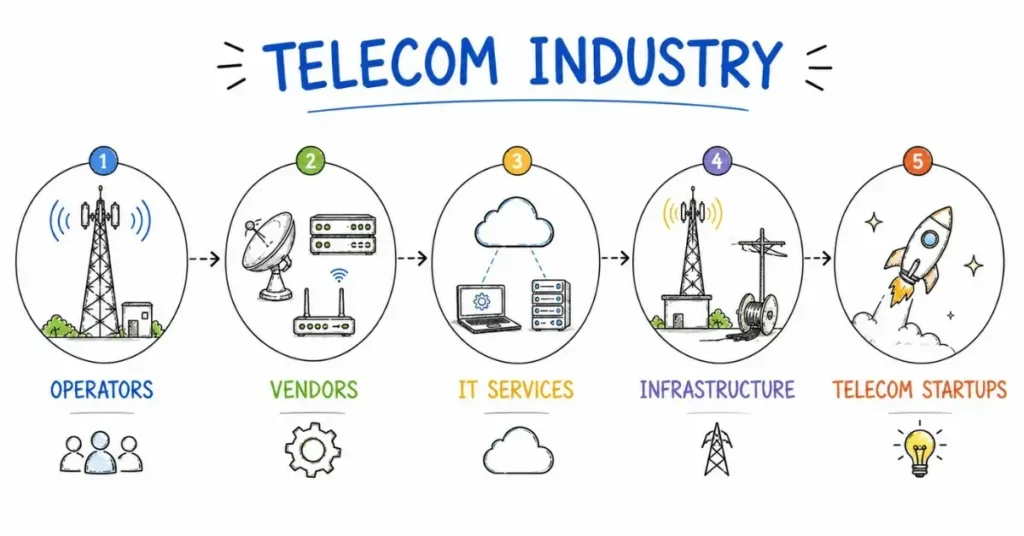
When you say “I want to work in telecom,” you are talking about a sector that has several layers. It helps to understand these layers because different kinds of people find their fit in different parts of the industry.
Layer 1 — The Operators (The ones who run the networks)
These are the companies whose name is on your mobile bill. In India: Reliance Jio, Bharti Airtel, Vodafone Idea, and BSNL. They build and operate the mobile and broadband networks that consumers and businesses use every day. They are the biggest employers for roles that involve managing live networks, customer data, and network performance.
Layer 2 — The Vendors (The ones who build the equipment)
Companies like Ericsson, Nokia, Huawei, and Samsung Networks do not sell you a SIM card. They sell the base stations, routers, switches, and software that make the network work. When Jio installs a 5G tower, the equipment inside often comes from Ericsson or Nokia. These vendors hire engineers, project managers, and technical sales professionals.
Layer 3 — The IT Services Companies (The ones who manage the software)
Companies like TCS, Tech Mahindra, Infosys, and Wipro have entire practices dedicated to telecom. They manage the billing systems, customer portals, network operations software, and testing frameworks for telecom clients worldwide. A huge number of Indians work in telecom domain roles through these companies — often without realizing it counts as a “telecom career.”
Layer 4 — The Infrastructure Companies
Tower companies like Indus Towers and ATC India own the physical towers that operators rent space on. They hire field engineers, operations staff, and project coordinators.
Layer 5 — The Emerging Space
IoT companies, satellite internet providers, private 5G network builders, and telecom startups make up the newer edge of the industry. This is where some of the most interesting and higher-paying roles are forming right now.
The Main Job Roles — Explained in Plain Language
Here is a ground-level look at what the main roles actually do every day. No jargon, no inflated descriptions — just what the job is.
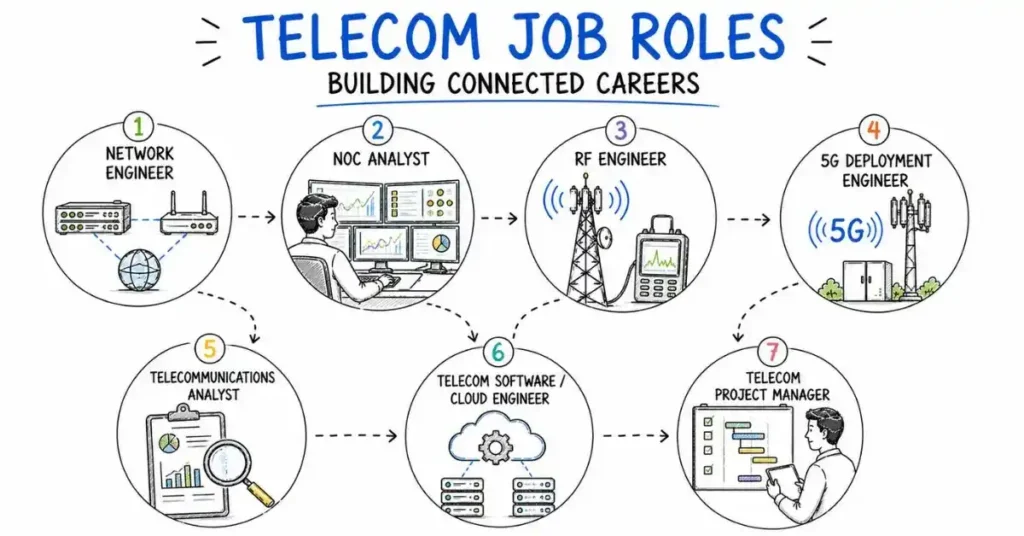
Network Engineer
You design and manage the networks that carry internet and phone traffic. You work with routers, switches, and protocols (the “rules” that data follows when moving between devices). You troubleshoot problems when something slows down or breaks. It is logical, detail-oriented work — more like solving puzzles than writing code.
Most network engineers in India work for operators, IT services companies, or vendors. The entry-level path is usually through networking certifications like CCNA, which gives you the foundation.
NOC (Network Operations Centre) Analyst
NOC analysts monitor live networks around the clock. Think of it as being an air traffic controller — except for data. You watch dashboards, respond to alarms, and coordinate with field engineers when something goes wrong.
This is the most accessible entry point for freshers. You do not need to know everything on day one. You learn on the job, fast. Over 60% of contractual workers in Indian telecom have less than two years of experience, which tells you how open this entry point is.
RF (Radio Frequency) Engineer
RF engineers work on the wireless signal side of 5G and 4G networks. They plan where to place towers, run drive tests (literally driving around with testing equipment to measure signal quality), and optimize the network so coverage gaps are closed. This role requires knowledge of signal physics and specialized planning tools, but it does not require coding skills. RF engineers are in high demand right now specifically because of 5G deployment.
5G Deployment Engineer
This role exists almost entirely because of India’s 5G rollout. 5G deployment engineers install and configure 5G base stations (called gNodeBs), run acceptance tests, and make sure the site is working correctly before it goes live. India’s 5G rollout hit 394,298 base stations across 738 districts by late 2023, and that number kept growing through 2025. Every one of those sites needed engineers to deploy it.
Telecommunications Analyst
Analysts sit between the technical and business sides of telecom. They work with data — network performance data, customer usage data, revenue data — and produce insights that help the company make decisions. If you are from a commerce, statistics, or IT background and want to enter telecom without needing deep engineering skills, this is your entry point. Roles in OSS (Operations Support Systems) and BSS (Business Support Systems) — the software that runs a telecom operator’s backend — fall into this category.
Telecom Software / Cloud Engineer
This is a newer category. 5G networks, unlike older networks, are built on cloud software. The “core” of a 5G network runs on Kubernetes, microservices, and cloud platforms — the same infrastructure you find in software companies. Engineers who can combine networking knowledge with cloud skills are some of the most sought-after professionals in telecom right now. Cloud-native engineers in telecom see 19–22% year-on-year salary growth.
Telecom Project Manager
Large network deployment projects — building 5G in a new city, upgrading an operator’s entire core network — involve dozens of vendors, government bodies, and internal teams. Project managers who understand both the technical side and how to manage timelines, budgets, and stakeholders are needed at every major operator and vendor. This is typically a role for engineers with 5+ years of experience.
Who Gets Hired and From Where
India has roughly 1.5 million engineering graduates every year. But only 8–12% enter telecom and cloud specializations. This is partly because telecom is not as visible as IT software, and partly because colleges do not push students toward it.
The academic pipeline into telecom comes from:
- IITs — 18–22% of graduates enter telecom and related tech sectors
- NITs — 15–20% go into telecom roles
- Private colleges (BITS, VIT, Manipal, etc.) — 12–18% absorption rate in telecom
But here is what the data also shows: the supply of qualified professionals is not keeping up with demand. There is currently a talent shortfall of 180,000–220,000 qualified professionals across 5G and cloud telecom roles. Senior-level positions are vacant for 8–12 months on average because the right candidates are so hard to find.
This shortage is your advantage if you prepare correctly.
Why the Telecom Job Market Is Different From IT
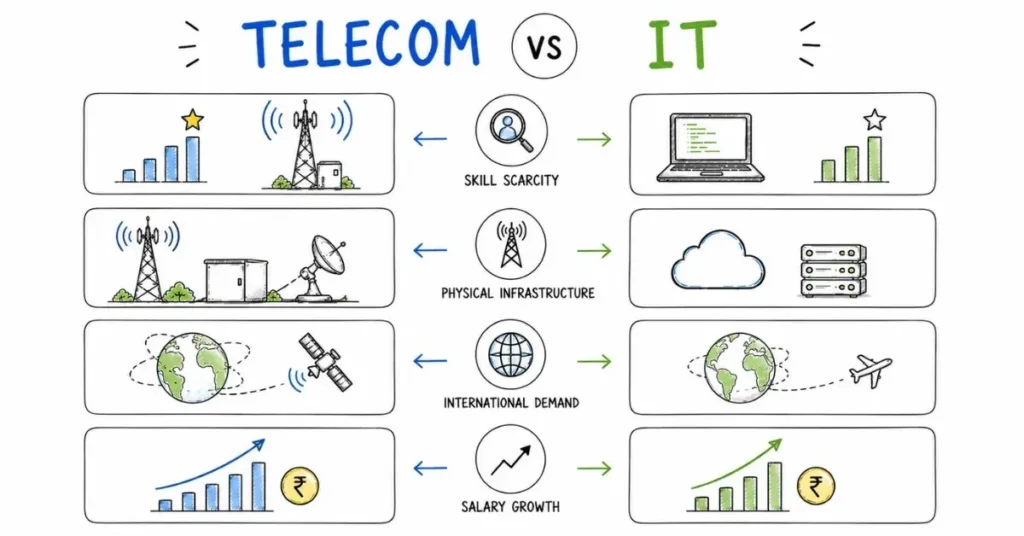
If you have ever looked at the IT software market, you know it can feel saturated. Hundreds of engineering graduates apply for the same 50 software developer roles. Telecom is different for a few reasons.
The pool of qualified candidates is smaller. Telecom requires domain-specific knowledge — protocols, RF fundamentals, vendor tools — that general software training does not cover. Someone who understands both networking and Python has a very specific skill set that is genuinely hard to find.
The demand is physical and real. 5G towers need to be deployed, maintained, and optimized by actual people in actual places. That work cannot be outsourced to a foreign country or automated away. This gives Indian telecom professionals long-term job security.
The international opportunity is large. The Middle East, Southeast Asia, and Europe are also rolling out 5G and actively recruit Indian telecom engineers. Senior 5G engineers with vendor certifications regularly get offers from companies in the UAE, Saudi Arabia, Malaysia, and the UK. The earning potential outside India — often 3–5x the Indian salary — is real and documented.
The sector pays competitively. 5G roles in India command an average of ₹24 lakh per year across experience levels, with senior specialists earning ₹35–57 lakh. Telecom wages grew 18% annually in 2023, outpacing the 12% growth in broader IT services.
The 2025–2030 Window: Why Now Matters
India’s telecom industry is at a specific inflection point that does not repeat often.
5G is deployed but not yet monetized. The infrastructure build-out created one wave of jobs. The next wave — building enterprise services, IoT platforms, private 5G networks, and AI-driven network management on top of that infrastructure — is starting now. Companies are hiring for roles that will define the next 5–7 years of the industry.
The government is involved. Programs like BharatNet (which has already connected 214,323 Gram Panchayats and laid 692,676 km of optical fiber) and the Production Linked Incentive (PLI) scheme for telecom equipment are putting real money into the sector. Government investment at this scale creates stable, long-term demand for skilled workers.
Hybrid roles are the future. The TeamLease EdTech Career Outlook Report for H1 2025 noted that telecom roles are blending with IT and data functions, creating hybrid job profiles that did not exist a few years ago. If you build skills that sit across both telecom and data or cloud, you do not compete in a crowded market — you create your own niche.
The fresher hiring intent in telecom stood at 45% in H1 2025 — meaning nearly half of all surveyed telecom companies planned to hire fresh graduates. That number has stayed above 45% consistently. For someone just entering the workforce, that is a significant signal.
What Kind of Background Do You Need?
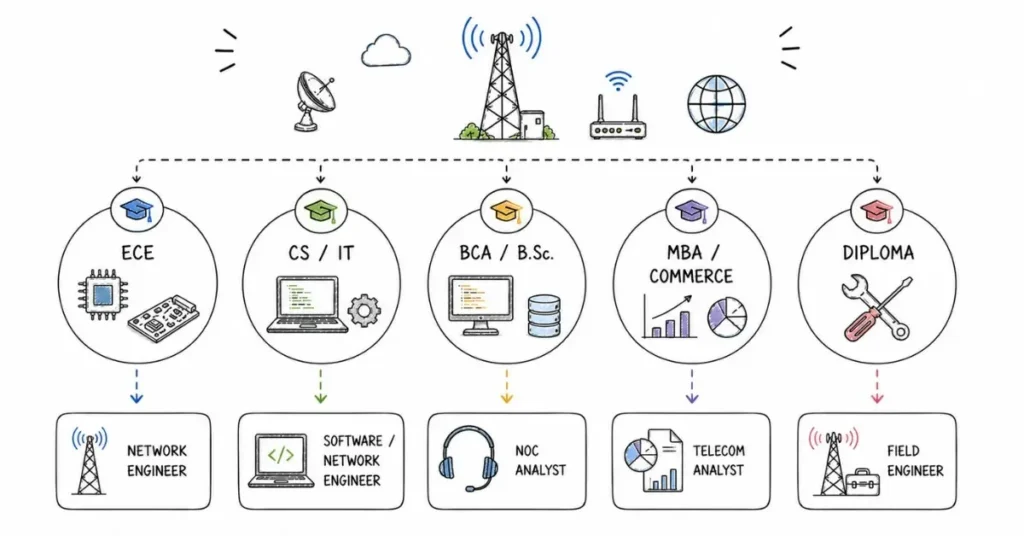
The short answer is: it depends on which role you want. Here is a quick map:
Your Background | Best Entry Role | Key Skills to Add |
B.Tech ECE | RF Engineer, 5G Deployment Engineer | Drive test tools, Nokia/Ericsson training |
B.Tech CS / IT | NOC Analyst, Cloud-Native Telecom | CCNA, networking fundamentals |
BCA / B.Sc. IT | OSS/BSS Analyst | SQL, telecom domain basics, ITIL |
MBA / Commerce | Telecom Analyst, Project Coordinator | OSS/BSS tools, PMP certification |
Diploma in Electronics | Field Technician, NOC support | CompTIA Network+, Cisco Packet Tracer |
The one thing every background has in common: you need at least one certification or demonstrable hands-on project before applying. A degree alone is not enough. Employers want to see that you understand how networks actually work, not just that you passed engineering exams.
Three Things to Do This Week If You Are Serious
- Set up Cisco Packet Tracer — it is free, and you can simulate real networks on your laptop within 30 minutes. Use it to build a basic network topology. This gives you something concrete to talk about in interviews.
- Create a focused LinkedIn profile — add “Telecom,” “5G,” “Network Engineering” to your skills section. Recruiters from Ericsson, Nokia, TCS Telecom, and Tech Mahindra filter by these terms. You want to show up in those searches.
- Identify your first certification — if you are from an ECE background, start with CCNA. If you are from a non-engineering background, start with CompTIA Network+. Both have free or low-cost study material available online.
Telecom is a sector where preparation converts directly into opportunity. The demand is there, verified by multiple reports. The question is whether you are the candidate companies find when they search.