
AgriTech Career Guide: Agriculture Technology & Farming Jobs in India
Table of Contents
Introduction:
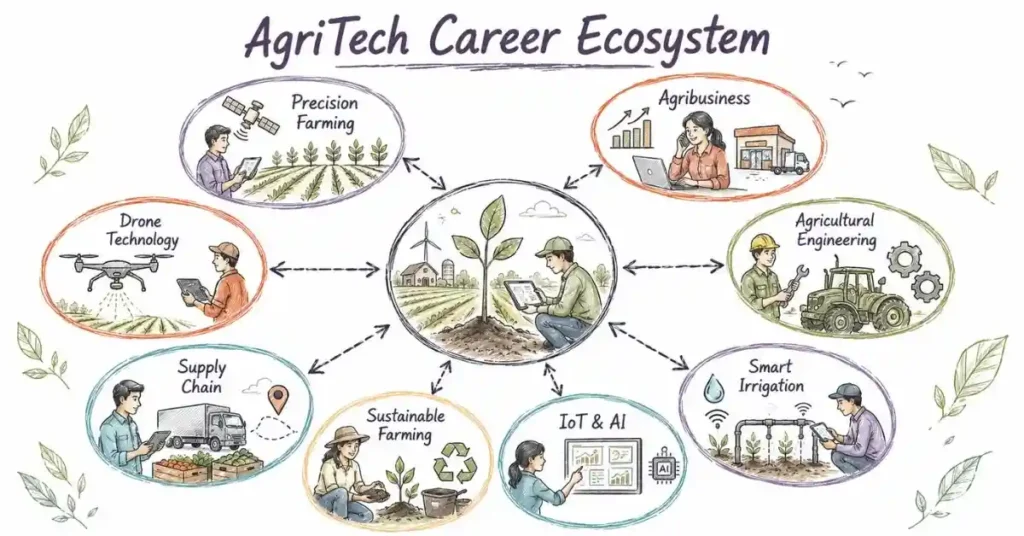
India feeds 1.4 billion people. And yet, most students who study agriculture or engineering never think of AgriTech as a serious career path.
That’s a mistake worth correcting.
Agricultural technology, or AgriTech, is no longer just tractors and fertilisers. It is drone-based crop monitoring. It is AI systems that predict pest attacks before they happen. It is IoT sensors that tell a farmer in Maharashtra exactly how much water his field needs from a phone screen. It is a logistics network that moves tomatoes from a farm in Andhra Pradesh to a cold storage unit in Hyderabad in under six hours.
And behind all of this? People with careers. Stable, well-paying, growing careers.
This guide is for you if:
- You studied B.Sc. Agriculture and wonder if your degree has a future beyond teaching or government jobs
- You’re a B.Tech graduate in Mechanical, Electronics, or Computer Science and want to work in a sector that actually matters
- You’re a farm supervisor or field officer who wants to understand how to move up in a world that’s going digital fast
By the time you finish reading, you’ll know what AgriTech actually is, what careers exist inside it, what skills you need, which companies are hiring, and what salaries look like across levels all specific to India.
What Is AgriTech? A Plain-Language Definition
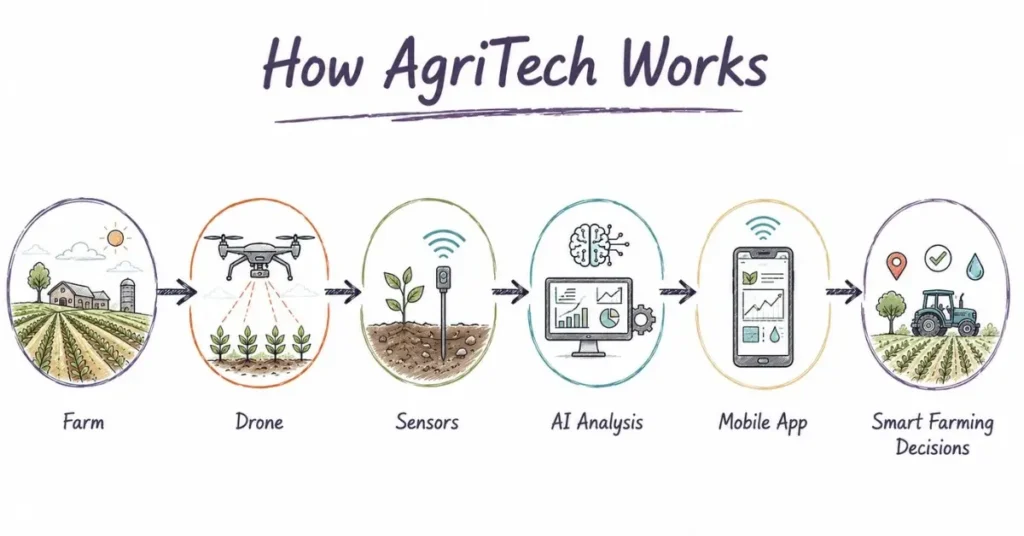
AgriTech means using modern technology to improve how farming works from growing crops to selling them.
Think of it this way. A traditional farmer checks his crop by walking the field. An AgriTech-enabled farmer sends a drone over the same field in 20 minutes, gets a heat map of moisture levels, and knows exactly which patch needs irrigation. He saves water, saves time, and loses fewer crops.
That drone was built by an engineer. The software analysing the images was written by a developer. The data was interpreted by an agronomist trained in precision farming. The results were sent to the farmer through an app managed by a product team. The whole system was sold to 500 farmers by a sales team, financed by an agribusiness analyst, and supported by a supply chain manager who ensures spare parts reach rural districts on time.
Every single one of those roles is an AgriTech career.
The sector sits at the intersection of five fields:
- Agriculture and agronomy: the foundational science of crops, soil, and farming
- Engineering: mechanical, electronic, and civil systems applied to farms
- Information technology: software, IoT, AI, and data systems
- Business: supply chains, finance, marketing, and operations
- Environmental science: sustainability, soil health, and climate adaptation
This is why AgriTech is genuinely one of the most cross-disciplinary career sectors in India today. You don’t need to be an expert in all five. You need depth in one and working knowledge of how it connects to the others.
Why AgriTech Careers Are Growing Fast in India
Here are facts, not motivational filler.
India is the world’s second-largest agricultural producer. Agriculture contributes roughly 18–20% of India’s GDP and employs over 40% of the workforce. But productivity per hectare in India is significantly lower than global averages which means there is enormous room for improvement through technology.
The Indian government has recognised this. Schemes like the Digital Agriculture Mission (2021–2025), PM-KISAN, and the National Agriculture Market (eNAM) are pumping thousands of crores into agricultural modernisation. ICAR (Indian Council of Agricultural Research) is actively collaborating with private AgriTech startups. NABARD runs dedicated funding programmes for rural AgriTech ventures.
On the private side, Indian AgriTech startups raised over $1.2 billion in funding in 2022 alone, according to AgFunder reports. Companies like DeHaat, Ninjacart, AgroStar, Waycool, and BharatAgri are scaling fast and hiring across technical, business, and field roles.
The demand for skilled AgriTech professionals far exceeds supply right now. That gap is your opportunity.
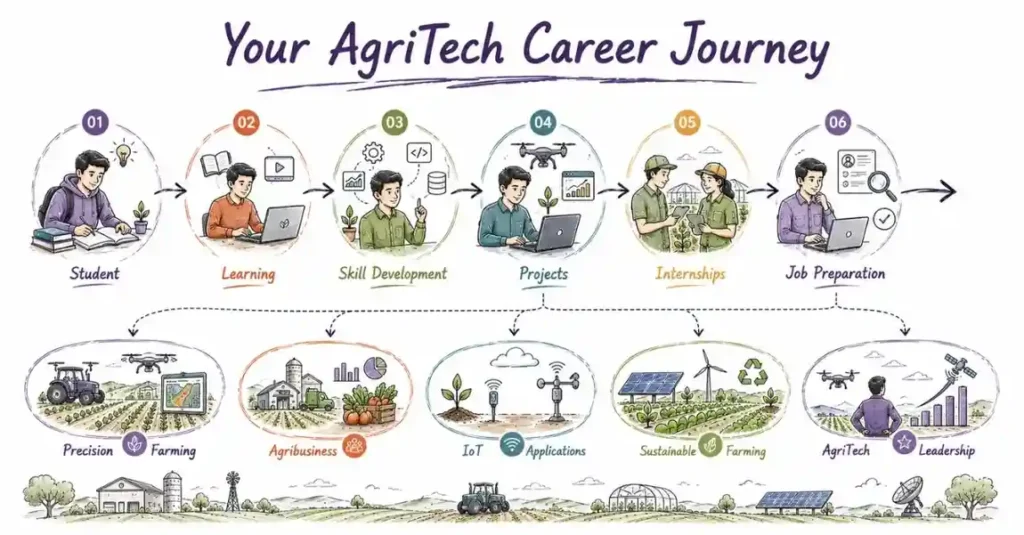
The 5 Core Career Tracks in AgriTech
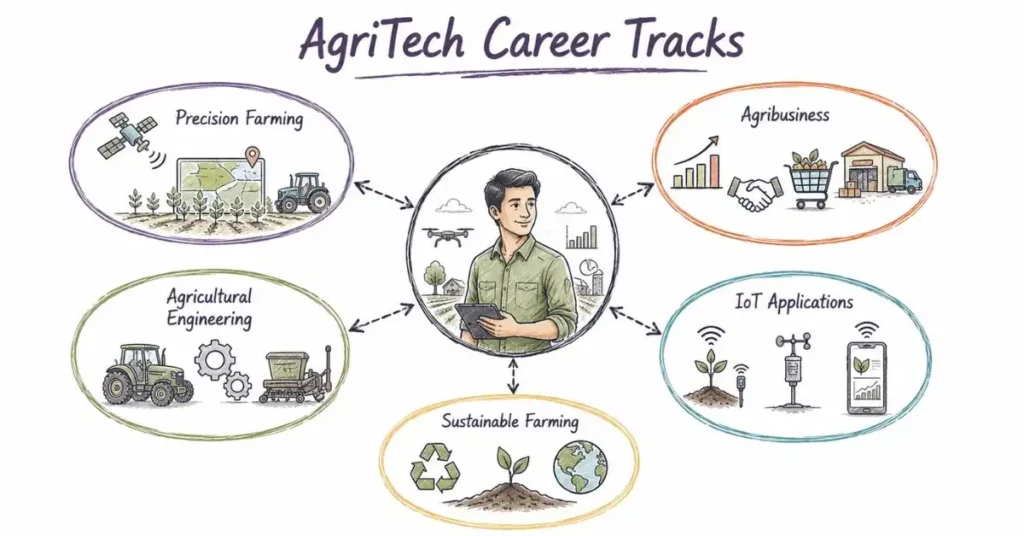
1. Precision Farming
Precision farming means applying the right input water, fertiliser, pesticide at the right time, in the right amount, to the right part of a field. It relies on drones, GPS mapping, remote sensing satellites, and sensor networks.
Who fits here: B.Tech graduates in Electronics, CS, or Agricultural Engineering; B.Sc. Agriculture students with an interest in data.
Sample roles: Precision Agriculture Specialist, GIS Analyst, Drone Operator/Technician, Remote Sensing Analyst, Farm Data Scientist.
Indian employers: SatSure, Cropin, Stellapps, ESRI India, ISRO’s agricultural monitoring divisions.
Salary range (India): ₹3.5 LPA (entry-level field roles) to ₹18 LPA (senior data scientists and specialists with 5+ years).
2. Agribusiness
Agribusiness covers everything that happens after the crop leaves the field and a lot of what happens before. Supply chains, procurement, commodity trading, rural marketing, agri-finance, and food processing business operations all fall here.
Who fits here: B.Sc. Agriculture graduates, MBA students with agri-sector interest, commerce graduates with rural sector exposure.
Sample roles: Agribusiness Manager, Commodity Analyst, Procurement Executive, Rural Marketing Manager, Agricultural Loan Officer, Cold Chain Logistics Coordinator.
Indian employers: ITC Agri Business, Mahindra Agri Solutions, DCM Shriram, BigBasket (sourcing), Reliance Retail (farm-to-shelf operations), NAFED.
Salary range (India): ₹4 LPA (procurement executive) to ₹20 LPA (senior agribusiness manager or commodity trader with experience).
3. Agricultural Engineering
Agricultural engineering applies engineering principles to farming equipment, irrigation systems, post-harvest storage, soil conservation structures, and farm machinery design. It is one of the oldest AgriTech disciplines but is being rapidly modernised.
Who fits here: B.Tech in Agricultural Engineering, Mechanical Engineering, or Civil Engineering graduates.
Sample roles: Farm Equipment Design Engineer, Irrigation Systems Engineer, Post-Harvest Technology Specialist, Agricultural Machinery Technician, Rural Infrastructure Engineer.
Indian employers: Mahindra & Mahindra (Farm Equipment Division), TAFE (Tractors and Farm Equipment), John Deere India, KSB Pumps, Jain Irrigation Systems, ICAR institutes.
Salary range (India): ₹3.5 LPA (junior field engineer) to ₹16 LPA (senior design or systems engineer).
4. IoT and Technology Applications in Agriculture
This is the fastest-growing track right now. IoT (Internet of Things) in agriculture means deploying sensors, connected devices, and automated systems across farms to collect real-time data and automate decisions. Think soil moisture sensors, automated drip irrigation controllers, livestock health trackers, and smart greenhouse systems.
Who fits here: B.Tech graduates in CS, Electronics, Instrumentation, or IT especially those willing to work in rural deployment contexts.
Sample roles: IoT Solutions Engineer (Agriculture), Embedded Systems Developer, AgriTech Product Manager, Full Stack Developer (AgriTech platforms), AI/ML Engineer (crop analytics).
Indian employers: BharatAgri, Fasal, Stellapps, AgroStar, Intello Labs, Microsoft (FarmBeats India), IBM (Agriculture AI projects), Bosch India (precision agriculture division).
Salary range (India): ₹4.5 LPA (junior developer) to ₹22 LPA (senior product or ML engineer at funded startups).
5. Sustainable Farming and Environmental AgriTech
Sustainable farming careers sit at the intersection of agriculture, environmental science, and climate technology. As India faces increasing pressure on water resources and soil degradation, roles in organic certification, carbon farming, watershed management, agroforestry, and climate-smart agriculture are growing fast.
Who fits here: B.Sc. Agriculture / Horticulture / Forestry graduates, Environmental Science graduates, NGO and development sector professionals wanting private sector exposure.
Sample roles: Sustainability Manager (Agri), Organic Certification Auditor, Agroforestry Specialist, Carbon Credits Analyst, CSR Manager (Agriculture), Climate-Smart Agriculture Consultant.
Indian employers: Earthtree, SaciWATERs, WOTR (Watershed Organisation Trust), ITC’s Social and Farm Forestry division, Tata Trusts, UNDP India (agriculture and climate programmes).
Salary range (India): ₹3 LPA (NGO field roles) to ₹15 LPA (corporate sustainability manager at large agri-conglomerates).
What Skills Do You Actually Need?
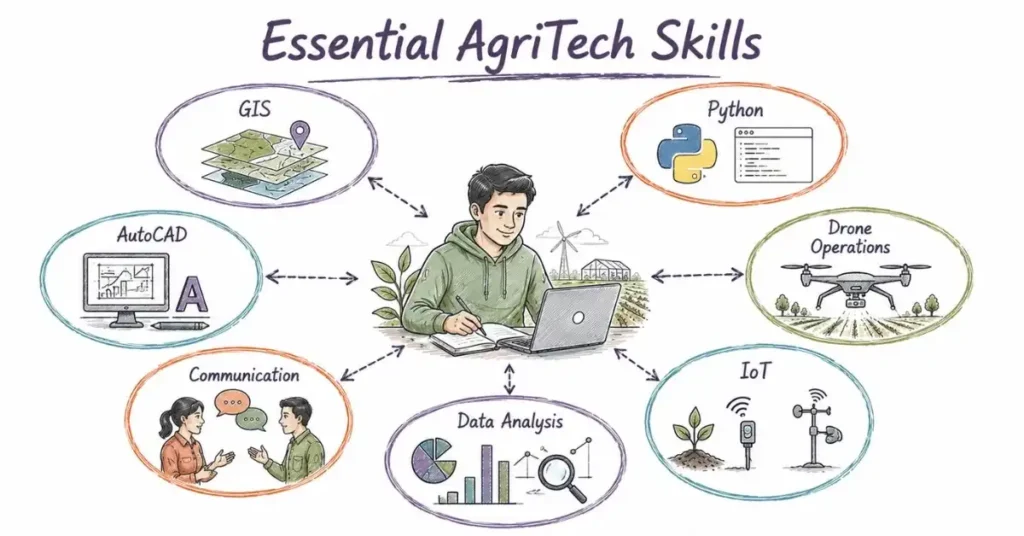
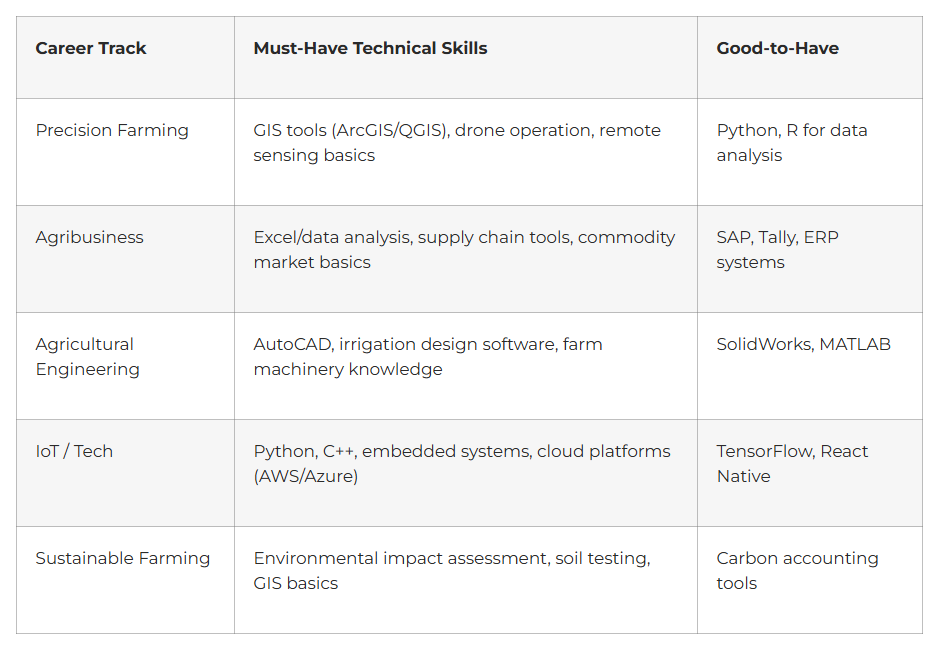
Let’s be honest about this. The skills required in AgriTech are not the same as what most agriculture colleges in India teach. Here’s how to read the gap and fill it.
Technical Skills by Track
Transferable Skills Every AgriTech Professional Needs
Regardless of which track you choose, three skills come up in almost every hiring conversation in this sector:
Communication with farmers: AgriTech fails when technology doesn’t reach the last mile. If you can explain a soil health app to a farmer in Telugu, Marathi, or Hindi in terms they immediately understand you are worth more than a technically brilliant person who can’t leave an office.
Field comfort: Most AgriTech roles, even tech ones, require some degree of field visits. Comfort with rural environments, willingness to travel to Tier 2 and Tier 3 districts, and physical stamina for field work are genuinely valued.
Data literacy: You don’t need to be a data scientist. But you should be able to read a dataset, understand what an average and an outlier mean, and make a decision based on numbers rather than gut feeling alone.
Education Pathways Into AgriTech
You don’t need a single specific degree. Here’s how different educational backgrounds map to AgriTech careers:
If You Have a B.Sc. Agriculture Degree
Your foundation in crop science, soil science, and agronomy is directly valuable. The gap is usually in technology and business. Fill it with:
- A Post Graduate Diploma in Agribusiness Management (PGDABM) offered by MANAGE Hyderabad, IRMA Anand, and several state agricultural universities
- Online certifications in GIS, precision farming, or data analysis
- Internships with AgriTech startups where you act as a domain expert paired with tech teams
Target entry roles: Field Agronomist, Procurement Executive, Precision Farming Specialist, Sustainability Field Officer.
If You Have a B.Tech in Engineering (Any Branch)
You have the technical base. What you need is agricultural domain knowledge and an understanding of rural India. Fill it with:
- Short courses in agronomy basics, soil science, and crop physiology (ICAR e-learning platforms offer free content)
- Internships at AgriTech companies in product or engineering roles
- Work on personal projects build a small IoT sensor system, contribute to open-source farm data tools
Target entry roles: IoT Engineer, Software Developer, Product Analyst, GIS Analyst, Agricultural Equipment Design Engineer.
If You Are a Working Farm Supervisor or Field Officer
You have what no college can teach ground-level understanding of how Indian farms actually work. What you need is a credential that signals upskilling to employers. Consider:
- MBA in Agribusiness (distance or weekend programmes from IGNOU, KSOU, or MANAGE)
- Digital literacy certifications through PMKVY or state skill development programmes
- Moving laterally into AgriTech companies as Field Implementation Officers, where your on-ground experience is the primary qualification
Target roles: Field Operations Manager, Farmer Relationship Manager, District Sales Manager (AgriTech), Rural Program Coordinator.
Top Companies Hiring in Indian AgriTech Right Now
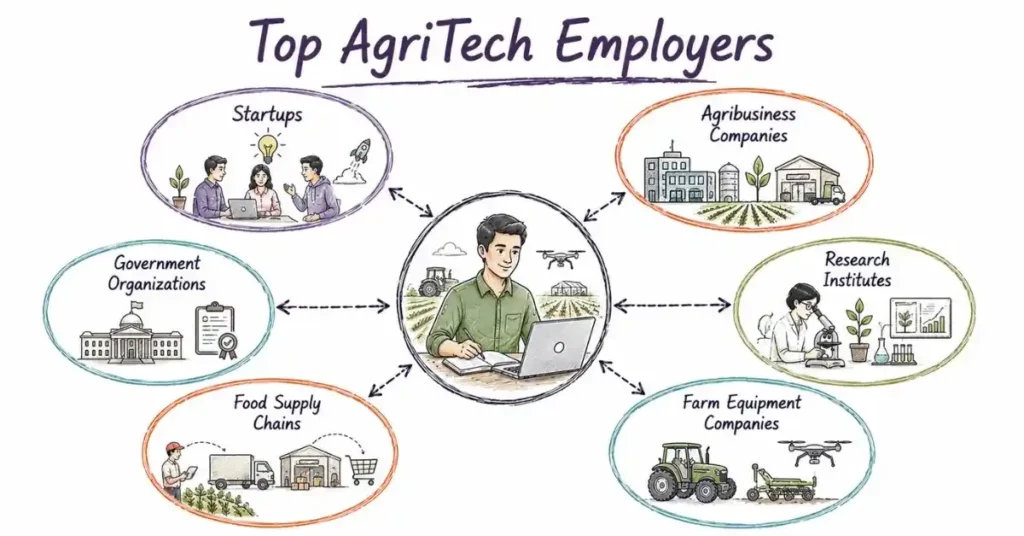
Here is an honest map of the hiring landscape startups, mid-size companies, and large corporations.
High-Growth Startups
DeHaat: One of India’s largest agri-input and advisory platforms. Headquartered in Patna, operational across Bihar, UP, Odisha, and Rajasthan. Hires agronomists, field officers, data analysts, and software developers. Check their careers page and LinkedIn frequently.
Ninjacart: B2B fresh produce supply chain. Based in Bengaluru. Strong hiring in supply chain operations, data analytics, and technology. Backed by Walmart and Tiger Global.
AgroStar: Digital agri-advisory and input delivery platform. Strong in Maharashtra and Gujarat. Hires in product management, agronomy, field sales, and customer success.
BharatAgri: AI-powered crop advisory startup. Hires agronomists, app developers, and content specialists (vernacular language content is a specific hiring area).
Fasal: IoT-based precision irrigation company. Hires electronics engineers, embedded developers, and field implementation executives.
Waycool: Farm-to-retail supply chain. South India focus. Hires in logistics, supply chain, and procurement.
Large Corporates with Significant AgriTech Divisions
ITC Agri Business Division: One of India’s largest agri commodity traders with strong sustainability and farmer linkage programmes. Hires agribusiness managers, procurement specialists, and sustainability officers.
Mahindra Agri Solutions: Covers farm machinery, agri inputs, and digital farm services. Hires engineers, agronomists, and business development managers.
Jain Irrigation Systems: Global leader in micro-irrigation. Headquartered in Jalgaon, Maharashtra. Strong hiring in irrigation engineering, project management, and international business.
Tata Rallis (Rallis India): Agrochemicals and seeds. Hires in R&D, field agronomy, and supply chain.
Government and Research Bodies
ICAR (Indian Council of Agricultural Research): Recruits Scientists, Research Associates, and Technical Officers through competitive exams. Strong job security and research exposure.
NABARD: Hires Development Assistants and Officers through the NABARD exam. Focuses on rural development finance directly relevant to agribusiness careers.
FCI (Food Corporation of India): Management Trainee and Assistant Grade posts through competitive exams. Focused on grain procurement, storage, and distribution.
Salaries in Indian AgriTech: What to Realistically Expect
Here is a level-by-level breakdown based on current data from Naukri.com, AmbitionBox, and LinkedIn salary insights for India:
Entry Level (0–2 years)
Role | Annual Salary Range |
Field Agronomist | ₹2.5 – ₹4.5 LPA |
Junior Software Developer (AgriTech startup) | ₹4 – ₹7 LPA |
Procurement Executive | ₹3 – ₹5 LPA |
IoT Field Engineer | ₹3.5 – ₹6 LPA |
Graduate Trainee (Large Corporates) | ₹4 – ₹6 LPA |
Mid Level (3–6 years)
Role | Annual Salary Range |
Precision Agriculture Specialist | ₹7 – ₹12 LPA |
Product Manager (AgriTech) | ₹10 – ₹18 LPA |
Agribusiness Manager | ₹8 – ₹14 LPA |
Agricultural Engineer (Senior) | ₹7 – ₹13 LPA |
Sustainability Manager | ₹8 – ₹14 LPA |
Senior Level (7+ years)
Role | Annual Salary Range |
Head of Agri Operations | ₹18 – ₹30 LPA |
Director AgriTech Product | ₹22 – ₹40 LPA |
VP Agribusiness | ₹25 – ₹45 LPA |
These numbers are for private sector roles. Government roles (ICAR Scientist, NABARD Officer) pay less at junior levels (₹35,000–₹60,000 per month) but offer job security, pension, housing allowance, and consistent increments.
How to Break Into AgriTech: A Practical Roadmap
Step 1: Identify Your Track
Go back to the five career tracks above. Based on your current qualification, shortlist one primary track and one adjacent track. Don’t try to prepare for all five simultaneously you’ll end up average across all.
Step 2: Build One Visible Credential
Employers in AgriTech especially startups look for evidence that you understand the sector beyond your degree. This could be:
- A certification in precision farming, GIS, or IoT fundamentals
- A published blog post or LinkedIn article explaining an AgriTech concept in local context
- A final-year project or personal project with real agricultural data
- A documented internship with any organisation working in rural India
Step 3: Build Your LinkedIn Profile Around AgriTech
This matters more than most students realise. Recruiters at DeHaat, Ninjacart, and AgroStar actively search LinkedIn. Your profile should mention specific skills “GIS mapping,” “precision irrigation,” “supply chain operations” not just your degree. Follow the companies you want to work for. Engage with their posts.
Step 4: Apply Directly, Not Just Through Portals
Naukri and Indeed are fine. But many AgriTech startup jobs in India are filled through:
- LinkedIn direct applications
- College placement cells with AgriTech company tie-ups (especially at MANAGE, IARI, and TNAU)
- Agricultural fairs and expos like AgriTech India (Bengaluru) and India International Agro & Food Expo
- Referrals from people already working in the sector
Step 5: Prepare for the Reality of Field Work
Many students from urban backgrounds underestimate this. A significant portion of AgriTech entry-level roles involve field visits sometimes for days at a stretch in rural districts. This is not a downside. It is how you learn the sector from the ground up, build trust with farmers, and move up faster than desk-bound colleagues. Embrace it early.
AgriTech and the Future of Indian Farming
India’s agricultural sector is at an inflection point. Climate change is making traditional farming patterns unreliable. The average age of Indian farmers is rising the next generation is migrating to cities, and the farms they leave behind will need to be managed with fewer people and better technology.
This creates a structural, decades-long demand for people who understand both agriculture and technology.
The government’s push toward digital agriculture including soil health cards, satellite-based crop insurance assessments, and AI-based price forecasting on eNAM means that even government agriculture jobs are becoming technology-intensive. The days of an agriculture officer doing only field inspections are numbered. The future belongs to those who can read a satellite image, interpret sensor data, and still walk into a field and earn a farmer’s trust.
If you are reading this guide, you are early. The competition for skilled AgriTech professionals in India is currently low relative to the opportunity. That window will not stay open forever.
Quick-Reference: Your AgriTech Career Starter Checklist
Before you move on to any of the detailed subtopic guides in this series, run through this checklist:
- I know which of the 5 career tracks fits my background best
- I have identified 3–5 companies I want to research further
- I know what salary range is realistic for my entry-level role
- I have one skill gap I will address in the next 60 days
- My LinkedIn profile mentions AgriTech-relevant keywords
- I have looked up at least one open job posting in my chosen track
Education, Exams, Certifications & Learning Resources for AgriTech Careers in India
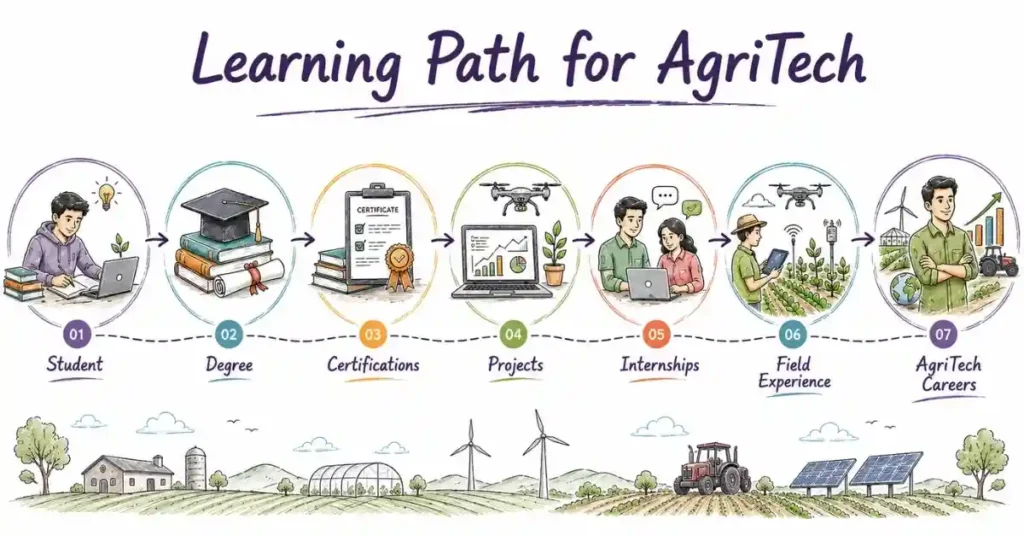
Most career guides stop at “get a degree and apply.” That advice doesn’t work in AgriTech because the sector moves faster than most university curricula. This section gives you a practical, honest map of how to build your credentials, whether you’re a fresh graduate or a working professional.
Formal Degree Programmes Worth Considering
Undergraduate Degrees That Feed Into AgriTech
If you are still at the stage of choosing your undergraduate degree, these are the programmes with the strongest AgriTech career alignment in India:
B.Tech in Agricultural Engineering
Offered by state agricultural universities (SAUs) like IARI (New Delhi), TNAU (Coimbatore), PAU (Ludhiana), ANGRAU (Guntur), and MPKV (Rahuri). Admission is through JEE Main scores or state-level engineering entrance exams, plus ICAR AIEEA for central agricultural universities. This is the most direct path into AgriTech engineering roles.
B.Sc. Agriculture (Honours)
A four-year programme available at all state agricultural universities and many deemed universities. Admission is through ICAR AIEEA-UG or state-level agriculture entrance exams. This gives you the agronomic foundation that technology-track people often lack which makes you genuinely valuable in cross-functional AgriTech teams.
B.Tech in Computer Science / Electronics / Mechanical Engineering
If you are already in one of these programmes at any decent engineering college, you do not need to switch. You need to add domain knowledge through electives, internships, and certifications. Your core engineering skills are directly transferable.
B.Sc. in Environmental Science / Horticulture / Forestry
These feed specifically into the sustainable farming and agroforestry career tracks. Less directly into tech roles, but highly valuable in NGO, government, and corporate CSR-linked AgriTech positions.
Postgraduate Options That Open Senior Doors
M.Sc. Agriculture (Specialisations: Agronomy, Soil Science, Plant Pathology, Agricultural Economics)
If you want to go into research, government, or senior advisory roles, a master’s from IARI, TNAU, or a good SAU is worth it. Admission through ICAR JRF/SRF exam (explained below).
MBA in Agribusiness Management
This is the highest-ROI postgraduate qualification for the business side of AgriTech. The top programmes in India:
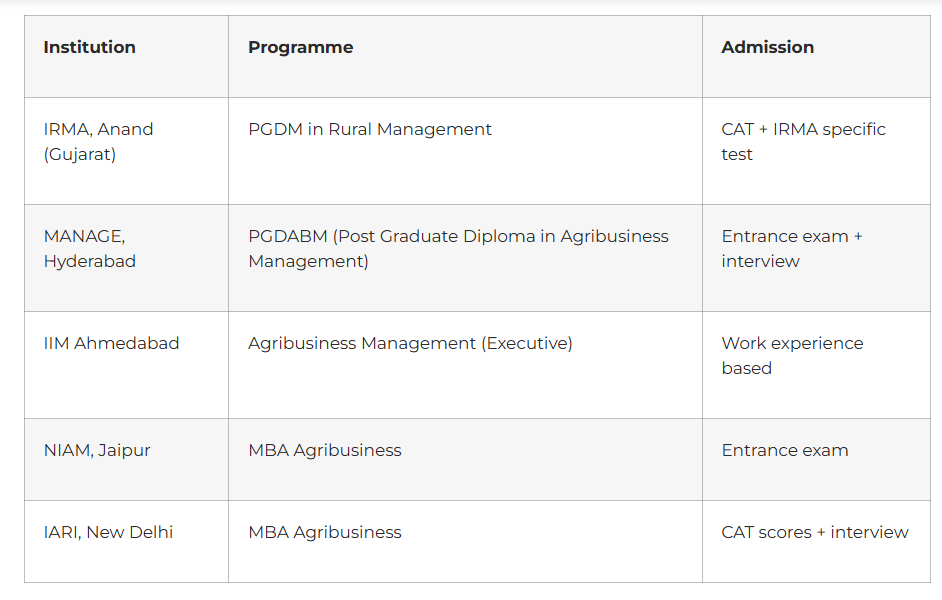
IRMA and MANAGE are the gold standard in India. If you can get into either, do it. Placements at both institutions include ITC, Mahindra, NABARD, and top AgriTech startups.
M.Tech in Agricultural Engineering / Precision Agriculture
Available at IARI, TNAU, and select IITs (IIT Kharagpur has a strong Agricultural and Food Engineering department). If you want to go into R&D, equipment design, or academic research, this is the path.
Key Competitive Exams for AgriTech Careers in India
These are the exams that open specific doors know which ones are relevant to your track.
ICAR AIEEA (All India Entrance Examination for Admission)
- What it is: Central entrance exam for UG and PG admission to ICAR-funded agricultural universities
- Who should take it: Students wanting B.Sc. Agriculture or M.Sc. Agriculture at IARI and other central institutions
- When: Usually conducted in June-July each year
- Why it matters: Clearing ICAR AIEEA gives you access to India’s best agriculture research institutions, which directly connects you to industry partnerships and top placements
ICAR JRF/SRF (Junior/Senior Research Fellowship)
- What it is: National fellowship exam that funds M.Sc. and Ph.D. research in agriculture
- Who should take it: B.Sc. Agriculture graduates wanting to pursue research without the burden of tuition fees
- Why it matters: JRF holders get a monthly stipend (currently ₹31,000/month for JRF, ₹35,000/month for SRF) and are among the most sought-after research hires at ICAR institutes and AgriTech R&D departments
NABARD Grade A and B Officer Exam
- What it is: Recruitment exam for Development Assistants and Officers at the National Bank for Agriculture and Rural Development
- Who should take it: B.Sc. Agriculture, Agribusiness MBA, or Economics graduates interested in agri-finance and rural development
- Salary on joining: Around ₹44,000–₹55,000 per month (Grade A) with full government benefits
- Why it matters: NABARD officers work directly at the intersection of agricultural finance and rural technology one of the most stable and impactful careers in the sector
FCI Management Trainee Exam
- What it is: Recruitment for Management Trainee posts at Food Corporation of India
- Relevant streams: Agriculture, General Management, Technical
- Why it matters: FCI manages India’s national food grain procurement and storage massive exposure to supply chain, procurement, and food security operations
SBI Agriculture Officer / RRB Agriculture Officer
- What it is: Specialist officer posts in public sector banks focused on lending to the agriculture sector
- Who should take it: B.Sc. Agriculture graduates interested in agri-finance
- Why it matters: Strong job security, direct farmer interaction, and a launching pad toward NABARD-level roles
State Public Service Commission (APSSC, TSPSC, MPSC, UPSC) Agriculture Cadre
- What it is: State government recruitment for Agriculture Officers, Horticulture Officers, and related posts
- Why it matters: These are stable, pensionable roles with real impact on ground-level agricultural programmes. The salary is lower than private sector, but the job security and social respect are significant especially in Tier 2 and Tier 3 districts.
Certifications That Actually Matter to Employers
Here’s the honest truth about certifications in AgriTech: a certification alone will not get you a job. What it does is signal that you took initiative, filled a genuine skill gap, and can speak the language of the role you’re applying for. Pair a certification with a project or internship and it becomes genuinely powerful.
For Precision Farming and GIS Track
ESRI ArcGIS Training (Online)
- Provider: ESRI India / ESRI Global
- Cost: Free basic courses available; paid advanced courses around ₹5,000–₹15,000
- Why it matters: ArcGIS is the industry-standard GIS software. ESRI certification is recognised by SatSure, Cropin, and most precision agriculture companies
Drone Pilot Certification (DGCA)
- Provider: DGCA-approved training centres
- Cost: ₹15,000–₹50,000 depending on provider
- Why it matters: Operating drones commercially in India requires a Remote Pilot Certificate from DGCA. This is a hard requirement for field drone roles not optional
Google Earth Engine (Free)
- Provider: Google (self-paced)
- Cost: Free
- Why it matters: Used by SatSure, ISRO, and multiple AgriTech analytics companies for satellite-based crop monitoring
For IoT and Technology Track
AWS IoT Core / Azure IoT Hub Fundamentals
- Provider: Amazon Web Services / Microsoft Learn
- Cost: Free (learning) + exam fee for certification (₹8,000–₹12,000)
- Why it matters: Most Indian AgriTech IoT platforms are built on AWS or Azure. Cloud IoT literacy is directly applicable
Python for Data Analysis (Coursera / NPTEL)
- Provider: Multiple (IIT courses on NPTEL are free and credible)
- Cost: Free (NPTEL) or ₹3,000–₹6,000 (Coursera paid certificates)
- Why it matters: Data analysis in Python is the baseline skill for any analytics-adjacent role in AgriTech
Embedded Systems Fundamentals (NPTEL)
- Provider: IIT Kharagpur / IIT Madras via NPTEL
- Cost: Free (with paid certificate option for ₹1,000–₹1,500)
- Why it matters: Directly applicable to IoT hardware roles at companies like Fasal and Stellapps
For Agribusiness Track
Supply Chain Management Certification (APICS CSCP)
- Provider: APICS (American Production and Inventory Control Society)
- Cost: ₹40,000–₹60,000 (international certification)
- Why it matters: Recognised by Ninjacart, Waycool, and every large agri-supply chain employer in India. Worth the investment if you are serious about supply chain careers
Financial Modelling and Valuation (NSE Academy / CFI)
- Provider: NSE Academy (India) or Corporate Finance Institute (online)
- Cost: ₹5,000–₹20,000
- Why it matters: Commodity analysts and agribusiness finance roles require basic financial modelling skills that most agriculture graduates lack
MANAGE Short-Term Programmes
- Provider: National Institute of Agricultural Extension Management, Hyderabad
- Cost: Subsidised government rates often ₹2,000–₹8,000 for residential programmes
- Why it matters: MANAGE runs short courses on agribusiness management, agricultural extension, and rural marketing that are specifically designed for working professionals and fresh graduates. Faculty and industry connections at MANAGE are strong.
For Sustainable Farming Track
Organic Farming Certification (APEDA / Third-Party)
- Provider: APEDA-accredited certification bodies (Control Union, ECOCERT India, OneCert Asia)
- Cost: Varies auditor training programmes are typically ₹10,000–₹25,000
- Why it matters: India is the world’s largest producer of certified organic farmers by count. Organic certification auditors are in genuine short supply.
Climate Change and Agriculture (CGIAR / FAO Online Courses)
- Provider: CGIAR Research Program / FAO e-learning
- Cost: Free
- Why it matters: Credibility in the sustainable farming space requires understanding the science of climate-smart agriculture these free courses provide a solid foundation
Free and Low-Cost Learning Resources Specific to India
You do not need to spend lakhs on courses to build AgriTech knowledge. Here are resources that are either free or nearly free:
ICAR e-Krishi Shiksha (icar.org.in)
Free online courses from ICAR on agronomy, soil science, plant pathology, and agricultural engineering. Developed by Indian agricultural scientists for Indian conditions. Underused and underrated.
NPTEL (nptel.ac.in)
IIT and IISc professors teach courses on subjects directly relevant to AgriTech soil mechanics, remote sensing, IoT systems, environmental science, supply chain management. All free to watch. Paid certificates available for around ₹1,000.
eNAM Learning Resources (enam.gov.in)
The National Agriculture Market platform has learning resources on commodity trading, mandi operations, and digital agriculture that are highly specific to Indian agricultural markets.
Krishi Vigyan Kendras (KVKs)
India has over 700 KVKs across every district. If you are a working farmer or farm supervisor, your local KVK offers free training programmes on new farming technologies, soil testing, and crop management. These are consistently underutilised.
YouTube Vernacular AgriTech Channels
For those who learn better in Hindi or regional languages, channels like Kisan Tak, Farming Leader, and DD Kisan cover precision farming and agricultural technology in accessible language. These are useful for understanding farmer psychology critical if your role involves farmer-facing work.
LinkedIn Learning + LinkedIn Agriculture Groups
Several Indian AgriTech professionals actively share knowledge on LinkedIn. Following people who work at SatSure, DeHaat, BharatAgri, and NABARD, and engaging with their content, puts you on the radar of hiring managers passively over time.
Internship Strategy for AgriTech in India
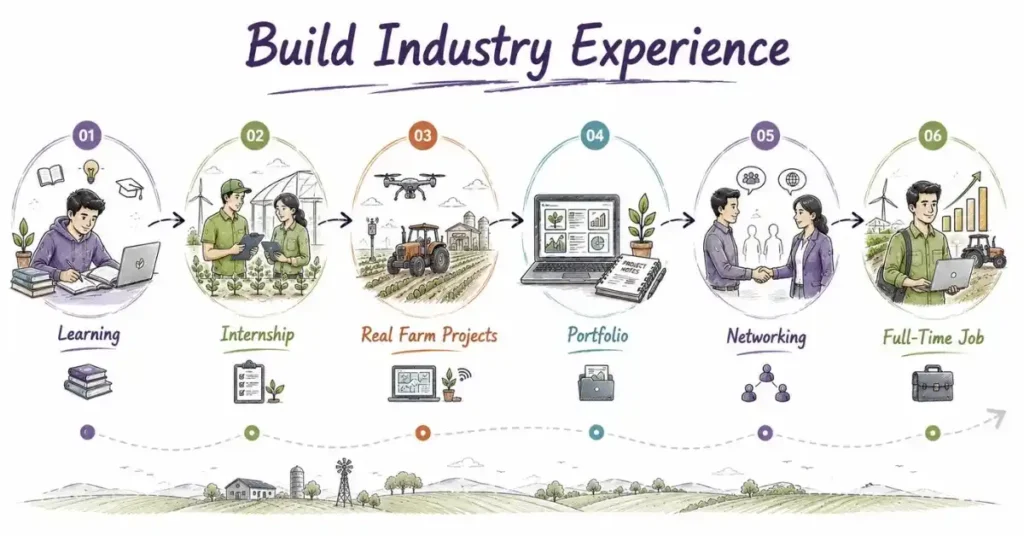
Getting your first internship in AgriTech is often the hardest step. Here is how to approach it practically:
Where to look:
- LinkedIn Jobs (filter: “internship” + “agriculture” + “India”)
- Internshala has a reasonable number of AgriTech and agribusiness internships
- Direct applications to startup careers pages (DeHaat, AgroStar, BharatAgri all have listed internship programmes)
- Your college’s placement cell if you are at an agricultural university, ask specifically whether any AgriTech companies have visited. If not, suggest they reach out to 5 companies from the list in this guide.
What to say in your application:
Do not write a generic “I am interested in agriculture” email. Instead:
- Name one specific problem you know the company is working on
- Explain exactly what you bring your crop science knowledge, your coding skills, your regional language fluency
- Offer a concrete deliverable “I can help you document farmer feedback from your Maharashtra cluster in Marathi” is worth more than “I am a hardworking student”
Unpaid vs. paid internships:
Many early-stage AgriTech startups offer unpaid or stipend-only internships (₹5,000–₹10,000/month). Take them if you can afford to the learning and network are worth more than the stipend at this stage. If you genuinely cannot afford it, look at MANAGE and ICAR, which offer stipended traineeships.
Professional Communities and Networks in Indian AgriTech
Careers are built as much through community as through qualifications. These are the networks worth joining:
ASSOCHAM Agriculture Council: Industry body with events and networking forums relevant to agribusiness professionals.
AgriTech India (Biennial Expo, Bengaluru): The largest agricultural technology exhibition in South Asia. Attending even as a visitor gives you direct access to company representatives, new technologies, and potential employers.
NAIP (National Agricultural Innovation Project) Alumni Networks: If you studied at an ICAR institute, the alumni community is active and often posts job opportunities.
Indian Society of Agribusiness Professionals (ISAP): A professional body for agribusiness management graduates. Membership gives access to job boards and seminars.
CII Agri Summit: The Confederation of Indian Industry runs annual agribusiness summits that attract senior professionals from ITC, Mahindra, Rallis, and leading startups. Student passes are sometimes available.
Frequently Asked Questions: AgriTech Careers in India
These are real questions students and working professionals ask answered directly, without padding.
1. I studied B.Sc. Agriculture but I don't know coding. Can I still get into AgriTech?
Yes and this is one of the most common misconceptions. A large portion of AgriTech roles do not require coding at all. Field agronomists, procurement executives, sustainability officers, organic certification auditors, farmer relationship managers, and agribusiness analysts all work in AgriTech without writing a single line of code. Your crop science and soil knowledge is domain expertise that technology graduates genuinely lack. Companies hire you for exactly that.
2. I am a B.Tech Computer Science graduate. Do I need to study agriculture separately before applying to AgriTech companies?
You don’t need a formal agriculture qualification. But you do need enough domain knowledge to understand what your product or system is actually doing. Spend 4–6 weeks going through ICAR e-Krishi Shiksha free courses, read about the crops grown in the region your target company operates in, and understand basic soil and water concepts. This preparation shows up clearly in interviews and sets you apart from CS graduates who apply without any agricultural context.
3. What is the minimum salary I should expect as a fresher in Indian AgriTech?
Honestly, it depends on the type of employer. Large corporates like ITC, Mahindra, and Jain Irrigation typically start at ₹4–₹6 LPA for graduate trainees. Early-stage startups may offer ₹2.5–₹4 LPA for field roles but can offer faster growth and equity in some cases. Government roles (NABARD, ICAR, FCI) start at ₹35,000–₹55,000 per month with benefits. Do not accept less than ₹2.5 LPA for a full-time role regardless of employer that is the current floor for any graduate-level position in this sector.
4. Is AgriTech only for people who want to work in villages and rural areas?
No. There are significant AgriTech roles based entirely in cities. Product managers, software developers, data analysts, marketing teams, commodity traders, supply chain analysts, and finance professionals at companies like Ninjacart, AgroStar, and DeHaat work from Bengaluru, Hyderabad, Mumbai, and Pune offices. That said, field-facing roles do involve rural travel and those roles often pay better and grow faster because fewer people are willing to do them.
5. I am currently working as a farm supervisor. Is it too late to transition into a formal AgriTech career?
It is not too late and your experience is actually an advantage that fresh graduates cannot replicate. Companies building farmer-facing products and services actively need people who understand how real farms operate, what farmers trust, and how decisions are made at the ground level. Start by updating your LinkedIn profile to include your field experience in concrete terms crops managed, acreage supervised, technologies used. Then look at roles titled Field Implementation Manager, Farmer Relations Manager, or District Operations Manager at AgriTech companies. These are built for people exactly like you.
6. Which Indian state has the most AgriTech job opportunities?
Karnataka (Bengaluru in particular) has the highest concentration of AgriTech startup headquarters. Maharashtra (Pune and Mumbai) is strong for agribusiness and supply chain roles. Telangana and Andhra Pradesh have growing clusters linked to horticulture and aquaculture technology. Bihar and UP are where companies like DeHaat are building large field operations teams. If you are open to field roles, the opportunity is genuinely pan-India rural districts in every state have active AgriTech deployment happening right now.
7. What is the difference between an agronomist and a precision farming specialist?
An agronomist uses their crop science knowledge to advise farmers on what to grow, when to plant, how to manage soil health, and how to deal with pests and disease. A precision farming specialist uses technology drones, sensors, GIS mapping to collect data that helps make those same decisions more efficiently and at scale. In practice, the best precision farming specialists have a strong agronomy foundation. Many agronomists are actively upskilling into precision farming roles because it dramatically increases their earning potential.
8. Does ICAR JRF lead to private sector jobs or only government and research?
ICAR JRF is primarily a gateway to research careers at ICAR institutes, SAUs, and Ph.D. programmes. However, JRF holders are increasingly hired by large AgriTech companies for R&D and product development roles. Cropin, SatSure, and the R&D divisions of ITC and Rallis actively recruit M.Sc. and Ph.D. agriculture graduates. The fellowship itself signals strong agricultural science fundamentals which is valuable in any technical AgriTech role.
9. Are there AgriTech opportunities specifically for women in India?
Yes and this is an area where the sector is actively trying to grow. Women farmers and self-help groups form a significant portion of the rural customer base for AgriTech companies, which means female field officers and agronomists have a genuine advantage in farmer trust and communication. Organisations like SEWA, Mahila Kisan Sashaktikaran Pariyojana (MKSP), and several NABARD-funded programmes specifically recruit women for field-facing AgriTech roles. On the corporate side, ITC, Mahindra, and HDFC Bank Agri have active diversity hiring in their agribusiness divisions.
10. How do I prepare for an AgriTech job interview if I have no prior experience in the sector?
Three steps: First, read everything you can find about the specific company their product, the farmers they serve, the states they operate in, and their recent news. Second, prepare one concrete example of a problem you solved that is transferable to their context even if it is from a different sector. Third, have an informed opinion about one challenge in Indian agriculture that their product addresses. Interviewers at AgriTech companies consistently say that candidates who demonstrate genuine curiosity about the sector stand out more than those with technically stronger CVs but no sector interest.
11. Is an MBA necessary for a good career in AgriTech?
Not necessary but valuable for specific tracks. If you want to move into senior agribusiness management, commodity trading, or leadership roles at large corporates like ITC or Mahindra, an MBA from IRMA, MANAGE, or a reputed IIM significantly accelerates your path. If you are in the technology track software, IoT, data an MBA is not required and the investment may not give you proportional returns. Focus on technical depth and a strong portfolio instead.
12. What are the best LinkedIn profiles to follow for learning about Indian AgriTech?
Look for profiles of people working at SatSure, Cropin, DeHaat, Ninjacart, and BharatAgri in product, agronomy, and operations roles. Also follow senior professionals at ICAR, NABARD, and agricultural universities who regularly share sector insights. The AgriTech India and FICCI Agriculture committees also maintain active LinkedIn pages with industry news and events.
13. Can I freelance or consult in AgriTech without a full-time job?
Yes and this is an underexplored path. Small and mid-size AgriTech startups often need freelance agronomists, content writers with agriculture knowledge, GIS analysts for project-based work, and training facilitators for farmer programmes. Platforms like Upwork and Toptal have some AgriTech gigs, but the better route is direct outreach contact 10 startups in your target area and offer a specific, time-bound service. Organic farming advisory, soil testing interpretation, vernacular content creation, and field data collection are all services small AgriTech companies pay for on a project basis.
14. How stable is AgriTech as a career compared to IT or banking?
AgriTech is not as liquid a job market as IT there are fewer companies and fewer positions at any given time. However, it is structurally stable because agriculture itself is non-negotiable India will always need to feed its population. The sector also has strong government backing, which reduces the boom-bust cycles typical of consumer tech. The risk, honestly, is at very early-stage startups some will shut down. The mitigation is to prioritise companies with clear revenue models and established funding, not just the most exciting pitch.
15. What is the single most important thing I should do this week if I want to start an AgriTech career?
Update your LinkedIn profile today. Add “AgriTech,” “precision farming,” “agribusiness,” or whatever your specific track is to your headline, summary, and skills section. Then follow five companies from the list in this guide and connect with two people who currently work in roles you want. Do not send a generic connection request write one sentence about why you are reaching out. That one action, done consistently over four weeks, will open more doors than any certification or degree update.