
Blockchain QA Engineer Career : Smart Contract Testing
Table of Contents
Introduction: The Last Line of Defence Before Millions Are At Risk

In traditional software, a quality assurance engineer who misses a bug causes user frustration perhaps a feature doesn’t work, a form submission fails, or an app crashes. Annoying, but fixable with a patch. In blockchain, a QA engineer who misses a critical bug in a smart contract can enable the theft of millions of dollars from thousands of users permanently and irreversibly.
This high-stakes environment makes blockchain QA engineering one of the most critically important roles in the entire technology ecosystem. It’s also a career path that’s often overlooked by people exploring blockchain careers creating a supply shortage that drives strong demand and competitive compensation for skilled blockchain QA professionals.
Blockchain QA engineers in India find active hiring across platforms Shine.com lists 116,000+ test engineer positions, with blockchain-specific roles actively posted in Indore, Ahmedabad, Bangalore, Pune, and Hyderabad. Salaries range from ₹6–10 lakhs for junior roles to ₹14–22 lakhs for senior blockchain QA engineers with smart contract testing expertise. International remote QA positions pay $45,000–90,000 depending on specialization.
What makes this career particularly accessible is the entry path: if you’re already a software QA engineer with experience in testing web applications, APIs, or mobile apps, transitioning to blockchain QA requires 3–4 months of focused upskilling in blockchain-specific testing tools and methodologies. Your existing quality mindset and testing fundamentals are directly transferable you simply add blockchain-specific knowledge as a specialist layer.
This guide covers everything you need to know about building a blockchain QA career: what the role involves, what tools and skills are required, how to specialize, and how to land your first blockchain QA position.
What Blockchain QA Engineers Do
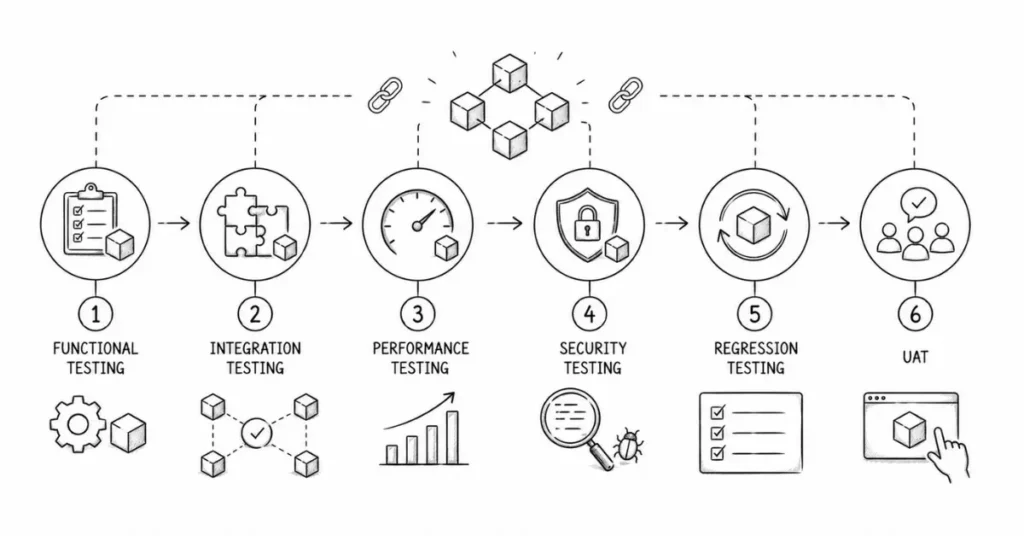
Core Testing Responsibilities
Smart Contract Functional Testing:
The highest-priority blockchain QA activity. Smart contract functional tests verify that every function behaves exactly as specified under all conditions.
This involves:
- Writing test cases covering every function’s happy path (expected behavior)
- Writing tests for edge cases (zero values, maximum values, exact boundary conditions)
- Testing failure scenarios (what happens when conditions aren’t met? Does the transaction revert correctly?)
- Verifying all state changes after every function execution
- Checking event emissions (are the right events fired with correct parameters?)
Integration Testing:
Blockchain applications involve multiple interacting smart contracts, frontend interfaces, backend APIs, and external protocols (price oracles, other DeFi protocols). Integration tests verify that these components work together correctly.
For example, testing a DeFi lending protocol might require:
- Depositing via frontend → verifying smart contract state updates → checking user balance displays correctly
- Testing liquidation: manipulating price oracle → verifying liquidation triggers → confirming liquidation proceeds go to correct addresses
- Testing across multiple contract interactions (collateral contract + lending contract + token contract)
Performance Testing:
Blockchain has unique performance constraints. QA engineers test:
- Transaction throughput under simulated load
- Gas consumption (is it within acceptable limits for users?)
- Smart contract execution time
- Frontend performance with real blockchain data (blockchain queries are slower than database queries)
Security Testing (Overlap with Auditing):
QA engineers conduct first-pass security testing before professional auditors:
- Running automated vulnerability scanners (Slither, Mythril)
- Testing access control—attempting to call admin functions as regular user
- Testing reentrancy attack vectors
- Verifying integer arithmetic correctness
- Checking for known vulnerability patterns
This isn’t a replacement for professional security audits but catches obvious issues early, reducing audit findings and costs.
Regression Testing:
After every code change, regression tests verify that existing functionality wasn’t broken. In blockchain, regression testing is critical because contract interdependencies mean changes in one contract can unexpectedly affect others.
User Acceptance Testing (UAT):
Testing the complete user experience from a non-technical perspective:
- Can a user with only a MetaMask wallet complete the core user flows?
- Is error messaging clear when transactions fail?
- Does the UI correctly reflect blockchain state changes?
- How does the application behave when MetaMask is locked, rejected, or switches networks?
Essential Testing Tools for Blockchain QA
Smart Contract Testing Frameworks
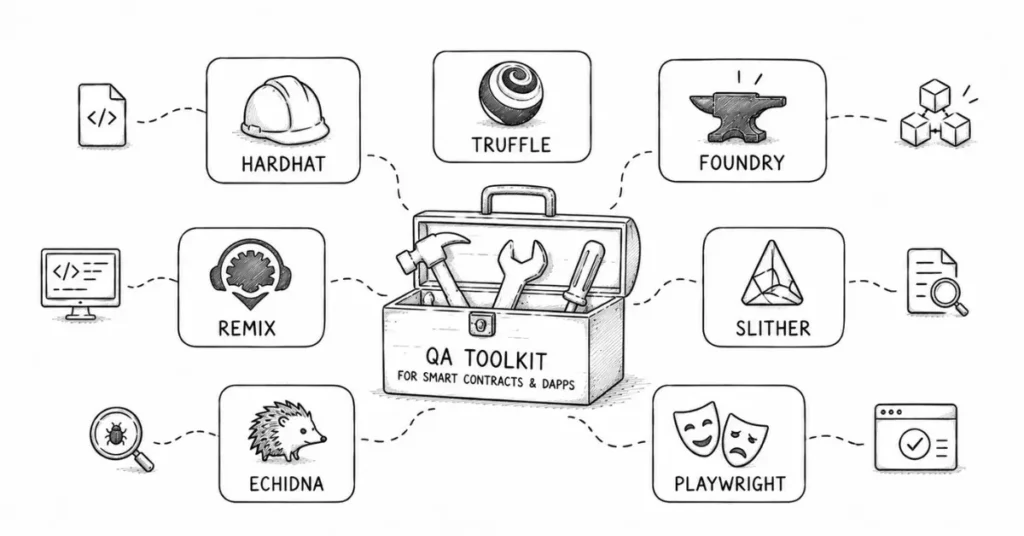
Hardhat: The most popular blockchain development and testing environment. Hardhat provides:
- Local Ethereum network for testing (Hardhat Network)
- JavaScript/TypeScript testing with Mocha/Chai
- Advanced debugging with stack traces and console.log
- Network forking (testing against real mainnet state)
- Comprehensive plugin ecosystem
Most production blockchain projects use Hardhat for testing. Learning Hardhat is essentially mandatory for blockchain QA roles.
Truffle Suite: Older framework that remains widely used, especially in enterprise blockchain contexts. Includes:
- Truffle for testing and migration
- Ganache for local blockchain
- Drizzle for frontend testing assistance
- More mature integration with some enterprise tools
Foundry: Increasingly popular modern framework with distinctive features:
- Tests written in Solidity (same language as contracts) rather than JavaScript
- Extremely fast test execution
- Built-in fuzzing capabilities
- Advanced gas reporting
- Growing adoption in DeFi protocols
Learning Foundry positions you for cutting-edge DeFi projects increasingly adopting it.
Remix IDE: Browser-based environment useful for quick contract testing and debugging during development. Less powerful for comprehensive test suites but excellent for rapid iteration.
Automated Testing and Fuzzing Tools
Echidna: Property-based fuzzing tool that generates random inputs automatically to find unexpected behaviors. Excellent for finding edge cases human testers would never think to try.
Manticore: Dynamic symbolic execution tool from Trail of Bits, exploring all possible code paths mathematically to find vulnerabilities.
Slither: Static analysis tool detecting known vulnerability patterns and code quality issues. Should be run on every smart contract as first-pass screening.
Certora Prover: Formal verification tool mathematically proving contract correctness against specified properties. Advanced but increasingly valued for high-security contracts.
Frontend and Integration Testing Tools
Selenium/Cypress: Standard web testing frameworks applicable to blockchain frontends. Test user flows including wallet connections and transaction submissions.
Playwright: Modern browser automation increasingly preferred over Selenium for its reliability and built-in support for multiple browsers.
Mock Wallets (ganache-jest, hardhat-ethers): Tools allowing automated testing of wallet interactions without manual MetaMask approval each time.
Tenderly: Advanced transaction simulation platform allowing testing of transactions against forked mainnet state before execution.
Blockchain-Specific Testing Approaches
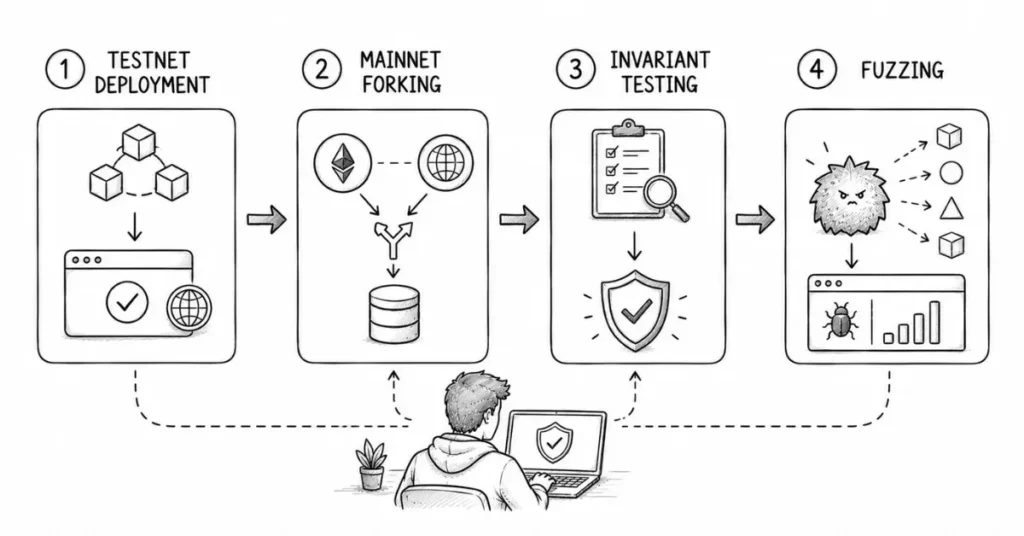
Testnet Deployment Testing:
Before mainnet, deploy to public testnets (Goerli, Sepolia, Mumbai) and conduct real-world testing:
- Test with actual MetaMask wallets on testnet
- Verify transactions on Etherscan testnet explorer
- Test with multiple users simultaneously
- Check behavior under network congestion conditions
Mainnet Forking:
Hardhat and Foundry allow forking the actual Ethereum mainnet state locally. This enables testing how your contracts interact with real deployed protocols (Uniswap, Aave, Chainlink) without spending real money.
Invariant Testing:
Define properties that should always hold true (e.g., “total token supply never exceeds maximum,” “sum of all user balances equals total supply”) and write tests verifying these invariants are maintained through all operations.
Building a Blockchain QA Career: Skills and Learning Path
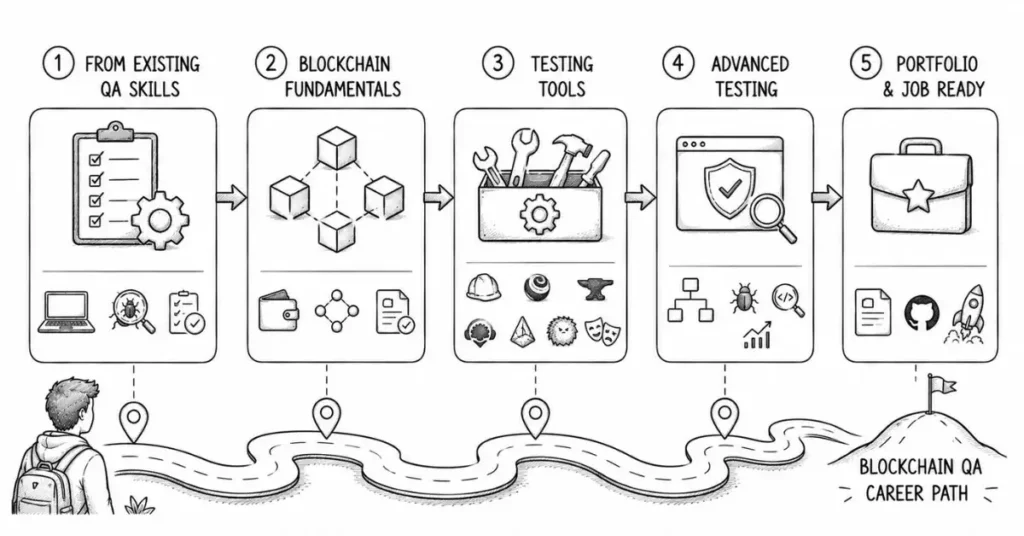
For Existing QA Engineers (3–4 Month Transition)
If you already work as a software QA engineer, your core skills—test planning, test case writing, bug reporting, regression testing—transfer directly. You need to add:
Month 1: Blockchain Fundamentals
- Complete a blockchain basics course understanding what smart contracts are, how they work, and what makes blockchain testing different
- Install MetaMask, interact with testnet dApps, observe how blockchain transactions differ from API calls
- Learn Solidity basics enough to read contract code—you don’t need to write it, but you must understand what you’re testing
Month 2: Smart Contract Testing Tools
- Complete Hardhat documentation and official tutorial
- Write test suites for practice contracts from scratch
- Learn to use Slither for automated scanning
- Practice writing Mocha/Chai tests for Solidity contracts
Month 3: Advanced Testing and Integration
- Learn Foundry for fuzzing and advanced testing
- Practice testing DeFi protocols using mainnet forking
- Build integration tests combining smart contracts and frontend
- Study common smart contract vulnerabilities to know what to look for
Month 4: Portfolio Project
- Build comprehensive test suite for a DeFi protocol (simple lending or DEX)
- Document test coverage metrics and testing methodology
- Write postmortem analysis of what bugs your tests caught
- Begin applying to blockchain QA positions
For Complete Beginners (6–8 Months)
Build software QA foundations simultaneously with blockchain knowledge:
- Month 1–2: Software testing fundamentals (ISTQB Foundation curriculum)
- Month 2–3: JavaScript/Python for test automation
- Month 3–4: Web application testing (Selenium or Cypress)
- Month 4–6: Blockchain fundamentals + smart contract testing
- Month 6–8: Advanced blockchain testing and portfolio building
Specialization Areas in Blockchain QA
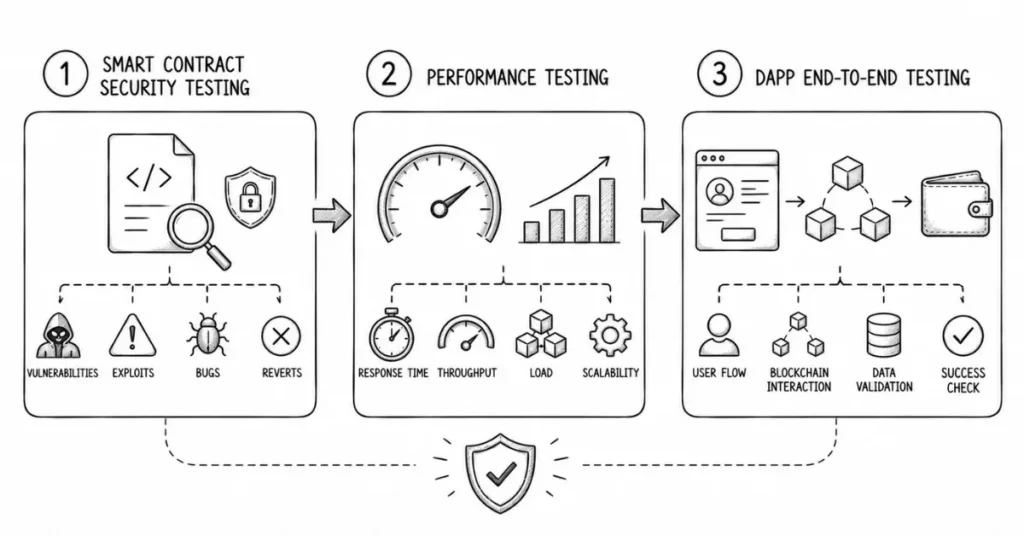
Smart Contract Security Testing
Bridging QA and security, these specialists focus specifically on finding security vulnerabilities through testing methodology:
- Systematic vulnerability class testing
- Attack simulation testing
- Economic attack modeling and testing
- Formal specification and verification
This specialization commands the highest QA compensation: ₹14–22 lakhs in India, $60,000–90,000 internationally.
Performance and Scalability Testing
With blockchain scaling remaining a challenge, performance QA specialists test:
- Transaction throughput under load
- Gas efficiency optimization testing
- Layer 2 solution performance characteristics
- Network behavior under congestion
Valuable for blockchain infrastructure companies and exchanges handling high transaction volumes.
dApp End-to-End Testing
Frontend-focused QA specialists testing complete user journeys:
- Wallet integration testing across different wallets
- Multi-browser and mobile testing
- Cross-network testing (Ethereum, Polygon, BNB Chain)
- User experience testing under real blockchain conditions (slow confirmations, failed transactions)
Good entry point for QA engineers with web testing background transitioning to blockchain.
Salary Structure and Career Progression
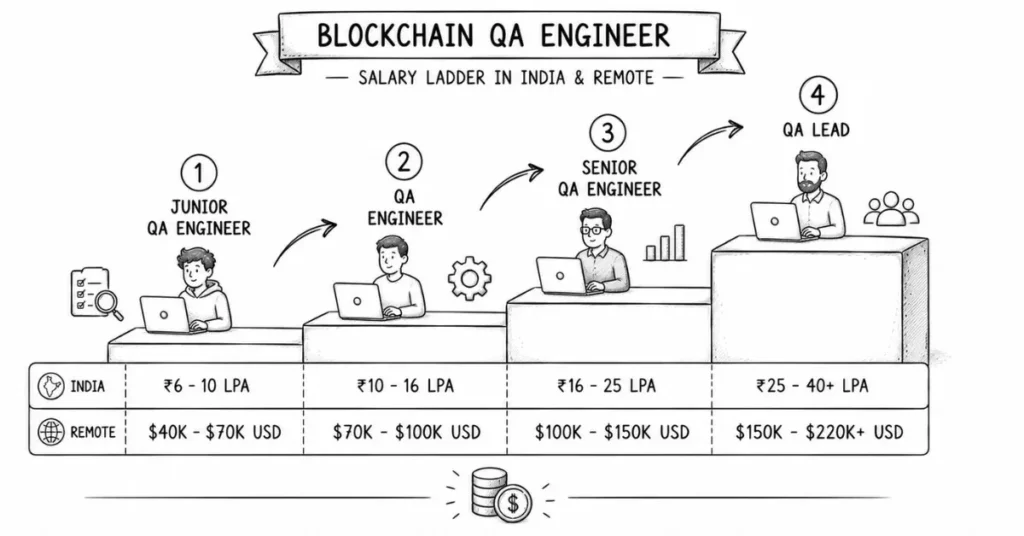
Junior Blockchain QA Engineer (0–2 Years): ₹6–10 lakhs
- Execute existing test plans and report findings
- Learn testing tools under guidance
- Maintain and update regression test suites
Blockchain QA Engineer (2–4 Years): ₹10–15 lakhs
- Design comprehensive test strategies independently
- Build automated test frameworks
- Coordinate with developers on bug fixes
Senior Blockchain QA Engineer (4–7 Years): ₹15–22 lakhs
- Define QA standards for entire organization
- Lead security testing initiatives
- Mentor junior QA engineers
- Contribute to architectural decisions affecting testability
QA Lead / Head of Quality (7+ Years): ₹22–35+ lakhs
- Set quality philosophy and standards
- Build and manage QA teams
- Represent quality in product strategy decisions
International Remote Positions: $45,000–90,000 depending on experience and specialization.
Challenges in Blockchain QA Careers
Challenge 1: Incomplete Test Coverage Anxiety
No test suite catches every possible vulnerability. In high-stakes financial contracts, this creates genuine anxiety about what tests might be missing.
Solution: Adopt multiple complementary testing approaches—unit tests, integration tests, automated fuzzing, invariant testing. Understand that test coverage is risk reduction, not risk elimination. Document testing scope clearly so stakeholders understand limitations.
Challenge 2: Rapidly Evolving Testing Tools
Blockchain testing tools evolve rapidly. Foundry emerged as a major alternative to Hardhat/Truffle relatively recently and is gaining dominance.
Solution: Learn foundational testing concepts that transfer across tools. Stay connected to developer communities where tool adoption trends emerge early. Maintain profiles on GitHub showing continuous tool learning.
Challenge 3: Testing Non-Deterministic Systems
Blockchain introduces time-dependent behavior, random number generation, and cross-contract interactions that make testing inherently more complex than traditional software.
Solution: Use deterministic testing environments (Hardhat Network allows controlling block timestamps and other parameters). Mock external dependencies. Use snapshot and restore capabilities to create reproducible test states.
Conclusion: Building Quality Into Blockchain's Foundation
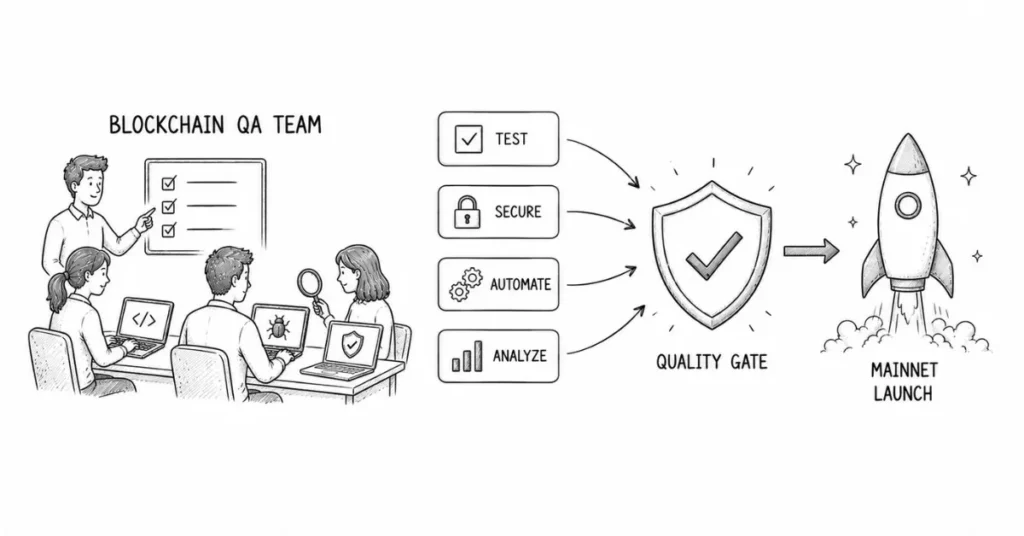
Blockchain QA engineers prevent disasters—quietly, systematically, without fanfare. When a DeFi protocol launches without incident, handles millions of dollars securely, and delivers seamless user experiences, skilled QA professionals made that possible.
India’s growing blockchain development ecosystem creates strong demand for QA professionals who understand both traditional testing practices and blockchain-specific challenges. With clear career progression from ₹6–10 lakhs entry level to ₹20+ lakhs senior roles, plus international remote opportunities for those building deep expertise, blockchain QA offers a stable, impactful, and well-compensated career path.
Start your journey today: install Hardhat, deploy a simple smart contract to a local test network, and write your first five test cases. This small technical exercise begins building the skills that protect blockchain users worldwide—and builds a career that rewards your thoroughness generously.