
Blockchain Project Manager Career : Web3 Leadership Guide
Table of Contents
Introduction : The Person Who Makes Blockchain Projects Actually Happen
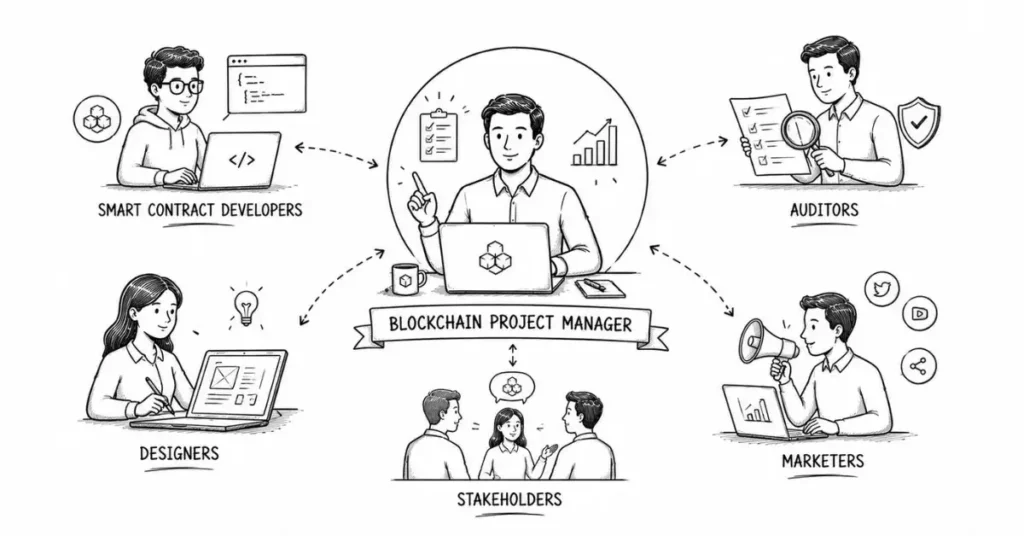
Here’s a truth most people in tech don’t openly admit: brilliant engineers with exceptional technical skills routinely fail to deliver projects on time, within budget, and to the right quality standards not because of technical limitations, but because of coordination failures. In blockchain, where teams are often globally distributed, development is highly complex, and stakeholders range from anonymous DAO members to Fortune 500 executives, this coordination challenge is amplified tenfold.
That’s exactly where blockchain project managers become indispensable. They are the professionals who transform technical capability into delivered products. They manage timelines, resolve conflicts, communicate progress, remove blockers, and ensure that smart contract developers, frontend engineers, security auditors, marketing teams, and business stakeholders all move in the same direction at the same time.
The financial rewards reflect this importance. Globally, Web3 project managers earn an average of $122,000 annually, with a range from $65,000 to $185,000. Blockchain and cryptocurrency startup PMs earn an average of $106,000 with ranges from $18,000 to $279,000 depending on company stage and location. In India, domestic blockchain PM roles pay ₹10–22 lakhs, while international remote PM positions actively hiring from Bangalore and other Indian cities pay $68,000–$148,000 at companies like Tether, Xalts, and FalconX.
What makes this career path particularly accessible is the entry requirement: you don’t need to be a blockchain developer. If you have project management experience from any technical domain software development, IT infrastructure, product management you can transition into blockchain project management within 3–4 months of focused upskilling. Your existing coordination skills are the foundation; blockchain knowledge is the specialized layer you add.
This comprehensive guide covers what blockchain project managers do, the unique challenges of Web3 environments, required skills, how to make the transition, and how to build a successful career managing blockchain projects at any scale.
What Blockchain Project Managers Do
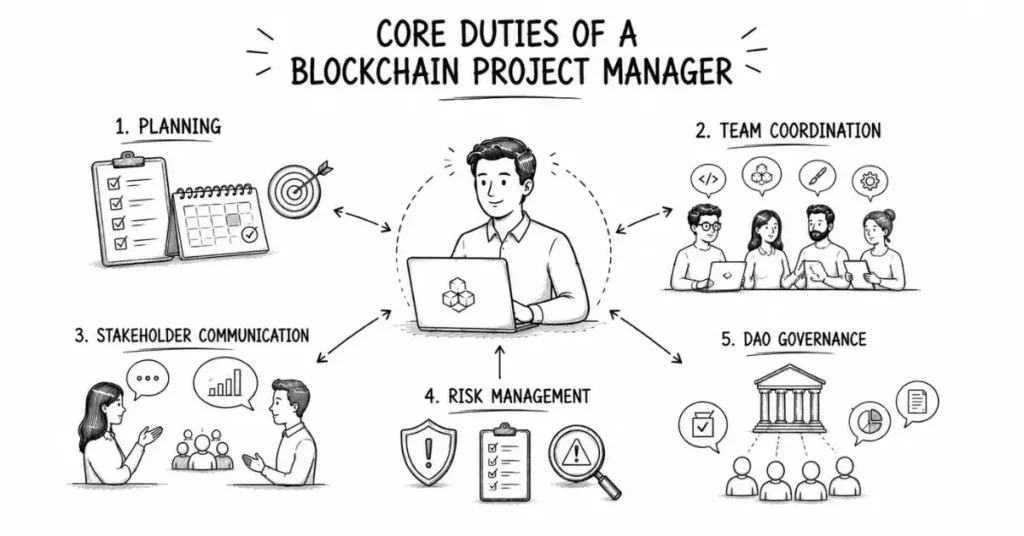
Core Responsibilities
Project Planning and Scoping:
Every blockchain project begins with defining what will be built, in what sequence, and to what specifications. PMs work with product owners and technical leads to break ambitious visions into concrete deliverables, realistic timelines, and measurable milestones.
Blockchain projects have unique scoping challenges:
- Smart contract audits add 2–4 weeks to every major release
- Testnet deployment and community testing phases are non-negotiable
- Regulatory compliance reviews may be required before certain features launch
- External dependencies (oracle integrations, partner protocol upgrades) are outside your control
Experienced blockchain PMs build these realities into every project plan from Day 1.
Team Coordination Across Disciplines:
A typical blockchain project team might include:
- Smart contract developers writing Solidity
- Frontend developers building the dApp interface
- Backend engineers managing APIs and off-chain infrastructure
- Security auditors reviewing contracts before deployment
- DevOps engineers managing nodes and deployment pipelines
- UI/UX designers creating user interfaces
- Marketing teams preparing launch campaigns
- Community managers briefing Discord on incoming changes
Each group has different working styles, vocabularies, and priorities. The PM ensures they all understand how their work connects, when handoffs happen, and what blockers exist across the entire chain.
Stakeholder Communication:
Blockchain projects often have multiple stakeholder groups with different information needs:
- Technical team: Detailed sprint goals, technical blockers, architecture decisions
- Executive leadership: Budget status, milestone progress, risk flags
- Investors: High-level progress, market positioning, timeline to launch
- Community (DAO context): Transparent updates via Discord, governance forums, Twitter
- Partners: Integration timelines, API specifications, joint marketing opportunities
Managing these communication streams simultaneously—with the right level of detail for each audience—is one of the most demanding and valuable PM skills in blockchain.
Risk Management:
Blockchain projects carry risks traditional software projects don’t:
- Smart contract vulnerability discoveries requiring scope changes
- Gas price spikes affecting product economics
- Regulatory announcements impacting product legality
- Partner protocol exploits affecting integrations
- Token price volatility affecting team morale and token compensation value
Blockchain PMs must identify, assess, and create mitigation plans for these unique risks.
DAO Governance Management:
In decentralized autonomous organizations, major decisions require community votes. PMs working in DAO contexts must:
- Draft governance proposals clearly enough for non-technical community members to evaluate
- Manage community feedback and incorporate legitimate concerns
- Coordinate implementation of approved proposals
- Communicate timelines and progress back to token holders
- Navigate the slower decision-making pace of decentralized governance while maintaining momentum
This governance dimension makes blockchain PM genuinely different from traditional software PM.
Agile in Web3: What Changes and What Stays the Same
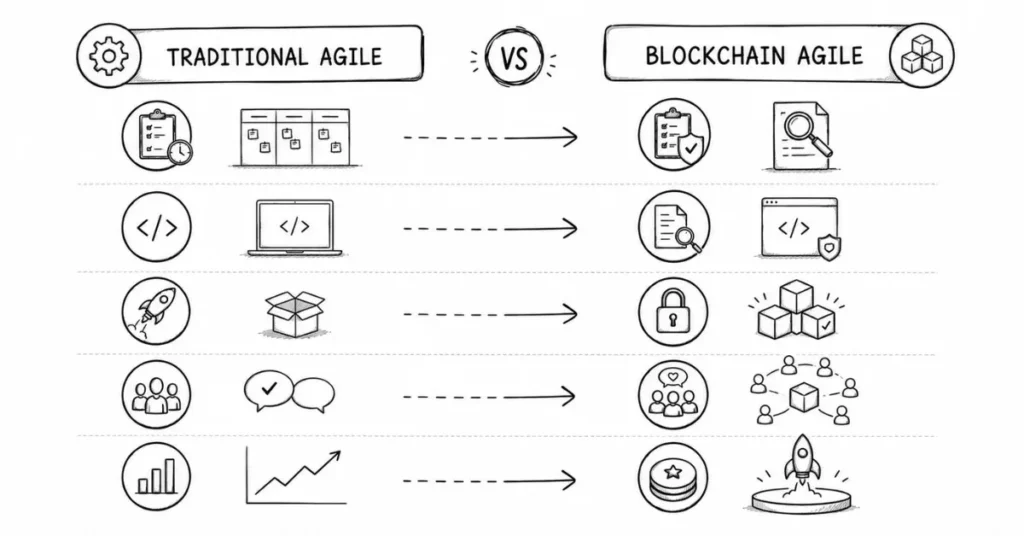
Adapting Traditional Agile for Blockchain
Most software teams use Agile frameworks—Scrum, Kanban, or hybrid approaches. Blockchain development uses these same frameworks but with important adaptations.
What Stays the Same:
- Sprint cycles (typically 2-week sprints work well for smart contract development)
- Daily standups (critical for distributed global teams)
- Sprint reviews and retrospectives
- Backlog grooming and story point estimation
- Definition of “Done” criteria for each user story
What Changes Significantly:
Security Reviews as First-Class Deliverables:
In traditional software, security review is often an afterthought. In blockchain, internal security review and external audit are mandatory milestones before any mainnet deployment. Every sprint plan must account for security review time.
Immutable Deployments Require Higher Quality Gates:
Traditional software teams can push hotfixes within hours. Smart contract bugs often require expensive migrations or remain permanently. Quality gates before deployment must be stricter—100% test coverage requirements, multiple review approvals, extended testnet periods.
Community as Stakeholder:
Traditional Agile has product owners representing users. In blockchain, especially DeFi and DAO projects, the community directly participates in product direction through governance. PMs must incorporate community feedback loops into Agile ceremonies.
Audit Sprint Integration:
Before major releases, teams dedicate an “audit sprint” where developers support external security auditors—answering questions, providing documentation, and addressing preliminary findings. This sprint breaks normal development flow and must be planned separately.
Token Launch Coordination:
Projects with token launches have an entirely separate coordination workstream—legal review, exchange listing negotiations, liquidity bootstrapping, marketing campaigns—that runs parallel to technical development. Managing these interdependencies requires sophisticated project planning.
Essential Skills for Blockchain Project Managers
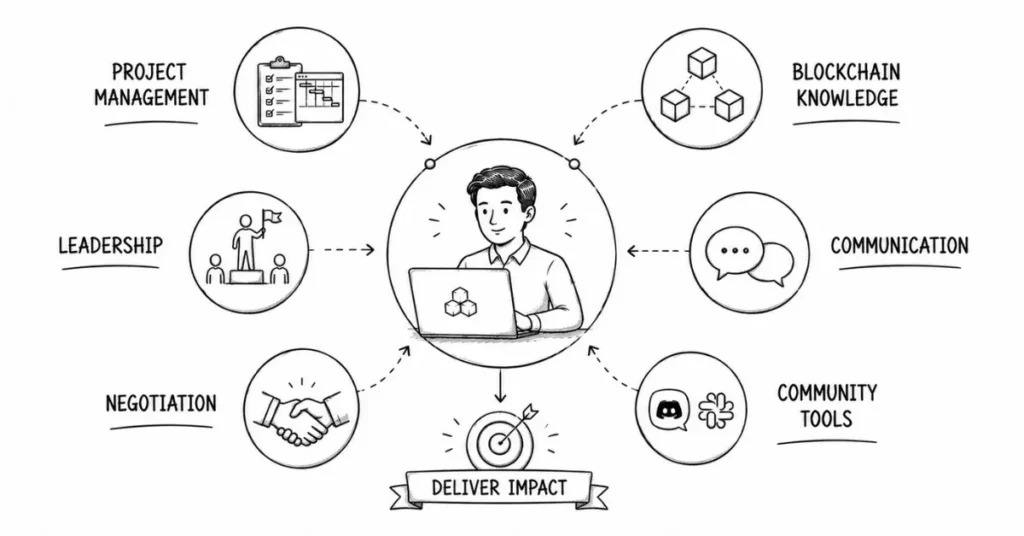
Project Management Foundation
PMP (Project Management Professional) Knowledge:
Understanding of traditional project management principles—scope, time, cost, quality, risk, communication, stakeholder management—provides the foundation. You don’t necessarily need PMP certification, but understanding the framework helps.
Agile Certification:
Certified Scrum Master (CSM) or PMI-ACP (Agile Certified Practitioner) demonstrates structured Agile knowledge. These certifications are recognized across blockchain companies and add credibility to your profile.
JIRA and Project Management Tools:
Most blockchain teams use JIRA, Linear, or Notion for project tracking. Proficiency in at least one is expected. Many Web3-native teams use Notion for its flexibility with DAO documentation.
OKR (Objectives and Key Results) Framework:
Many blockchain protocols use OKRs for setting and tracking goals. Understanding how to set measurable objectives and track key results helps align team work with strategic goals.
Blockchain-Specific Knowledge
Smart Contract Development Lifecycle:
You don’t need to write Solidity, but you must understand the lifecycle: design → coding → internal review → testing → audit → testnet deployment → community testing → mainnet deployment. Misunderstanding this process leads to unrealistic timelines that damage team credibility.
Development Tool Familiarity:
Knowing your way around GitHub (PRs, branches, CI/CD), Hardhat development environment, testnet faucets, and Etherscan helps you understand technical progress and blockers more accurately.
DeFi and Web3 Product Categories:
Understanding what different blockchain products do—DEXs, lending protocols, NFT platforms, DAOs, bridges—helps you ask the right questions, understand technical complexity, and communicate intelligently with both engineers and stakeholders.
Gas Economics:
Understanding how gas fees affect product design decisions. A feature that’s technically elegant but costs users $50 in gas per transaction needs redesigning. PMs who understand gas economics prevent costly late-stage product changes.
Community Tools:
Proficiency with Discord (server management, roles, announcements), Snapshot (decentralized voting), Discourse (governance forums), and Twitter/X (community communications) is essential for Web3 PM roles.
Leadership and Soft Skills
Remote Team Management:
Blockchain teams are almost universally distributed across time zones. Managing async communication, ensuring no team member is blocked waiting for responses across time zones, and building team cohesion without physical presence are core PM skills in Web3.
Conflict Resolution:
Disagreements between technical and product priorities are constant. Security researchers and developers often have different risk appetites. Community members and core team may disagree on direction. PMs navigate these conflicts diplomatically while keeping projects moving.
Written Communication Excellence:
Blockchain teams communicate primarily through written channels—Slack, Discord, Notion, GitHub. Exceptional written clarity reduces misunderstandings, accelerates decisions, and builds team confidence.
Negotiation:
PMs negotiate scope with product owners, timelines with engineering leads, audit schedules with security firms, and integration timelines with partner protocols. Negotiation skills directly affect project outcomes.
Building Your Blockchain PM Career
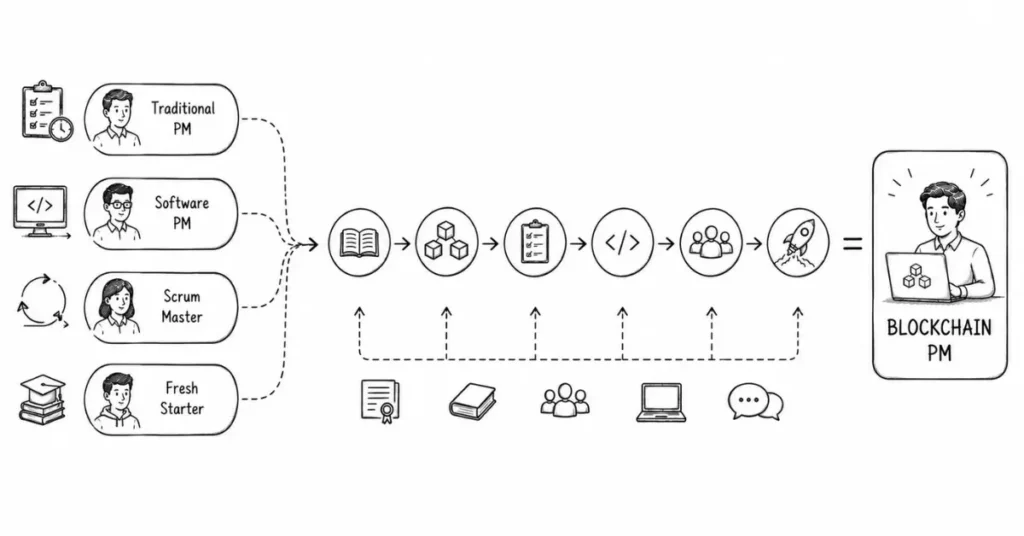
Transition Path from Traditional Project Management
If you’re currently a software PM, IT PM, or Scrum Master at a traditional tech company, your transition to blockchain is straightforward:captiare+1
Month 1: Blockchain Immersion
- Complete a blockchain fundamentals course (not coding-focused—look for business/product perspective courses)
- Join 5–10 blockchain project Discord servers and observe how they communicate updates
- Read 3–5 post-mortems of blockchain project failures (delays, hacks, governance crises)—understand what went wrong from a PM perspective
- Set up MetaMask, use a DeFi protocol, participate in a DAO vote—experience the user journey firsthand
Month 2: Framework Adaptation
- Map your existing PM skills onto blockchain contexts: “My sprint planning experience translates to managing audit sprints by adding X days for security review”
- Study how a real blockchain protocol manages their development publicly (many post roadmaps and release notes on GitHub)
- Learn JIRA or Notion for blockchain project contexts
- Study governance frameworks: how Uniswap, Aave, and Compound manage DAO governance
Month 3: Portfolio and Network
- Contribute to an open-source blockchain project’s project management—offer to manage their GitHub issues, create project boards, write release documentation
- Attend ETHIndia or local blockchain meetups to build network
- Write LinkedIn articles sharing your traditional PM perspective on blockchain challenges
- Update resume highlighting transferable skills with blockchain framing
Month 4: Active Job Search
- Apply to PM roles at Indian Web3 companies and international remote positions
- Prepare for interviews with blockchain-specific PM scenarios
- Leverage network from meetups and Discord communities
Starting Fresh in PM (No Prior PM Experience)
If you’re new to both blockchain and project management, build the foundation first:
Phase 1 (3 months): Get Scrum Master certification (CSM from Scrum Alliance). Work on traditional software PM internships or junior roles to build base competency.
Phase 2 (2–3 months): Add blockchain knowledge using path above.
Phase 3 (ongoing): Seek PM roles at early-stage blockchain startups where you take on more responsibility faster. Startup blockchain companies often promote based on demonstrated performance rather than years of experience.
Career Progression and Salary Structure
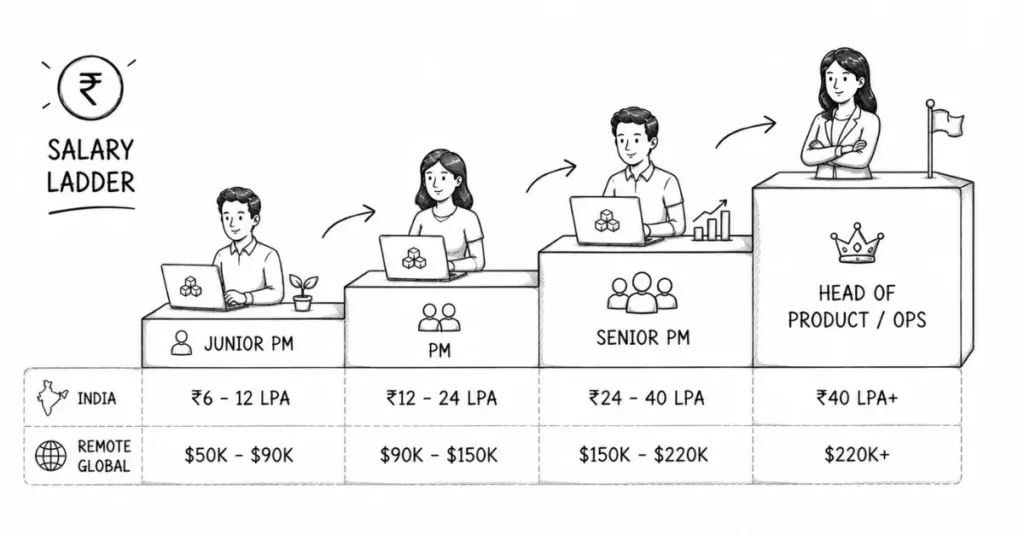
Career Ladder in Blockchain PM
Junior PM / Scrum Master (0–2 Years): ₹8–12 lakhs (India)
- Manage sprint ceremonies and tracking
- Coordinate specific teams (e.g., smart contract team only)
- Learn blockchain development lifecycle under senior PM guidance
Project Manager (2–4 Years): ₹12–18 lakhs (India), $65,000–90,000 (international remote)
- Own complete project delivery from scoping to launch
- Manage multiple stakeholder groups simultaneously
- Handle audit coordination and community communication
Senior PM / Program Manager (4–7 Years): ₹18–25 lakhs (India), $90,000–150,000 (international)wellfound+1
- Manage multiple simultaneous projects or protocol workstreams
- Set PM processes and standards for growing teams
- Strategic input on product roadmap
Head of Product/VP of Engineering Operations (7+ Years): ₹25–45+ lakhs (India), $150,000–185,000+ (international)
- Define organizational delivery framework
- Manage team of PMs
- C-suite reporting and strategic planning
International Remote Opportunities:
Companies actively hiring India-based PMs with exceptional global compensation:
- Tether (Bangalore): $115,000–$148,000 for product manager roles
- Xalts (Bengaluru): $68,000–$148,000
- FalconX (Bangalore): $80,000–$107,000
- Mastercard Web3 (Gurgaon): $72,000 for Web3 PM roles
These salaries are 3–4x equivalent domestic Indian PM salaries, making international remote positions extremely attractive.
Unique Challenges in Blockchain PM
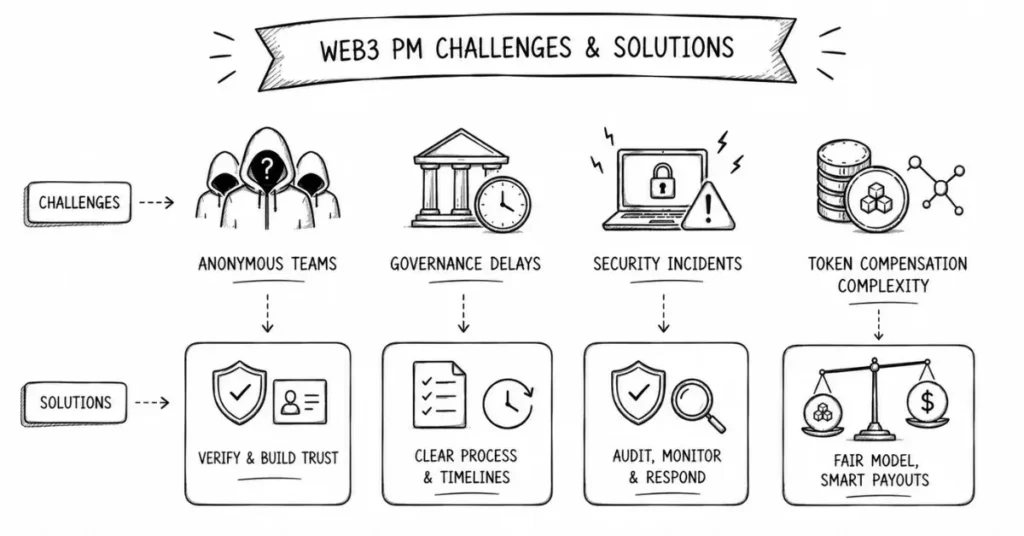
Challenge 1: Managing Anonymous Teams
Many blockchain teams include pseudonymous contributors—developers and community members known only by usernames. Traditional HR and performance management frameworks don’t apply.
Solution: Focus on output quality and contribution consistency rather than identity. Use GitHub contributions, Discord participation, and deliverable completion as performance indicators. Build culture of documentation that makes contributions transparent regardless of contributor identity.
Challenge 2: Community Governance Delays
In DAO-governed projects, a PM might prepare a feature for launch, only to have governance votes reject or delay it indefinitely. This unpredictability disrupts traditional project planning.
Solution: Build governance milestones into project plans early. Engage community stakeholders during design phases rather than just at approval stage. Develop contingency plans for both approval and rejection scenarios.
Challenge 3: Security Incidents During Projects
Exploits in partner protocols, unexpected vulnerabilities discovered late, or market events can force immediate project pivots regardless of existing sprint commitments.
Solution: Build buffer time into all project plans. Develop incident response protocols in advance. Maintain clear escalation paths for security-triggered scope changes.
Challenge 4: Token Compensation Complexity
Team members receiving token compensation alongside salary have financial interests that align with project success—which is positive—but also creates pressure to launch before adequate security review when token prices are high.
Solution: Establish immovable quality gates for security reviews. Frame rushed launches as creating long-term token value destruction through hack risk. Align incentives by tying token vesting to post-launch stability milestones rather than just launch date.
Conclusion: The Conductor of Blockchain's Orchestra
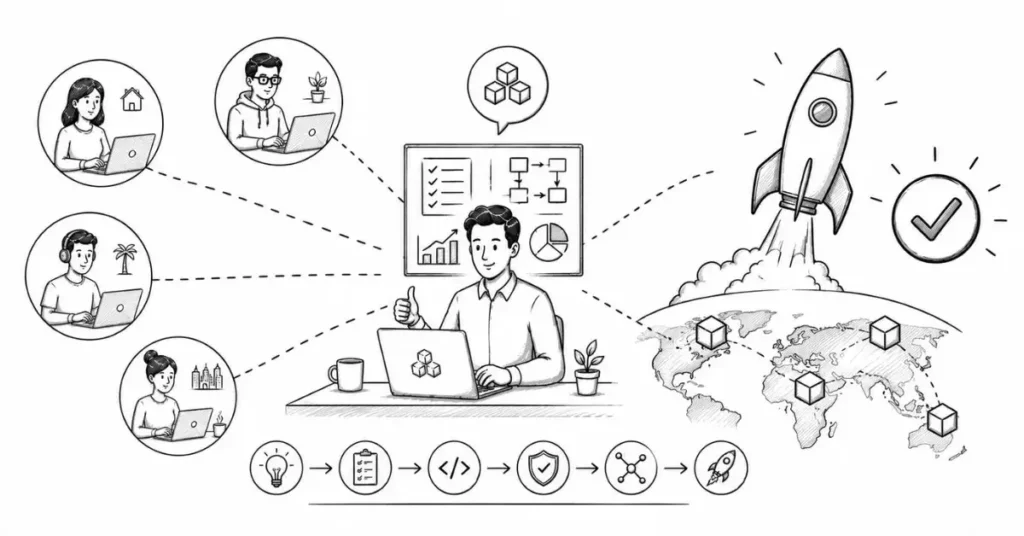
Every successful blockchain project every DEX that launched cleanly, every DeFi protocol that deployed without incident, every NFT collection that sold out seamlessly had a project manager ensuring hundreds of moving parts aligned at the right moment. This coordination work is invisible when done well and catastrophic when absent.
With global Web3 PM salaries averaging $122,000 and Indian tech professionals increasingly competitive for international remote positions, blockchain project management offers exceptional career rewards for those willing to combine traditional PM skills with blockchain-specific knowledge. Whether you’re transitioning from traditional PM roles, making the jump from engineering into management, or building fresh from the ground up, the path is clear and the demand is strong.
Start today: join a blockchain project’s Discord community and observe how they communicate. Study a failed blockchain project launch and identify what PM practices could have prevented the failure. Update your resume to highlight how your existing skills transfer to Web3 contexts. The blockchain projects of tomorrow need experienced coordinators today and that opportunity is yours to seize.