
Satellite Communication Jobs in India
Table of Contents
Introduction:

When a fishing boat off the coast of Kerala sends a distress signal, a satellite receives it. When a school in a remote village in Arunachal Pradesh connects to an online class, a satellite makes it possible. When India’s defence forces communicate in areas with no mobile tower, they use satellite links.
Satellite communication is not glamorous in the way rocket launches are. It does not make headlines as often. But it is arguably the most practically impactful application of space technology in daily Indian life and it is one of the fastest-growing career areas in the country’s space sector.
This guide covers everything you need to know about building a career in satellite communications in India: what the work involves, which roles exist, who is hiring, what they pay, and how you get started.
What Is Satellite Communication?
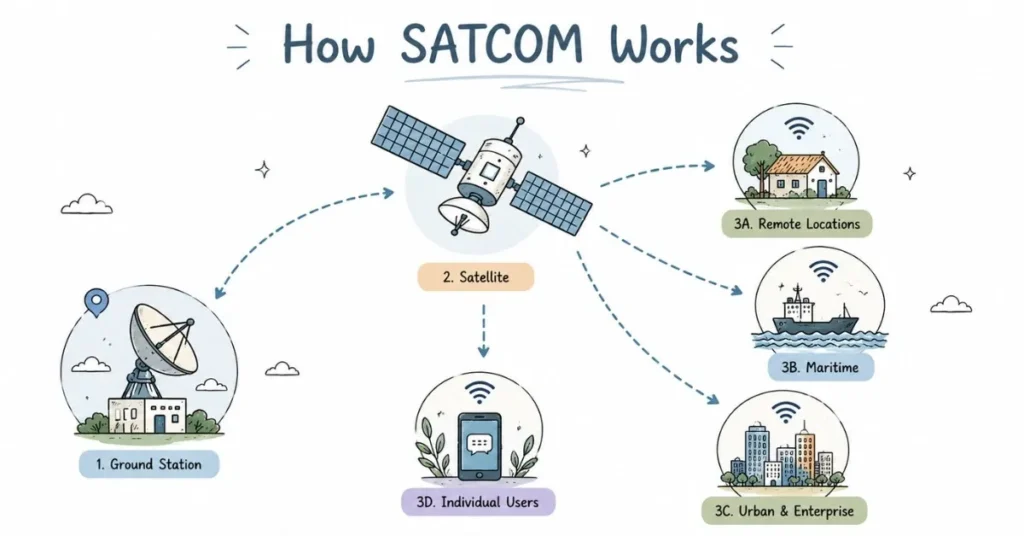
Satellite communication (SATCOM) is the use of satellites to transmit signals voice, data, video, broadband internet between locations on Earth that cannot be easily connected through ground-based infrastructure.
India has a particular need for SATCOM. With a geography that includes remote Himalayan villages, island territories, dense forests, and deep ocean shipping lanes, ground-based telecommunications simply cannot reach everywhere. Satellites bridge that gap.
India’s SATCOM sector serves several distinct application areas:
- Broadcasting: DTH (Direct-to-Home) television services; India has over 40 million DTH subscribers
- Internet connectivity: Broadband for rural areas, remote enterprises, ships, and aircraft
- Defence communications: Secure encrypted links for military operations
- Disaster management: Emergency communication when ground infrastructure is destroyed
- Banking and financial services : VSAT networks connecting rural ATMs and bank branches
- Navigation: NavIC, India’s own satellite navigation system, built and operated by ISRO
Each of these application areas creates its own set of jobs.
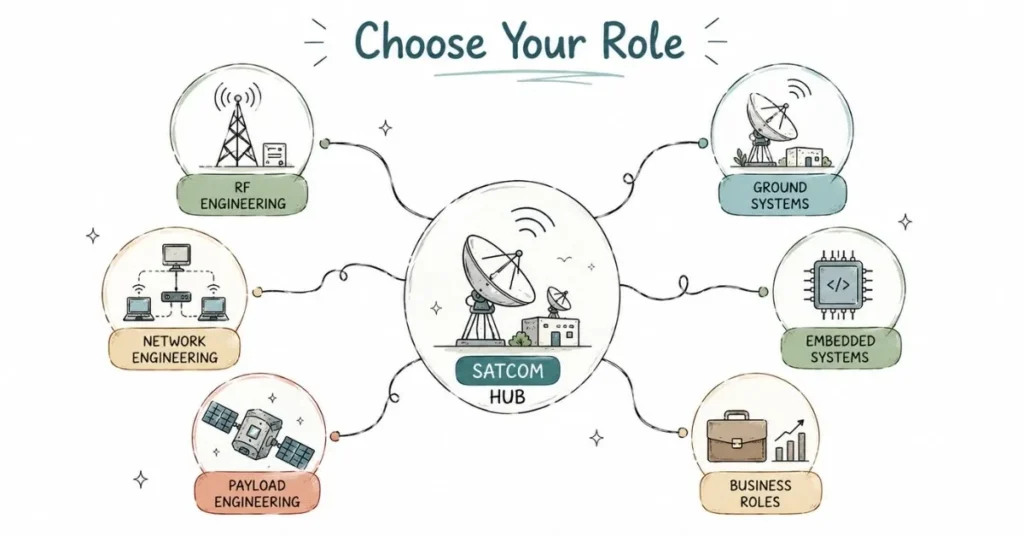
Key Job Roles in Satellite Communication
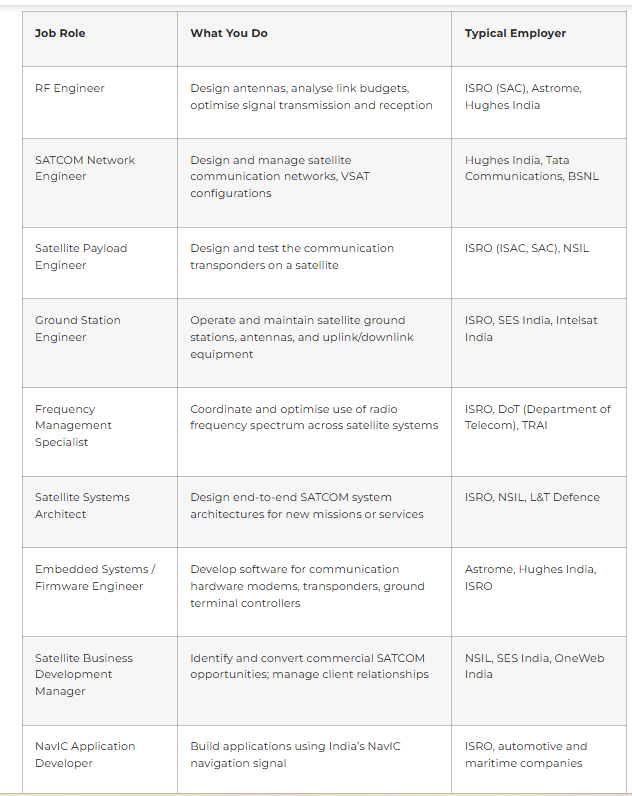

India's Satellite Communication Sector Why It Is Growing Now
Three developments are driving rapid growth in India’s SATCOM job market:
- Satellite broadband is finally becoming real in India.
Global operators like OneWeb (now Eutelsat OneWeb), Starlink, and Amazon Kuiper are entering or preparing to enter the Indian market. ISRO’s own GSAT satellites and HTS (High Throughput Satellites) are expanding rural broadband. Astrome Technologies is building India’s own millimetre-wave satellite broadband solution. Every operator needs ground infrastructure, network engineers, and support teams in India. - NavIC is expanding.
India’s homegrown navigation satellite system (NavIC) is being mandated in more devices smartphones, vehicles, maritime transponders. This creates a growing market for NavIC chip designers, application developers, and integration engineers across industries well beyond the space sector itself. - Defence SATCOM spending is rising.
India’s defence forces are rapidly expanding their satellite communication capabilities both for domestic operations and as part of broader space defence investments. DRDO, HAL, and private defence contractors all have active SATCOM-related hiring pipelines.
Top Companies Hiring in Satellite Communication India
ISRO SAC (Space Applications Centre, Ahmedabad)
SAC is the primary centre for satellite communication payload design in India. RF engineers, antenna specialists, and communication payload engineers are the backbone of SAC’s workforce. Entry is through ICRB recruitment.
NSIL (NewSpace India Limited)
NSIL manages commercial satellite communication services leasing transponder capacity on ISRO’s GSAT satellites to broadcasters and internet service providers. As NSIL grows its commercial operations, it needs satellite operations engineers, commercial managers, and technical sales professionals.
Astrome Technologies (Bengaluru)
One of India’s most interesting SATCOM startups. Astrome is building a millimetre-wave broadband satellite system designed to deliver gigabit internet across India. They hire RF engineers, systems engineers, and embedded software developers. Well-funded and growing.
Hughes Network Systems India (Hughes India)
Hughes India operates one of the largest VSAT networks in the country, providing broadband connectivity to enterprises, banks, and government institutions in remote areas. They hire SATCOM network engineers, ground station operations staff, and technical support professionals regularly.
Tata Communications
Operates satellite bandwidth and managed SATCOM services for enterprise clients. Their satellite division hires network engineers and commercial managers.
SES India
SES is a global satellite operator with India operations. They lease capacity on their global fleet to Indian broadcasters and enterprise clients. Hires commercial and technical roles from their Gurugram office.
BSNL Satellite Services
BSNL operates VSAT and satellite broadband services for rural areas under government schemes. Regularly hires network operations and technical staff.
Bharti Airtel OneWeb India
Airtel has a major stake in OneWeb’s Low Earth Orbit (LEO) broadband constellation. Their India operations team is actively building the ground infrastructure and commercial partnerships to launch satellite broadband services. Hires across network engineering, commercial, and regulatory roles.
L&T Defence
Builds military communication systems including satellite communication terminals and networks for India’s armed forces.
Salary in Satellite Communication Roles India
Fresher (0–2 years)
- ISRO SAC / government: ₹56,100/month base + allowances
- Private companies (Hughes India, Astrome, Tata Communications): ₹5–8 LPA
- Defence contractors (L&T, BEL): ₹5–8 LPA
Mid-level (3–7 years)
- Government/PSU: ₹12–20 LPA equivalent total compensation
- Private sector: ₹14–25 LPA
- Specialised RF roles command a premium: ₹18–28 LPA at this experience level
Senior (7+ years)
- Private sector and MNCs: ₹28–45 LPA
- Business development and commercial roles at global operators: ₹30–50 LPA
RF engineering is a particularly valuable specialisation. Experienced RF engineers with satellite link budget expertise, antenna design skills, and familiarity with space communication standards (CCSDS, DVB-S2X) are consistently among the highest-paid technical profiles in the satellite sector.
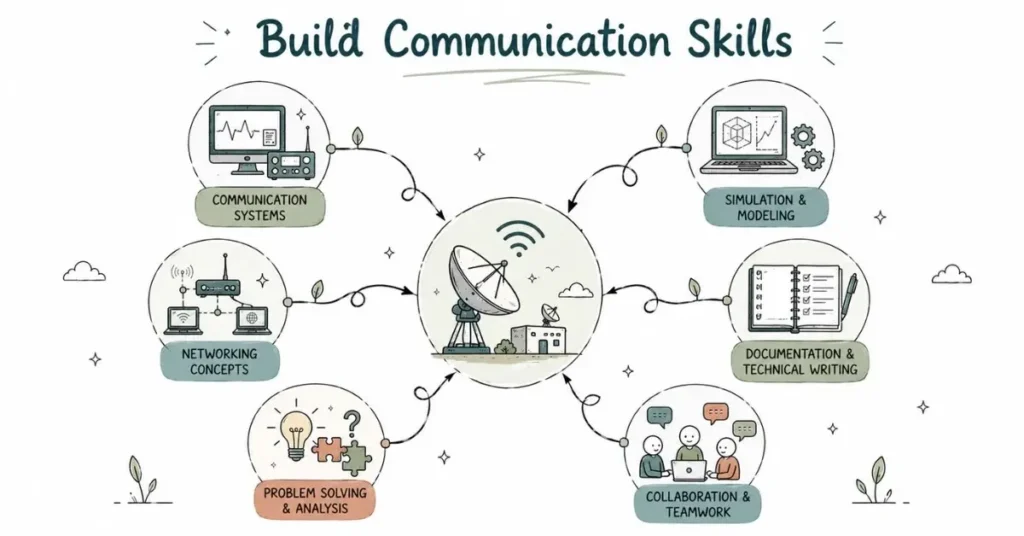
Skills You Need to Build
Technical skills:
- RF and antenna fundamentals link budget analysis, Friis transmission equation, antenna gain and beamwidth, interference analysis. These are the core skills for most SATCOM roles.
- Communication protocols and standards DVB-S2 and DVB-S2X (the standards used for satellite broadband); CCSDS (Consultative Committee for Space Data Systems standards used in spacecraft communication); VSAT network protocols.
- RF simulation tools HFSS (High-Frequency Structure Simulator) and CST Studio Suite for antenna design; STK for link analysis; MATLAB for signal processing and system modelling.
- Signal processing Modulation schemes (BPSK, QPSK, 16-APSK), error correction coding, spread spectrum techniques. Relevant for both payload and ground terminal engineering.
- Network management For VSAT and SATCOM network roles: IP networking fundamentals, network monitoring tools, bandwidth management.
- NavIC-specific knowledge If targeting NavIC application roles: GNSS receiver design, signal acquisition and tracking, positioning algorithms.
Soft skills that matter:
- Regulatory awareness satellite communication is heavily regulated by TRAI (Telecom Regulatory Authority of India), DoT (Department of Telecommunications), and ITU (International Telecommunication Union) globally. Understanding the regulatory environment is a genuine differentiator.
- Technical writing link budget reports, system design documents, test procedures.
- Cross-functional coordination SATCOM systems involve hardware, software, network, and regulatory teams working simultaneously.
How to Break Into Satellite Communication Step by Step
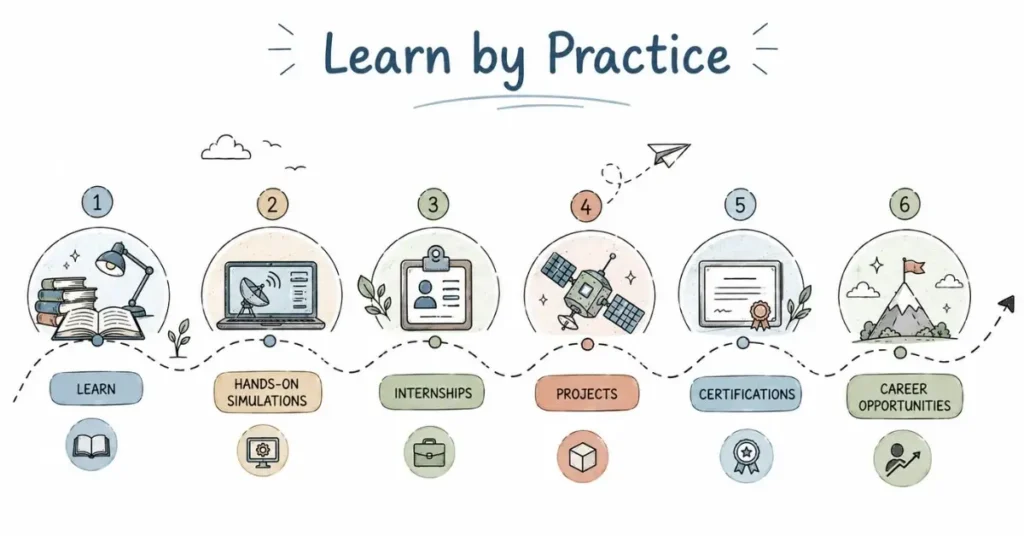
Step 1: Get the right degree
ECE (Electronics and Communication Engineering) is the primary entry point for technical SATCOM roles. Physics graduates with a strong electronics background can also enter payload and RF roles. For network and commercial roles, ECE or computer science backgrounds both work.
Step 2: Build RF fundamentals in college
Most ECE curricula cover communication theory, but few go deep on satellite-specific RF. Supplement your coursework with:
- NPTEL courses on antenna and wave propagation (free, high quality)
- Online courses on satellite communication systems (available on Coursera and edX from institutions like TU Delft)
- IEEE Xplore papers on SATCOM topics reading actual research papers builds vocabulary and awareness quickly
Step 3: Get hands-on with simulation
A link budget spreadsheet or MATLAB simulation of a simple SATCOM system is more valuable on your resume than most coursework projects. Document the assumptions, results, and limitations clearly.
Step 4: Target ISRO SAC for internship
SAC specifically works on satellite communication payloads and applications. An internship here even a short one gives you direct exposure to real SATCOM hardware and design processes. Apply through ISRO’s official internship portal with a clear statement of interest in communication payloads
Step 5: Follow India's SATCOM policy space
TRAI’s consultations on satellite broadband, IN-SPACe’s spectrum allocation decisions, and the DoT’s evolving SATCOM licensing regime are all active and consequential. Employers in commercial SATCOM value candidates who understand the regulatory landscape, not just the technology.
Step 6: Consider M.Tech specialisation
IIT Delhi, IIT Bombay, IIT Kharagpur, and IISc all offer M.Tech programs with SATCOM-relevant specialisations (Communication Systems, RF and Microwave Engineering, Signal Processing). An M.Tech from these institutions, combined with a GATE score, positions you well for both senior ISRO roles and private sector positions.
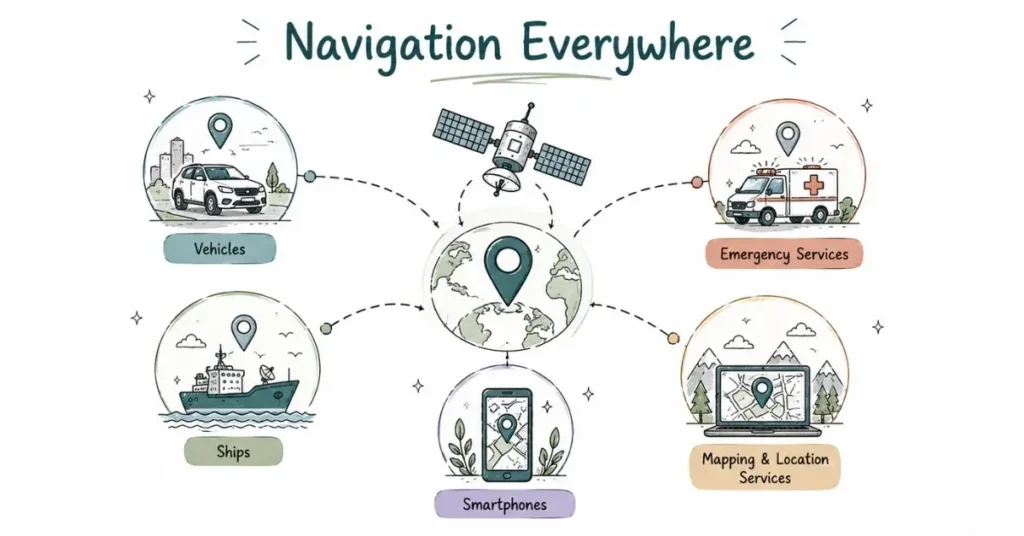
The NavIC Opportunity Something Most Students Miss
India’s NavIC (Navigation with Indian Constellation) satellite navigation system is an area where demand for engineers is genuinely exceeding supply right now. The government has mandated NavIC chips in smartphones sold in India, in maritime transponders for fishing vessels, and in aviation systems. Automotive companies are integrating NavIC into vehicle navigation systems.
This creates jobs not just at ISRO where the NavIC satellites are built and operated but across India’s electronics, automotive, maritime, and defence industries. If you have a background in ECE with interest in GNSS (Global Navigation Satellite Systems), NavIC application development is an underexplored career track with low competition and growing demand.
Companies to watch for NavIC roles: ISRO (SAC and NavIC programme office), Accord Software and Systems (Bengaluru), Quectel India, u-blox India, and automotive Tier-1 suppliers like Bosch India and Continental India.

FAQs : Satellite Communication Jobs in India
Q: Is satellite communication the same as telecom?
They overlap but are not the same. Telecom covers all forms of long-distance communication mobile networks, fibre, satellite. Satellite communication specifically uses satellites as the relay point. Engineers who understand both satellite and terrestrial telecom are particularly valuable at companies like Airtel and Tata Communications that operate both types of infrastructure.
Q: What is VSAT and why does it matter for careers?
VSAT stands for Very Small Aperture Terminal the small dish antennas you see on the roofs of rural bank branches, petrol stations, and remote offices. VSAT networks use satellites to deliver internet and data connectivity to locations without fibre or mobile coverage. Hughes India and BSNL operate large VSAT networks in India, creating consistent demand for VSAT network engineers and operations staff.
Q: Do I need a licence to work in satellite communication?
No personal licence is required. However, satellite communication operators in India require licences from DoT and spectrum assignments from TRAI. Understanding this regulatory framework is part of the professional knowledge expected of mid-to-senior SATCOM professionals.
Q: What is the difference between GEO, MEO, and LEO satellites for communication?
GEO (Geostationary) satellites sit at 35,786 km altitude and appear fixed in the sky ideal for broadcasting and wide-area VSAT. MEO (Medium Earth Orbit) satellites are used primarily for navigation (GPS, NavIC). LEO (Low Earth Orbit) satellites at 500–2,000 km altitude offer lower latency broadband this is what OneWeb and Starlink use. Understanding all three orbital regimes and their trade-offs is expected knowledge for SATCOM engineers.
Q: With Starlink entering India, will there be job opportunities?
Yes. Starlink’s India operations will require ground infrastructure, regulatory affairs staff, enterprise sales teams, and technical support professionals based in India. As Starlink, OneWeb, and Amazon Kuiper set up Indian operations, they will all hire locally.