
Crypto Compliance Career : Legal & Regulatory Guide
Table of Contents
Introduction : The Rulebook Writers of the Crypto World
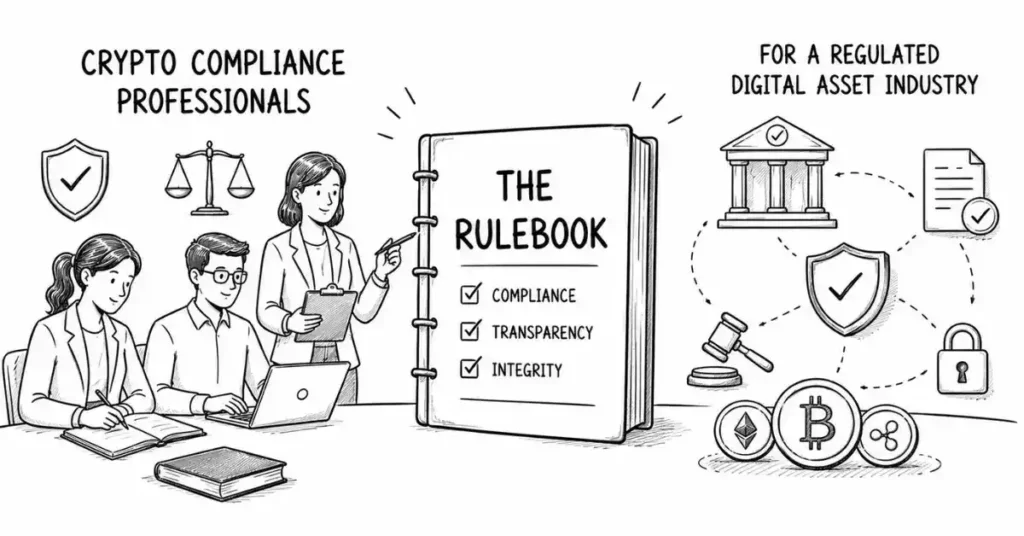
Every industry that reaches scale eventually faces regulation and cryptocurrency is no exception. India’s crypto industry has evolved from regulatory grey area to an emerging structured framework, with tax obligations clarified, virtual digital assets officially defined, and regulatory bodies like SEBI and RBI increasingly involved in oversight. This evolution from Wild West to regulated marketplace has created an entirely new career category: crypto compliance, legal, and policy professionals.
Here’s what makes this career path particularly exciting right now: the regulations are still being written. India’s crypto policy framework is evolving in real time, creating enormous demand for professionals who can interpret existing rules, predict regulatory direction, implement compliance systems, and even contribute to shaping policy. The professionals who build expertise in this space now will be the industry’s leading compliance voices for the next decade.
Financially, crypto compliance careers are extremely attractive. Legal and compliance specialists in India’s crypto industry earn ₹8–25 lakhs annually depending on experience and specialization. Senior compliance officers at major exchanges like WazirX and CoinDCX earn ₹18–28 lakhs. Legal counsel specializing in crypto at law firms earn ₹20–35 lakhs with partnership track potential. International crypto compliance roles pay $60,000–130,000 (₹50–107 lakhs)—reflecting the global shortage of professionals who understand both legal frameworks and blockchain technology.
Importantly, this career path doesn’t require coding skills or technical blockchain development knowledge. Legal professionals, finance graduates, chartered accountants, policy researchers, and compliance professionals from traditional banking can all transition effectively into crypto compliance with focused additional learning. This makes it one of the most accessible high-paying crypto career paths for professionals from non-technical backgrounds.
This guide covers every aspect of crypto compliance and legal careers: the regulatory landscape in India, specific roles available, required knowledge, transition pathways, and how to position yourself as a compliance expert in this fast-growing field.
Understanding India's Crypto Regulatory Landscape
The Evolving Regulatory Framework
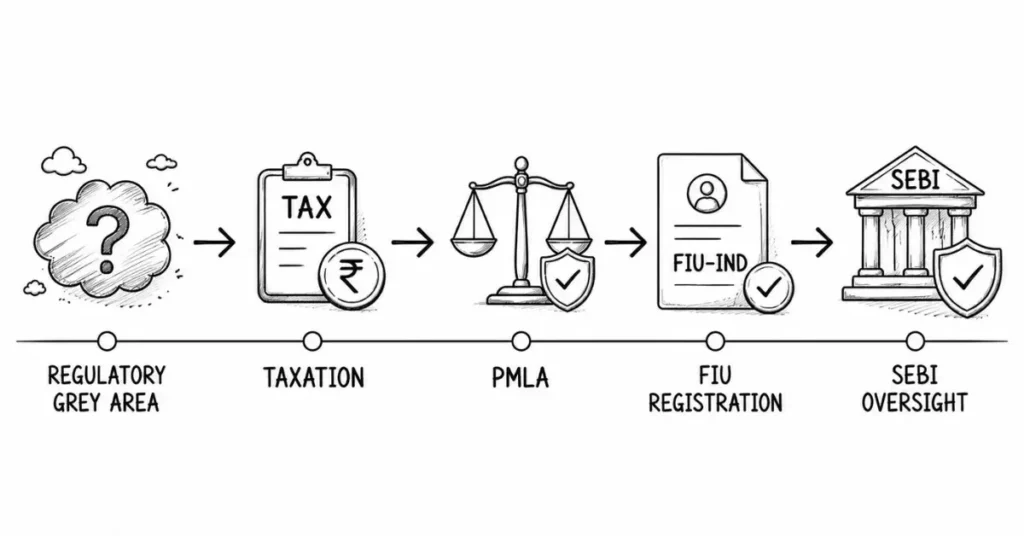
India’s approach to cryptocurrency has evolved significantly from the initial RBI banking ban (overturned by Supreme Court in 2020) to the current framework of taxation, disclosure, and emerging sector-specific regulations.
Key Regulatory Developments:
Taxation Framework (2022–Present):
The Finance Act 2022 introduced a 30% tax on crypto gains and 1% TDS (Tax Deducted at Source) on crypto transactions above threshold amounts. This brought cryptocurrency firmly into India’s tax framework—a major compliance milestone requiring sophisticated systems at exchanges and reporting obligations for traders.
Virtual Digital Assets (VDA) Classification:
The Income Tax Act now formally defines Virtual Digital Assets, providing legal clarity on what constitutes taxable crypto property. This definition forms the foundation of India’s emerging crypto regulatory structure.
PMLA Application (2023):
The government brought crypto exchanges under the Prevention of Money Laundering Act (PMLA), making AML/KYC compliance mandatory for cryptocurrency exchanges operating in India—transforming compliance requirements overnight.
FIU Registration Requirements:
Virtual asset service providers must register with the Financial Intelligence Unit (FIU-India), implementing anti-money laundering and counter-terrorism financing measures. This created immediate demand for compliance professionals at every Indian crypto company.
SEBI’s Digital Asset Framework:
SEBI (Securities and Exchange Board of India) is developing frameworks for crypto asset regulation, potentially classifying certain tokens as securities requiring capital market compliance.
Why This Matters for Careers:
Every regulatory development creates compliance work—new frameworks require interpretation, implementation, training, and monitoring. Each regulation is also a career opportunity for professionals who understand what it means and how to comply with it.
Global Regulatory Context
Indian crypto compliance professionals also need awareness of international frameworks because:
- Indian exchanges serve international customers subject to their home country regulations
- Global companies hiring Indian compliance professionals operate across multiple jurisdictions
- India’s regulatory development draws from international models (EU MiCA, US FinCEN, FATF recommendations)
Key International Frameworks:
FATF (Financial Action Task Force): The global AML/CFT standard-setting body whose Travel Rule for virtual assets is increasingly adopted globally—and influencing India’s framework
EU Markets in Crypto Assets (MiCA): The world’s most comprehensive crypto regulatory framework, now fully in effect in Europe. Understanding MiCA provides insight into where India’s framework may evolve.
US FinCEN Requirements: US money transmission rules for crypto businesses serve as a reference point for Indian regulatory development.
Singapore MAS Framework: Singapore’s comprehensive crypto regulation is particularly relevant as a comparison point for APAC-focused compliance work.
Crypto Compliance Career Roles in Detail
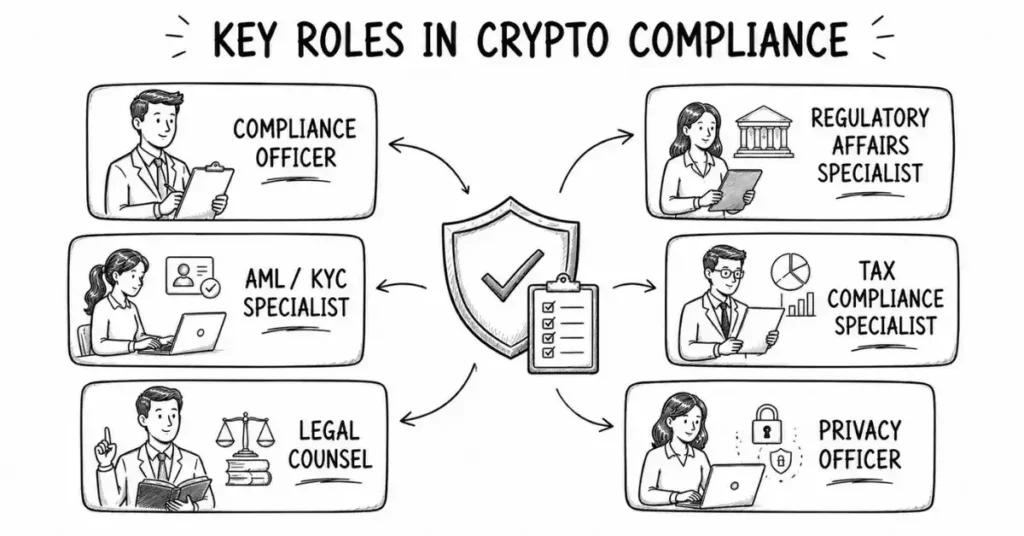
1. Compliance Officer (Crypto Exchange)
What They Do:
Compliance officers at cryptocurrency exchanges are responsible for ensuring the company operates within all applicable legal and regulatory requirements.
Core Responsibilities:
- Develop, implement, and maintain AML/KYC compliance programs
- Register and maintain reporting requirements with FIU-India
- Monitor transactions for suspicious activity
- File Suspicious Transaction Reports (STRs) with FIU
- Conduct periodic compliance audits and gap assessments
- Train staff on compliance obligations
- Manage regulatory relationships and examination requests
- Stay current with regulatory developments and update programs accordingly
- Coordinate with legal counsel on regulatory interpretation
Required Knowledge:
- PMLA and its application to virtual assets
- FIU-India registration and reporting requirements
- KYC documentation requirements for Indian customers
- Suspicious activity indicators specific to crypto transactions
- AML transaction monitoring systems and tools
- Record-keeping requirements for VDA transactions
Salary Range:
- Entry-level Compliance Analyst: ₹6–10 lakhs
- Compliance Officer: ₹10–18 lakhs
- Senior Compliance Officer: ₹18–28 lakhs
- Chief Compliance Officer: ₹28–45+ lakhs at major exchanges
Career Path: Compliance Analyst → Compliance Officer → Senior Compliance Officer → Head of Compliance → Chief Compliance Officer
2. AML/KYC Specialist
What They Do:
AML (Anti-Money Laundering) and KYC (Know Your Customer) specialists design and operate systems that verify customer identities and detect suspicious financial activity.
This role is India-specific opportunity: India’s massive population of crypto users combined with PMLA requirements has created enormous demand for AML/KYC specialists at Indian exchanges. WazirX, CoinDCX, ZebPay, and CoinSwitch all need teams of AML/KYC professionals.
Core Responsibilities:
- Design KYC verification workflows for new customer onboarding
- Implement risk-based customer due diligence (CDD) and enhanced due diligence (EDD)
- Configure transaction monitoring rules and thresholds
- Review and investigate alerts generated by monitoring systems
- Conduct sanctions screening (OFAC, UN, Indian sanctions lists)
- Prepare STR/CTR reports for FIU submission
- Document investigations and maintain audit trails
- Conduct periodic KYC reviews for existing customers
Required Skills:
- Understanding of PMLA provisions and FIU-India requirements
- KYC documentation standards (Aadhaar-based eKYC, PAN verification, video KYC)
- Transaction monitoring systems (Chainalysis, Elliptic, or similar)
- Blockchain analytics for tracing transaction histories
- Report writing for regulatory submissions
- Risk assessment and customer risk profiling
Blockchain Analytics—A Key Differentiator:
Unlike traditional banking AML, crypto AML requires understanding blockchain transaction tracing. Tools like Chainalysis Reactor and Elliptic Navigator track funds across blockchain addresses, identify wallet clusters, and score risk—combining traditional AML methodology with blockchain-specific analysis. AML specialists who master these tools command significant salary premiums.
Salary Range: ₹7–18 lakhs depending on experience and tools expertise
3. Legal Counsel (Crypto/Blockchain)
What They Do:
Legal counsel specializing in cryptocurrency and blockchain law advise companies on legal matters specific to the digital asset industry.
Core Responsibilities:
- Advise on regulatory compliance across applicable frameworks
- Draft and review token offering documents (not public securities)
- Negotiate and review technology vendor and partnership agreements
- Analyze new regulatory developments and advise on implications
- Manage regulatory examination responses
- Handle consumer disputes and regulatory investigations
- Advise on intellectual property in blockchain contexts
- Support product launches with legal risk assessment
Legal Specializations Within Crypto:
Regulatory Compliance Lawyer: Focuses on crypto-specific regulations, RBI/SEBI requirements, FIU obligations. Most in-demand specialty currently.
Token and Smart Contract Lawyer: Advises on legal status of tokens, smart contract enforceability, DAO legal structures. Emerging and highly specialized.
Intellectual Property (IP) Lawyer: NFT IP rights, software licensing for blockchain projects, open-source compliance.
Employment Lawyer (Crypto-Specific): Token compensation structures, employee agreements with vesting schedules, remote work across jurisdictions.
Litigation Lawyer: Crypto fraud cases, exchange disputes, regulatory enforcement actions.
Required Background:
- LLB or LLM from recognized Indian law school
- 2–5 years corporate/financial services legal experience (for mid-level)
- Self-study of virtual digital asset regulations and global frameworks
- Understanding of technology sufficient to review technical documentation
- Strong drafting and analytical writing skills
Salary Range:
- Associate (0–3 years): ₹8–15 lakhs
- Senior Associate (3–6 years): ₹15–25 lakhs
- Legal Counsel (in-house): ₹20–35 lakhs
- Partner track at crypto-focused law firm: ₹35–60+ lakhs
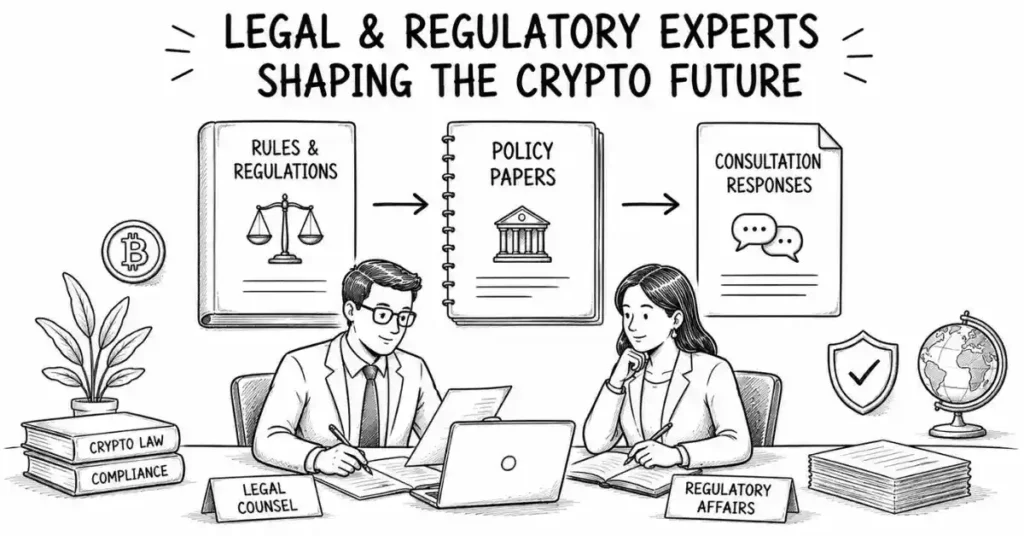
4. Regulatory Affairs Specialist
What They Do:
Regulatory affairs specialists monitor regulatory developments, analyze their implications, and ensure companies proactively adapt to changing requirements.
Core Responsibilities:
- Monitor RBI, SEBI, Ministry of Finance, FIU-India communications
- Track international regulatory developments (FATF, EU MiCA, G20 crypto frameworks)
- Analyze regulatory proposals and prepare company response/position papers
- Liaise with industry associations (IAMAI Crypto Committee, BACC) on regulatory advocacy
- Brief internal stakeholders on regulatory changes
- Coordinate with legal and compliance teams on implementation
- Represent company at regulatory consultations and hearings
Policy Advocacy Aspect:
India’s crypto regulations are still being developed. Regulatory affairs professionals who engage constructively with regulators—through industry associations, consultation responses, and thought leadership—have genuine influence on policy outcomes. This makes regulatory affairs one of the few compliance roles where your work shapes the rules rather than just following them.
Required Background:
- Background in financial regulation, public policy, or law
- Excellent analytical and writing skills for policy analysis
- Understanding of both crypto industry dynamics and regulatory processes
- Network within regulatory and industry association circles
- Comfort engaging with government officials and policymakers
Salary Range: ₹10–22 lakhs depending on seniority and organization type
5. Tax Compliance Specialist (Crypto)
What They Do:
With India’s 30% crypto gains tax and 1% TDS requirements, specialized tax compliance has become a distinct profession within the crypto industry.
Core Responsibilities:
- Ensure exchange TDS deduction and deposit compliance
- Advise clients or internal teams on crypto tax obligations
- Prepare and review crypto tax reports for individual and institutional clients
- Develop internal controls for tax compliance
- Advise on tax-efficient structuring (within legal bounds)
- Stay current with tax circular updates from CBDT
- Coordinate with CA firms on tax filings
India-Specific Opportunity:
India’s crypto tax rules are unusually complex globally—no set-off against losses, no deductions except cost of acquisition, TDS on every transaction above threshold. This complexity creates demand for specialists who understand the nuances. Chartered Accountants who develop crypto tax expertise are particularly valuable.
Required Background:
- CA (Chartered Accountant) qualification strongly preferred
- Understanding of Income Tax Act provisions for VDAs
- Knowledge of TDS compliance systems and processes
- Crypto exchange or trading experience helpful
- Technology comfort for working with exchange APIs and transaction data
Salary Range: ₹8–20 lakhs (CA-qualified specialists at the higher end)
6. Data Privacy Compliance Officer
What They Do:
Crypto platforms collect substantial personal data for KYC—Aadhaar numbers, PAN, biometrics, financial history. Data privacy compliance ensures this data handling meets India’s data protection requirements.
Core Responsibilities:
- Ensure compliance with the Digital Personal Data Protection Act (DPDPA) 2023
- Develop and maintain privacy notices, consent mechanisms, and data retention policies
- Conduct data protection impact assessments for new products
- Manage data subject rights requests (access, deletion, correction)
- Advise on data sharing with government agencies (FIU, SEBI, RBI)
- Respond to data breach incidents
Salary Range: ₹9–20 lakhs, growing rapidly as DPDPA compliance requirements mature
Building Your Crypto Compliance Career
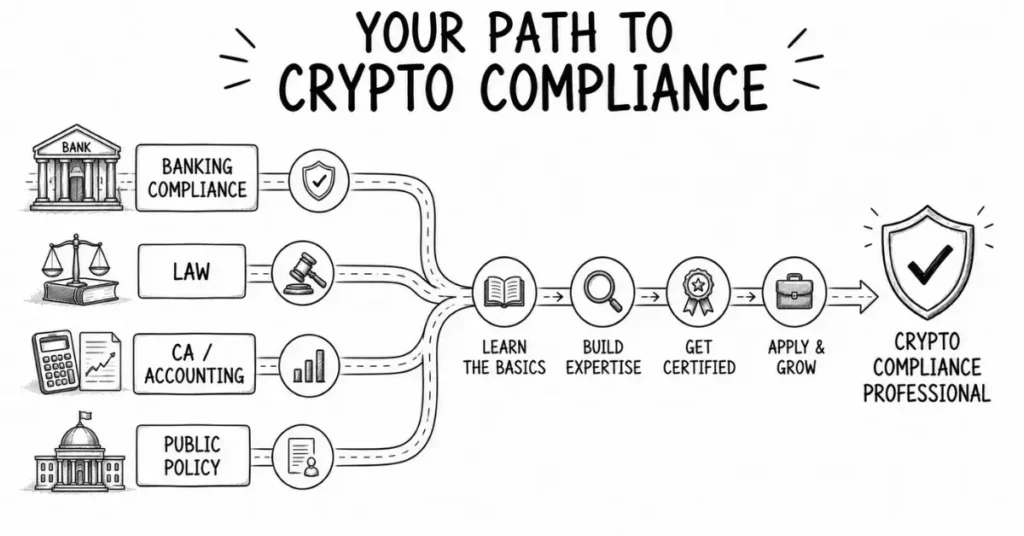
Transition Paths by Background
From Traditional Banking Compliance:
This is the most natural transition. Banking compliance professionals already understand AML/KYC frameworks, regulatory relationship management, and compliance program design. The crypto-specific additions are:
- Virtual Digital Asset regulations and FIU-India requirements
- Blockchain analytics tools (Chainalysis, Elliptic)
- Crypto transaction patterns and red flags
- Understanding of how blockchains work at a basic level
Timeline to transition: 2–3 months of focused study
Entry point: Compliance Officer at Indian crypto exchange
Immediate salary premium: Banking compliance experience commands ₹12–18 lakhs entry
From Law Practice:
Lawyers specializing in financial services, banking, or technology law transition effectively by adding:
- VDA regulatory framework deep knowledge
- Smart contract legal principles
- Token classification understanding
- Global crypto regulatory comparison (MiCA, FATF)
Timeline: 3–4 months of specialized study
Entry point: Legal counsel at crypto company or crypto practice at law firm
Salary: ₹20–30 lakhs at senior level
From Chartered Accountancy:
CAs who add crypto expertise become exceptional tax compliance and financial crime specialists:
- Crypto-specific tax provisions
- Blockchain transaction tracing for audit purposes
- Financial crime indicators in crypto transactions
Timeline: 2–3 months of crypto-specific study
Salary: ₹15–25 lakhs for experienced CAs in crypto compliance
From Public Policy or Government:
Former government officials and policy professionals are uniquely positioned for regulatory affairs roles, bringing:
- Understanding of regulatory processes and decision-making
- Relationships with regulators and policymakers
- Knowledge of how rules get made and enforced
Salary: ₹14–25 lakhs depending on seniority of prior government role
Essential Certifications and Learning Resources
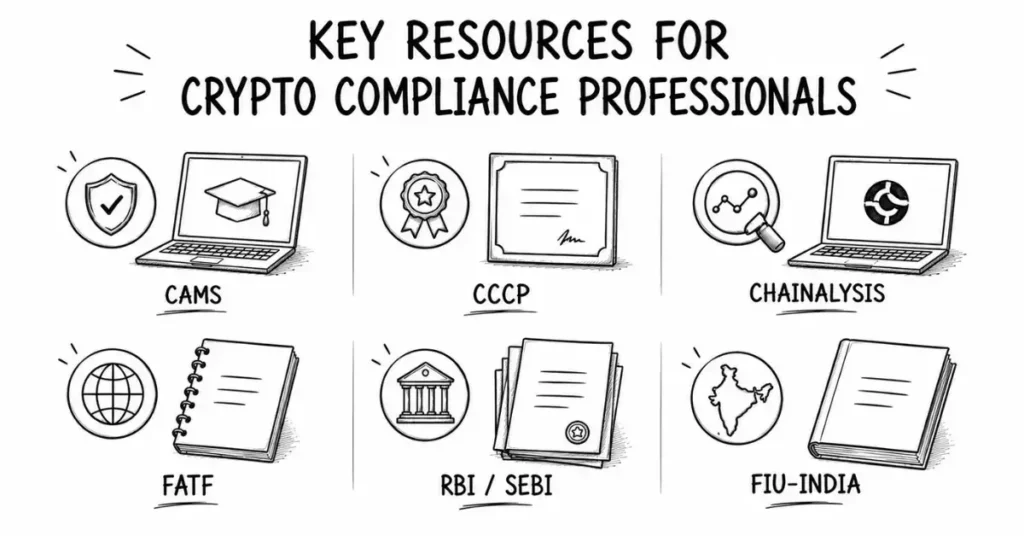
CAMS (Certified Anti-Money Laundering Specialist):
The gold standard for AML professionals globally, offered by ACAMS. Highly recognized by Indian and international crypto companies. The certification covers financial crime compliance broadly and is increasingly required for senior AML roles. Cost: approximately $1,000–1,500 for materials and exam.
Certified Cryptocurrency Compliance Professional (CCCP):
Newer certification specifically for crypto compliance from the Association of Certified Financial Crime Specialists (ACFCS). Covers crypto-specific AML/KYC requirements.
FATF Guidance Study:
FATF publishes free guidance specifically for virtual assets and virtual asset service providers. Reading and understanding these documents provides foundation knowledge used by regulators worldwide.
Chainalysis Reactor Certification:
Chainalysis offers free online certification for their blockchain analytics tool—increasingly required for crypto AML roles. Certification is free and demonstrates practical tool competency.
RBI and SEBI Publications:
Reading primary sources—RBI circulars, SEBI consultation papers, Ministry of Finance notifications on VDAs—builds regulatory knowledge no course fully replaces. Develop habit of reading regulatory publications directly.
India-Specific Resources:
- FIU-India guidelines for reporting entities
- PMLA (Maintenance of Records) Rules
- Income Tax Act provisions for virtual digital assets
- SEBI consultation papers on crypto regulation
- IAMAI Blockchain and Crypto Assets Council (BACC) publications
What the Job Market Looks Like

Active Hiring Companies
Indian Crypto Exchanges:
- WazirX: Actively hiring compliance officers post-PMLA implementation
- CoinDCX: Building compliance team for institutional expansion
- CoinSwitch Kuber: Compliance and legal roles across experience levels
- ZebPay: Regulatory affairs and AML roles for market expansion
Financial Institutions:
- ICICI Bank, HDFC Bank digital asset compliance teams
- Kotak Mahindra Bank fintech compliance covering crypto
- YES Bank blockchain and crypto compliance expansion
Law Firms:
Major Indian law firms developing crypto practices:
- AZB & Partners
- Cyril Amarchand Mangaldas
- Khaitan & Co
- Trilegal
International Companies:
Global crypto firms hiring India-based compliance talent:cryptocurrencyjobs+1
- Coinbase (India operations)
- Binance India compliance team
- Kraken regulatory team (India remote)
- Various blockchain infrastructure companies
Interview Preparation:
Technical Knowledge Questions:
- “Walk us through India’s PMLA requirements for virtual asset service providers”
- “What are the key provisions of FATF’s Travel Rule and how does it apply to crypto?”
- “How would you investigate a suspicious transaction on a crypto exchange?”
- “What are the key differences between Bitcoin and Ethereum transactions from an AML perspective?”
Scenario-Based Questions:
- “A customer sends ₹50 lakhs in crypto from multiple wallets in a single day—what steps do you take?”
- “We receive a notice from FIU-India requesting transaction records. How do you respond?”
- “A new regulation is announced requiring additional KYC for transactions above ₹10,000. How do you implement this within 30 days?”
Knowledge Assessment:
Some companies conduct written assessments testing regulatory knowledge. Study India-specific VDA regulations and PMLA provisions thoroughly for these.
Future of Crypto Compliance in India
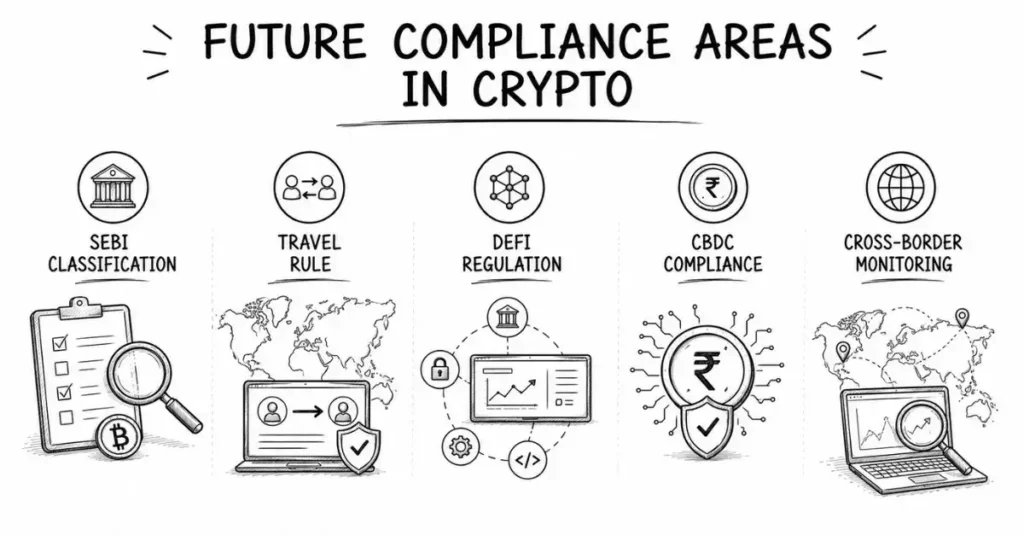
Growing Complexity Creates Enduring Demand
As crypto regulations mature and expand, compliance requirements will only grow more sophisticated—creating long-term career security for compliance professionals who build expertise now.
Emerging Regulatory Areas:
SEBI Securities Classification:
If SEBI classifies certain tokens as securities, entire capital markets compliance framework applies—disclosure requirements, investor protection rules, trading restrictions. This would create enormous demand for compliance professionals who understand both securities law and crypto.
Travel Rule Implementation:
FATF’s Travel Rule requires crypto exchanges to share originator and beneficiary information for transactions above thresholds. Full implementation in India will require sophisticated compliance infrastructure and specialists to run it.
DeFi Regulatory Framework:
Regulators globally are working on DeFi oversight. As India develops its DeFi approach, specialized compliance expertise will be needed for decentralized protocols—a genuinely novel regulatory challenge.
CBDC Compliance:
India’s digital rupee (CBDC) rollout will create compliance requirements for banks and financial institutions handling digital currency—combining traditional banking compliance with digital asset understanding.
Cross-Border Transaction Monitoring:
As Indian crypto users increasingly interact with international protocols, cross-border transaction monitoring will require understanding of both Indian PMLA requirements and international frameworks—a specialized expertise commanding premium rates.
Challenges in Crypto Compliance Careers
Challenge 1: Regulatory Uncertainty
India’s crypto regulations continue evolving, sometimes with short implementation timelines. Staying current while managing ongoing compliance programs is demanding.
Solution: Develop real-time monitoring habits for regulatory developments. Build strong networks with regulatory affairs peers who share information. Join industry associations where regulatory updates are discussed first.
Challenge 2: Technology Complexity
Compliance professionals must understand blockchain technology well enough to analyze transactions, understand audit trails, and evaluate technical controls—without necessarily being developers.
Solution: Invest in blockchain literacy specifically for compliance purposes. Take blockchain fundamentals courses. Learn Chainalysis and Elliptic through their free certification programs. Regular hands-on exposure to blockchain explorers builds intuition.
Challenge 3: Crypto Industry Cultural Fit
Traditional banking compliance culture emphasizes conservatism and hierarchy. Many crypto companies have startup cultures—faster-moving, less hierarchical, higher risk tolerance.
Solution: Demonstrate adaptability and startup mindset in interviews. Show that compliance can enable business growth rather than just blocking it. Build collaborative rather than adversarial relationships with product and technology teams.
Challenge 4: Defining Novel Situations
Crypto regularly creates scenarios that existing regulations don’t clearly address—DeFi protocol obligations, DAO legal responsibilities, cross-chain transaction attribution. Compliance professionals must make judgment calls under uncertainty.
Solution: Develop strong regulatory reasoning skills—ability to apply regulatory intent when specific guidance doesn’t exist. Build relationships with regulators where appropriate. Document reasoning thoroughly for defensible positions.
Conclusion: Building the Foundation India's Crypto Industry Needs
Crypto compliance, legal, and policy professionals don’t just follow rules—they build the foundation of trust and legitimacy that allows the crypto industry to grow sustainably in India. Without compliance frameworks, KYC systems, and legal clarity, institutional adoption remains impossible. Every compliance professional who builds robust systems at an Indian crypto company contributes directly to India’s position as a global crypto leader.
The timing is genuinely exceptional. India’s regulatory framework is being established right now, creating opportunities for professionals to become foundational experts rather than followers of entrenched practice. Compliance specialists who build expertise in India’s crypto regulatory framework in 2026 will be the industry’s senior compliance leaders through 2035 and beyond.
If you have a background in banking compliance, law, accounting, public policy, or financial regulation—your experience is more valuable in crypto compliance than you might realize. Add crypto-specific knowledge, develop blockchain literacy sufficient for compliance purposes, and position yourself at the intersection of two worlds most professionals inhabit separately.
India’s crypto industry needs its rulebook writers. Your legal and compliance expertise combined with crypto knowledge makes you perfectly positioned to write it.