
Satellite Engineer Career in India
Table of Contents
Introduction:
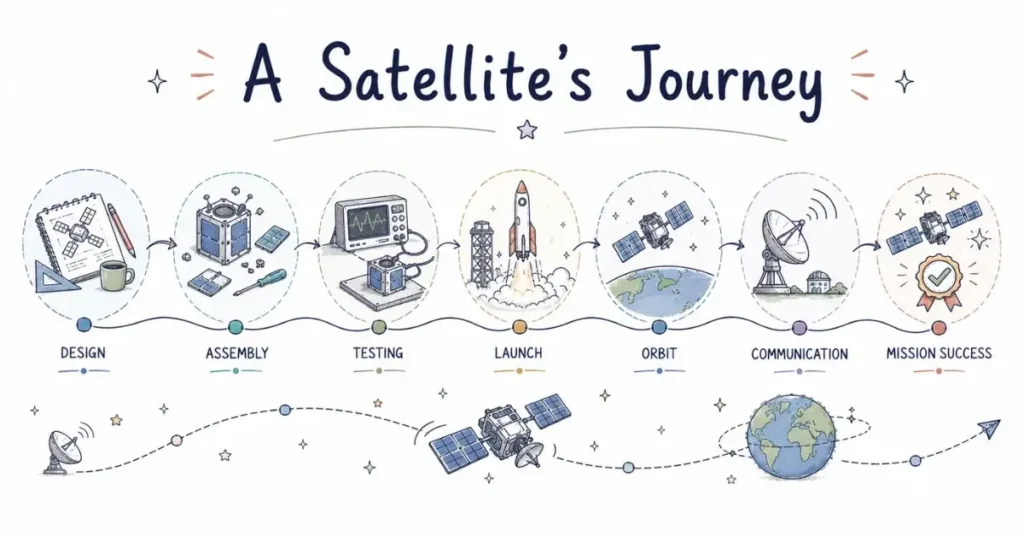
Every time you use Google Maps, check weather updates, or watch a DTH broadcast, a satellite is doing the work above you. Someone in India designed it, built it, tested it, and launched it.
Satellite engineering is one of the most in-demand specialisations in India’s space sector right now. With ISRO launching communication, navigation, and earth observation satellites at an accelerating pace and private companies like Pixxel, Dhruva Space, and Digantara building their own satellite constellations the demand for people who understand how satellites work has never been higher.
This guide covers every aspect of a satellite engineering career in India: what the job actually involves, which roles exist, what skills you need, who is hiring, and what they pay.
What Is Satellite Engineering?
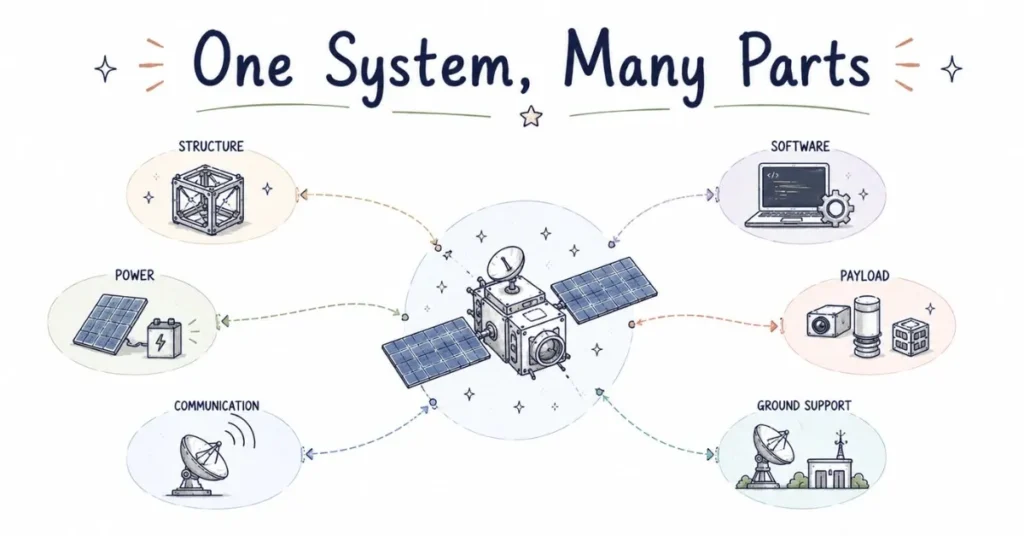
Satellite engineering is the discipline of designing, building, testing, operating, and maintaining satellites and their ground systems. It sits at the intersection of several engineering domains mechanical, electronics, software, and physics which is why satellite engineers are among the most technically versatile professionals in the space sector.
A satellite is not just a metal box floating in orbit. It is a precisely engineered system with multiple subsystems that must all work together flawlessly in extreme temperatures, vacuum conditions, and radiation environments for years at a time, without any possibility of a technician walking up to fix a problem.
That complexity is what makes satellite engineering both challenging and genuinely interesting.
The Key Subsystems And the Engineers Who Build Them
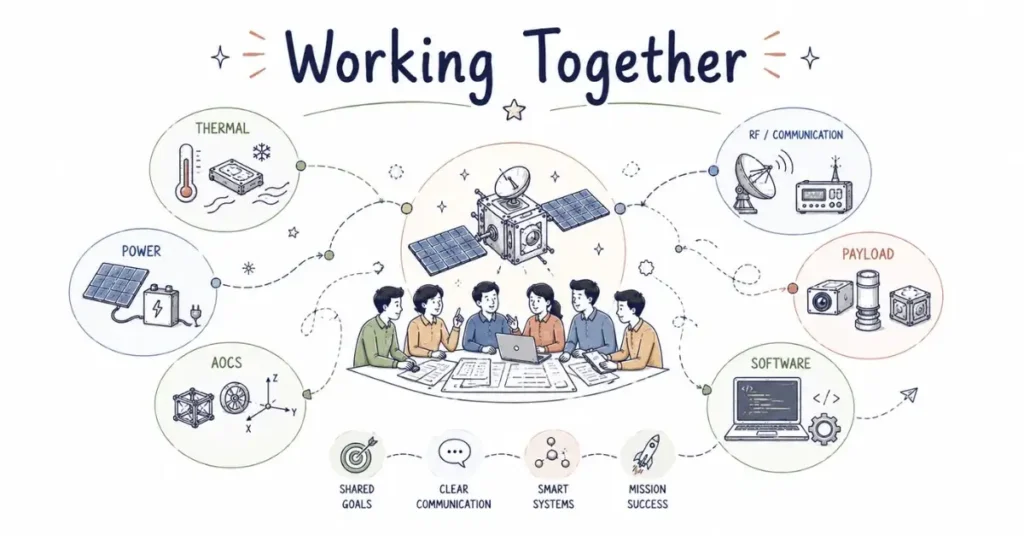
To understand satellite engineering careers, you first need to understand what a satellite is made of. Each subsystem is essentially a specialisation:
- Structure and Thermal Subsystem
The physical frame of the satellite and the systems that manage its temperature in space (which swings between -150°C and +150°C depending on sun exposure). Engineers here work on materials, mechanical design, and thermal control. - Power Subsystem
Solar panels, batteries, and power distribution systems. Engineers here ensure the satellite always has enough power to operate its instruments and survive eclipse periods. - AOCS Attitude and Orbit Control System
One of the most specialised and in-demand areas. AOCS engineers design the systems that keep a satellite pointed in the right direction and in the correct orbit. This involves reaction wheels, magnetorquers, star trackers, thrusters, and complex control algorithms. - Communication / RF Subsystem
The antennas, transponders, and radio frequency systems that allow the satellite to send and receive data. RF engineers design these systems and ensure they meet link budget requirements. - On-Board Computer (OBC) and Software
The brain of the satellite. Engineers here develop the flight software that manages all subsystems, handles telemetry and commands, and executes mission logic. - Payload
The instrument the satellite actually carries to do its job a camera, a radar, a communication transponder, a scientific sensor. Payload engineers design and integrate the primary mission instrument. - Ground Segment
The systems on Earth that communicate with, control, and receive data from the satellite. Ground segment engineers build and operate mission control software, antenna networks, and data processing pipelines.
Major Job Roles in Satellite Engineering India
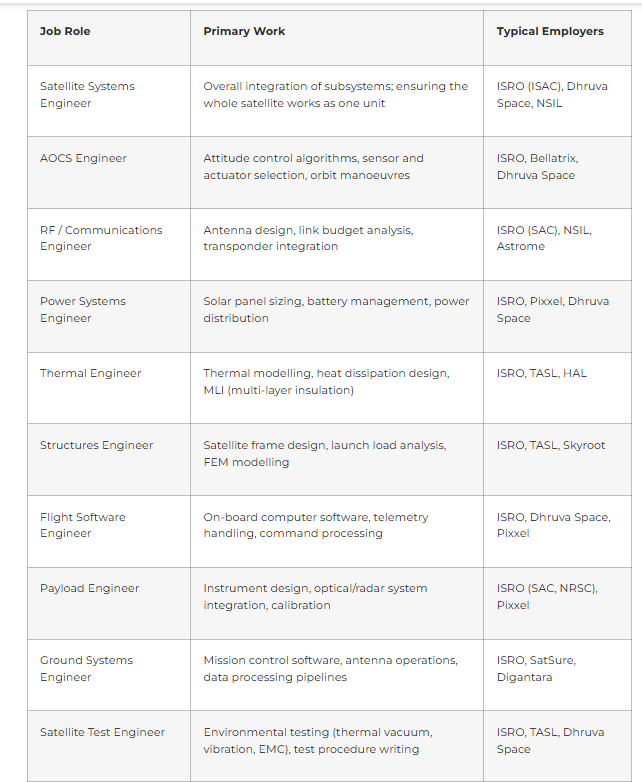
Top Companies Hiring Satellite Engineers in India
ISRO – ISAC (ISRO Satellite Centre, now U R Rao Satellite Centre, Bengaluru)
ISAC is ISRO’s primary satellite design and manufacturing facility. It built Chandrayaan-3’s orbiter, all of India’s communication satellites (GSAT series), and navigation satellites (NavIC). Almost every satellite engineering specialisation exists here.
ISRO – SAC (Space Applications Centre, Ahmedabad)
SAC is ISRO’s centre for satellite payloads and applications. Payload engineers, RF engineers, and remote sensing specialists are the core workforce here.
NSIL (NewSpace India Limited)
ISRO’s commercial arm, focused on manufacturing and launching satellites for commercial clients both domestic and international. Hiring is growing as NSIL expands its order book.
Pixxel (Bengaluru)
India’s leading hyperspectral Earth observation satellite company. Pixxel has launched multiple satellites and is building a constellation. They hire across satellite systems, software, payload, and data analytics.
Dhruva Space (Hyderabad)
Builds satellite platforms and offers satellite deployment and operations services. Actively hiring across AOCS, power, structures, and ground systems engineering.
Digantara (Bengaluru)
Focused on space situational awareness tracking objects in orbit to prevent collisions. Combines satellite engineering with data science.
Bellatrix Aerospace (Bengaluru)
Specialises in in-space propulsion systems and orbital transfer vehicles. Highly technical, relatively small team, strong research culture.
Astrome Technologies (Bengaluru)
Builds millimetre-wave communication systems for satellite broadband. RF and communications engineers are their primary hire.
SatSure (Bengaluru)
Satellite data analytics company serving agriculture, infrastructure, and financial sectors. Hires payload scientists, remote sensing engineers, and data engineers alongside satellite systems staff.
L&T Technology Services (LTTS)
Provides satellite engineering services to international clients. Large-scale hiring for AOCS, RF, and systems engineers.
Satellite Engineer Salary in India Realistic Numbers
Fresher (0–2 years experience)
- ISRO (Scientist/Engineer SC): ₹56,100/month basic + allowances; take-home ₹60,000–₹75,000/month
- Private startups (Pixxel, Dhruva Space): ₹5–9 LPA
- MNCs and service companies (LTTS, TASL): ₹5–8 LPA
Mid-Level (3–7 years experience)
- ISRO: ₹10–18 LPA total compensation equivalent
- Private startups: ₹12–22 LPA
- MNCs: ₹14–25 LPA
Senior Level (7+ years experience)
- Private sector and MNCs: ₹25–40 LPA
- ISRO senior scientists: ₹37,400–₹67,000 basic pay per month plus allowances
AOCS engineers and RF engineers with 5+ years of experience are among the highest-paid profiles in the satellite engineering job market, because these specialisations are genuinely rare very few universities teach AOCS at any meaningful depth, and most engineers learn it on the job.
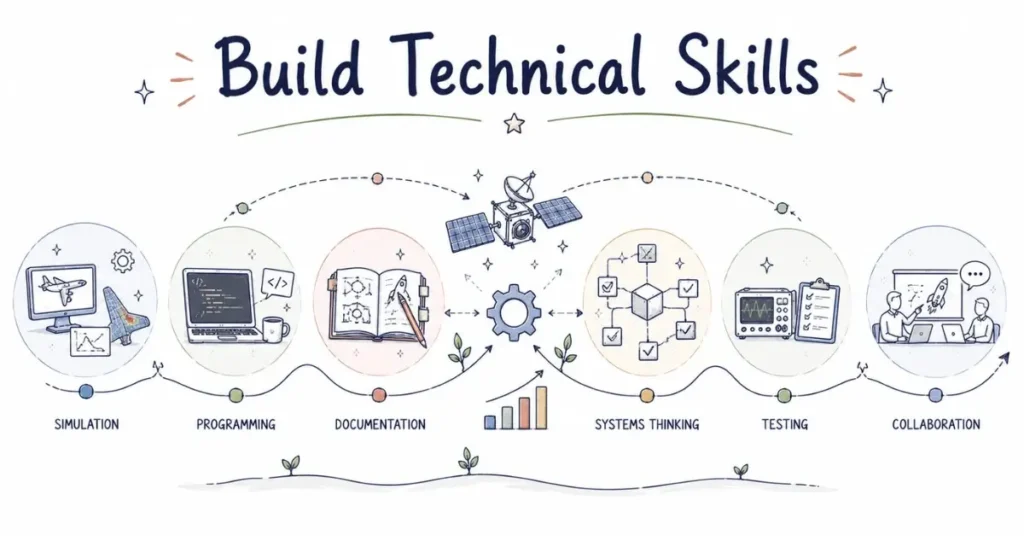
Skills You Need to Build
Technical skills by subsystem focus:
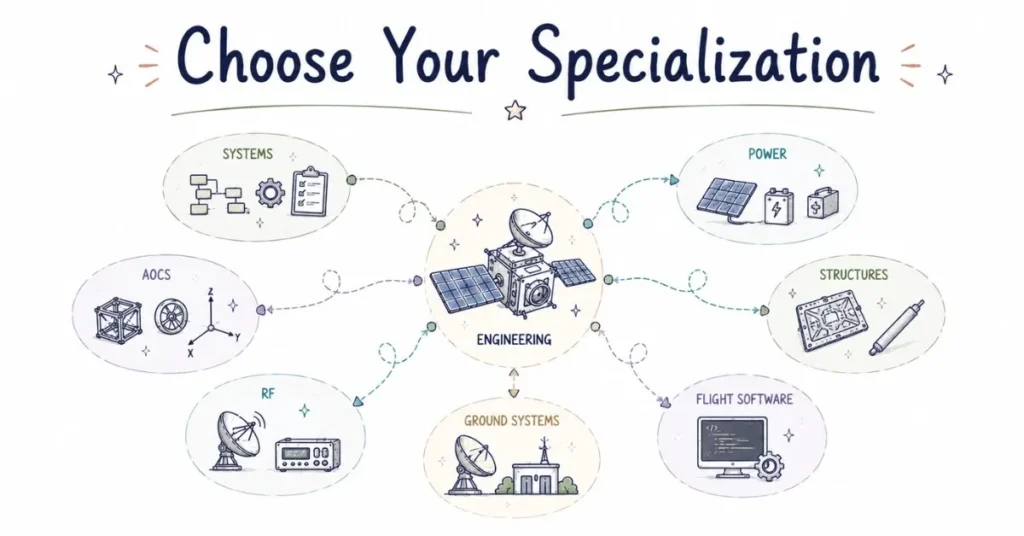
For AOCS roles:
- Control theory (PID, state-space, Kalman filters)
- MATLAB/Simulink for control system modelling
- Understanding of spacecraft dynamics and kinematics
- Knowledge of sensors (star trackers, IMUs, sun sensors) and actuators (reaction wheels, thrusters)
For RF/Communications roles:
- Antenna design fundamentals
- Link budget analysis
- Knowledge of communication protocols (CCSDS standards used in space)
- RF simulation tools (HFSS, CST Studio)
For Systems Engineering roles:
- MBSE (Model-Based Systems Engineering) increasingly expected
- Systems architecture and interface management
- FMEA (Failure Mode and Effects Analysis)
- Requirements management tools (DOORS, Jama)
For Flight Software roles:
- C / C++ (the primary languages for embedded space software)
- Real-time operating systems (RTOS)
- ECSS software engineering standards
- Python for ground tools and testing
Cross-cutting skills every satellite engineer needs:
- Technical documentation (every design decision must be written down and traceable)
- Understanding of space environment effects (radiation, vacuum, thermal cycling)
- Systems thinking understanding how your subsystem affects every other subsystem
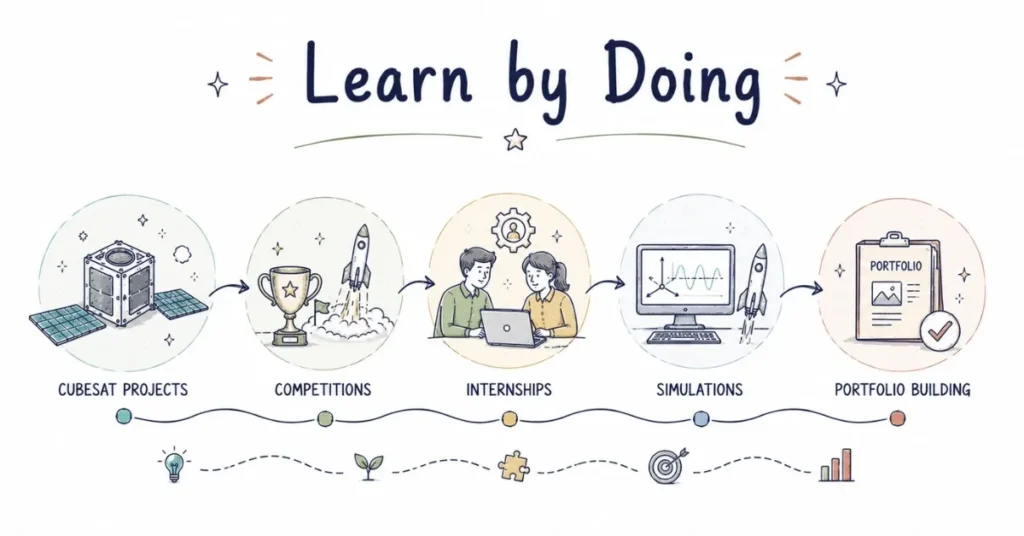
How to Break Into Satellite Engineering Step by Step
Step 1: Choose the right undergraduate degree
ECE (Electronics and Communication Engineering) is the most direct entry for AOCS, RF, and flight software roles. Mechanical or aerospace engineering works best for structures and thermal roles. Computer science fits ground systems and software roles. All are valid paths.
Step 2: Build satellite-relevant projects during college
The most valuable thing you can put on a satellite engineering resume is a CubeSat project. Many colleges in India SRM University, Amrita, MIT Manipal, IIT Bombay, IIT Madras have active student satellite programs. Join one. If your college does not have one, consider starting one or collaborating with a nearby institution.
CANSAT competitions are another strong option you design and build a mini satellite payload that is deployed from a small rocket, simulating satellite operations. Employers notice this.
Step 3: Learn at least one simulation tool for your target subsystem
- AOCS: MATLAB/Simulink with Aerospace Toolbox
- RF: HFSS or CST Studio
- Structures/Thermal: ANSYS
- Software: C++ with a RTOS simulation environment
Step 4: Apply for a relevant internship
- ISRO’s ISAC and SAC both take interns for satellite-specific work
- Pixxel, Dhruva Space, and Digantara have active internship programs
- India Space Academy (ISA) training programs cover satellite technology specifically
Step 5: Target your application carefully
When applying to ISRO, specify your subsystem interest in your application materials. ISRO has very specific teams for each satellite subsystem and a generic application gets lost. The same applies to private companies apply for a specific role, not “any engineering position.”
Step 6: Stay current on India's satellite program
Knowing what satellites ISRO has launched recently, what the GSAT series does, what NavIC is, and what Pixxel’s hyperspectral constellation is used for this kind of awareness demonstrates genuine interest and comes up in interviews. Follow ISRO’s official channels and read NSIL’s news regularly.
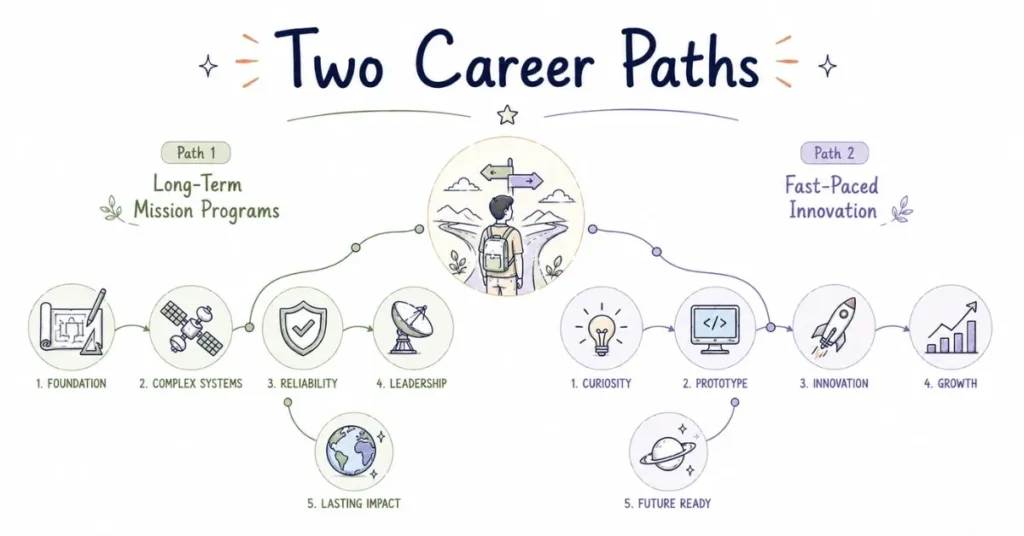
Government vs Private Sector : What Changes in Satellite Engineering
The work itself is similar in both sectors. What differs is scale, speed, and culture.
At ISRO, a single satellite program can take 5–7 years from design to launch. You will work on something large and methodical, with extensive documentation, peer reviews, and multiple approval stages. The rigor is high. The timeline is long. But when that satellite launches, you know every decision was tested thoroughly.
At a startup like Pixxel or Dhruva Space, a satellite program might run 18–24 months. You will likely work across multiple subsystems not just one because the team is smaller. Decision-making is faster. You will see your work fly sooner. But you also carry more personal responsibility, and the margin for error is thinner.
Neither is objectively better. Both produce genuinely excellent satellite engineers.
FAQs : Satellite Engineer Career in India
Q: Is a dedicated satellite engineering degree available in India?
Not as a standalone undergraduate degree. The closest option is IIST’s B.Tech in Avionics, which covers many satellite-relevant topics. Most satellite engineers come from ECE, aerospace, mechanical, or computer science backgrounds and specialise on the job or through postgraduate study.
Q: What is AOCS and why is it so important?
AOCS stands for Attitude and Orbit Control System. It is the subsystem that keeps a satellite pointed in the correct direction ensuring a camera satellite always faces Earth, a communication satellite stays locked on its target, or a scientific satellite points at its observation target. Without AOCS, a satellite is just an expensive piece of metal tumbling in orbit. AOCS engineers are among the most sought-after profiles in satellite engineering globally.
Q: Can a software engineer transition into satellite engineering?
Yes specifically into flight software, ground systems, and data engineering roles. Companies like Pixxel and SatSure actively hire software engineers with strong Python, C++, or data engineering backgrounds. The transition requires learning space-specific standards and constraints, but the core programming skills transfer directly.
Q: How competitive are ISRO satellite jobs?
Very competitive. ISRO receives thousands of applications for each Scientist/Engineer SC vacancy. The written exam is the primary filter. Strong technical fundamentals, awareness of ISRO’s missions, and a clear subsystem specialisation give you a meaningful edge.
Q: What is the difference between a satellite engineer and a remote sensing engineer?
A satellite engineer builds and operates the satellite. A remote sensing engineer uses the data that the satellite collects. The two roles are complementary satellite engineers work upstream (hardware, systems), remote sensing engineers work downstream (data, analysis, applications). Some engineers work in both, particularly at companies like ISRO’s SAC and startups like SatSure.