Space Technology Career Guide: Aerospace & Satellite Jobs in India (2026)
Table of Contents
Introduction:
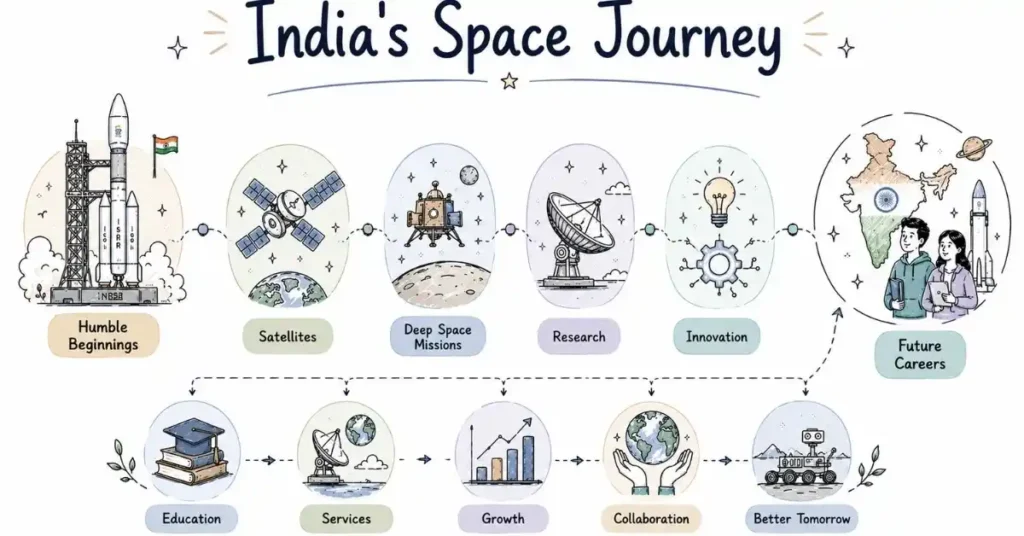
India sent a spacecraft to the Moon’s south pole in 2023 a place no country had ever reached before. Chandrayaan-3 did not just make history. It changed how millions of young Indians thought about their future.
If you were one of them, this guide is for you.
The space sector in India is not what it was ten years ago. It is not just ISRO anymore. As of 2025, India has over 300 active space startups, an $8.4 billion space economy, and a government policy framework that now allows private companies to build rockets, own satellites, and compete for global contracts. The industry is expected to reach $44 billion by 2033. That kind of growth does not happen without people engineers, software developers, data scientists, business managers, and policy experts
This guide maps every major career path in India’s space sector. Whether you are a student choosing a college, a working engineer thinking about a switch, or someone who simply wants to understand what “working in space” actually means everything you need is here.
Why Space Tech Is the Career Sector to Watch Right Now
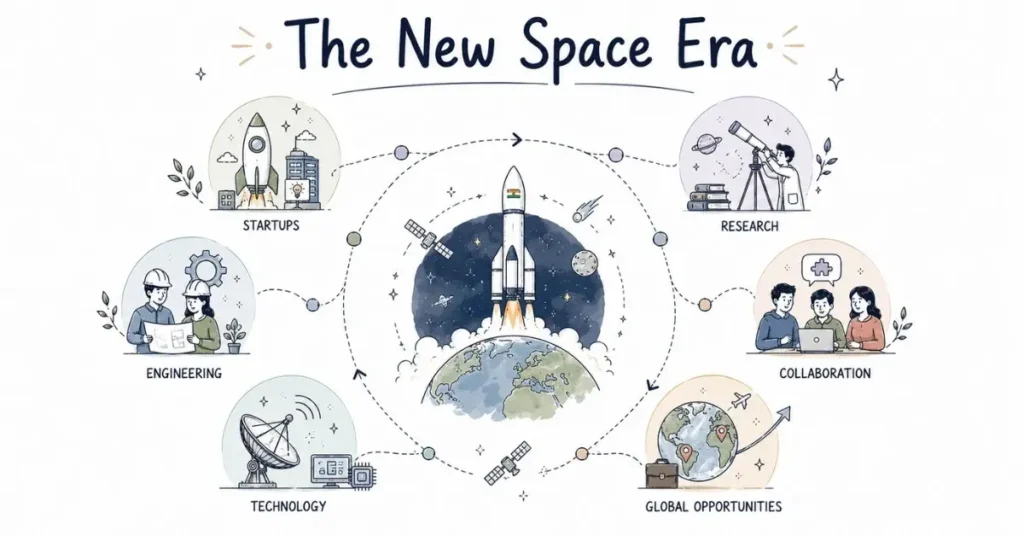
Three things changed India’s space story in the last five years.
- The government opened the door to private companies. The New Space Policy 2023, liberalised FDI norms in 2024, and IN-SPACe’s single-window authorisation framework now let private Indian and international firms build and launch satellites, run their own rocket companies, and offer commercial space services. Before 2020, this was simply not possible.
- Money started following. Private space startups in India raised nearly ₹1,250 crore (roughly $150 million) in FY 2025 alone, taking total funding past $617 million. The government additionally operationalised a ₹1,000 crore IN-SPACe Venture Capital Fund and a ₹500 crore Technology Adoption Fund that covers up to 60% of project costs for startups.reports.weforum+1
- Projects are real, not just announcements. Skyroot Aerospace launched India’s first private rocket Vikram-S. Agnikul Cosmos flew the world’s first rocket with a fully 3D-printed engine. Pixxel’s hyperspectral satellites are already delivering Earth observation data. These are not experiments. They are operational companies with active hiring pipelines.
India’s national space budget also nearly tripled from ₹5,615 crore in 2013–14 to ₹13,416 crore in 2025–26. Every rupee of that spending translates into jobs somewhere in the value chain.
Who Is Hiring in India's Space Sector?
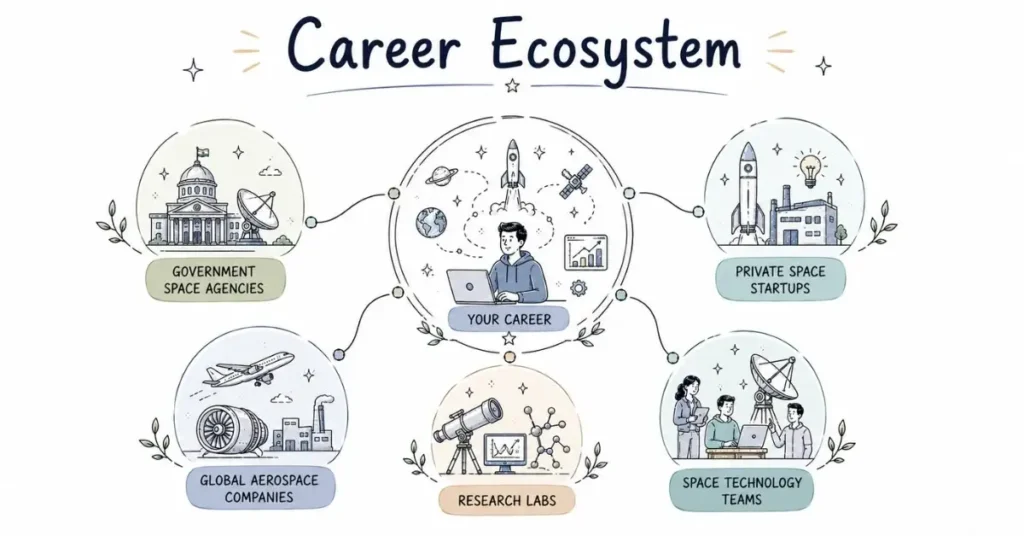
India’s space hiring ecosystem has three distinct layers:
Government / PSU organisations
- ISRO (Indian Space Research Organisation) – the primary national agency, with centres across Bengaluru, Thiruvananthapuram, Ahmedabad, Sriharikota, and Hyderabad
- NSIL (NewSpace India Limited) – ISRO’s commercial arm, focused on satellite manufacturing and launch service exports
- IN-SPACe – the regulatory and promotional body for private space activities
- DRDO (Defence Research and Development Organisation) – defence-aerospace overlap roles
- HAL (Hindustan Aeronautics Limited) – aircraft and spacecraft manufacturing
- BEL (Bharat Electronics Limited) – electronics and avionics for space systems
Private Indian startups (the new engine of hiring)
- Skyroot Aerospace (Hyderabad) – launch vehicles
- Agnikul Cosmos (Chennai) – semi-cryogenic rockets
- Pixxel (Bengaluru) – hyperspectral Earth observation satellites
- Dhruva Space (Hyderabad) – satellite platforms and deployment services
- Bellatrix Aerospace (Bengaluru)- in-space propulsion and orbital transfer
- Digantara (Bengaluru)- space situational awareness
- SatSure (Bengaluru)- satellite data analytics for agriculture and infrastructure
MNCs and global aerospace companies with India operations
- Boeing India (Bengaluru)
- Airbus India
- Tata Advanced Systems Limited (TASL)
- L&T Technology Services (LTTS)
- GE Aviation India
- Rolls-Royce India
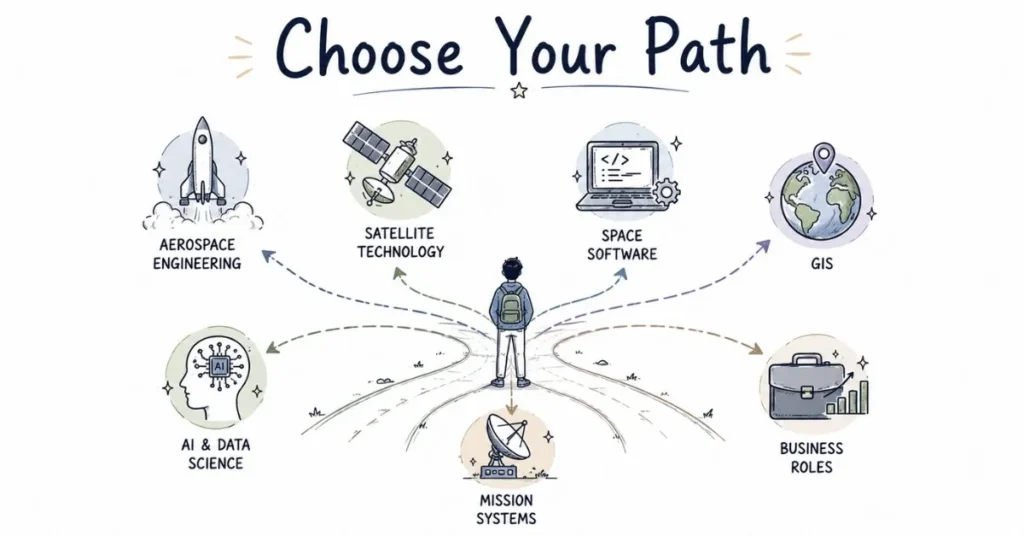
India's Space Career Pathways At a Glance
There are nine broad career tracks in India’s space sector. Each one is covered in a dedicated guide below, but here is a quick orientation:
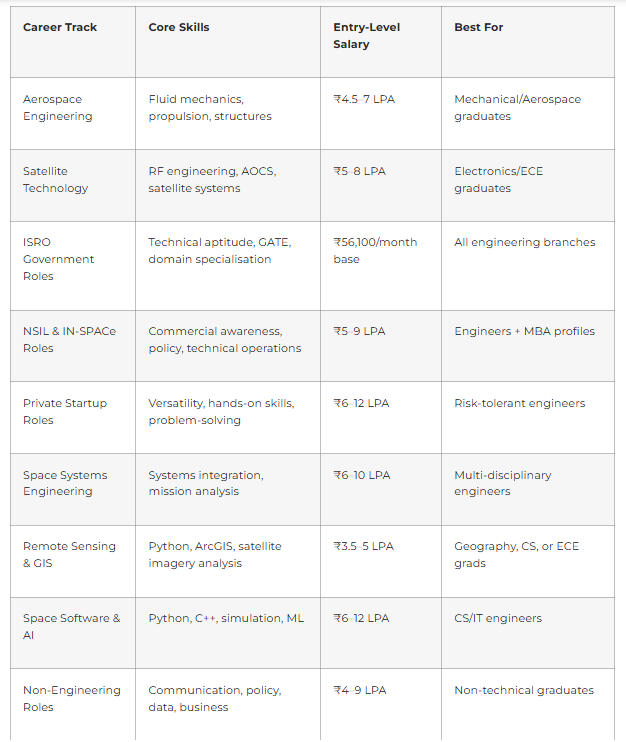
Career Track | Core Skills | Entry-Level Salary | Best For |
Aerospace Engineering | Fluid mechanics, propulsion, structures | ₹4.5–7 LPA | Mechanical/Aerospace graduates |
Satellite Technology | RF engineering, AOCS, satellite systems | ₹5–8 LPA | Electronics/ECE graduates |
ISRO Government Roles | Technical aptitude, GATE, domain specialisation | ₹56,100/month base | All engineering branches |
NSIL & IN-SPACe Roles | Commercial awareness, policy, technical operations | ₹5–9 LPA | Engineers + MBA profiles |
Private Startup Roles | Versatility, hands-on skills, problem-solving | ₹6–12 LPA | Risk-tolerant engineers |
Space Systems Engineering | Systems integration, mission analysis | ₹6–10 LPA | Multi-disciplinary engineers |
Remote Sensing & GIS | Python, ArcGIS, satellite imagery analysis | ₹3.5–5 LPA | Geography, CS, or ECE grads |
Space Software & AI | Python, C++, simulation, ML | ₹6–12 LPA | CS/IT engineers |
Non-Engineering Roles | Communication, policy, data, business | ₹4–9 LPA | Non-technical graduates |
What Qualifications Do You Actually Need?
The honest answer: it depends on where you want to work.
For ISRO: The main entry route is through ISRO Centralised Recruitment Board (ICRB). Most roles require a B.E./B.Tech in a relevant engineering branch with a minimum 65% aggregate. GATE scores are not mandatory for ISRO recruitment (unlike IIT admissions) but help at some centres. A few roles also recruit through written exams and interviews conducted by individual ISRO centres.
For private startups: Startups care more about what you have built than what grade you scored. A strong portfolio a CubeSat project, MATLAB simulations, CAD models, a GitHub repository with aerospace-related code often carries more weight than a specific degree. Many startups also recruit from NITs, BITS Pilani, and UPES Dehradun, not just IITs.
For MNCs: Boeing, Airbus, and TASL typically hire through campus placements at IITs, NITs, and IIST, and also through job portals like Naukri and LinkedIn. They generally require B.E./B.Tech in aerospace, mechanical, electronics, or computer science.
The one degree that gives you a direct lane: IIST (Indian Institute of Space Science and Technology, Thiruvananthapuram) is India’s only university dedicated exclusively to space science and technology. Entry is through JEE Advanced. B.Tech fees range from ₹1.45 lakh (first year) to ₹6.3 lakh total. IIST graduates are directly absorbed into ISRO on completing their degree no separate exam required
The Three Career Tracks Simplified
If you are new to the field and feeling overwhelmed by options, think of the entire space sector as three broad tracks:
Track 1 Build Things (Hardware)
Aerospace engineers, propulsion specialists, structures engineers, avionics engineers, mechanical engineers. You design, test, and manufacture the physical components of rockets and satellites.
Track 2 Connect and Control Things (Electronics + Software)
RF engineers, AOCS engineers, firmware developers, mission software engineers, embedded systems engineers. You make sure the hardware communicates, navigates, and operates correctly.
Track 3 Use the Data (Analytics + Applications)
GIS analysts, remote sensing engineers, satellite data scientists, earth observation specialists. You work with what satellites send back turning raw data into actionable insights for agriculture, urban planning, disaster management, and defence.
All three tracks have government and private sector versions, and all three are growing.

Salary Reality Check What You Can Actually Earn
compared to IT. The honest answer: entry-level space jobs pay less than a TCS or Infosys package, but mid-career and senior earnings catch up quickly and the work is more specialised, which means less competition for the top slots.
Fresher to 3 years experience: ₹4.5–8 LPA across most roles
3–7 years experience: ₹10–25 LPA depending on specialisation and company
Senior/lead (7–15 years): ₹25–50+ LPA at MNCs; ISRO senior scientists earn ₹37,400–₹67,000 basic pay per month
ISRO Scientist/Engineer SC (entry level): ₹56,100/month in-hand base, plus allowances
At private startups like Skyroot and Agnikul, early employees with high ownership roles often also receive ESOPs (equity stakes), which can be significantly valuable if the company grows toward an IPO or acquisition.
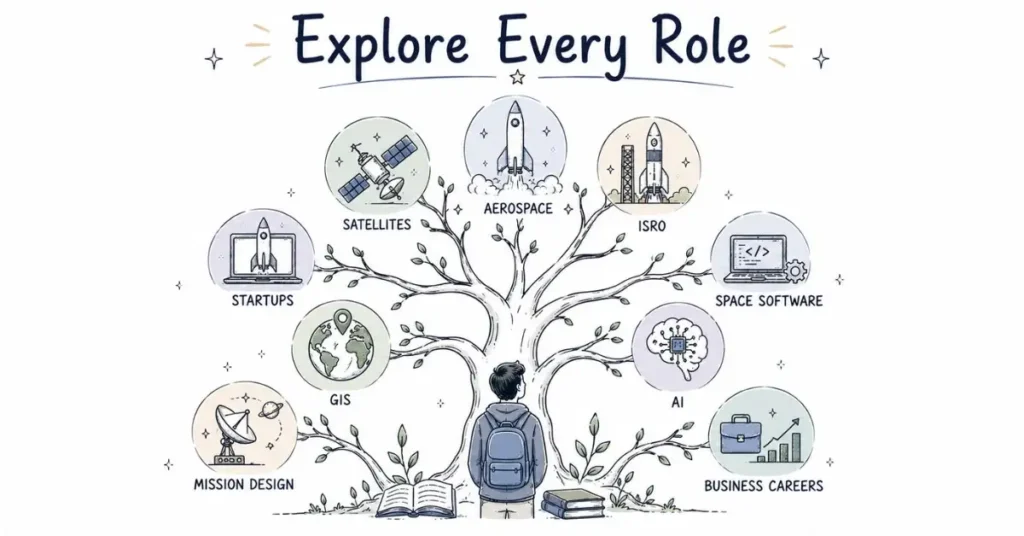
The 12 Career Guides in This Series
Each guide below goes deep on one specific career track with job roles, salary data, how to break in, and which companies are actively hiring.
Cluster 1: Aerospace Engineering
- Aerospace Engineer Career in India: Roles, Salary & How to Start
- How to Become an Aerospace Engineer in India: Colleges, Exams & Roadmap
Cluster 2: Satellite Technology
- Satellite Engineer Career in India: Job Roles, Skills & Top Recruiters
- Satellite Communication Jobs in India: Scope, Salary & Companies
Cluster 3: Government Space Careers
- ISRO Career Guide: How to Get a Job at ISRO After Engineering
- NSIL & IN-SPACe Careers: Government Space Jobs Beyond ISRO
Cluster 4: Private Startups
Cluster 5: Space Systems
Cluster 6: Remote Sensing & GIS
Cluster 7: Space Software & AI
Cluster 8: Education & Certifications
Cluster 9: Non-Engineering Roles
FAQs About Space Technology Careers in India
Q: Can a student from a non-IIT college get a job in ISRO?
Yes. ISRO recruits nationally through ICRB and conducts its own written tests and interviews. Students from NITs, BITS Pilani, regional engineering colleges, and IIST all get selected. Grades, technical depth, and a genuine understanding of space systems matter more than your college brand.
Q: Is coding necessary for a space career?
For software and data roles, absolutely. For hardware roles like propulsion or structures engineering, coding is not mandatory but knowing Python or MATLAB for simulation and data analysis makes you significantly more competitive. Even ISRO scientists regularly use simulation tools.
Q: What is IN-SPACe and why does it matter for my career?
IN-SPACe (Indian National Space Promotion and Authorisation Centre) is the government body that regulates and promotes private space activities. It is also building its own team of policy, technical, and commercial professionals. For people interested in space policy or regulatory work, IN-SPACe is a direct employer and an important body to understand.
Q: Are space startup jobs stable?
All startup jobs carry some risk that is honest. But India’s top-tier space startups like Skyroot, Agnikul, and Pixxel are well-funded, have launched hardware successfully, and have active government and international contracts. They are not speculative ventures anymore. The risk is lower than a typical early-stage startup, but higher than ISRO.
Q: How soon can I expect a job after completing a space-related degree?
IIST graduates are absorbed directly into ISRO on completing their B.Tech that is effectively a guaranteed placement. For IIT/NIT graduates, campus placements from aerospace and defence companies happen in their final year. For private startups, the hiring cycle is continuous and you can apply at any stage.
One Final Thought Before You Pick a Path
India is at a genuinely rare moment. The country has the institutional credibility of ISRO’s 50+ year track record and the fresh energy of 300+ startups, all operating in the same ecosystem at the same time. Most countries never get both simultaneously.
The careers available in this sector today building rockets, designing satellites, analysing Earth observation data, managing space missions were not accessible to ordinary Indian engineers just five years ago. They are now. The question is whether you will be ready when the opportunity opens for you.
Pick the guide that matches your background and start there.
Here is something most career counsellors will not tell you:
some of the most interesting engineering jobs in India right now are not in IT. They are in propulsion labs in Hyderabad, satellite assembly rooms in Bengaluru, and launch pads in Sriharikota.
Aerospace engineering in India is no longer a niche field with three government jobs and nothing else. The sector has over 300 active space startups, an $8.4 billion economy, and a hiring pipeline that is growing faster than most engineering disciplines. If you have been wondering whether aerospace engineering leads anywhere in India the answer in 2025 is a clear yes.
This guide breaks down what an aerospace engineer actually does, which companies are hiring, what they pay, and how you get your foot in the door.
What Does an Aerospace Engineer Actually Do?
The job title sounds impressive, but what does the work look like on a Tuesday afternoon?
Aerospace engineers design, analyse, test, and sometimes manufacture vehicles that fly aircraft, rockets, satellites, missiles, and drones. In India, the work splits into two broad domains:
Aeronautical engineering focused on vehicles that fly within Earth’s atmosphere. Think fighter jets, commercial aircraft, UAVs (drones).
Astronautical engineering focused on vehicles and systems that operate in space. Think launch vehicles, satellites, spacecraft, orbital systems.
Most Indian aerospace engineering graduates end up working across both domains, especially in organisations like ISRO and HAL where the lines between the two often overlap.
On a practical level, your daily work as an aerospace engineer might involve:
- Running computational fluid dynamics (CFD) simulations to test how a rocket nose cone handles air resistance
- Checking structural load calculations for a satellite panel
- Writing test reports after a propulsion component undergoes stress testing
- Collaborating with software teams to integrate guidance, navigation, and control (GNC) systems
- Supporting launch campaign operations at a facility like SDSC SHAR in Sriharikota
The work is deeply technical but also deeply collaborative. You almost never work alone.
Major Job Roles in Aerospace Engineering India
you will encounter most often in Indian job postings:
Job Role | What You Do | Typical Employer |
Propulsion Engineer | Design and test rocket engines, fuel systems, thruster mechanisms | ISRO, Skyroot, Agnikul, DRDO |
Structures Engineer | Analyse stress, fatigue, and load tolerance of aircraft/rocket structures | HAL, TASL, Boeing India |
Aerodynamics Engineer | Study airflow, drag, lift, and vehicle stability using CFD tools | ISRO, DRDO, Airbus India |
Avionics Engineer | Work on electronic systems flight computers, sensors, navigation | HAL, BEL, Dhruva Space |
Systems Engineer | Integrate multiple engineering subsystems into one working vehicle | ISRO, L&T, Skyroot |
Quality & Reliability Engineer | Ensure components meet safety and performance standards | HAL, BEL, TASL |
Mission Analysis Engineer | Calculate trajectories, orbital parameters, mission profiles | ISRO, Bellatrix, NSIL |
Manufacturing/Process Engineer | Oversee production of aerospace components | HAL, Tata Advanced Systems |
Test Engineer | Design and run tests on hardware and software systems | ISRO, DRDO, private startups |
At ISRO, entry-level engineers join as Scientist/Engineer SC, which is a combined designation covering both technical research and engineering functions. At private startups, you are more likely to hold a specific role title from day one like “Propulsion Engineer” or “Structures Lead” with significant hands-on responsibility from an early stage.
Step 2: Start Your Own Content Creation (Month 2Top Companies Hiring Aerospace Engineers in India-4):
ISRO (Indian Space Research Organisation)
ISRO is the first name that comes to mind for most aerospace engineering aspirants and for good reason. With centres spread across Bengaluru (ISAC, VSSC liaison), Thiruvananthapuram (VSSC), Sriharikota (SDSC SHAR), Ahmedabad (SAC), and Hyderabad (NRSC), ISRO hires aerospace, mechanical, electronics, computer science, and civil engineers across multiple disciplines. Recruitment happens through ICRB (ISRO Centralised Recruitment Board) via written tests and interviews.
HAL (Hindustan Aeronautics Limited)
HAL is India’s largest aerospace and defence manufacturer. It builds Tejas fighter jets, helicopters, and aircraft components for international clients. HAL recruits through a Management Trainee (Technical) exam and direct campus recruitment from IITs, NITs, and IIST.
DRDO (Defence Research and Development Organisation)
DRDO works on missiles, combat aircraft (Tejas), and aerospace defence systems. Entry is through the CEPTAM exam for technicians and the SET (Scientist Entry Test) for scientists.
Skyroot Aerospace (Hyderabad)
India’s first private company to successfully launch a rocket. They are actively hiring propulsion engineers, avionics engineers, and systems engineers. Startup culture fast-paced, high ownership, equity on the table.
Agnikul Cosmos (Chennai)
Creators of the world’s first fully 3D-printed rocket engine. They hire across propulsion, structures, manufacturing, and avionics. Work is hands-on from day one.
Tata Advanced Systems Limited (TASL)
The aerospace and defence arm of the Tata Group. They manufacture aircraft fuselages, helicopter components, and UAV systems. Hires from IITs, NITs, and through experience.
Boeing India (Bengaluru)
Boeing’s India Engineering and Technology Center (BIETC) employs thousands of aerospace and software engineers on projects spanning commercial aircraft, defence systems, and autonomous vehicles.
Airbus India (Bengaluru)
Airbus’s India Engineering Centre works on A320, A380, and next-generation aircraft design and certification. Strong hiring from IIT and NIT campuses.
L&T Technology Services (LTTS)
Provides aerospace engineering services to global aerospace OEMs. Large-scale hiring of engineers for CAD, simulation, testing, and embedded systems projects.
Aerospace Engineer Salary in India What You Can Realistically Expect
This is the question everyone actually wants answered, so let us be specific:
Fresher (0–2 years experience)
- Government (ISRO Scientist/Engineer SC): ₹56,100/month basic pay + HRA + other allowances. Take-home typically ₹60,000–₹75,000/month.
- HAL/DRDO (Management Trainee): ₹40,000–₹60,000/month CTC
- Private startups (Skyroot, Agnikul): ₹6–9 LPA, plus ESOPs at funded startups
- MNCs (Boeing, Airbus India): ₹5–9 LPA
Mid-Level (3–7 years experience)
- Government/PSU: ₹10–18 LPA total compensation
- Private startups: ₹12–22 LPA
- MNCs: ₹12–25 LPA
Senior Level (7–15 years experience)
- Government/PSU: ₹20–35 LPA (equivalent)
- Private startups / MNCs: ₹25–50 LPA
One honest note: ISRO and HAL pay less in raw cash compared to Boeing or a funded startup, but they offer job security, government perquisites (housing, medical, pension), and the chance to work on national missions Chandrayaan, Gaganyaan, Aditya-L1 that simply cannot be replicated anywhere else.
Skills You Need to Build A Practical List
Different roles need different technical skills, but these are the ones that appear most consistently across Indian aerospace job descriptions:
Core engineering fundamentals
- Fluid mechanics and thermodynamics
- Structural analysis and finite element methods (FEM)
- Materials science (composites, alloys used in aerospace)
- Orbital mechanics and astrodynamics (for space-focused roles)
Software and simulation tools
- MATLAB / Simulink widely used for control systems, simulations
- ANSYS / ABAQUS structural and thermal analysis
- OpenFOAM / FLUENT CFD (computational fluid dynamics)
- CATIA / SolidWorks / NX 3D CAD design
- STK (Systems Tool Kit) for orbital and mission analysis
- Python increasingly expected even in hardware roles for data analysis and automation
Soft skills that matter more than most people expect
- Technical writing (test reports, design documents)
- Cross-functional collaboration (you work with software, electronics, and manufacturing teams daily)
- Problem-solving under constraints (weight, cost, and deadline are always in tension in aerospace)
You do not need to master all of these before your first job. But knowing two or three of the simulation tools well, and being able to demonstrate that in a project or internship, will immediately separate your application from 80% of your batch.
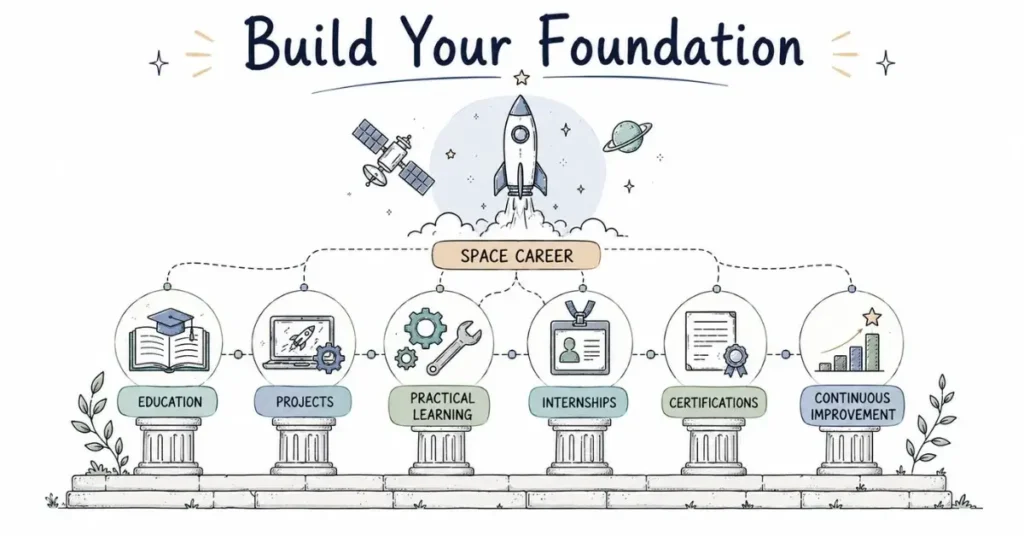
How to Break Into Aerospace Engineering in India Step by Step
Step 1: Get the right degree
B.E./B.Tech in Aerospace Engineering, Aeronautical Engineering, or Mechanical Engineering from a recognised institution. Top choices: IIST (direct ISRO pipeline), IIT Bombay, IIT Madras, IIT Kharagpur, UPES Dehradun (dedicated aerospace program), Manipal Institute of Technology, MIT Pune. If you are a JEE Advanced qualifier, IIST gives you the most direct route into ISRO.
Step 2: Build something during your degree
Projects and competitions beat grades in this field. Participate in SAE Aerodesign, Team Indus (student rocketry), CANSAT competitions, or build a CubeSat project with your college team. These give you practical evidence of your skills.
Step 3: Learn at least one simulation tool seriously
Pick MATLAB or ANSYS and go deep. Complete an online certification, use it for your final year project, document your work publicly on GitHub or LinkedIn.
Step 4: Do a relevant internship
ISRO offers internships through its centres apply early, as seats fill fast. Private startups like Skyroot and Agnikul also take interns. India Space Academy (ISA) runs structured winter and summer training programs. Even an internship at a tier-2 aerospace component manufacturer counts if you can describe what you learned clearly.
Step 5: Prepare for your target employer's selection process
- For ISRO: Study ICRB previous year papers. Focus on your core engineering branch plus general aptitude and space awareness.
- For HAL: Prepare for the Management Trainee (Technical) written exam.
- For startups: Build a strong resume with project details, a clean LinkedIn profile, and apply directly through their careers pages.
- For MNCs: Campus placement is the primary route. Prepare for technical interviews, group discussions, and aptitude tests.
Step 6: Consider a postgraduate degree if you want research or senior roles faster
M.Tech from IITs, IISc, or IIST in aerospace or related disciplines opens senior technical positions. ISRO also has a Research Fellowship (RESPOND program) for students working on space-related M.Tech and Ph.D. research at Indian universities.
Government vs Startup vs MNC Which Is Right for You?
This is a genuinely personal decision, not a hierarchy.
Factor | ISRO / HAL / DRDO | Skyroot / Agnikul / Startups | Boeing / Airbus / MNCs |
Job security | Very high | Moderate | High |
Starting salary | ₹56K–₹75K/month | ₹6–9 LPA | ₹5–9 LPA |
Work on national missions | Yes | Sometimes (ISRO contracts) | Rarely |
Ownership of work | Moderate | Very high | Moderate |
Growth speed | Structured, slower | Fast but unpredictable | Structured |
ESOPs / equity | No | Yes | No |
Work-life balance | Generally good | Variable | Generally good |
If stability and national mission work matter most to you ISRO or HAL.
If you want to build things fast, see your work fly sooner, and are comfortable with some uncertainty go to a well-funded startup.
If you want international exposure, structured career progression, and strong pay MNCs like Boeing or Airbus India are the right fit.
FAQs Aerospace Engineer Career in India
Q: Is aerospace engineering a good career in India for someone from a Tier-3 college?
Yes, but you need to compensate with strong project work, certifications, and direct applications. ISRO’s ICRB exam is open to all engineering graduates regardless of college tier your score and technical depth matter, not your college name.
Q: Do aerospace engineers work only in space? What about aviation?
Not at all. HAL, Boeing India, Airbus India, Safran India, Honeywell India, and GE Aviation India all hire aerospace engineers for commercial aviation work. The career options span both aviation and space.
Q: What is the scope for aerospace engineers in defence?
DRDO’s Aeronautical Development Agency (ADA), which built the Tejas fighter jet, BEL, and ordnance factories all hire aerospace and allied engineers. The defence-aerospace intersection is large and growing as India increases domestic defence manufacturing.
Q: I am a mechanical engineer. Can I get into aerospace without a dedicated aerospace degree?
Yes. ISRO, HAL, and most aerospace companies hire mechanical engineers for structures, propulsion, thermal, and manufacturing roles. Electronics engineers are hired for avionics. Computer science engineers are hired for software and simulation roles. Aerospace is a multi-disciplinary field.
Q: How long does it take to reach a ₹20 LPA salary in aerospace?
At an MNC or well-funded startup, most engineers with strong performance reach ₹15–20 LPA within 4–6 years. At ISRO/HAL, the equivalent compensation (including all benefits) takes longer to reflect in raw CTC terms but is comparable in real purchasing power with housing and medical benefits included.