
Real Estate Appraiser Career India : Certification Guide
Table of Contents
Introduction

Real estate appraisers and valuers perform critical functions in India’s property ecosystem, providing independent, professional opinions on property values that inform buying decisions, financing arrangements, taxation assessments, insurance coverage, legal proceedings, and investment analysis. As a specialized analytical career, appraisal attracts individuals who enjoy working with numbers, conducting detailed research, applying systematic methodologies, and delivering objective assessments backed by data and professional judgment.
The role of registered valuers has gained significant prominence following the Insolvency and Bankruptcy Code, 2016, and the Companies (Registered Valuers and Valuation) Rules, 2017, which formalized qualifications and registration processes for professional valuers in India. These regulatory frameworks ensure valuers meet minimum competency standards through the Insolvency and Bankruptcy Board of India (IBBI), protecting clients and the public from incompetent or fraudulent valuations.
Real estate appraisers work in diverse contexts including property transactions where buyers or sellers need independent value assessments, mortgage financing where lenders require valuations before approving loans, property taxation where government authorities assess values, insurance where insurers need accurate replacement costs, litigation where courts need expert value opinions in disputes, and investment analysis where investors evaluate potential acquisitions.
The career offers solid earning potential with clear progression. Entry-level valuers earn ₹4-5 lakh annually, while experienced professionals with 5+ years command ₹8-10 lakh or more. Valuation analysts and specialists at advanced levels earn average salaries of ₹5-5.5 lakh, with the highest earners in the field reaching ₹9 lakh annually. The estimated monthly salary ranges from ₹16,678 to ₹18,391 for professional valuers in India.
This comprehensive guide explores everything you need to build a successful real estate appraisal career in India, from understanding regulatory requirements and qualification pathways through developing essential valuation skills, establishing your practice, and creating long-term success in this respected analytical profession.
Understanding the Real Estate Appraiser Role
Core Responsibilities
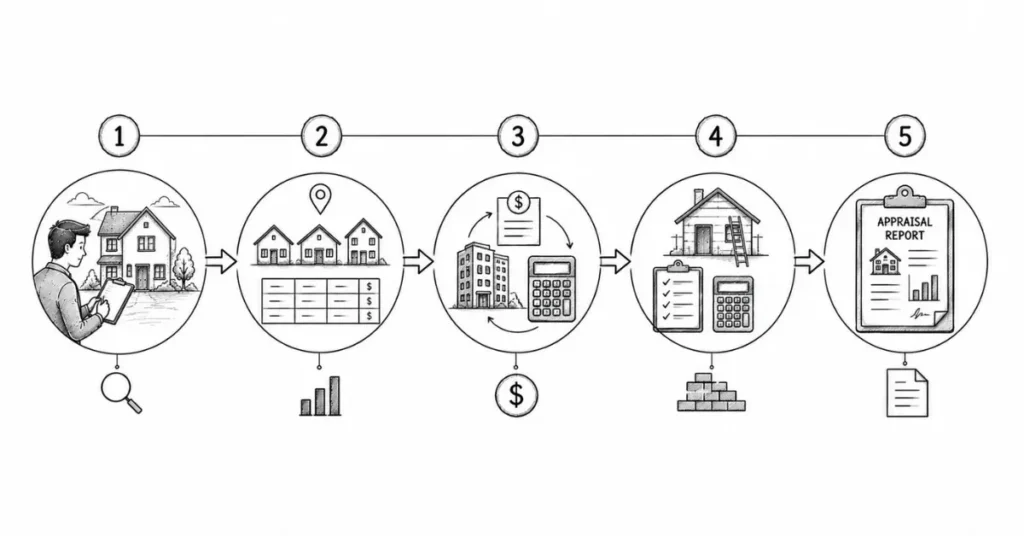
Real estate appraisers provide well-researched, objective opinions on property values through systematic analysis and application of accepted valuation methodologies. Your primary deliverable is a comprehensive appraisal report documenting your value conclusion and the analysis supporting it.
Property inspection forms the foundation of accurate valuation. You conduct thorough property inspections measuring dimensions and calculating areas, photographing exterior and interior features, noting construction quality and condition, identifying features, amenities, and upgrades, documenting defects or deferred maintenance, assessing compliance with building codes, and evaluating neighborhood characteristics and location factors. Detailed inspections provide the factual basis for your analysis and value conclusion.
Market research and comparable analysis require investigating recent sales of comparable properties in the same or similar neighborhoods. You identify truly comparable properties with similar sizes, locations, conditions, and features. You analyze sale prices, dates, terms, and conditions. You make adjustments for differences between comparables and subject properties. And you synthesize comparable data into value indications for your subject property.
Income approach analysis applies to investment properties valued based on income-generating capacity. You analyze actual or potential rental income for the property, estimate operating expenses including maintenance, utilities, management, taxes, and insurance, calculate net operating income (NOI) by subtracting expenses from income, and apply capitalization rates reflecting market expectations to determine property value. The income approach is standard for commercial properties like office buildings, retail centers, and apartment complexes where value derives primarily from income production.
Cost approach analysis estimates property value based on reproduction or replacement costs. You estimate land value separately through comparable land sales, calculate the cost to reproduce or replace improvements considering current construction costs, materials, and labor, subtract depreciation reflecting physical deterioration, functional obsolescence, and external obsolescence, and add land value to depreciated improvement cost. The cost approach works well for unique properties with limited comparable sales data and special-use properties where income approach doesn’t apply.
Report preparation documents your entire analysis in formats meeting professional standards and client requirements. Appraisal reports include property identification and description with complete addresses, legal descriptions, and ownership information, description of inspection findings, market analysis including neighborhood trends and property positioning, explanation of valuation approaches applied, reconciliation of different value indications, final value conclusion, limiting conditions and assumptions, certification of objectivity and competence, and supporting exhibits including photographs, maps, comparable sales data, and calculations.
Valuer Career Opportunities
Valuers can work in diverse settings. As property advisors, you provide expert guidance on property investments and market trends. As property dealers, you facilitate transactions while offering valuation expertise. As financial experts, you evaluate assets for banks, insurance companies, and investment firms. As property estimators, you assess construction costs and property values for developers. As asset management advisors, you guide clients on portfolio optimization and strategic property decisions.
The career offers high levels of job security with satisfactory compensation and the positive impact of helping clients make informed financial decisions in today’s investment-conscious environment.
Qualifications to Become a Registered Valuer
Educational Requirements for Land and Building Valuation
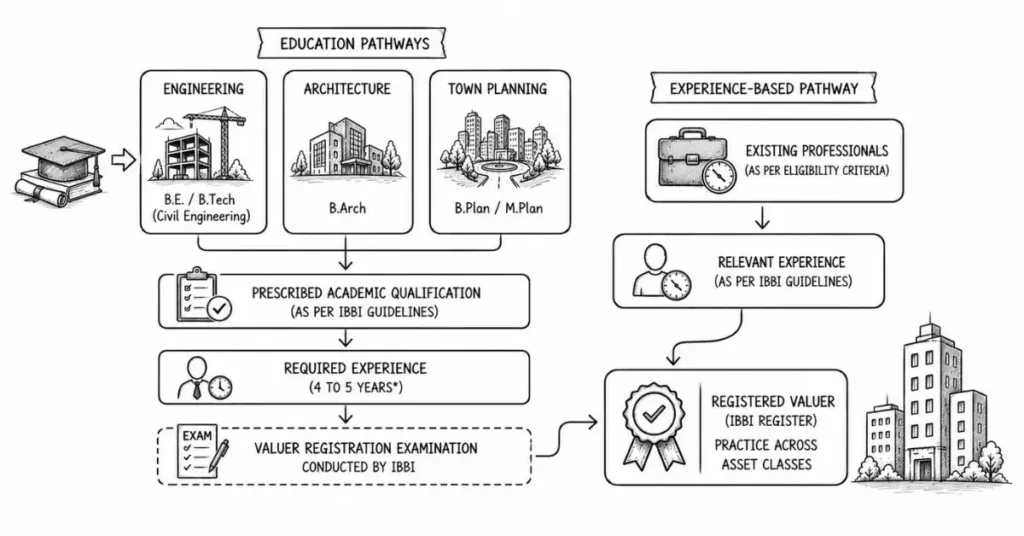
India’s regulatory framework establishes specific educational qualifications ensuring valuers possess necessary technical knowledge. For real estate/land and building valuation, acceptable qualifications include:
Option 1: Graduate degree pathways
- Graduate in civil engineering from a recognized university
- Graduate in architecture from a recognized university
- Graduate in town planning from a recognized university
- Post-graduate in valuation of real estate from a recognized university
These educational backgrounds provide technical knowledge of construction, design, building systems, materials, and structural considerations essential for property valuation.
Option 2: Post-graduate with reduced experience
A post-graduate degree or post-graduate diploma in the specified discipline (civil engineering, architecture, real estate valuation) from a University or Institute established, recognized or incorporated by law in India, plus at least three years of experience in the specified discipline thereafter qualifies you for registration.
Option 3: Bachelor’s degree with extended experience
A Bachelor’s degree or equivalent in the specified discipline from a recognized University or Institute in India, plus at least five years of experience in the specified discipline thereafter also qualifies you.
Option 4: Professional membership pathway
Membership of a professional institute established by an Act of Parliament enacted for the purpose of regulation of a profession (such as Institute of Valuers), with at least three years’ experience after such membership.
These pathways recognize that practical expertise developed through years of work can complement or partially substitute for formal education, making the profession accessible to experienced practitioners who’ve built valuation skills through employment or independent practice.
Becoming a Registered Valuer: Step-by-Step Process
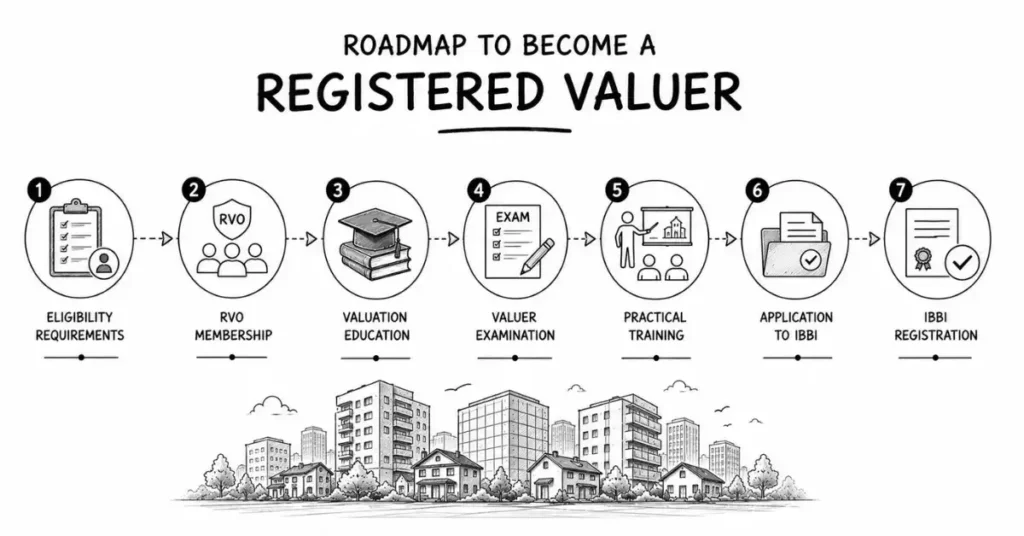
The journey to becoming a registered valuer under IBBI involves several mandatory steps.
Step 1: Meet Educational and Experience Eligibility
Verify you meet either the educational qualifications (degrees in civil engineering, architecture, town planning, or real estate valuation) or experience qualifications outlined above. Ensure you can document your education through certificates and your experience through employment letters, practice records, or income documentation.
Step 2: Enroll with a Registered Valuers Organization (RVO)
To become a registered valuer, you must first become a member of a Registered Valuers Organization (RVO) recognized by IBBI. Major RVOs include:
- ICAI Registered Valuers Organisation (ICAI RVO)
- ICMAI Registered Valuers Organisation (ICMAI RVO)
- ICSI Registered Valuers Organisation (ICSI RVO)
- Institute of Valuers (IOV)
Each RVO has specific membership requirements and fee structures. Research multiple RVOs to determine which best suits your background and career goals.
Step 3: Complete Mandatory Valuation Education Program
After RVO membership, complete the mandatory valuation education course designed for your asset class (Land and Building). These courses typically span 50-100 hours covering:
- Valuation theory and methodologies
- Regulatory framework and compliance
- Asset-specific technical knowledge
- Professional ethics and standards
- Practical applications and case studies
The education course can be completed through classroom sessions, online learning, or hybrid formats depending on your RVO. Course fees typically range from ₹40,000 to ₹1,00,000 depending on the RVO and delivery format.
ICMAI RVO, for example, offers online property/land & building valuation courses to help you become a certified valuation professional. ICAI RVO also provides specialized courses, with specific eligibility criteria for real estate valuation requiring careful review.
Step 4: Pass the IBBI Valuation Examination
After completing the education course, candidates must pass the Valuation Examination conducted by IBBI. This exam tests:
- Technical knowledge specific to Land and Building valuation
- Regulatory understanding of IBBI rules and frameworks
- Analytical ability to apply valuation methodologies
- Professional judgment in complex scenarios
Key examination requirements:
- The exam must be cleared within three years of application for registration
- Passing is non-negotiable and acts as final proof of competence before formal registration
- The exam ensures every Registered Valuer meets a consistent national benchmark of competence, irrespective of their background
Examination preparation typically requires 90-120 hours of focused study using RVO-provided materials, practice questions, and case studies.
Step 5: Complete Practical Training
Most RVOs require practical training or apprenticeship with registered valuers, typically 6-12 months. This provides hands-on experience in actual valuation assignments, report preparation, client interactions, and professional practice. Document your training experiences thoroughly as registration applications require detailed training logs.
Step 6: Apply for Registration with Your RVO
Once you’ve completed education, passed the examination, and fulfilled training requirements, submit your registration application to your RVO. Applications require:
- Educational qualification certificates
- Experience documentation (employment letters, practice records)
- Examination pass certificate
- Training completion certificates
- Character references
- Background verification documents
- Registration fees (typically ₹10,000-₹50,000)
Step 7: RVO Recommendation to IBBI
Your RVO reviews your application and, if satisfied you meet all requirements, recommends you to IBBI for registration as a Registered Valuer. The RVO must be satisfied regarding your qualifications, experience, examination success, and character before making this recommendation.
Step 8: IBBI Registration
Upon RVO recommendation, IBBI processes your registration and issues your Registered Valuer certificate authorizing you to practice professionally. Your registration is specific to the asset class for which you qualified (Land and Building in this case).
Maintaining Your Valuer Registration
Registered valuer status requires ongoing maintenance demonstrating continued competency.
Continuing Professional Education (CPE): Most registration authorities require 15-30 hours of CPE annually or 45-90 hours per three-year renewal cycle. CPE can be completed through approved courses, workshops, seminars, conferences, webinars, and sometimes self-study programs with examinations.
Periodic Renewal: Registration typically requires renewal every 3-5 years involving submission of renewal applications, documentation of completed CPE hours, payment of renewal fees, and confirmation of continued good standing without disciplinary actions.
Professional Liability Insurance: Many registration authorities mandate minimum insurance coverage as a condition of registration or renewal, typically ₹25 lakh to ₹1 crore or more depending on your practice size and risk exposure.
Ethical Compliance: Professional standards prohibit conflicts of interest, require objectivity and independence, mandate confidentiality of client information, demand competent work within your expertise areas, and require truthful reporting. Violations can result in registration suspension or revocation.
Essential Skills for Appraisal Success
Analytical and Research Abilities
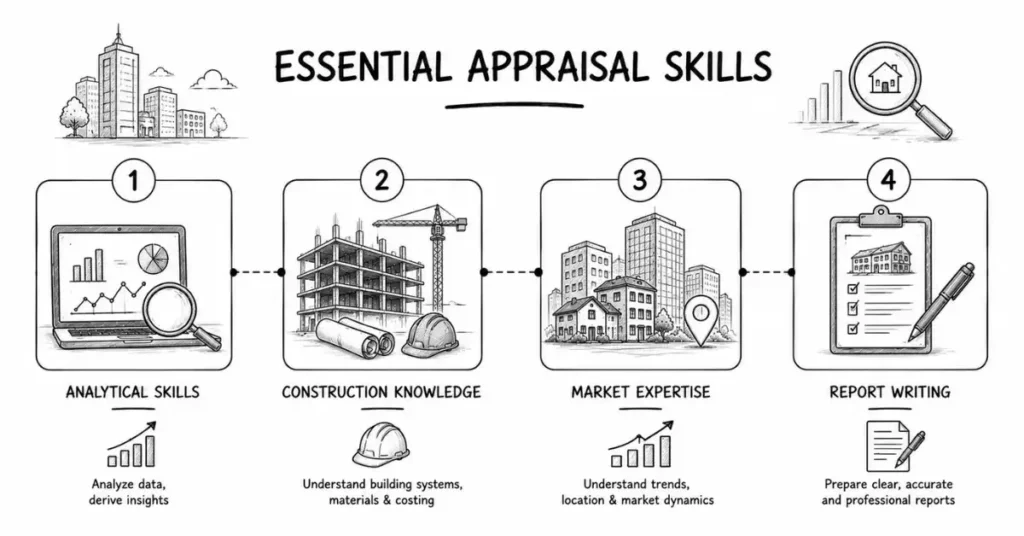
Real estate appraisal is fundamentally analytical, requiring systematic thinking and rigorous analysis. Data collection abilities help you efficiently gather property information from public records, MLS databases, interviews with owners or tenants, physical inspections, market reports, and demographic/economic data sources.
Quantitative analysis skills enable you to calculate areas and measurements accurately, analyze financial statements for income properties, apply statistical techniques to comparable sales data, compute capitalization and discount rates, calculate depreciation using various methods, and reconcile value indications from different approaches.
Critical thinking helps you evaluate data reliability and relevance, identify appropriate comparable properties, make sound adjustments for differences, recognize market trends and patterns, and detect inconsistencies requiring investigation. Research methodology ensures you follow systematic processes collecting comprehensive data, documenting sources, organizing information logically, analyzing objectively, and drawing supported conclusions.
Analytical and Research Abilities
Understanding buildings, construction, and property components is essential for accurate inspection and valuation. Building systems knowledge covers structural systems (foundations, framing, load-bearing walls), mechanical systems (HVAC, plumbing, electrical), exterior systems (roofing, siding, windows, doors), interior finishes (flooring, walls, ceilings, fixtures), and site improvements (landscaping, paving, drainage, utilities).
While you’re not expected to be an engineer or contractor, understanding these systems helps you identify quality levels, condition issues, functional obsolescence, and appropriate cost estimates. Construction cost estimation requires familiarity with current costs per square foot for various construction types and quality levels, understanding how age and condition affect reproduction costs, knowing regional cost variations, and applying appropriate depreciation factors.
Market Knowledge and Local Expertise
Deep understanding of local real estate markets differentiates excellent appraisers from merely adequate ones. Neighborhood analysis requires knowledge of location characteristics affecting values, development trends and area direction, demographic composition and changes, amenities and infrastructure, employment centers and transportation access, school quality, safety statistics, and supply/demand dynamics.
Market trends monitoring tracks pricing trends over time, absorption rates and inventory levels, days on market and sale-to-list price ratios, new construction activity, demographic shifts, economic indicators, and regulatory changes.
Communication and Report Writing
Appraisal reports represent your primary work product, making excellent communication essential. Written communication must be clear and accessible avoiding unnecessary jargon, logically organized following standard formats, thorough covering all relevant factors, well-supported with data and reasoning, grammatically correct without errors, and appropriately detailed balancing completeness with readability.
Visual presentation enhances reports through professional photographs, maps clarifying location and neighborhoods, charts and graphs illustrating trends, tables organizing comparable data, and floor plans or site plans when relevant.
Real Estate Appraiser Salary and Career Outlook
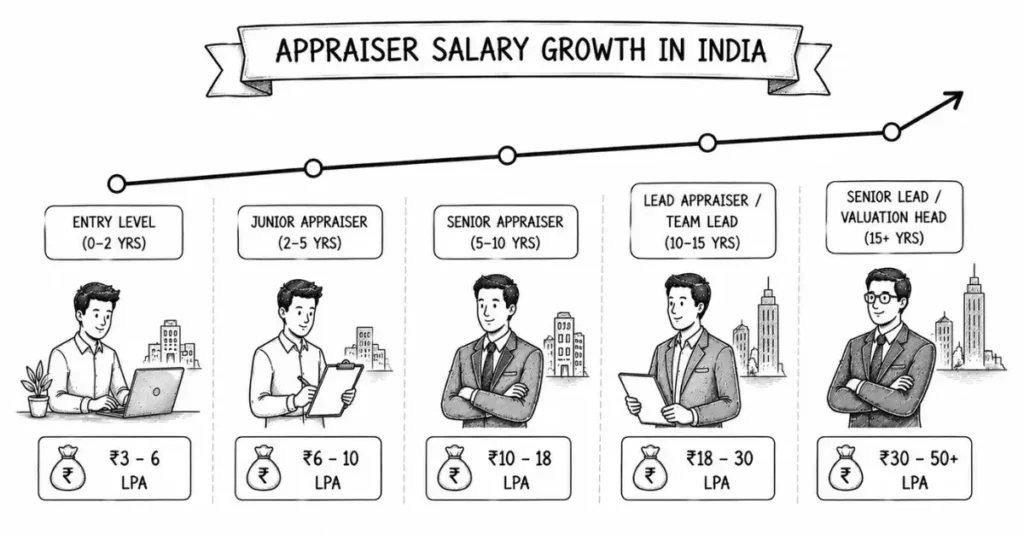
Earnings by Experience Level
Appraiser income varies based on experience, specialization, practice type, and location.
Entry-Level (0-2 years): Beginning valuers earn ₹4-5 lakh annually while building skills and working toward full registration. These entry positions provide learning opportunities through employment at appraisal firms, government agencies, or banks requiring valuation services.
Early Career (3-5 years): Registered appraisers with 3-5 years of experience typically earn ₹5-8 lakh annually. At this stage, you’ve developed efficient processes, established referral relationships, and built market knowledge enabling productive work. The average salary for valuers in India is ₹2.4 lakh according to some sources, though this appears to reflect very early career positions, as more experienced professionals earn substantially more.
Mid-Career (5-10 years): Experienced appraisers with 5-10 years command ₹8-10 lakh or more through higher fees, greater efficiency, specialized expertise, and established client relationships. Valuation specialists and analysts at this level average ₹5-5.5 lakh annually.
Senior Level (10+ years): Senior appraisers with 10+ years and strong reputations can earn ₹15-30 lakh or more through premium assignments, expert witness work commanding higher fees, consulting engagements beyond basic appraisals, large commercial or specialized properties, and leadership roles in appraisal firms. The highest earners in the valuation field reach ₹9 lakh annually according to salary surveys, though specialized commercial appraisers can exceed these figures.
Income Factors
Property type specialization: Commercial property appraisers typically earn more than residential appraisers due to larger values, greater complexity, and sophisticated analysis requirements. Industrial, special-use, and unique properties command premium fees.
Geographic location: Metropolitan markets offer higher fees reflecting larger property values and higher living costs. However, competition is also more intense in major cities.
Practice type: Independent practitioners can earn more than employed appraisers by retaining full fees, but bear all business expenses and risks. Employed appraisers enjoy salary stability and benefits but typically lower total compensation.
Credentials and reputation: Registered Valuer certification, membership in professional organizations, specialized training, and established reputation enable higher fees and better client opportunities.
Cost of Becoming a Valuer
The investment required varies by educational path and RVO choice. If attending government colleges after cracking entrance exams, course costs are economical. Private colleges or management quota students may invest ₹4,00,000 to ₹5,00,000 or more to complete the required education.
Additional costs include:
- RVO membership fees: ₹10,000-₹30,000
- Valuation education course: ₹40,000-₹1,00,000
- IBBI examination fees: ₹5,000-₹15,000
- Registration fees: ₹10,000-₹50,000
- Professional liability insurance: ₹20,000-₹50,000 annually
- Continuing education: ₹10,000-₹30,000 annually
Total investment typically ranges from ₹5,00,000 to ₹8,00,000 including education, certification, and first-year practice expenses. This investment typically pays for itself within 2-3 years through professional fees earned.
Building Your Appraisal Career
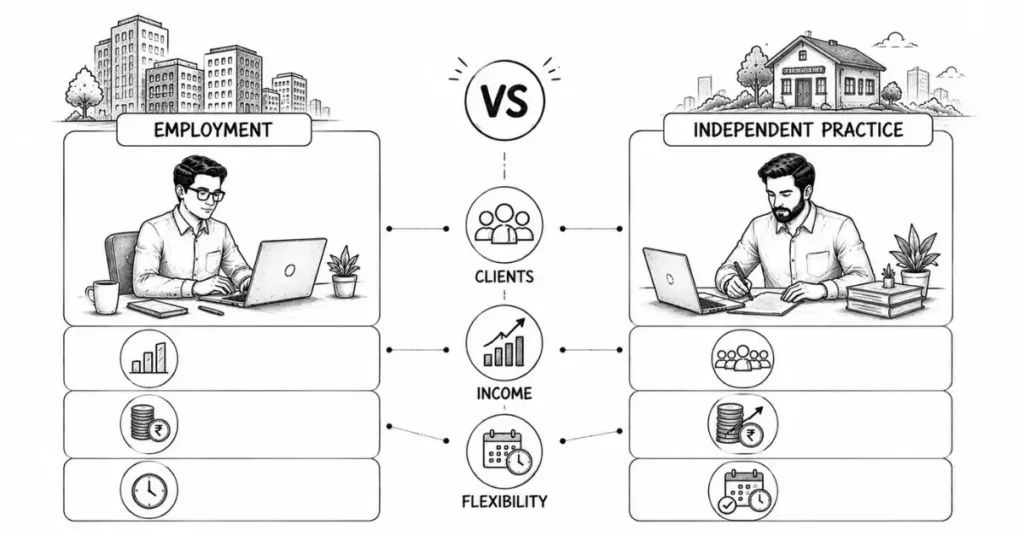
Employment vs. Independent Practice
Employment opportunities exist at appraisal firms serving multiple clients, banks and financial institutions requiring valuations for lending, government agencies needing staff appraisers for taxation or acquisition, insurance companies employing appraisers for underwriting, and consulting firms offering valuation among broader services.
Employment provides steady income and predictable paychecks, benefits like health insurance and paid leave, training and mentorship from experienced appraisers, reduced business development burden, administrative support, and liability coverage through employer insurance.
Independent practice offers higher earning potential keeping full fees, complete autonomy choosing clients and assignments, flexible schedule controlling your time, geographic flexibility working from anywhere, and direct client relationships building personal reputation.
But independence requires business development and marketing to secure clients, income variability especially initially, full responsibility for expenses and benefits, administrative burden handling all operations, and complete professional liability exposure.
Many appraisers begin as employees gaining experience, building skills, establishing networks, and understanding markets before launching independent practices.
Finding Clients
Lender relationships represent the largest client category. Banks, NBFCs, and housing finance companies require appraisals for virtually all mortgage loans. Develop relationships by registering with appraisal management companies, directly contacting local lenders, providing excellent work meeting deadlines, and maintaining required certifications and insurance.
Legal and accounting networks generate valuations for divorce proceedings, estate settlements, property disputes, tax planning, and bankruptcy cases. Connect with attorneys and CPAs through professional associations, focused marketing, expert witness directories, and referrals.
Business and investor clients need valuations for financial reporting, acquisitions, partnerships, and portfolio management. Reach these clients through commercial brokers, accountant referrals, direct marketing to investors and developers, and networking at investment associations.
Government agencies require appraisals for taxation, public acquisitions, asset disposal, and regulatory purposes through formal proposal processes or approved panels.
Frequently Asked Questions
How long does it take to become a registered valuer? The timeline varies based on your starting qualifications. With a civil engineering or architecture degree, you can potentially complete registration in 12-18 months including education (3-6 months), examination (several months including preparation), and practical training (6-12 months). If pursuing experience-based qualification, you need significant years of relevant experience before eligibility.
Is IBBI registration mandatory for all appraisers? IBBI registered valuer status is mandatory for valuations required under the Insolvency and Bankruptcy Code, Companies Act, and other statutory requirements. While some informal valuation work exists, serious appraisal careers require registration for credibility, legal protection, and access to most client relationships.
Can I specialize in only residential or commercial properties? Yes, many appraisers specialize in specific property types developing deep expertise. However, your IBBI registration covers the entire “Land and Building” asset class, so you’re legally authorized to value any real estate within that category.
What’s the difference between appraisers and real estate agents? Appraisers provide independent, objective value opinions through systematic analysis without advocating for any party. Agents represent buyers or sellers, advocating for their clients’ interests while facilitating transactions. Appraisers earn fees for analysis regardless of transaction outcomes; agents earn commissions when deals close. These are fundamentally different roles requiring different mindsets.
How stable is the appraiser career? Property valuation demand remains relatively stable as lending, taxation, insurance, and legal proceedings require ongoing appraisals regardless of market cycles. While transaction volumes fluctuate, baseline demand from these sources provides career stability.
Conclusion
Real estate appraiser careers offer analytical challenge, professional respect, meaningful impact on major financial decisions, and solid earning potential for those with appropriate qualifications, technical knowledge, and systematic thinking abilities. The profession combines technical property knowledge with financial analysis, market research with report writing, and independent field work with detailed office analysis.
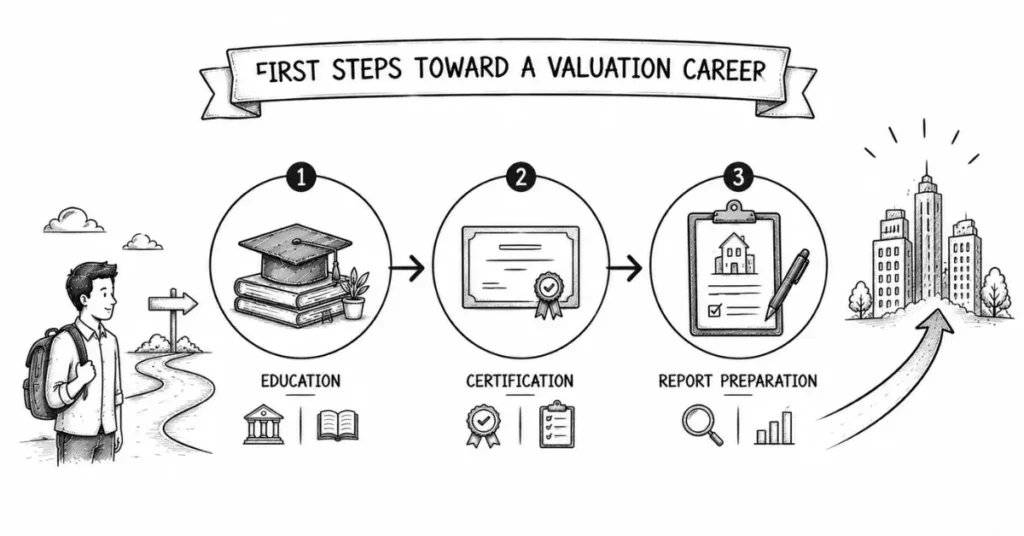
Your journey to registered valuer status begins with understanding qualification pathways, pursuing required education and RVO membership, completing valuation courses, passing IBBI examinations, fulfilling training requirements, and applying for registration. Success requires continuous market knowledge development, rigorous methodology application, excellent communication skills, ethical professional practice, and commitment to ongoing learning.
The appraisers who build rewarding long-term careers approach valuation as a serious profession requiring constant skill development rather than a simple technical task. They invest in education and certification, specialize strategically to differentiate themselves, build strong client relationships through excellent work quality, and maintain objectivity and independence regardless of external pressures.
Begin your appraisal career today by verifying your qualification eligibility, researching RVOs and education programs, connecting with registered valuers for guidance, and taking the first concrete step toward this respected analytical profession in India’s growing real estate sector.