
Essential Skills for E-commerce Professionals in 2026
Table of Contents
Introduction: The Skills That Actually Matter (Not What Job Descriptions Say)
Let me be honest about something: job descriptions lie.
A typical e-commerce job posting says:
“Required: MBA from top-tier college, 5+ years experience, proficiency in 15 tools, excellent communication, strategic thinking, data-driven mindset…”
Reality: The person who got hired?
- Tier-3 college graduate
- 2 years experience
- Knew 4 tools well (not 15 superficially)
- Could explain data insights clearly
- Demonstrated customer empathy
- Showed hunger to learn
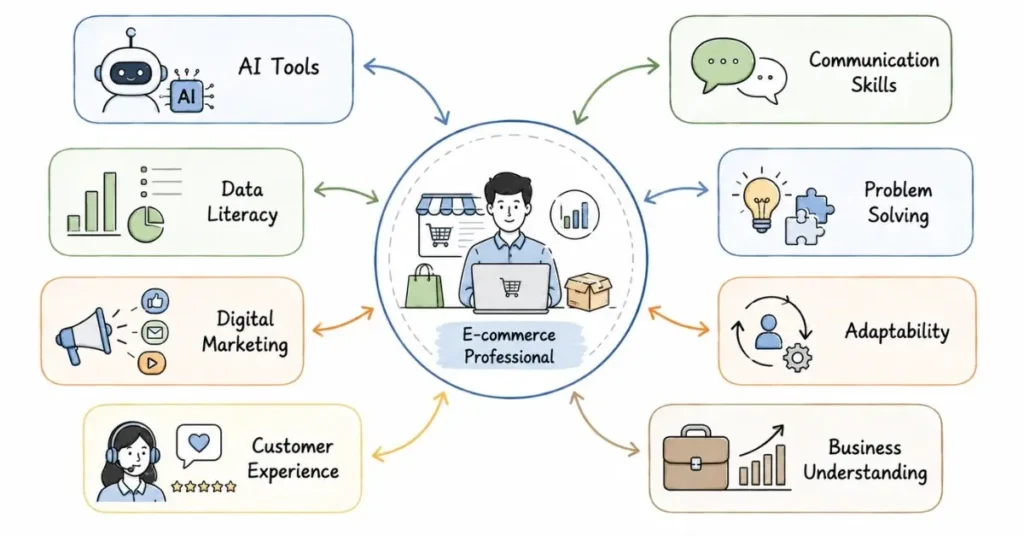
The difference between job descriptions and what actually gets you hired, promoted, and successful in e-commerce is what this guide addresses.
After analyzing 100+ successful e-commerce careers in India, interviewing hiring managers, and observing what separates good professionals from great ones, I’ve identified the skills that actually matter in 2026.
This isn’t a generic “learn Excel and communication” list. This is specific, actionable, and focused on what will make you valuable in Indian e-commerce over the next 3-5 years.
The Foundation: Core Skills Every E-commerce Professional Needs
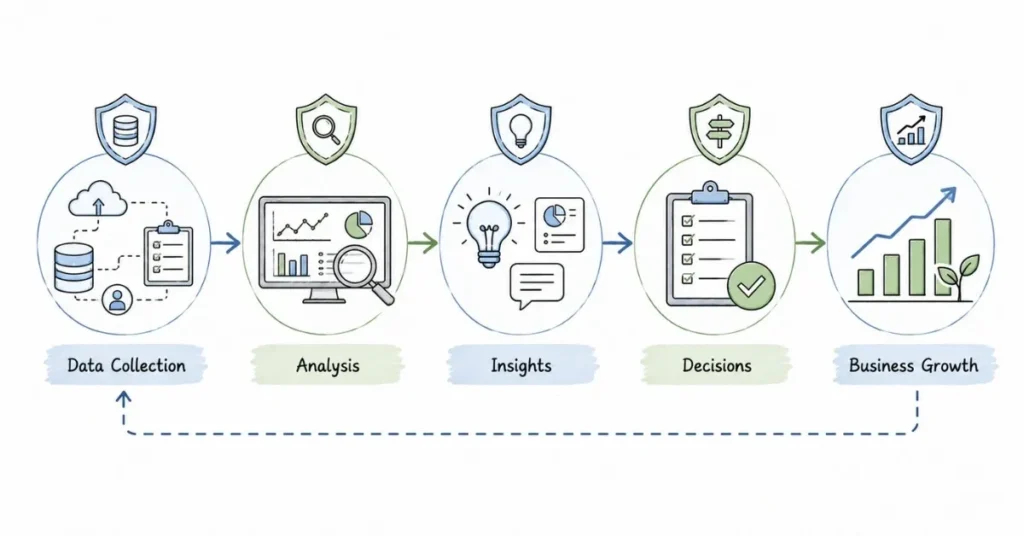
1. Data Literacy: Speaking the Language of Business
What it actually means:
Not advanced statistics or machine learning. Data literacy means:
- Understanding basic metrics (conversion rate, AOV, CAC, LTV)
- Reading and interpreting dashboards
- Making decisions based on data, not just gut feeling
- Asking the right questions when looking at data
Why it matters:
E-commerce generates data on everything every click, every purchase, every abandoned cart. Professionals who can swim in this data ocean thrive. Those who drown in it struggle.
Example of data literacy in action:
Without data literacy:
“Sales are down. Let’s run a bigger sale.”
With data literacy:
“Sales are down 15% vs. last month. Let me check:
- Traffic down 5% (marketing issue?)
- Conversion rate down 8% (website issue? checkout problem?)
- Average order value down 3% (pricing issue?)
- Return rate up 12% (quality issue?)
Drilling deeper: Conversion drop is highest in checkout page. Funnel analysis shows 40% drop at payment step. Hypothesis: Payment gateway issues. Action: Investigate payment failures, not run blanket sale.”
How to build data literacy:
Level 1 (Foundation): Understand e-commerce metrics
- Spend 2 hours learning what each metric means (conversion rate, bounce rate, ROAS, LTV, etc.)
- Resource: Free blog posts, YouTube videos
Level 2 (Application): Use Google Analytics
- Install GA on a website (yours or practice site)
- Spend 30 minutes daily exploring data
- Ask questions: Why did traffic spike on Tuesday? Where do most users come from?
Level 3 (Analysis): Excel for analysis
- Master pivot tables, charts, basic formulas
- Practice analyzing sample e-commerce data (available free on Kaggle)
Time investment: 2-3 months of consistent practice gets you to Level 3.
Career impact: Data-literate professionals earn 20-30% more than data-illiterate peers at same experience level.
2. Customer Empathy: Thinking Like Your Customer
What it actually means:
Not “being nice to customers.” Customer empathy means deeply understanding:
- What motivates your customers
- What frustrates them
- What they value
- How they think and make decisions
Why it’s your superpower in Indian e-commerce:
India is incredibly diverse:
- 28-year-old software engineer in Bangalore buying gadgets
- 45-year-old homemaker in Jaipur shopping for groceries
- 22-year-old college student in Bhubaneswar buying fashion
- 60-year-old retiree in Kochi ordering medicines
Each has different:
- Technology comfort levels
- Language preferences
- Payment preferences (credit card vs. COD vs. UPI)
- Shopping motivations
- Trust factors
Understanding this diversity and designing for it separates good e-commerce professionals from great ones.
Example of customer empathy in action:
Without empathy:
Checkout has 5 steps. Payment options listed alphabetically. Address form has 12 fields. “Proceed to Pay” button in English only.
With empathy:
“My customer in tier-2 city might be shopping online for first time. Let me make this easy:
- Checkout in 3 simple steps with clear progress indicator
- COD option displayed prominently (they trust it more)
- Address form has auto-complete for Indian addresses
- ‘Proceed to Pay’ button also says ‘आगे बढ़ें’ for Hindi speakers
- WhatsApp confirmation (they check WhatsApp more than email)”
How to build customer empathy:
Practice 1: Customer shadowing
Spend a day with customer service team. Listen to customer complaints, questions, confusion. Patterns emerge.
Practice 2: User testing
Watch 5-10 people (different demographics) use your website/app. Don’t help them. Just observe where they struggle.
Practice 3: Review analysis
Read 100 customer reviews (positive and negative). What do people love? What frustrates them? Themes emerge.
Practice 4: Be the customer
Shop on your own platform as if you’re your target customer. What’s your experience?
Time investment: Ongoing practice, not one-time learning.
Career impact: Customer-empathetic professionals identify problems others miss and create solutions that actually work.
3. Technology Comfort: You Don't Code, But You Understand
What it means:
You’re not a developer, but you understand:
- How websites/apps work (frontend, backend, database, API what are these?)
- What’s technically easy vs. difficult
- Why some changes take 2 days and others take 2 months
- How to have intelligent conversations with tech teams
Why it matters:
E-commerce is fundamentally a technology business. Professionals who understand technology:
- Set realistic expectations
- Make better decisions
- Communicate effectively with tech teams
- Don’t get frustrated by “tech team says it takes 3 months” without understanding why
Example of technology understanding in action:
Without understanding:
Marketing Manager: “Can we add a ‘compare products’ feature by next week? How hard can it be?”
Developer: “That needs 6 weeks.”
Marketing Manager: “You guys are always slow and make excuses!”
[Frustration, tension, bad relationship]
With understanding:
Marketing Manager: “I’d like a compare products feature. I understand this needs:
- Frontend UI changes
- Backend API to fetch multiple products
- Database query optimization
- Testing across devices
What’s a realistic timeline?”
Developer: “6 weeks for full functionality. We could do a basic version in 3 weeks if you’re flexible on some features.”
Marketing Manager: “Let’s do 3-week basic version, gather feedback, iterate.”
[Collaboration, realistic expectations, good relationship]
How to build technology understanding:
Step 1: Learn basics of how web works
- Free resource: “How does the internet work?” videos on YouTube
- Time: 2-3 hours
Step 2: Understand your platform
- If your company uses Shopify, spend 4-5 hours exploring Shopify tutorials
- Understand what’s built-in vs. needs customization
Step 3: Learn tech vocabulary
- Frontend, backend, API, database, server, cloud, deployment
- Not how to build them, just what they mean
- Time: 5-6 hours of reading/watching videos
Step 4: Ask developers to explain
- When tech team says something takes time, ask: “Help me understand what’s involved?”
- Most developers love explaining if you’re genuinely curious
Time investment: 20-30 hours of learning gives you 80% of understanding you need.
Career impact: Technology-comfortable professionals advance to leadership roles faster because they bridge business and tech.
4. Adaptability: The Only Constant is Change
What it means:
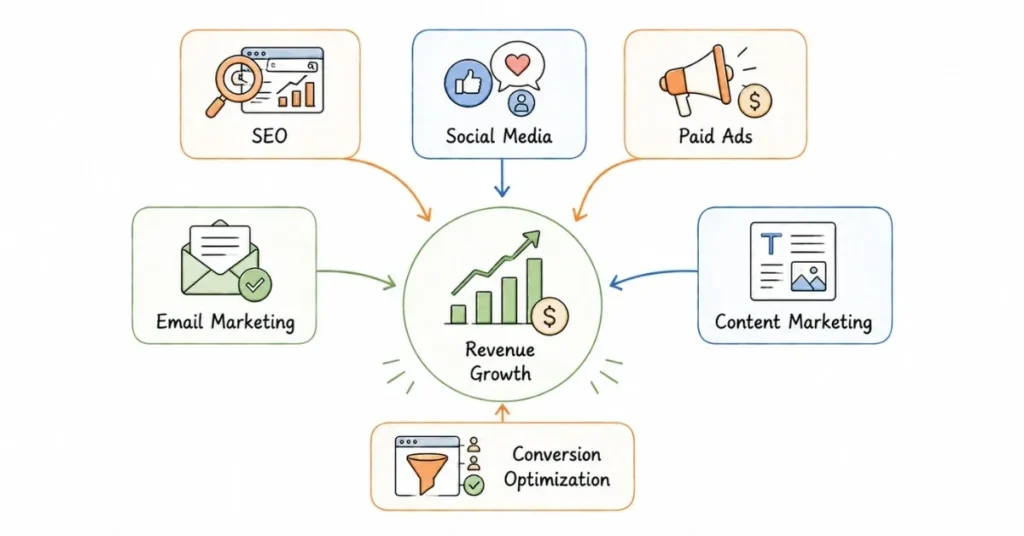
E-commerce changes fast:
- Algorithms change (Google algorithm update affects SEO)
- Platforms change (Instagram adds new features)
- Customer behavior changes (UPI adoption exploded in 3 years)
- Competition changes (new player enters market)
- Technology changes (AI tools everywhere now)
Adaptability means: You learn new things quickly, adjust strategies, and don’t get stuck in “this is how we’ve always done it.”
Example:
2020: Facebook ads were cheapest customer acquisition channel
2023: Facebook costs doubled, Instagram Reels organic reach exploded
Adaptable marketer: Quickly learned Reels, shifted budget, maintained ROI
Non-adaptable marketer: Kept running same Facebook ads, complained about costs, poor ROI
How to build adaptability:
Mindset shift: View change as opportunity, not threat.
Continuous learning habit:
- Spend 30 minutes daily reading industry news
- Follow e-commerce leaders on LinkedIn/Twitter
- Try new tools and features immediately when they launch
Experimentation mindset:
- Test new approaches regularly
- 80% proven strategies, 20% experiments
- Learn from failures fast
Time investment: Daily habit, not one-time skill.
Career impact: Adaptable professionals are promoted first because companies need people who can handle change.
2026 Specific: Emerging Skills That Will Set You Apart
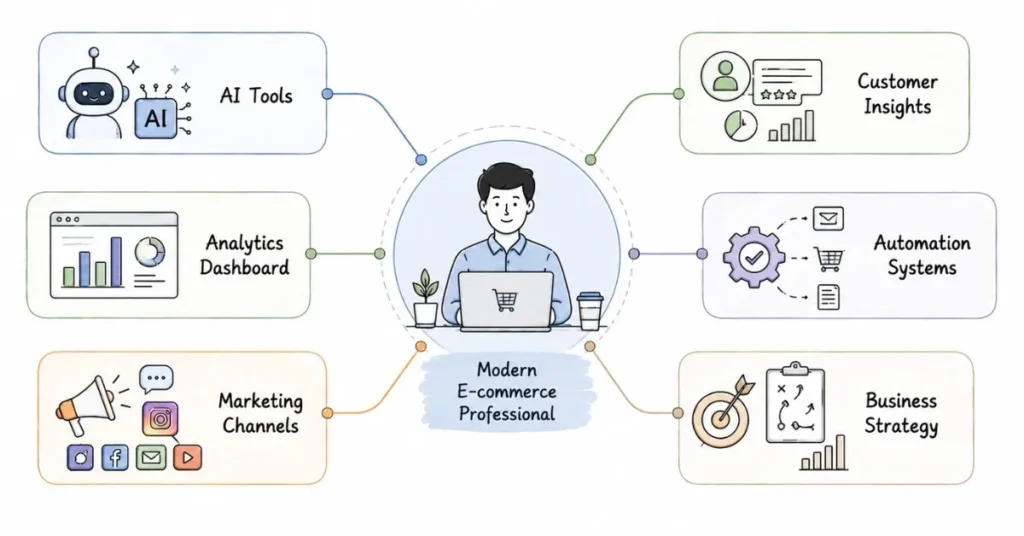
5. AI Tool Proficiency: Using AI Without Being Replaced by AI
The reality of AI in 2026:
AI won’t replace e-commerce professionals. But professionals using AI will replace those who don’t.
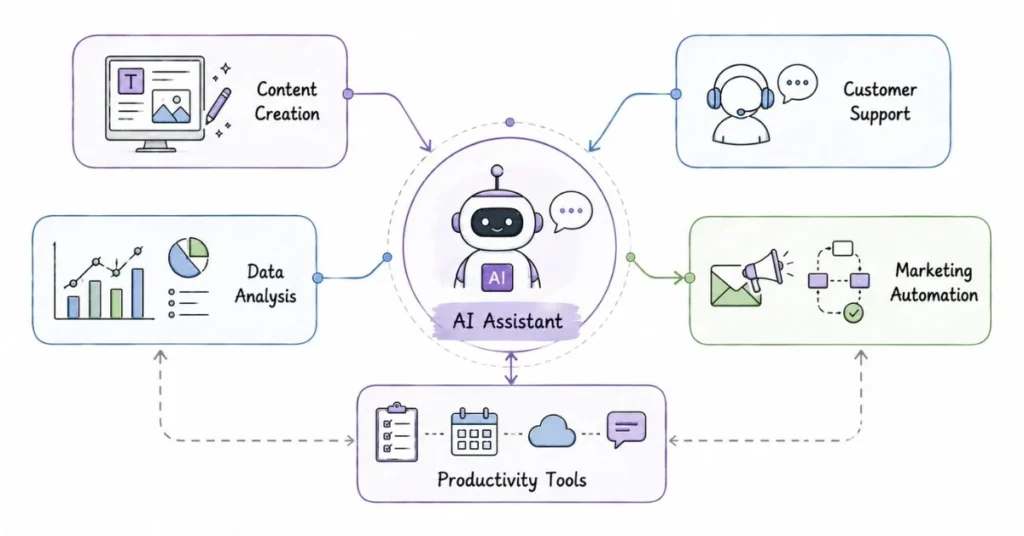
AI tools you should be using:
For content creation:
- ChatGPT/Claude: Product descriptions, email copies, blog outlines
- Jasper/Copy.ai: Marketing copy, ad variations
- Midjourney/DALL-E: Product photography enhancement, marketing creatives
For data analysis:
- ChatGPT with data: Analyzing Excel data, finding insights
- Numerous.ai: Spreadsheet functions powered by AI
For customer service:
- Chatbots: Handling 70% of repetitive queries
- Sentiment analysis tools: Understanding customer emotions at scale
For design:
- Canva AI: Quick design creation
- Remove.bg: Background removal for product photos
How to use AI effectively:
Bad use: “AI, write product description for jeans.”
[Gets generic, boring description]
Good use: “AI, write product description for premium men’s jeans targeting 25-35 year old urban professionals in India. Tone: Aspirational but authentic. Include benefits: comfort for long work hours, versatile for office and casual. 100 words.”
[Gets targeted, relevant description]
The skill isn’t just using AI tools. It’s prompting them effectively and editing their output.
How to build AI proficiency:
Week 1: Create ChatGPT account (free), experiment with prompts
Week 2: Use it for real work tasks (writing, analysis, brainstorming)
Week 3: Learn prompt engineering basics (free YouTube tutorials)
Month 2-3: Explore specialized tools for your function
Time investment: 10-15 hours gives you functional proficiency.
Career impact: AI-proficient professionals are 2-3x more productive, handle more responsibilities, get promoted faster.
6. Video Content Creation: The Future of E-commerce Marketing
The shift:
2020: Product photos were enough
2024: Product videos standard
2026: Short-form video content (Reels, Shorts, TikTok-style) is primary discovery method
Why it matters:
Indian consumers increasingly discover and purchase through:
- Instagram Reels
- YouTube Shorts
- Video reviews
- Live shopping events
Professionals who can create or coordinate video content are highly valuable.
You don't need to be professional videographer. You need:
Basic video shooting:
- Using smartphone effectively
- Basic composition and lighting
- Capturing B-roll footage
Basic editing:
- Using CapCut, InShot, or similar apps
- Adding text overlays
- Selecting trending audio
- Creating 15-60 second engaging videos
Content strategy:
- Understanding what videos work (problem-solution, before-after, how-to, unboxing)
- Scripting concisely
- Hook in first 3 seconds (or users scroll past)
How to build video skills:
Week 1-2: Watch and analyze 50 successful brand Reels/Shorts
- What hooks you? What makes you watch till end?
- Note patterns
Week 3-4: Create 10 practice videos
- Product demos, unboxings, tutorials
- Even if not for publishing, practice
Month 2: Learn one editing app deeply (CapCut is beginner-friendly)
Month 3: Create 30-day video content calendar and execute
Time investment: 30-40 hours to functional competence.
Career impact: Video-capable marketers earn 25-40% more than non-video marketers in 2026.
7. Cross-functional Collaboration: The Orchestra Conductor Skill
The reality:
E-commerce success needs multiple teams working together:
- Marketing drives traffic
- Tech ensures website works
- Operations fulfills orders
- Customer service handles queries
- Finance manages budgets
But these teams often have different priorities, languages, and metrics.
The skill: Being the person who connects these teams, translates between them, and drives collaborative solutions.
Example:
Problem: Cart abandonment rate is 75% (high).
Marketing says: “Website is slow, that’s why people abandon.”
Tech says: “Website is fine. Marketing drives wrong traffic.”
Operations says: “Delivery charges are too high, that’s why.”
Cross-functional collaborator:
“Let’s look at data together:
- 30% abandon at product page (likely pricing issue)
- 25% abandon at checkout start (could be delivery charges)
- 20% abandon at payment (tech issue or payment failures)
Let’s address all three:
- Marketing: Test pricing strategy
- Operations: Test free delivery threshold
- Tech: Investigate payment failures
Meet in 2 weeks with results.”
How to build this skill:
Practice 1: Learn basics of other functions
- If you’re in marketing, understand operations challenges
- If you’re in tech, understand marketing metrics
Practice 2: Build relationships
- Have coffee with people from other teams
- Understand their pressures and goals
Practice 3: Use common language
- Translate tech language for business team
- Translate business requirements for tech team
Practice 4: Focus on shared goals
- Instead of “my team vs your team,” frame as “how do we together serve customers better?”
Time investment: Ongoing relationship and communication practice.
Career impact: Cross-functional collaborators get promoted to leadership roles because they can manage complexity.
Soft Skills That Matter More Than Hard Skills
8. Clear Communication: The Multiplier Skill
Your technical knowledge is useless if you can’t explain it.
What clear communication means:
For presentations:
- Complex ideas explained simply
- Data visualized clearly
- Recommendations actionable
For writing:
- Emails that are clear, concise, actionable
- Documents that people actually read
- Reports that drive decisions
For speaking:
- Explaining technical concepts to non-technical stakeholders
- Persuading without being pushy
- Active listening
How to improve:
For presentations:
- Study TED talks (notice structure, storytelling, visuals)
- Practice rule: 1 slide = 1 idea
- Always end with “So what?” (action items)
For writing:
- Read “On Writing Well” by William Zinsser
- Practice: Write something, cut 30% of words, it becomes clearer
- Before sending email: Read it from recipient’s perspective
For speaking:
- Join Toastmasters or similar groups
- Practice explaining your work to family members (if they understand, anyone will)
Time investment: Continuous improvement over months and years.
Career impact: Clear communicators rise to leadership. Period.
9. Resilience: The E-commerce Survival Skill
The reality of e-commerce:
- Launch carefully planned campaign → Compete launches better campaign same day
- Website crashes during peak sale → Revenue loss, angry customers
- Star team member quits mid-project → Need to redistribute work
- Budget gets cut 40% → Need to deliver same results with less
This isn’t occasional. This is regular.
Resilience means:
- Bouncing back from failures fast
- Maintaining performance under pressure
- Learning from mistakes without dwelling
- Staying optimistic through challenges
How to build resilience:
Mindset reframe:
- Failure isn’t opposite of success, it’s part of success
- Every problem is a learning opportunity (cliché but true)
Pressure management:
- Regular breaks (burnout kills resilience)
- Physical exercise (scientifically proven to build mental resilience)
- Support system (talking through challenges helps)
Continuous learning from failures:
- After every failure: What did I learn? What will I do differently?
- Keep failure journal (patterns emerge)
Time investment: Daily practices, not one-time learning.
Career impact: Resilient professionals last long, survive layoffs, get challenging opportunities.
The T-Shaped Professional: Your Career Strategy
What is T-shaped:
Horizontal bar (top of T): Broad understanding of many skills
Vertical bar (stem of T): Deep expertise in 1-2 specific skills
Example T-shaped E-commerce Professional:
Broad understanding (Horizontal):
- Basic data analysis
- Customer empathy
- Technology comfort
- Marketing fundamentals
- Operations awareness
- Communication
Deep expertise (Vertical):
- Performance marketing (expert level)
- AI tool optimization (expert level)
Why T-shaped professionals win:
- Can have intelligent conversations across functions (horizontal)
- Provide unique expert value (vertical)
- Get hired for expertise, promoted for breadth
Your T-shaped development plan:
Years 0-2: Build horizontal bar
- Explore multiple areas
- Understand how e-commerce works end-to-end
- Find what you enjoy and what you’re naturally good at
Years 3-5: Build vertical bar
- Specialize in 1-2 areas
- Become the go-to expert
- Build reputation
Years 6+: Expand horizontal again
- Leadership requires broad understanding
- Strategic roles need cross-functional knowledge
Your 90-Day Skill Building Plan
Month 1: Foundation
- Data literacy basics (2 hours/day, 3 days/week)
- Customer empathy practice (read reviews, talk to customers)
- Start AI tool experimentation (ChatGPT for work tasks)
Month 2: Application
- Apply data skills to real projects
- Create first video content
- Build cross-functional relationships at work
Month 3: Deepening
- Choose 1-2 skills to specialize in
- Build portfolio/evidence of skills
- Share learnings publicly (LinkedIn posts, blog)
Final Thoughts: Skills vs. Credentials
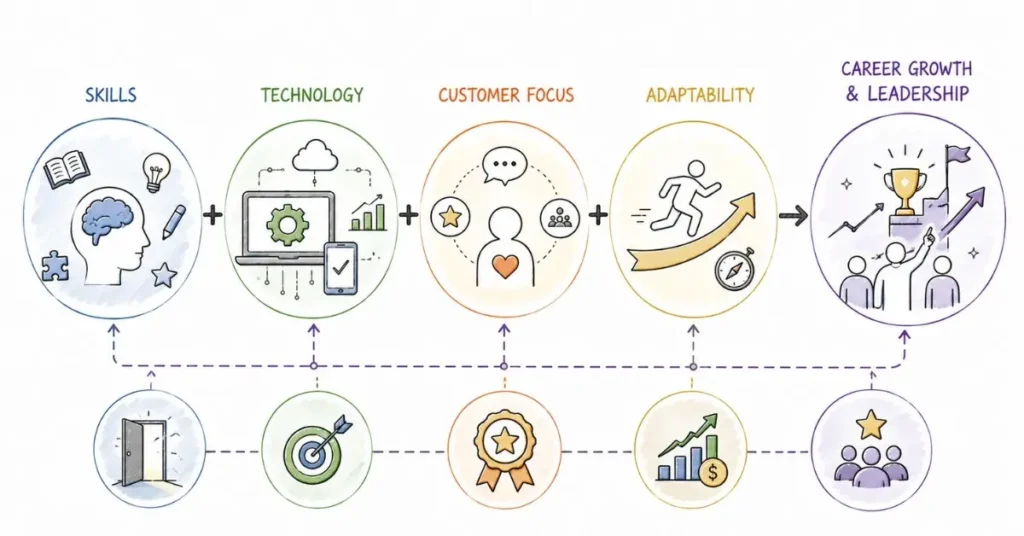
Here’s what matters in e-commerce careers:
Credentials (degrees, certifications): Get you interview
Skills (what you can actually do): Get you job and promotions
Results (what you’ve delivered): Get you respect and salary
Focus your energy accordingly.
The beautiful part about e-commerce? It’s merit-based. Your tier-3 college degree doesn’t matter if you can demonstrate customer empathy, data literacy, and deliver results.
The challenging part? Skills require consistent effort. No shortcuts.
But if you commit to building these skills over next 6-12 months, you’ll be more valuable than 80% of e-commerce professionals in India.
Your skill-building journey starts today. Pick one skill from this guide. Spend 30 minutes learning it today. Repeat tomorrow.
Welcome to your high-value e-commerce career.