
E-commerce Career Paths: Entry to Executive Level
Table of Contents
Introduction: The Reality of E-commerce Career Growth in India
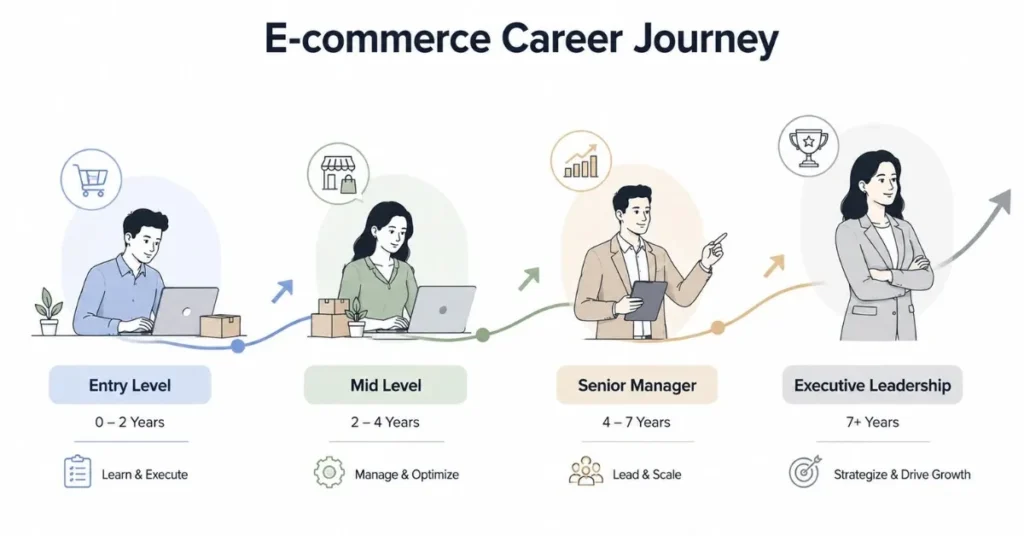
Let’s have an honest conversation about climbing the e-commerce career ladder in India. Unlike traditional corporate jobs where promotions happen every 3-5 years based on seniority, e-commerce rewards results and adaptability. I’ve seen people go from interns to managers in 18 months, and I’ve also seen folks stuck at the same level for years because they stopped learning.
This guide maps out the realistic career progression in e-commerce, what each level actually involves (not the fancy job descriptions), what you’ll earn, and how long it typically takes to move up. Whether you’re a final-year student in Pune wondering where to start, or a 4-year professional in Hyderabad planning your next move, this roadmap is for you.
The best part about e-commerce careers in India? The industry is so new that there’s no “fixed” path. Someone with 3 years of sharp experience can sometimes leapfrog someone with 7 years of mediocre experience. It’s about what you know and what you can deliver, not just how long you’ve been around
Entry Level: Getting Your Foot in the Door (0-2 Years)
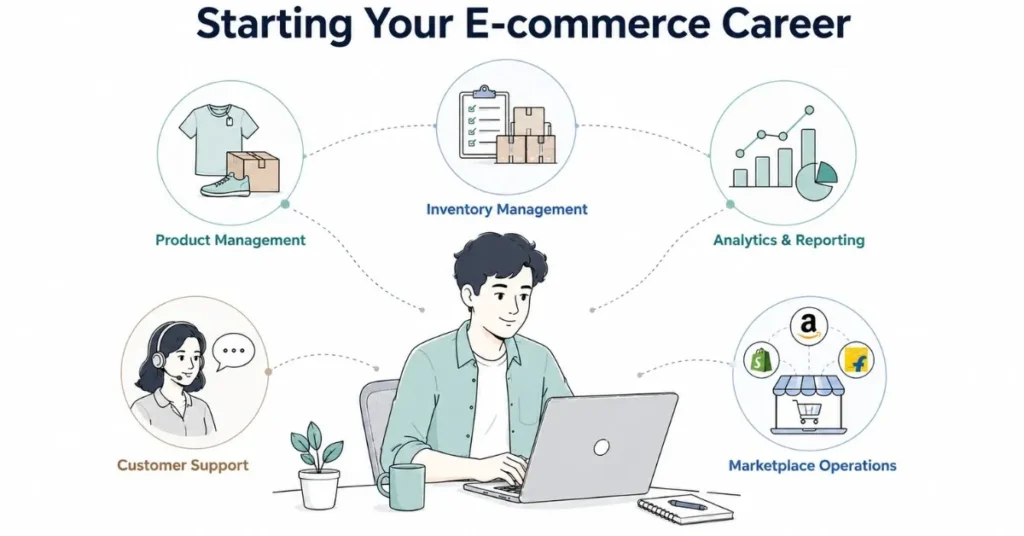
E-commerce Executive/Assistant (₹2.5-5 LPA)
The work can feel repetitive. You might wonder if you’re just a “data entry person.” But here’s what’s actually happening you’re learning the backend of e-commerce. You’re seeing what makes a product page convert, why certain images work better, how pricing affects sales. This foundational knowledge is gold for your next roles.
How to excel and move up faster:
- Take initiative: Don’t just upload products mechanically. Notice patterns. “Sir, I noticed products with lifestyle images sell 20% better than plain white background photos” statements like this get you noticed.
- Learn adjacent skills: If you’re in operations, learn basic marketing. If you’re in marketing, understand operations. This cross-functional knowledge accelerates growth.
- Document processes: Create SOPs (Standard Operating Procedures) for your tasks. Managers love people who bring order to chaos.
- Ask for stretch assignments: “Can I help with competitor analysis?” “Can I draft some product descriptions?” Show hunger to learn beyond your job description.
Typical timeline at this level: 12-24 months before promotion if you’re proactive, 24-36 months if you’re just doing assigned tasks.
Digital Marketing Executive (₹3-6 LPA)
What you actually do:
You’re running campaigns, but not strategizing them yet. Your manager says “Run Facebook ads for these products with ₹50,000 budget, target women 25-35, metro cities.” You execute it, monitor results, report back.
You’re also:
- Creating ad copies and coordinating with designers for creatives
- Scheduling social media posts
- Running basic Google Ads campaigns
- Tracking metrics in Google Analytics
- A/B testing ad variations
- Managing email marketing campaigns
The learning curve:
Rahul, a Digital Marketing Executive in Bangalore, describes his first 6 months: “I wasted ₹15,000 in my first campaign by targeting too broadly. But that failure taught me more than any course. By month 6, I was consistently delivering 3-4x ROAS (Return on Ad Spend).”
This role is beautiful because you see immediate results. Run an ad today, see sales tomorrow. This quick feedback loop accelerates learning faster than most careers.
How to stand out:
- Become data-obsessed: Don’t just report “We spent ₹50,000 and got ₹1.5 lakhs revenue.” Break it down: “Our Instagram carousel ads delivered 4.2x ROAS, while static images only delivered 2.8x. Suggest we shift 60% budget to carousels.”
- Stay updated: Marketing changes every quarter. Follow industry experts, try new features first, bring ideas to your manager.
- Build a personal case study portfolio: Document your best campaigns with metrics. This becomes your ticket to better jobs.
Timeline to next level: 18-30 months to Senior Executive or Specialist roles.
Operations Coordinator (₹3-5.5 LPA)
What you actually do:
You’re the bridge between the digital world and physical reality. Someone orders a phone case on the website you ensure it reaches them. Sounds simple? It’s not.
Daily activities:
- Processing orders and ensuring correct products are picked from warehouse
- Coordinating with logistics partners (Delhivery, Blue Dart, etc.)
- Handling return and exchange requests
- Managing inventory levels and raising alerts for low stock
- Solving delivery issues (“Customer says product not delivered but courier shows delivered”)
The unsexy but crucial role:
Operations don’t get glory like marketing or tech, but here’s the truth: you can have the best website and marketing, but if orders don’t reach customers properly, the business fails. Operations people are the unsung heroes.
Sneha, an Operations Coordinator in Jaipur, shares: “During Diwali sale, we got 3x normal orders. I worked 14-hour days for a week coordinating with 3 warehouses and 5 delivery partners. When we achieved 96% on-time delivery despite the chaos, I realized the impact of my role.”
How to grow:
- Optimize processes: Find inefficiencies and fix them. “If we pack orders before 2 PM, same-day pickup is guaranteed. After 2 PM, it goes to next day. Can we set a 1 PM internal deadline?”
- Learn basic data analysis: Operations generate tons of data. Those who can analyze it (average delivery time by city, return rates by product category) become managers faster.
- Understand technology: Learn about Warehouse Management Systems (WMS), Order Management Systems (OMS). This knowledge is rare and valuable.
Timeline to next level: 18-24 months to Senior Coordinator or Assistant Manager roles.
Mid-Level: Where Strategy Meets Execution (3-6 Years)
E-commerce Manager (₹8-16 LPA)
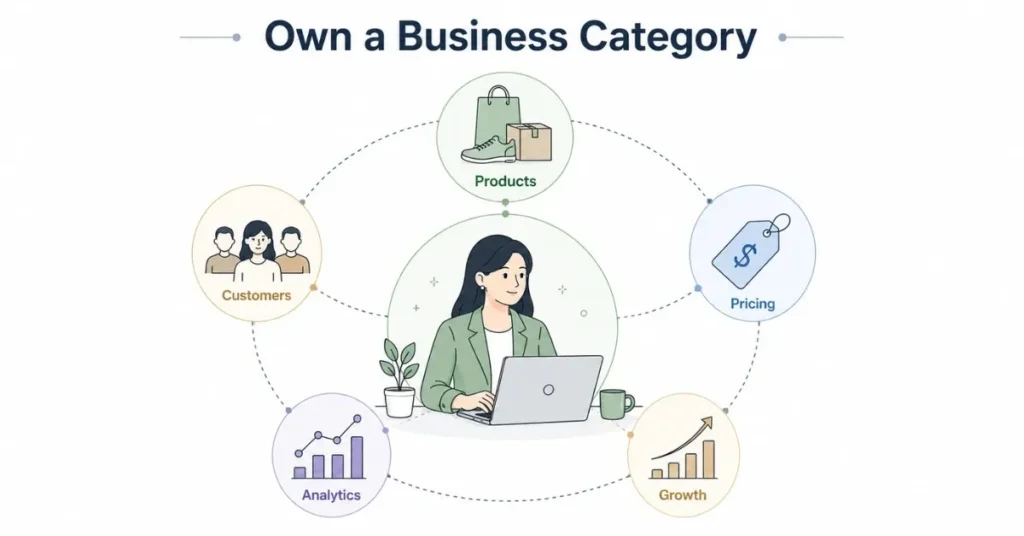
What you actually do:
Now you’re no longer just executing you’re planning. You have 2-4 people reporting to you, and you’re responsible for significant business metrics.
Your day involves:
- Weekly target setting and monitoring
- Planning promotional calendars (Republic Day sale, End of Season sale, etc.)
- Budget management (you have a monthly budget to deploy)
- Team management (assigning tasks, solving conflicts, performance reviews)
- Stakeholder meetings (updating leadership on progress)
Strategic decisions (Should we launch on Amazon or focus on our website?)
The pressure increases:
Amit, E-commerce Manager at an electronics brand in Noida, explains: “As an executive, if I made a mistake, my manager would catch it. Now, I’m the final check. If a sale starts with wrong prices or the website crashes, I’m accountable. The salary increase comes with responsibility increase.”
Success at this level requires:
- Strategic thinking: Not just “what to do” but “why to do it.” Understanding business objectives beyond your immediate tasks.
- People management: Technical skills matter less now; managing people matters more. Can you get the best out of your team? Can you handle someone underperforming? Can you fight for your team’s needs with leadership?
- P&L awareness: Understanding profit and loss. You might drive great revenue, but if the marketing cost is too high or return rates eat into profits, it’s not success.
- Cross-functional influence: You don’t manage the tech team, but you need them to prioritize your requirements. You don’t manage the warehouse, but you need them to ensure fast dispatch. Influencing without authority is a crucial skill.
Real challenges:
- Burnout risk: You’re managing up (reporting to senior management) and managing down (your team). Festive seasons mean 12-14 hour days.
- Blame game: Sales are down? Marketing blames tech for slow website, tech blames operations for stockouts, operations blames buying team for wrong inventory. You’re navigating this constantly.
- Decision fatigue: You make 50+ decisions daily. Which products to promote? What discount percentage? Which complaint to escalate?
Growth trajectory from here:
- Specialist path: Become Senior E-commerce Manager (₹12-20 LPA) focusing on execution excellence
- Leadership path: Move to Head of E-commerce or General Manager (₹18-35 LPA) with broader responsibilities
- Lateral moves: Category Manager, Growth Manager, Product Manager roles at similar or higher compensation
Typical timeline at this level: 2-4 years before next significant jump.
Senior Digital Marketing Manager (₹12-22 LPA)
What you actually do:
You own the entire digital marketing function or a significant part of it. You’re not running individual campaigns anymore you’re building the strategy while your team executes.
Responsibilities:
- Overall marketing strategy and channel mix decisions
- Budget allocation across channels (60% Facebook, 20% Google, 10% influencer marketing, 10% experimental)
- Team management (3-6 people typically)
- Agency coordination if external agencies are involved
- Marketing automation setup and optimization
Reporting to CEO/CMO with recommendations
The strategic shift:
Neha, Senior Marketing Manager at a beauty brand in Mumbai, describes: “Earlier I’d be happy getting good ROAS on a campaign. Now I’m thinking: Are we acquiring the right customers? A customer who orders once because of a heavy discount isn’t as valuable as someone who orders thrice at regular prices. I’m optimizing for LTV (Lifetime Value), not just immediate ROAS.”
What separates good from great at this level:
- Channel expertise vs. channel agnostic: Average managers stick to what they know (only Facebook ads). Great managers know which channel suits which objective. Instagram for brand awareness among youth, Google Search for high-intent buyers, WhatsApp for retention.
- Creative + analytical balance: You need both sides of the brain working. Understanding consumer psychology (why does this ad copy work?) while being data-driven (but these numbers say we should pause this campaign).
- Innovation mindset: The brands winning today are those experimenting early. When Instagram Reels launched, early adopters got cheap reach. When everyone’s on it, costs increase. Staying ahead of trends is your job.
Career peak or jumping point:
This level is interesting you can stay here comfortably earning well, or use it as a launchpad:
- Stay and specialize: Become VP/Head of Marketing (₹25-45 LPA)
- Switch industries: Your skills are transferable. Move to bigger brands or better-funded startups
- Go independent: Many start their own marketing agencies or become fractional CMOs for multiple brands (₹3-8 lakhs per client per month)
Timeline: Many spend 3-5 years at this level. It’s comfortable and well-paying enough that aggressive growth hunger can diminish.
Category Manager (₹10-20 LPA)
What you actually do:
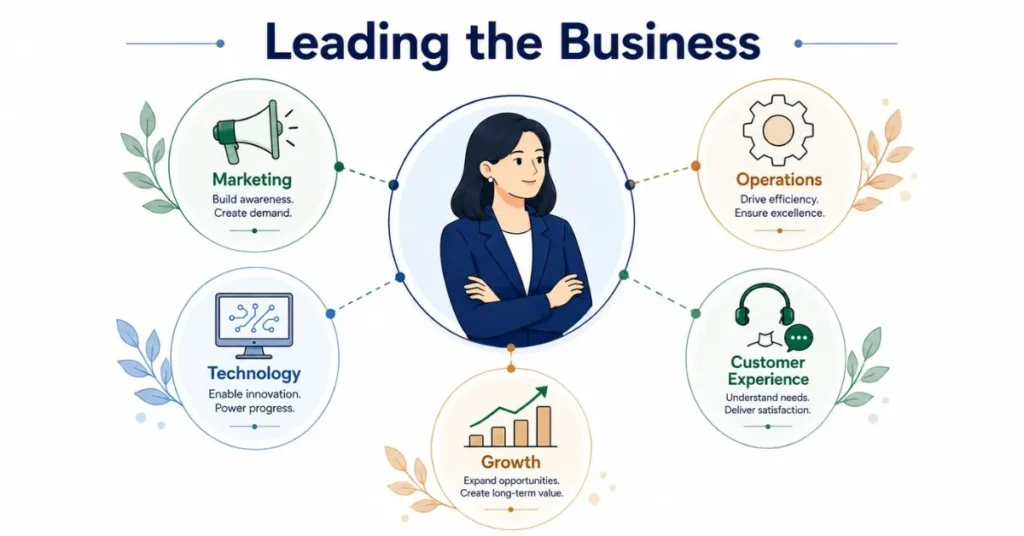
You own an entire product category like you own a business. Think of yourself as a mini-CEO of “Men’s Footwear” or “Home Appliances.”
Your responsibilities:
- Deciding product assortment (which products to add, which to remove)
- Pricing strategy (competitive pricing, promotional pricing)
- Vendor negotiations (for marketplaces) or buying decisions (for inventory-based models)
- Category growth targets and P&L accountability
- Merchandising decisions (how to display products, which to feature)
- Trend analysis and new product introduction
The business mindset:
Karthik, Category Manager for Electronics at a major marketplace in Hyderabad, explains: “I manage a ₹50 crore annual category. I’m constantly analyzing: Which smartphone brands are growing? Should we add more mid-range options or premium ones? Competitor has exclusive launch how do we counter? My decisions directly impact millions in revenue.”
Success factors:
- Market intelligence: You need to know your category better than anyone. What’s trending on Instagram? What are competitors doing? What are customer reviews saying?
- Negotiation skills: For marketplace category managers, negotiating with brands is crucial. Better margins, exclusive launches, marketing support your negotiation directly affects profitability.
- Analytical rigor: You’re swimming in data sales data, traffic data, conversion rates, return rates. Finding insights in this data ocean is your superpower.
- Consumer understanding: Why do customers in Tamil Nadu prefer different pressure cooker brands than customers in West Bengal? These cultural nuances affect purchasing and understanding them drives success.
Unique challenges:
- Cannibalization decisions: Adding a new product might increase category sales but hurt margins. Do you optimize for revenue or profitability? These trade-offs are constant.
- Blame for external factors: Festive season sales are down. Is it your category selection or overall market slowdown? You’ll still be accountable.
- Vendor relationships: Maintaining good relationships while negotiating hard is an art.
Growth path:
- Senior Category Manager (₹15-28 LPA)
- Head of Category/Vertical (₹25-40 LPA)
- VP Merchandising or Chief Business Officer (₹40-80 LPA)
Senior Level: Leadership & Strategy (7+ Years)
Head of E-commerce/General Manager (₹22-45 LPA)
What you actually do:
operations, customer service, analytics reports to you directly or indirectly.
Responsibilities:
- Overall business strategy and quarterly planning
- P&L ownership (revenue targets, cost management, profitability)
- Team building and leadership (hiring, firing, performance management)
- Cross-functional alignment (tech, supply chain, finance, buying teams)
- Board/investor presentations and reporting
Strategic decisions (expand to new marketplace? Launch own app? International expansion?)
The loneliness of leadership:
Rajesh, Head of E-commerce at a fashion brand in Bangalore, candidly shares: “Everyone brings me problems. Website crashed I need to solve. Marketing costs are high I need to solve. Warehouse is inefficient I need to solve. There’s no one above me to ask ‘What should I do?’ That’s both empowering and exhausting.”
What it takes to thrive:
- Vision beyond execution: You’re not in the weeds anymore (though you should understand the weeds). You’re setting 3-year vision while managing current quarter execution.
- Comfort with ambiguity: Clear answers rarely exist at this level. Should you invest ₹2 crores in technology upgrade or marketing? Both have merit. You make judgment calls with incomplete information.
- Political navigation: At this level, organizational politics are real. Influencing other department heads, managing upwards with CEO/founders, protecting your team it’s part of the job.
- Resilience: You’ll face failures. A major tech failure during peak sale costing crores. A wrong strategic bet. How you handle these defines your career.
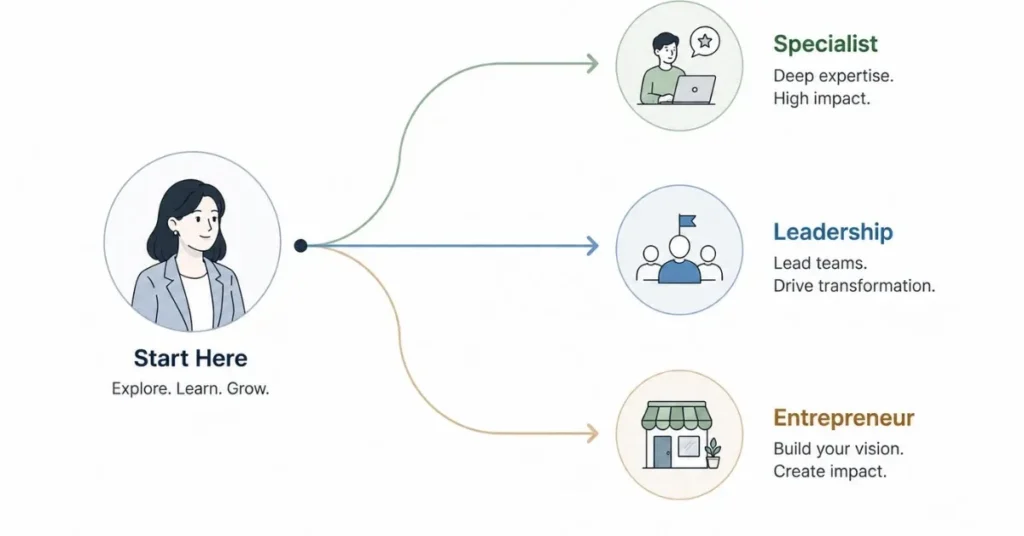
Two paths at the top:
- Corporate ladder: VP/SVP roles (₹45-80 LPA) at large organizations, potentially C-suite (Chief Digital Officer, Chief Commercial Officer) at ₹80 lakhs – ₹2 crores+
- Entrepreneurial path: Many at this level start their own brands or consulting firms. You’ve seen what works and what doesn’t across the e-commerce value chain.
Reality check:
Not everyone reaches this level, and that’s okay. Maybe 5-10% of people who start in e-commerce reach Head/VP roles. The pyramid narrows. Many find their sweet spot at Manager/Senior Manager levels and build great careers there.
Alternative Career Tracks: Not Everyone Climbs the Traditional Ladder
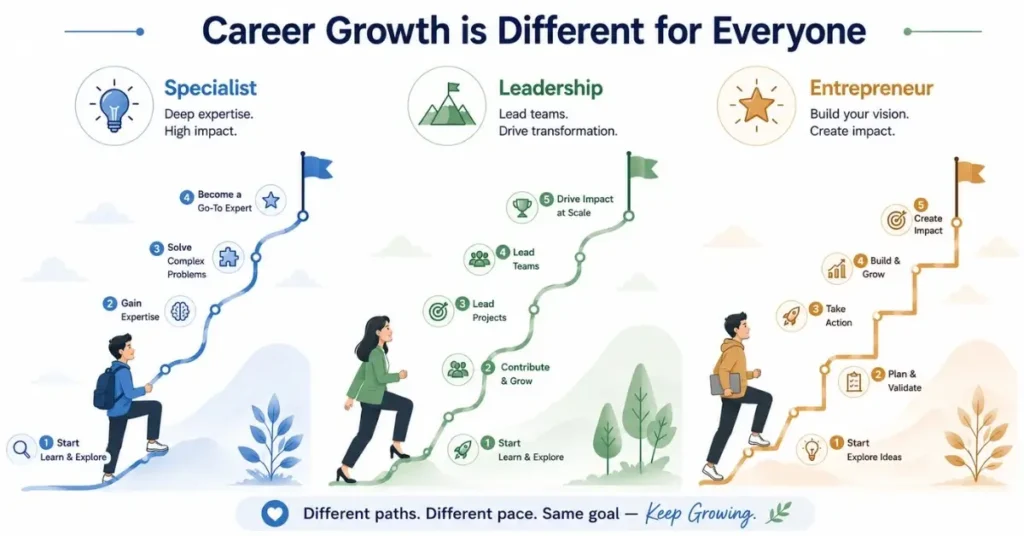
The Specialist Track
Some people become deep experts in one area rather than general managers. Examples:
Senior SEO Specialist (₹12-25 LPA): You’re the go-to expert for organic search strategy. Companies pay premium for this deep expertise.
Performance Marketing Expert (₹15-30 LPA): You can manage ₹10+ crore annual ad budgets and consistently deliver results.
E-commerce Analytics Lead (₹12-22 LPA): You’re the data guru everyone consults for insights.
These specialists often earn comparable to or more than generalist managers at similar experience levels.
The Freelance/Consultant Track
After 5-7 years of experience, many go independent:
E-commerce Consultant: Advising multiple brands (₹2-10 lakhs per client per month for 2-5 clients)
Agency Owner: Starting a Shopify development agency or marketing agency (Income varies wildly ₹10 lakhs to ₹1 crore+ annually)
Fractional Executive: Working as part-time Head of E-commerce for 2-3 startups (₹3-6 lakhs per month per company)
Real Career Timelines: Three True Stories
Story 1: The Fast Climber
Ananya, 29, currently Head of Digital at a D2C brand (₹32 LPA)
- Year 0 (Age 22): Graduated from a tier-2 college in Kolkata, joined a fashion startup as E-commerce Executive (₹3.6 LPA)
- Year 2 (Age 24): Promoted to Senior Executive (₹6 LPA), started managing intern
- Year 3 (Age 25): Moved to a bigger D2C brand as E-commerce Manager (₹11 LPA)
- Year 5 (Age 27): Promoted to Senior Manager (₹18 LPA)
- Year 7 (Age 29): Headhunted for current role (₹32 LPA)
Her success factors: Worked in high-growth startups where responsibility came fast, constantly upskilled (took 3 paid courses), built strong personal brand on LinkedIn, wasn’t afraid to switch companies for growth.
Story 2: The Steady Climber
Vikram, 35, Category Manager at a marketplace (₹16 LPA)
- Year 0 (Age 25): MBA from tier-2 college, joined marketplace as Assistant Manager (₹7 LPA)
- Year 3 (Age 28): Promoted to Manager (₹11 LPA)
- Year 6 (Age 31): Senior Manager (₹14 LPA)
- Year 10 (Age 35): Category Manager (₹16 LPA)
His reality: Steady, secure growth in a large organization. Good work-life balance. Not aggressive about climbing but comfortable and satisfied.
Story 3: The Career Switcher to Entrepreneur
Pradeep, 38, Founder of Shopify development agency (₹45-50 lakhs annual income)
- Year 0-8: Worked in IT industry, not e-commerce related
- Year 9 (Age 32): Career switch, joined small e-commerce company as Manager (₹12 LPA) took a pay cut from ₹18 LPA
- Year 11 (Age 34): Learned Shopify deeply, started freelancing on weekends
- Year 12 (Age 35): Quit job, went full-time freelance
- Year 15 (Age 38): Built 4-person agency, working with international clients
His journey: Non-linear, risky, but ultimately rewarding. Not for everyone.
Your Personalized Career Planning Framework
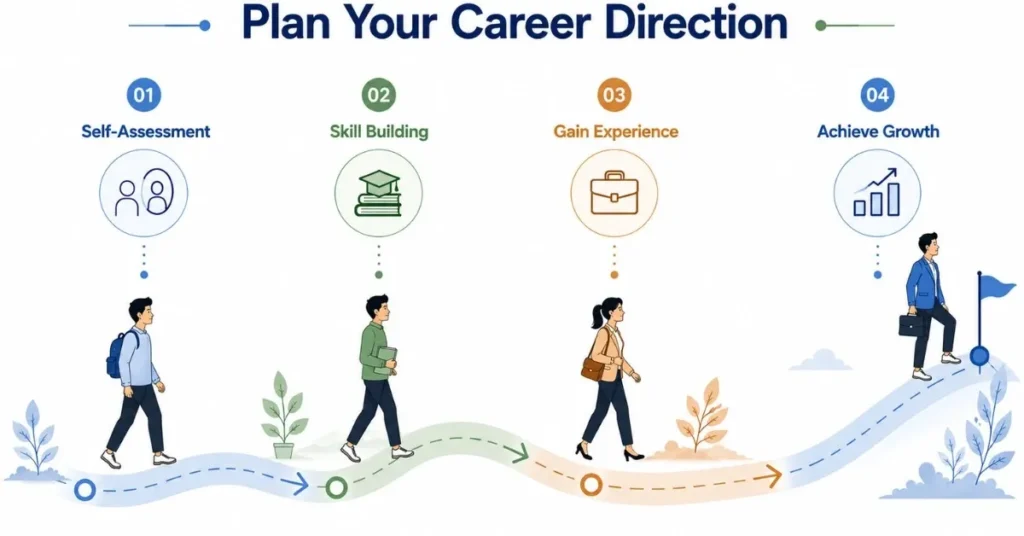
Step 1: Self-Assessment (Be brutally honest)
- Do you prefer execution or strategy? (Early career needs execution comfort)
- Are you comfortable with ambiguity or do you need clear instructions?
- Do you want specialist depth or generalist breadth?
- How aggressive are you about growth vs. stability?
- Financial flexibility can you take risks (job switches, pay cuts) or need stability?
Step 2: Set Realistic Timelines
- Conservative path: Entry level (2 years) → Mid-level (4 years) → Senior (4 years) = 10 years to senior roles
- Aggressive path: Entry level (1.5 years) → Mid-level (3 years) → Senior (3 years) = 7.5 years to senior roles
- Reality: Most people fall somewhere in between
Step 3: Define Your Success Metrics
Not everyone needs to be Head of E-commerce. Define what success means to you:
- Salary target by age 30? 35? 40?
- Work-life balance importance (senior roles demand more time)
- Learning vs. earning priority at different career stages
- Specialist expertise vs. leadership ambitions
Step 4: Build Parallel Skills
While climbing the ladder, build skills that make you valuable:
- Technical skills: Even non-tech roles benefit from understanding APIs, basic SQL, how systems work
- Soft skills: Communication, negotiation, stakeholder management
- Business acumen: Understanding P&L, unit economics, financial modeling
- Leadership: Start mentoring junior folks even before you have the manager title
Step 5: Strategic Job Switching
Average tenure in e-commerce is 2-3 years per company. Smart switching accelerates growth:
- Internal promotion: 10-20% hikes typically
- External switch: 30-50% hikes possible
- Timing: Switch when you’ve learned 80% of what the role offers, not at 100% (then you’ve stayed too long)
Common Career Mistakes to Avoid
Mistake 1: Optimizing only for salary
Taking a ₹12 LPA role at a stagnant company over ₹10 LPA at a high-growth startup might feel smart short-term. But if the startup experience accelerates your learning, the long-term gain from faster career progression outweighs immediate ₹2 LPA difference.
Mistake 2: Staying in comfort zone too long
You’ve mastered your role, everything’s smooth. That’s the danger zone. Growth happens in discomfort.
Mistake 3: Burning bridges
E-commerce is a small community in India. Your today’s colleague is tomorrow’s hiring manager elsewhere. Exit gracefully, maintain relationships.
Mistake 4: Ignoring personal brand
Your LinkedIn profile should reflect your expertise. Share learnings, engage with industry content. Many opportunities come through network, not job portals.
Mistake 5: Not negotiating
Indians are often uncomfortable negotiating salaries. Learn this skill. It’s not rude; it’s professional. A one-time negotiation can mean ₹2-3 lakhs extra annually.
Conclusion: Your Career is a Marathon, Not a Sprint
E-commerce careers in India offer incredible growth potential, but it’s not a get-rich-quick scheme. The people succeeding are those who:
- Consistently learn and adapt
- Deliver results, not just put in hours
- Build relationships and reputation
- Are patient with the process but impatient with stagnation
- Find their unique positioning (what makes them valuable)
Whether you’re just starting or five years in, remember: every successful Head of E-commerce was once an Executive uploading products at midnight. The question isn’t if you can climb this ladder it’s how committed you are to the climb.
Your e-commerce career journey is unique. Use this guide as a map, but chart your own path.