
FUTURE OF HR CAREERS AND EMERGING TRENDS
Table of Contents
t’s 2026, and you’re thinking about your HR career trajectory over the next 5-10 years. You’ve heard about AI disrupting industries, read articles about automation replacing jobs, and noticed new HR role titles you don’t fully understand—”Employee Experience Designer,” “People Analytics Engineer,” “AI Ethics Officer.” You’re wondering: Will my HR job exist in 2030? What skills do I need to build to stay relevant? What new opportunities will emerge? How do I ensure my career thrives rather than becomes obsolete as technology transforms HR?
These aren’t abstract concerns—they’re practical questions every forward-thinking HR professional must address. The HR function is undergoing fundamental transformation driven by artificial intelligence, automation, data analytics, remote work normalization, and shifting employee expectations. By 2030, HR will look dramatically different than today, with new roles emerging, some current roles evolving beyond recognition, and strategic capabilities becoming table stakes rather than differentiators.
This comprehensive guide helps you future-proof your HR career including major trends reshaping HR by 2030, how AI and automation impact HR roles, emerging HR roles and specializations, essential skills for future HR success, threats to current HR roles and how to adapt, and strategic actions to position yourself for the future HR landscape.
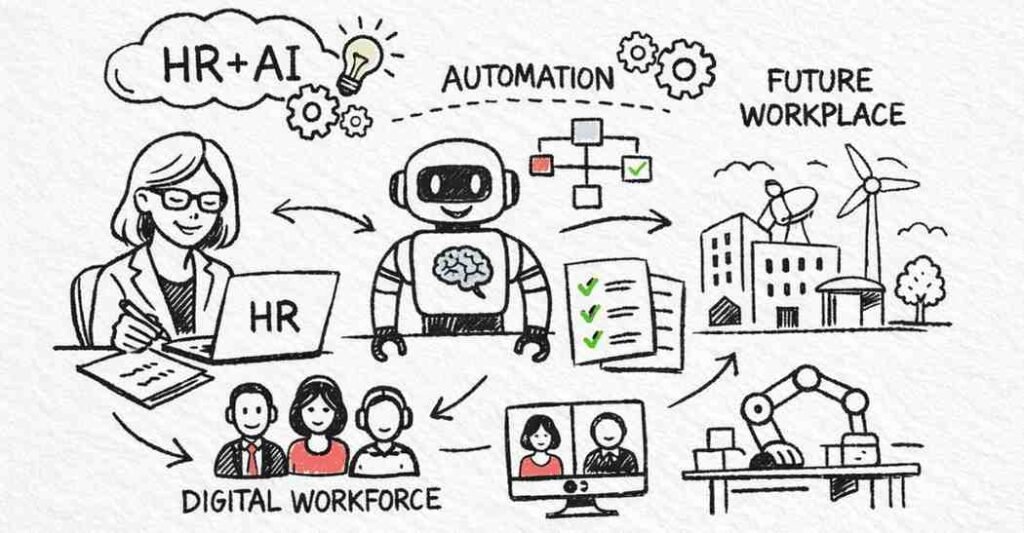
Nine Strategic Shifts Defining HR by 2030
According to Zalaris’s research on the future of work, nine fundamental shifts will transform HR by 2030:
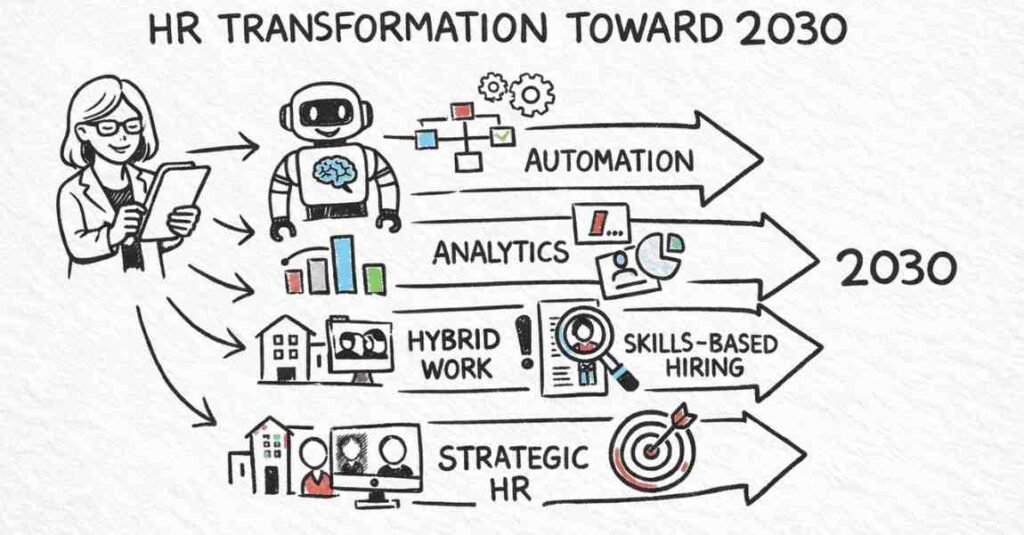
1. From Workforce Management to Human-Machine Collaboration Design
The Shift: HR’s responsibility expands from managing people to designing effective collaboration between humans, AI, and automation.
What It Means: By 2030, most organizations will have AI systems working alongside human employees. HR professionals must determine which tasks humans handle, which AI manages, how they collaborate effectively, when human judgment overrides AI recommendations, and how to manage employee concerns about AI.
Example: An AI system screens resumes and conducts initial video interviews, but human recruiters make final decisions. HR designs this workflow, trains humans on AI tool use, and ensures appropriate human oversight.
Skills Needed: AI literacy, systems thinking, workflow design, change management.
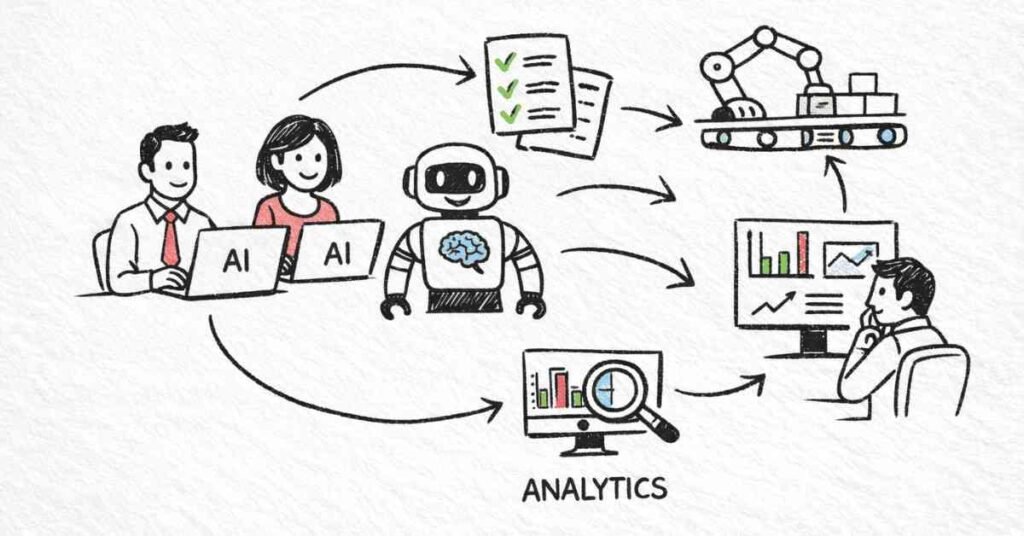
2. From Reactive Support to Proactive Behavioral Design
The Shift: HR moves from responding to people issues to proactively shaping behaviors, culture, and organizational effectiveness.
What It Means: Rather than addressing turnover after people leave, HR uses predictive analytics to identify flight risks early and intervene. Rather than reacting to poor performance, HR designs systems that encourage desired behaviors.
Example: People analytics reveals that employees who don’t complete onboarding within first week have 3x higher turnover. HR redesigns onboarding to ensure week-one completion, proactively preventing future attrition.
Skills Needed: People analytics, behavioral science, predictive modeling, preventive mindset.
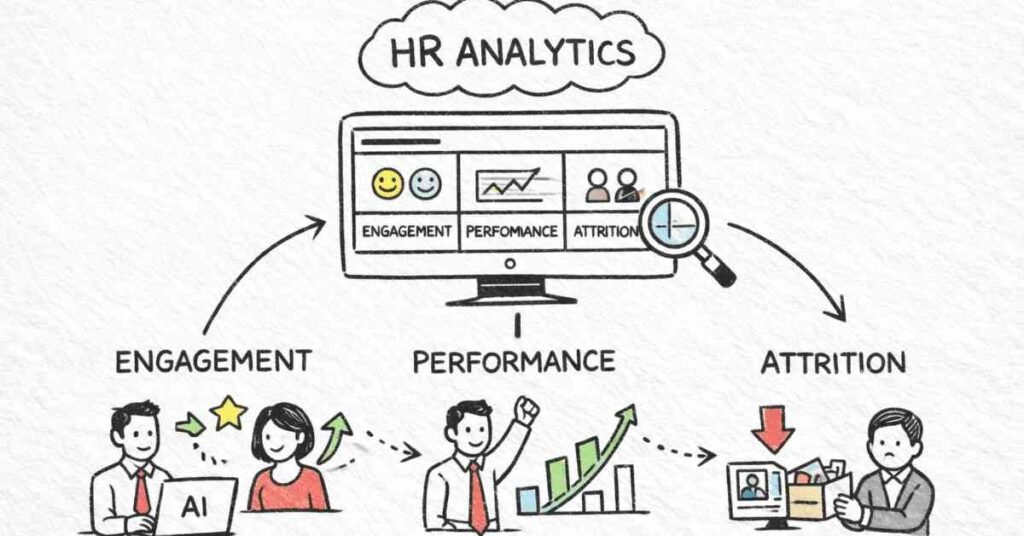
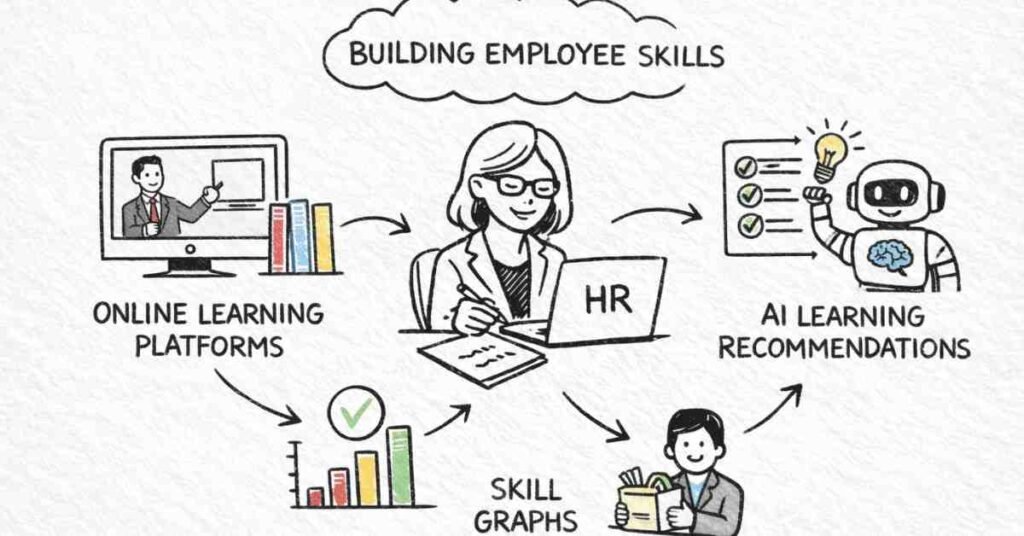
3. From Skills Inventory to Continuous Capability Building
The Shift: HR moves from tracking what skills employees have to continuously building capabilities they’ll need.
What It Means: By 2030, skills become obsolete faster than ever. India faces a projected shortfall of over one million AI-skilled professionals by 2027 without urgent upskilling. HR’s role shifts from maintaining static skill inventories to creating dynamic learning ecosystems ensuring continuous capability development.
Example: Rather than annual training programs, HR implements AI-enabled learning systems that identify individual skill gaps and automatically recommend personalized learning paths, enabling just-in-time capability building.
Skills Needed: Learning design, AI-enabled learning platforms, skills assessment, continuous learning culture building.
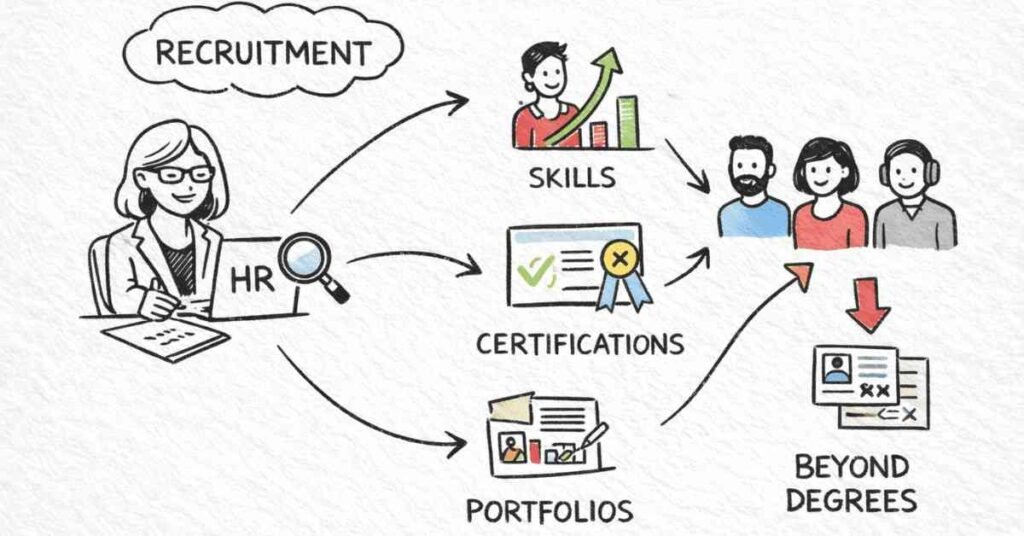
4. From Degree-Based to Skills-Based Hiring
The Shift: By 2030, HR eliminates degree requirements from job postings, focusing instead on competencies, certifications, and demonstrated capabilities.
What It Means: Traditional education credentials become less relevant than proven skills. Entry-level professionals with AI fluency earn up to 4x more than peers without these skills regardless of degrees. HR must redesign hiring processes to assess skills rather than credentials.
Example: Instead of requiring “Bachelor’s degree in HR,” job posting specifies “demonstrated expertise in compensation analysis, HRIS proficiency (Workday certification preferred), and data visualization skills (portfolio required)”.
Skills Needed: Competency-based assessment design, skills validation methods, bias-free evaluation.
5. From Employment Relationships to Portfolio Work Models
The Shift: Full-time employment becomes one option among many—including gig work, project-based contracts, fractional leadership, and hybrid models.
What It Means: HR must manage diverse work relationships simultaneously. A marketing team might include full-time employees, freelance designers, contract writers, and fractional CMO—all requiring different management approaches, compensation structures, and legal frameworks.
Example: HR builds AI-powered talent marketplaces connecting internal talent with internal project opportunities, enabling employees to work across functions while maintaining primary roles.
Skills Needed: Contract and gig worker management, flexible work design, talent marketplace platforms, legal compliance across work types.
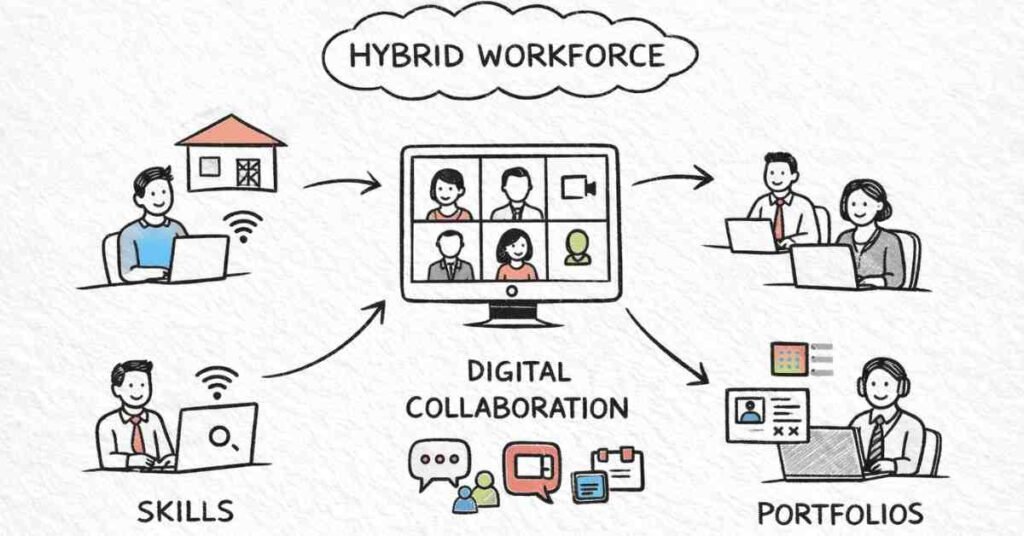
6. From Office-Based to Hybrid-First Design
The Shift: Remote and hybrid work models become permanent, requiring HR to redesign every process for distributed work.
What It Means: By 2030, workplace will blend remote and in-office work, requiring HR to create equitable experiences regardless of location, build culture without physical proximity, manage teams across time zones, and prevent proximity bias where office workers advance faster.
Skills Needed: Virtual employee experience design, distributed team management, digital collaboration platforms, preventing remote worker marginalization.
7. From Compliance Focus to Ethics and Climate Integration
The Shift: HR’s responsibility expands from legal compliance to ethical AI use, data privacy governance, environmental sustainability integration, and social responsibility.
What It Means: As AI makes more decisions about people, HR must ensure ethical use—preventing algorithmic bias, protecting employee privacy, being transparent about data use, and considering environmental impact of workforce decisions.aihr+1
Example: HR establishes AI Ethics Committee reviewing all people-related AI tools for bias, privacy risks, and ethical concerns before deployment.
Skills Needed: AI ethics, data privacy expertise, sustainability integration, ethical decision-making frameworks.
8. From Technical Skills to Competency Emphasis
The Shift: While technical skills (“what you know”) remain important, emphasis shifts to competencies—critical thinking, logical reasoning, strong decision-making, adaptability, and learning agility.
What It Means: AI can perform many technical tasks. What humans uniquely provide is judgment, creativity, ethical reasoning, and complex problem-solving. HR must hire, develop, and assess these competencies.
Example: Talent acquisition uses AI-enabled screenings assessing not just technical knowledge but critical thinking, decision quality, and reasoning capabilities.
Skills Needed: Competency-based assessment, critical thinking evaluation, soft skills measurement.
9. From Administrative Excellence to Strategic Value Creation
The Shift: As AI and automation handle routine HR operations, HR professionals focus exclusively on strategic value creation.
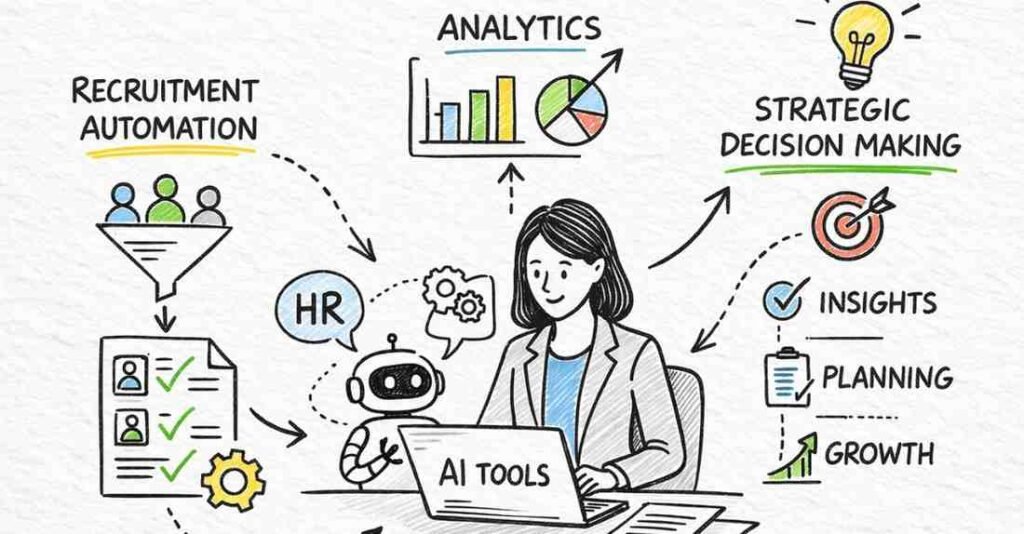
What It Means: By 2026-2030, agentic AI systems handle most administrative HR tasks—answering employee questions, processing requests, updating records, generating reports. HR professionals are freed to focus on strategy, complex problem-solving, innovation, and driving business results.
Skills Needed: Strategic thinking, business acumen, consultative skills, innovation mindset.
How AI and Automation Transform HR Roles
The most consequential trend is AI’s impact on HR work:
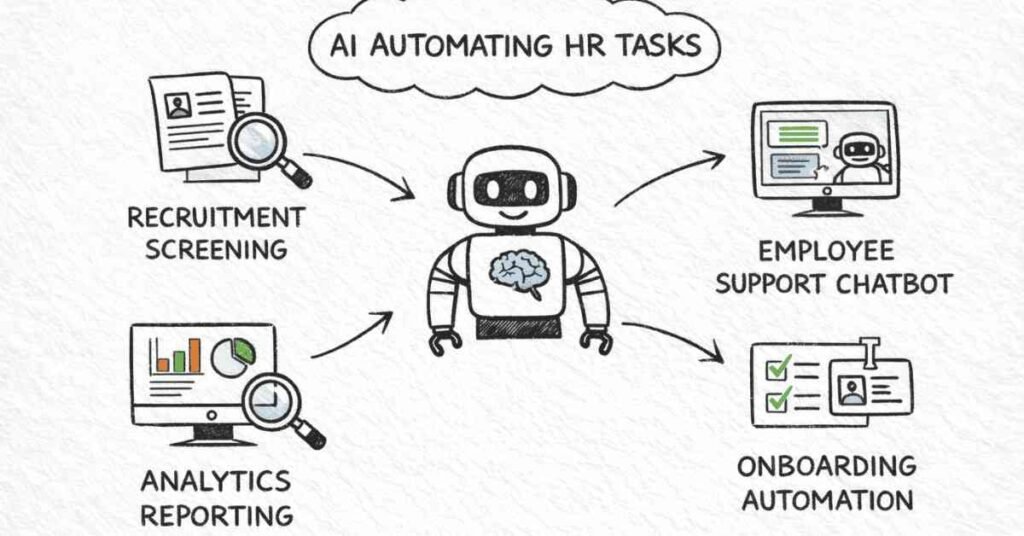
What AI Will Automate in HR
Recruitment and Hiring:
- Resume screening and candidate matching (already happening)
- Initial candidate outreach and scheduling
- Video interview analysis assessing communication and engagement
- Skills assessment through AI-enabled tests
- Job description creation and optimization
- Bias detection in hiring processes
Employee Support and Operations:
- Answering routine HR questions through chatbots
- Processing employee requests (time off, information updates
- Onboarding workflow automation
- Benefits enrollment guidance
- Policy question responses
Data and Analytics:
- Generating HR reports and dashboards
- Identifying workforce trends and patterns
- Predicting attrition and engagement risks
- Conducting skills gap analysis
- Benchmarking compensation against market data
Learning and Development:
- Personalizing learning paths based on skills gaps
- Delivering adaptive training adjusting to learner pace
- Recommending development opportunities
- Assessing learning effectiveness
Performance Management:
- Tracking goals and providing progress updates
- Generating performance insights for managers
- Identifying high performers and development needs
What AI Won't Replace: The Irreplaceable Human Elements
Despite automation, certain HR capabilities remain uniquely human:
Complex Judgment and Ethics:
- Making decisions involving ambiguous situations, ethical dilemmas, and competing values
- Determining appropriate responses to sensitive employee situations
- Balancing organizational needs with employee advocacy
Empathy and Emotional Intelligence:
- Understanding emotional context and human experiences
- Building trust and psychological safety
- Navigating complex interpersonal dynamics
- Providing genuine empathy during difficult situations (terminations, personal crises)
Strategic Thinking and Innovation:
- Connecting people strategy to business outcomes
- Creating novel approaches to organizational challenges
- Imagining future scenarios and planning accordingly
- Challenging assumptions and asking “why?”
Relationship Building:
- Developing trusted advisor relationships with leaders
- Building authentic connections across organizations
- Influencing stakeholders through relationships
- Creating community and belonging
Change Leadership:
- Leading organizational transformations
- Addressing resistance and building buy-in
- Inspiring and motivating during uncertainty
- Adapting approaches based on organizational culture
Creative Problem-Solving:
- Addressing novel problems AI hasn’t encountered
- Designing innovative people solutions
- Thinking laterally and making unexpected connections
The AI-Augmented HR Professional
The future isn’t humans OR AI—it’s humans WITH AI:
High-Performing Future HR Professional:
- Uses AI for data analysis, pattern recognition, and routine tasks
- Applies human judgment to AI recommendations
- Focuses energy on strategic, creative, and relationship work
- Continuously learns as AI capabilities evolve
- Designs effective human-AI collaboration
- Ensures ethical AI use
Emerging HR Roles and Specializations by 2030
New HR roles are emerging to address evolving organizational needs:
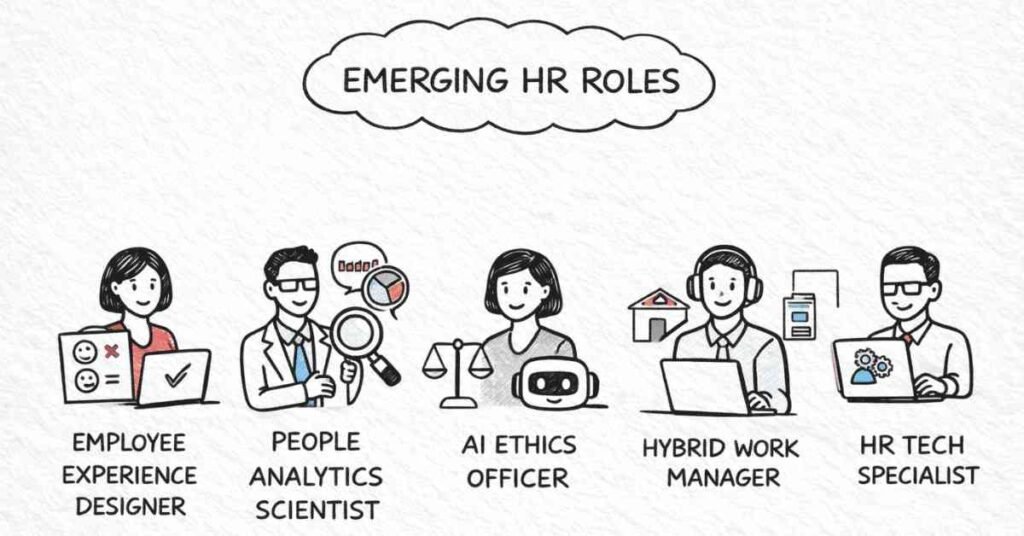
Employee Experience Designer
What They Do: Design end-to-end employee journeys from recruitment through offboarding, ensuring exceptional experience at every touchpoint.
Why It’s Emerging: Organizations recognize employee experience drives engagement, productivity, and retention. This requires dedicated expertise.
Skills Required: Design thinking, journey mapping, user experience principles, empathy, data analysis, technology platforms.
People Analytics Engineer/Scientist
What They Do: Build sophisticated predictive models, conduct workforce research, design experiments, and translate data into strategic insights.
Why It’s Emerging: As organizations become more data-driven, demand grows for HR professionals with advanced analytics capabilities.
Skills Required: Statistics, Python/R programming, machine learning, data visualization, research methodology, storytelling.
AI Ethics and Privacy Officer
What They Do: Ensure ethical use of AI in people decisions, protect employee data privacy, create governance frameworks, and assess algorithmic bias.
Why It’s Emerging: AI’s growing role in HR decisions creates ethical and privacy concerns requiring specialized expertise.
Skills Required: AI understanding, ethics frameworks, data privacy law, risk assessment, governance design.
Skills Architect/Skills Strategist
What They Do: Design organizational skills strategies, build skills taxonomies, create continuous learning ecosystems, and anticipate future capability needs.
Why It’s Emerging: Skills-based organizations require dedicated focus on capability building.
Skills Required: Skills assessment, learning design, labor market analysis, AI-enabled learning platforms.
Hybrid Work Experience Manager
What They Do: Design optimal hybrid work models, ensure equity between remote and office workers, create digital-first culture, and manage distributed teams effectively.
Why It’s Emerging: Permanent hybrid work requires dedicated management to succeed.
Skills Required: Remote work design, digital collaboration tools, culture building, preventing proximity bias.
HR Technology Integration Specialist
What They Do: Implement and integrate complex HR technology ecosystems, customize platforms, manage vendor relationships, and train users.
Why It’s Emerging: HR technology landscape grows increasingly complex with dozens of specialized tools requiring integration expertise.
Skills Required: HRIS platforms, API integrations, vendor management, project management, technical training.
Gig and Contingent Workforce Manager
What They Do: Manage relationships with freelancers, contractors, and gig workers; navigate legal compliance; design flexible work arrangements.
Why It’s Emerging: Growing portion of workforce operates outside traditional employment.
Skills Required: Contract management, legal compliance, talent marketplace platforms, flexible work design.
Organizational Network Analyst
What They Do: Map and analyze organizational networks, identify influential connectors, break down silos, and design optimal collaboration structures.
Why It’s Emerging: Understanding informal networks and collaboration patterns becomes critical as work becomes more distributed.
Skills Required: Network analysis tools, organizational behavior, collaboration design, relationship mapping.
Essential Skills for HR Success in 2030
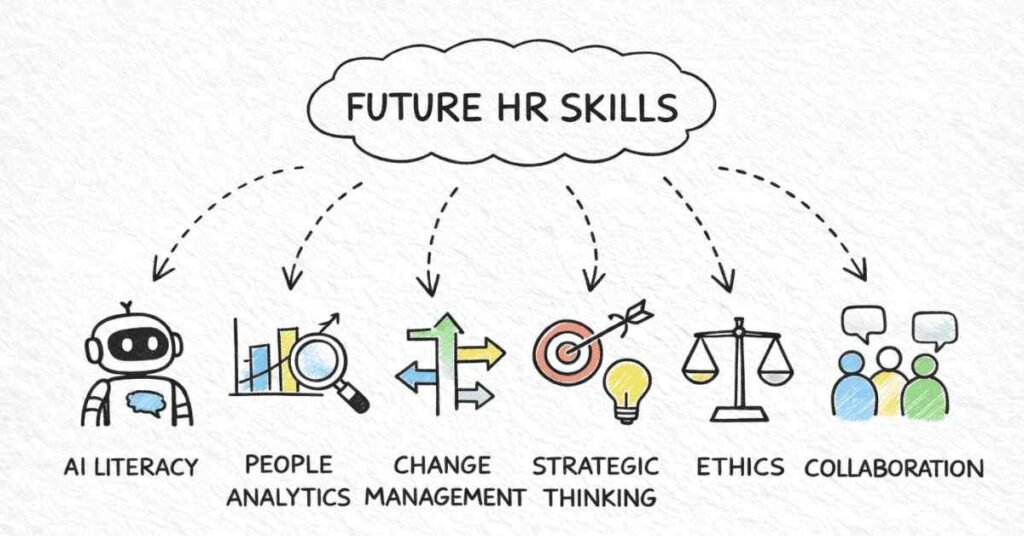
AIHR identifies 15 future HR skills you should start building now:
1. Change Management and Change Consulting
Why: Constant change is the only constant. HR professionals must lead organizational transformations effectively.
How to Build: Study change frameworks (Kotter, ADKAR), lead change initiatives, earn change management certifications.
2. Risk Management
Why: HR decisions carry increasing risks—compliance, reputation, employee relations. Strategic risk management becomes essential.
How to Build: Learn risk assessment frameworks, study HR legal cases, practice scenario planning.
3. Scenario Planning
Why: Uncertainty requires envisioning multiple futures and preparing for each.
How to Build: Practice creating scenarios for workforce planning, learn strategic foresight methods.
4. People Analytics
Why: Data-driven HR is no longer optional—it’s foundational.
How to Build: Learn statistics, Excel/Tableau, take people analytics courses, practice with real data.
5. AI Fluency and Literacy
Why: AI transforms every HR function. Understanding AI capabilities, limitations, and ethical implications is critical.
How to Build: Take AI fundamentals courses, experiment with AI tools (ChatGPT, recruitment AI), understand machine learning basics, learn prompt engineering.
6. Stakeholder Management
Why: HR success requires influencing diverse stakeholders—executives, managers, employees, unions, boards.
How to Build: Practice stakeholder mapping, develop influencing skills, seek stakeholder-intensive projects.
7. Management of Strategic Deals and Alliances
Why: Mergers, acquisitions, partnerships, and divestitures all require HR expertise in integration and separation.
How to Build: Study M&A HR practices, seek opportunities to work on deals, understand due diligence.
8. Integrating Cultural Differences
Why: Global organizations and diverse workforces require cultural intelligence.
How to Build: Work in multicultural environments, study cultural frameworks (Hofstede), develop cultural sensitivity.
9. Ethics and Data Privacy
Why: HR manages sensitive personal data and makes consequential decisions requiring ethical frameworks.
How to Build: Learn data privacy laws (GDPR principles applicable in India), study ethical decision-making, understand AI ethics.
10. Critical and Systems Thinking
Why: Complex organizational challenges require understanding interconnections and second-order effects.
How to Build: Study systems thinking, practice root cause analysis, consider unintended consequences.
11. Negotiation Skills
Why: HR constantly negotiates—with candidates, vendors, employees, unions, leadership.
How to Build: Take negotiation courses, practice in low-stakes situations, learn interest-based negotiation.
12. Interdepartmental Collaboration
Why: HR must work across functions—finance, IT, operations, marketing—to drive outcomes.
How to Build: Seek cross-functional projects, build relationships beyond HR, learn other functions’ languages.
13. Resilience and Being SAFE
Why: HR faces constant change, ambiguity, and pressure. Resilience prevents burnout.
How to Build: Develop stress management practices, build support networks, practice self-care, cultivate growth mindset.
14. Project Management
Why: HR increasingly works through projects and initiatives rather than ongoing operations.
How to Build: Learn project management methods (Agile, Waterfall), use project tools, lead initiatives.
15. Organizational Design
Why: As work evolves, organizational structures must adapt. HR must design optimal structures.
How to Build: Study organizational design principles, understand different models (hierarchies, networks, pods), practice designing structures.
13. Resilience and Being SAFE
Why: HR faces constant change, ambiguity, and pressure. Resilience prevents burnout.
How to Build: Develop stress management practices, build support networks, practice self-care, cultivate growth mindset.
Roles at Risk and How to Adapt
While AI creates opportunities, it also threatens certain HR roles:
High-Risk Roles (Significant Automation)
HR Coordinators and Assistants: Administrative tasks AI handles well—scheduling, data entry, basic question answering.
Adaptation Strategy: Move up to specialist or generalist roles requiring judgment, relationship building, and strategic thinking. Develop skills AI can’t replicate.
Routine Recruiters: Basic screening and scheduling automatable.
Adaptation Strategy: Develop expertise in complex roles, relationship building, employer branding, candidate experience, or senior executive search where human judgment essential.
Payroll and Benefits Administrators: Highly transactional work AI handles efficiently.
Adaptation Strategy: Develop analytical capabilities (compensation strategy, benefits design), advisory skills, or move to strategic HR roles.
Medium-Risk Roles (Partial Automation)
HR Generalists: Some aspects automate (data gathering, reporting) but relationship management and judgment remain human.
Adaptation Strategy: Emphasize strategic advisory, complex problem-solving, and stakeholder partnership aspects. Build AI fluency to leverage tools.
Compensation Analysts: Market data collection and analysis automatable, but strategy and design require human judgment.
Adaptation Strategy: Focus on strategic compensation design, executive compensation, equity structures, and advisory work.[
Low-Risk Roles (Minimal Automation)
HR Business Partners: Strategic partnership, complex problem-solving, executive relationships, and change leadership require human capabilities.
Why They’re Safe: HRBP work is inherently strategic, relationship-based, and requires nuanced judgment.
CHROs and HR Directors: Strategic leadership, organizational design, culture building, and executive partnership are uniquely human.
Why They’re Safe: These roles require vision, leadership, relationship building, and strategic thinking AI can’t replicate.
Employee Relations Specialists: Complex investigations, mediations, and sensitive situations require empathy and judgment.
Why They’re Safe: Handling emotionally-charged, ambiguous situations with high stakes requires human wisdom.
Organizational Development Consultants: Culture design, leadership development, and change management are inherently human work.
Why They’re Safe: These roles require creativity, empathy, and understanding organizational dynamics.
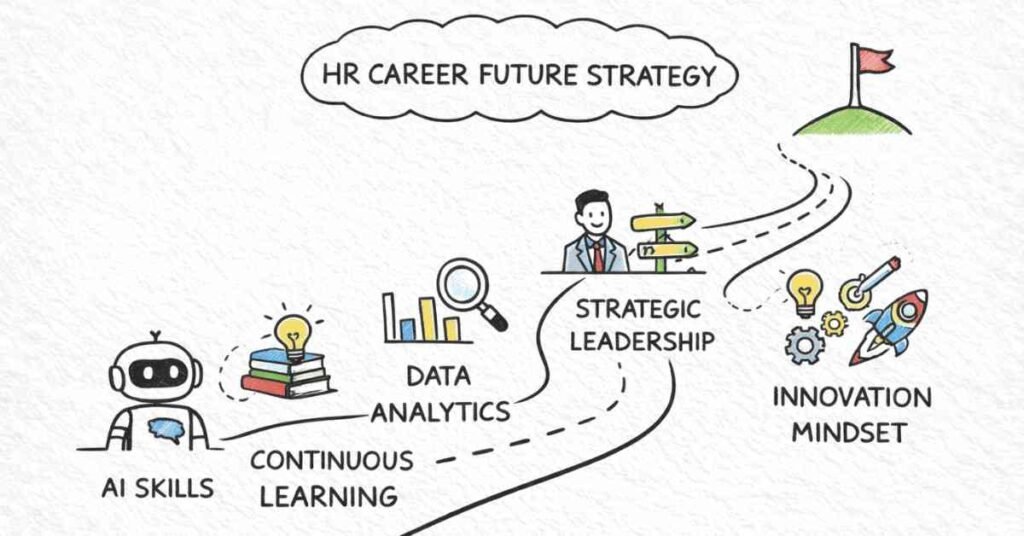
Strategic Actions to Future-Proof Your HR Career
1. Build AI Literacy Immediately
Start Now: Take AI fundamentals courses, experiment with ChatGPT and AI tools, understand how AI works.
Why: AI fluency becomes as essential as computer literacy. HR professionals who can’t work with AI will struggle.
2. Develop Uniquely Human Capabilities
Focus On: Emotional intelligence, strategic thinking, creativity, complex judgment, relationship building, ethical reasoning.
Why: These capabilities differentiate humans from AI and remain valuable.
3. Transition from Operational to Strategic
Action: Volunteer for strategic projects, develop business acumen, partner with leadership, think beyond transactions.
Why: As AI handles operations, strategic work becomes HR professionals’ primary value.
4. Master Data and Analytics
Action: Learn Excel deeply, study statistics basics, take people analytics courses, practice with real HR data.
Why: Data literacy is foundational for future HR.
5. Build Continuous Learning Habit
Action: Read extensively, take courses regularly, attend conferences, experiment with new approaches.
Why: Skills half-life accelerates. Continuous learning prevents obsolescence.
6. Specialize Strategically
Action: Build deep expertise in high-value, hard-to-automate areas—people analytics, employee experience design, organizational development, executive coaching.
Why: Specialized expertise in valuable domains protects against commoditization.
7. Build External Visibility
Action: Write about HR topics, speak at events, build LinkedIn thought leadership, publish research.
Why: External recognition creates career options and demonstrates expertise.
8. Develop Tech Fluency Broadly
Action: Learn HRIS platforms, collaboration tools, analytics software, AI applications.
Why: Technology enables all future HR work.
9. Cultivate Ethical Judgment
Action: Study ethics frameworks, consider implications of decisions, develop privacy awareness, learn AI ethics.
Why: Complex ethical questions require human wisdom.
10. Build Diverse Experience
Action: Seek cross-functional projects, work in different industries, take on stretch assignments.
Why: Diverse experience creates adaptability and unique value combinations.
The future of HR is simultaneously exciting and challenging. AI and automation will transform every aspect of HR work, eliminating some roles while creating others. The HR professionals who will thrive in 2030 are those who start preparing today—building AI literacy, developing uniquely human capabilities, transitioning from operational to strategic work, mastering data analytics, and cultivating continuous learning habits.
The future doesn’t belong to HR professionals who resist technology or hope their current skills remain sufficient. It belongs to those who embrace AI as powerful tool augmenting their capabilities, focus energy on work only humans can do, and continuously adapt as the landscape evolves.
By 2030, HR will be unrecognizably different from today—but also more strategic, more impactful, and more essential to organizational success than ever before. The question isn’t whether you’ll be part of that future. It’s whether you’ll thrive in it or struggle through it. The choice is yours, and the time to prepare is now.