
How to Crack Consulting Case Interviews: The Complete Preparation Guide
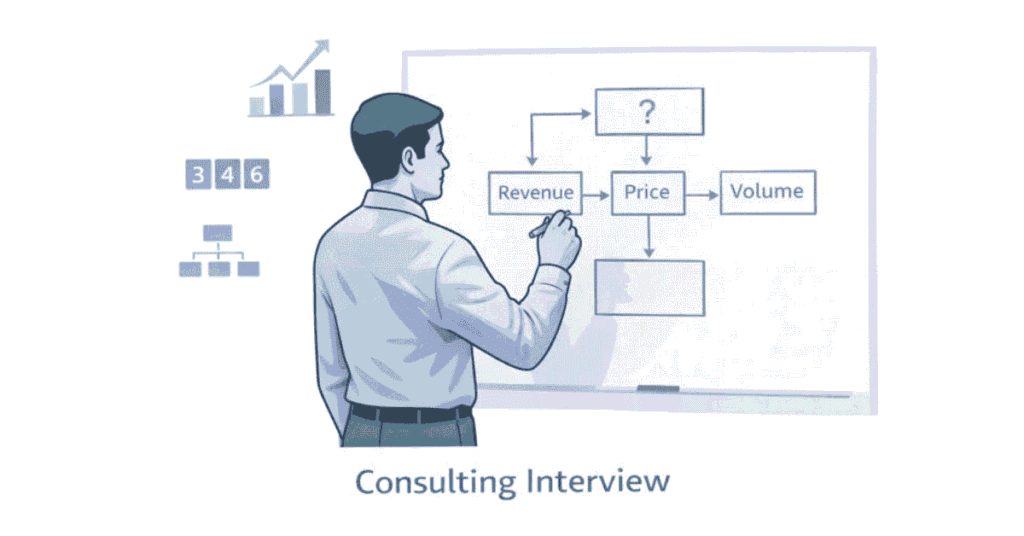
Table of Contents
Case interviews are the single biggest barrier between you and a consulting job. Unlike regular job interviews where you talk about your resume and answer behavioral questions, case interviews throw you into the deep end—you’re given a real business problem and asked to solve it live, out loud, while the interviewer watches how you think.
It feels intimidating at first. Most students freeze during their first few practice cases because they’re used to exams where there’s one right answer. But here’s the good news: case interviews are completely learnable. You don’t need to be a genius or have an MBA. You need structured thinking, deliberate practice, and the right preparation strategy.
This guide walks you through everything—what cases actually test, common case types, proven frameworks, step-by-step solving techniques, mental math shortcuts, and a realistic 8-12 week practice plan that works even if you’re starting from zero.c
What Are Case Interviews and Why Do Firms Use Them?
A case interview simulates real consulting work. The interviewer presents a business problem—maybe a company’s profits are falling, or they want to enter a new market, or they’re deciding whether to acquire a competitor. Your job is to:
- Structure the problem into logical parts
- Ask smart questions to gather information
- Analyze data and identify insights
- Make a clear recommendation with supporting logic
What firms are really testing:
- Structured thinking: Can you break messy problems into manageable pieces?
- Business intuition: Do you understand how companies make money and operate?
- Quantitative skills: Are you comfortable with numbers and quick calculations?
- Communication: Can you explain complex ideas simply and confidently?
- Coachability: Do you listen to hints and adapt your approach?upgrad+1
Cases reveal how you think under pressure, not just what you know. That’s why consulting firms rely on them—they predict actual job performance better than grades or resumes alone.
Common Case Types (With Examples)
Most cases fall into a few repeatable categories. Recognizing the type helps you apply the right thinking approach.
1. Profitability Cases
The Setup: “Our client’s profits have declined 15% in two years. Why is this happening and what should they do?”
Your Approach:
- Break profit into Revenue and Costs
- Revenue = Price × Volume (by product, customer segment, geography)
- Costs = Fixed costs + Variable costs
- Explore each branch systematically with data
Key Skills: Financial logic, structured decomposition, hypothesis testingmyconsultingoffer
2. Market Entry Cases
The Setup: “A European consumer goods company wants to enter the Indian market. Should they? If yes, how?”
Your Approach:
- Market attractiveness: Size, growth, trends, profitability potential
- Competition: Who’s there? How strong? Barriers to entry?
- Company capabilities: Brand strength, operations, finances
- Entry strategy: Build, buy, partner? Which cities first? Pricing?myconsultingoffer
Key Skills: Market analysis, strategic thinking, prioritization
3. Growth Strategy Cases
The Setup: “A regional bank wants to double revenue in 5 years. What options should they consider?”
Your Approach:
- Existing business growth: Increase customer base, cross-sell products, improve retention
- New products/services: Launch new offerings for current customers
- New markets: Geographic expansion, new customer segments
- M&A: Acquire competitors or complementary businesses
Key Skills: Creative thinking, business model understanding, realistic assessmentcareerinconsulting
4. M&A (Merger & Acquisition) Cases
The Setup: “Your client is considering acquiring a competitor for $500 million. Should they do it?”
Your Approach:
- Strategic fit: Does this strengthen market position? Synergies?
- Financial valuation: Is $500M reasonable based on revenues/profits?
- Integration risks: Culture clash? Customer overlap? Systems integration?
- Alternatives: Could we achieve same goals without buying?igotanoffer
Key Skills: Valuation logic, risk assessment, strategic reasoning
5. Operations/Process Improvement Cases
The Setup: “A manufacturing plant’s production costs are 20% higher than competitors. How can we fix this?”
Your Approach:
- Map the production process end-to-end
- Identify inefficiencies: waste, downtime, rework, poor utilization
- Benchmark against best practices
- Prioritize improvements by impact and feasibilityupgrad
Key Skills: Process thinking, operational knowledge, practical problem-solving
Case Frameworks: Use Smartly, Not Robotically
Frameworks are mental models that help you structure problems quickly. But here’s the trap many students fall into: memorizing generic frameworks and forcing them onto every case.
Interviewers hate when you sound like you’re reciting from a textbook. They want customized structures that fit the specific problem, not copy-paste templates.igotanoffer+1
Core Frameworks Worth Knowing
- Profitability Framework
Simple and powerful for profit/revenue/cost cases:
text
Profit = Revenue – Costs
Revenue = Price × Volume
– By product line
– By customer segment
– By geography
Costs = Fixed + Variable
– COGS (materials, labor, overhead)
– Operating expenses (SG&A, R&D, marketing)
When to use: Any profit, pricing, or cost problemmyconsultingoffer
- Market Entry Framework
text
Should we enter this market?
Market Analysis
– Market size and growth
– Customer needs and segments
– Profitability potential
Competitive Landscape
– Who are the players?
– Market shares and positioning
– Barriers to entry
Company Fit
– Our capabilities vs requirements
– Brand strength
– Financial resources
Entry Strategy
– Mode: Organic/Partnership/Acquisition
– Go-to-market approach
– Phasing and pilot strategy
When to use: Geographic expansion, new product launchesmyconsultingoffer
- Business Situation Framework (Flexible Catch-All)
When you’re unsure, use this flexible structure:
text
Company
– Products/services
– Operations and capabilities
– Financials
Customers
– Segments and needs
– Buying behavior
– Satisfaction/loyalty
Competitors
– Who they are
– Their strategies
– Our positioning vs them
Market/Industry
– Size and growth
– Trends (technology, regulation, social)
– Economics (suppliers, channels)
This is your safety net—works for many cases
How to Build Custom Structures
Instead of picking a memorized framework:
- Listen carefully to the case setup
- Identify the core question (grow revenue? cut costs? enter market?)
- Break it into 3-4 logical buckets that cover everything (MECE: Mutually Exclusive, Collectively Exhaustive)
- Explain your logic briefly before diving in
Example: “To figure out why profits are falling, I’d like to look at three areas: Revenue trends to see if we’re selling less or at lower prices, Cost trends to check if expenses have risen, and External factors like competition or market changes that might explain these shifts.”
This sounds natural, confident, and tailored—not robotic.
Step-by-Step: How to Solve Any Case
Here’s the universal approach that works across all case types.
Step 1: Listen and Clarify (2 minutes)
What to do:
- Listen actively while taking brief notes
- Pause for 10-15 seconds to absorb
- Ask 1-3 clarifying questions
Good clarifying questions:
- “Is our goal to increase profits in the short term or long term?”
- “Are we focused on one geography or globally?”
- “What does success look like—a specific profit target?”careerinconsulting
What NOT to ask:
- Random questions about details you haven’t analyzed yet
- Questions the case already answered
Step 2: Structure the Problem (30-60 seconds)
What to do:
- Take 30-60 seconds to think silently
- Jot down your structure (usually 3-4 main branches)
- Present it confidently: “Here’s how I’d like to approach this…”
- Explain the logic behind your structure briefly
Example structure presentation:
“To understand why profits fell, I’ll look at Revenue—broken into price and volume across segments—then Costs, both fixed and variable, and finally External factors like competition or regulation that might have changed. Does this sound reasonable?”igotanoffer+1
Pro tip: Always end with “Does this make sense?” or “Should I adjust anything?” Shows collaboration.
Step 3: Drive the Analysis (Main bulk of case)
What to do:
- Work through your structure systematically
- Ask for specific data as you need it (don’t ask for everything upfront)
- When you get numbers/charts, think aloud as you interpret them
- Share observations and what they mean
Good example:
“So revenue dropped from $100M to $85M. That’s a 15% decline. Can we break this down by product line to see where the drop is concentrated?”
[Gets data showing Product A fell 30%, Product B flat]
“Interesting—Product A is driving most of the decline while Product B held steady. This suggests the problem might be specific to Product A. Could we explore what changed—pricing, competition, or customer preferences?”careerinconsulting+1
What makes this good:
- You’re driving the conversation
- You’re thinking out loud
- You’re building hypotheses and testing them
Step 4: Do the Math (Throughout case)
When quantitative problems come up:
- Write down the numbers clearly on your paper
- Say your approach out loud before calculating
- Round intelligently to make math easier (49.8 → 50)
- Do the math step-by-step verbally so interviewer follows
- Sense-check your answer (“This means 20% growth, which seems reasonable given…”)careerinconsulting+1
Never do silent math in your head—interviewers can’t see your thinking.
Step 5: Synthesize and Recommend (Final 2-3 minutes)
What to do:
- Briefly summarize 2-3 key findings
- Make a clear recommendation
- Acknowledge risks and next steps
Strong closing example:
“Based on our analysis, I recommend the client enter the Indian market, specifically targeting Tier 1 cities first with a premium positioning. Here’s why: The market is large and growing at 12% annually, competition is fragmented, and our brand strength gives us an advantage.
The risks are regulatory uncertainty and distribution challenges, so I’d suggest a phased approach—pilot in Mumbai and Delhi for 6 months, measure results, then scale nationally if metrics hit targets.
Next steps would be finalizing go-to-market partners, setting up local operations, and developing city-specific marketing campaigns.”myconsultingoffer
What makes this strong:
- Clear stance (“I recommend…”)
- Supporting reasons (market size, growth, brand)
- Risk awareness
- Practical next steps
Mental Math: Essential Skills and Shortcuts
You’ll do math in almost every case—market sizing, percentage changes, growth rates, profitability calculations. You don’t need to be lightning-fast, but you need accuracy and confidence.
Core Skills to Practice
- Multiplication with large numbers
- 250 × 48 → think (250 × 50) – (250 × 2) = 12,500 – 500 = 12,000
- 17 × 24 → (17 × 20) + (17 × 4) = 340 + 68 = 408
- Percentages
- 15% of 240 → 10% = 24, 5% = 12, total = 36
- What % is 35 of 140? → 35/140 = 1/4 = 25%
- Growth and compound growth
- If revenue is ₹100M growing at 20% annually for 3 years:
Year 1: ₹120M, Year 2: ₹144M, Year 3: ₹173M (roughly)
- Averages and weighted averages
- Product A: 60% of sales at 20% margin
Product B: 40% of sales at 30% margin
Blended margin = (0.6 × 20) + (0.4 × 30) = 12 + 12 = 24%
Practice Drills (10 min daily)
- Set a timer, solve 10 problems
- Examples: “What’s 15% of 360?” “If 240 grows 8% annually for 5 years, what’s final value?”
- Use apps like Mental Math Practice or just make your own
Tricks to Simplify
- Round aggressively early: 47.8 × 23.2 → just do 48 × 23
- Break into easier parts: 17 × 34 → 17 × 30 + 17 × 4
- Use benchmarks: 12% of 250 → 10% (25) + 2% (5) = 30
- Say your rounding: “I’ll round 118 to 120 to make math simpler”igotanoffer
Interviewers care more about your approach than exact precision—being 5% off is fine if your logic is clear.
8-12 Week Case Practice Plan
Structured practice is the only way to get good. Here’s a realistic timeline.
Weeks 1-2: Learn Foundations
Goals: Understand what cases are, learn basic frameworks, watch examples
Activities:
- Read case interview guides (Victor Cheng, CaseInterview.com)
- Watch 5-10 solved case videos on YouTube
- Learn the profitability and market entry frameworks
- Solve 3-5 simple cases alone (reading solutions after)careerinconsulting
Time: 1-1.5 hours daily
Weeks 3-6: Build Core Skills
Goals: Practice structure, get comfortable verbalizing thinking, do cases with partners
Activities:
- Practice 3-4 cases per week with peers or mentors
- Focus on: opening structure, asking good questions, thinking aloud
- Record yourself and review (listen for filler words, pace, clarity)
- Do mental math drills 10 min dailyigotanoffer+1
Time: 1.5-2 hours daily
Weeks 7-10: Advanced Practice and Refinement
Goals: Handle harder cases, improve speed, refine communication
Activities:
- Mix case types (profitability, market entry, operations, M&A)
- Practice under time pressure (30-35 min per case)
- Join online case practice groups or communities
- Review your mistakes: Keep a “lessons learned” doc
Time: 2-2.5 hours daily
Weeks 11-12: Mock Interviews and Polish
Goals: Simulate real interviews, fine-tune confidence
Activities:
- Do full mock interviews with experienced consultants or seniors
- Practice firm-specific styles (McKinsey interviewer-led vs candidate-led)
- Review common mistakes one final time
- Rest 1-2 days before real interviews
Time: 2 hours daily + rest
Key Success Factors
- Practice with partners: Solo practice only goes so far—you need live interaction
- Get feedback: Ask partners what you did well and what to improve
- Track progress: Notice how your structure improves from week 3 to week 8
- Stay consistent: 1 hour daily beats 7 hours on Sundayi
Common Mistakes to Avoid
Mistake 1: Memorizing Frameworks Robotically
Problem: You sound like you’re reciting a textbook
Fix: Build custom structures based on the specific case
Mistake 2: Doing Silent Math
Problem: Interviewer can’t follow your thinking
Fix: Always verbalize your calculation steps
Mistake 3: Jumping to Solutions Too Fast
Problem: You skip analysis and guess the answer
Fix: Work through your structure systematically, gather data, then concludemyconsultingoffer
Mistake 4: Ignoring Interviewer Hints
Problem: Interviewer subtly guides you but you don’t notice
Fix: Listen actively, pause when they speak, adjust your approachcareerinconsulting
Mistake 5: Not Practicing Enough With Others
Problem: You can read cases but freeze in live situations
Fix: Practice 50+ cases with partners before real interviews
Best Resources for Case Practice
Free Resources
- CaseInterview.com: Free case library and guides
- Management Consulted: YouTube case walkthroughs
- PrepLounge: Free cases (paid for peer matching)
- Victor Cheng LOMS: Classic framework training
Paid Resources
- Case Interview Secrets (Victor Cheng): ₹5,000-8,000, structured program
- PrepLounge Premium: ₹3,000-6,000/month, peer practice platform
- IGotAnOffer: MBB-specific case courses
- RocketBlocks: Practice cases with feedbackmyconsultingoffer+1
Practice Partners
- Find classmates preparing for consulting
- Join LinkedIn/WhatsApp case prep groups
- Alumni networks (reach out to consultants 2-3 years ahead)
- Paid 1-on-1 coaching (₹2,000-5,000/session with ex-consultants)
Firm-Specific Tips
McKinsey
- Heavy emphasis on structure and “MECE” thinking
- Interviewer-led style (they control the flow more)
- Practice their “Personal Experience Interview” (PEI) equally
BCG
- Loves creative thinking and “out of the box” ideas
- More candidate-led (you drive the case)
- Comfort with ambiguity is key
Bain
- Results-focused and practical
- Expect more collaboration during cases
- Show you care about implementation, not just strategy
Big 4
- Mix of business and operational cases
- Less theoretical, more “real company” scenarios
Communication and team fit weighted heavilyu
Final Mindset Tips
- Treat the interviewer as a colleague, not an examiner
You’re solving the problem together, not being tested on trivia. - Stay calm when you’re stuck
Say: “Let me think through this for a moment” or “Could you give me a hint on where to focus?” - Show your personality
Consulting is about working with people. Be professional but also human—smile, be curious, show enthusiasm.upgrad+1 - It’s okay to not know everything
If you don’t know an industry term, just ask: “I’m not familiar with X—could you explain briefly?” Shows humility and learning mindset.
5. Improvement is nonlinear
You’ll feel stuck around week 4-5, then suddenly break through. Trust the process