
CUSTOMER SERVICE EXCELLENCE IN HOSPITALITY
Table of Contents
Customer Service Excellence: The Foundation of Hospitality Careers

Why Customer Service Is Your Most Valuable Asset
In hospitality, customer service isn’t just a job function—it’s the entire value proposition. Guests don’t remember the thread count of sheets or the thread count of linens; they remember how you made them feel. Whether you’re checking in a guest, serving food, or solving a problem, exceptional customer service creates loyalty, positive reviews, and repeat business. More importantly, it’s the skill that makes you promotable, valuable, and indispensable to any organization.
Customer service excellence differentiates hotels in a crowded market. Two hotels might have identical rooms and facilities, but the one with exceptional service wins bookings. This is why hospitality organizations invest heavily in service training and why professionals with outstanding customer service skills earn premium salaries and advance quickly.
Understanding the Hospitality Service Mindset
Before diving into specific techniques, understand what “service” truly means in hospitality.
Service isn’t subservience. It’s not about degrading yourself or being treated poorly. Hospitality professionals provide valuable expertise and create experiences. You’re a guide, facilitator, and problem-solver—not a servant.
Service is about understanding guests. Guests arrive with expectations, desires, sometimes stress, and occasionally frustration. Your job is understanding their needs (often unspoken) and exceeding expectations.
Service is about consistency. Every interaction matters. One bad experience can overshadow ten good ones. Consistency builds trust and reputation.
Service requires genuine care. Guests detect insincerity instantly. Exceptional service comes from genuinely wanting guests to have great experiences, not just going through motions.

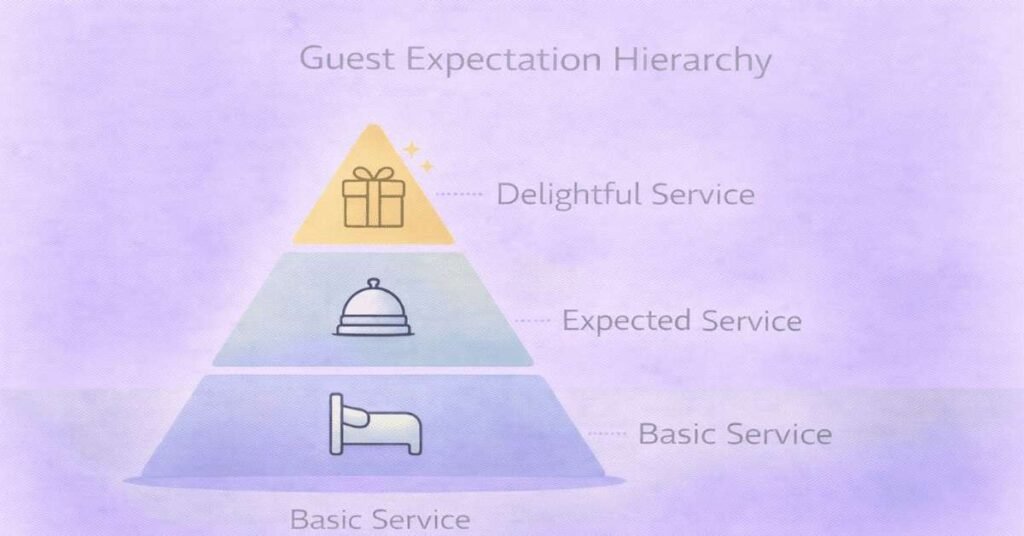
The Guest Expectation Hierarchy
Understanding what guests expect helps you deliver effectively:
Basic Expectations (Non-Negotiable)
These are minimum requirements. Failing here guarantees dissatisfaction:
- Cleanliness – Spotless rooms, clean public areas, hygienic food service
- Safety – Secure premises, proper food handling, emergency protocols
- Basic Functionality – Working air conditioning, hot water, functional equipment
- Professional Behavior – Staff professionalism, respectful treatment
Accuracy – What was promised is what’s delivered (room type, amenities, pricing)
Expected Service (Standard Excellence)
Guests expect these at mid-range and above properties:
- Responsiveness – Quick response to requests, issues handled promptly
- Problem Resolution – When issues arise, they’re solved fairly and effectively
- Cleanliness Standards – Impeccably clean rooms, meticulous attention to detail
- Friendliness – Warm, welcoming demeanor from staff
Professionalism – Knowledgeable, competent staff handling situations smoothly
Delightful Service (Service Recovery & Extras)
These exceed expectations and create loyalty:
- Anticipation – Staff predict needs before guests ask
- Personalization – Service tailored to individual preferences
- Going Beyond – Extra touches that surprise and delight (welcome gifts, special requests)
- Recovery Excellence – When problems occur, recovery efforts exceed the original promise
- Genuine Care – Service that demonstrates authentic concern for guest well-being
Core Customer Service Skills for Hospitality
1. Active Listening
Why It Matters:
Guests often communicate their needs indirectly or incompletely. Active listening—truly hearing what’s being said—helps you understand real needs and provide appropriate solutions.
How to Practice:
- Focus Completely – When a guest speaks, give full attention. No phone checking, no distraction.
- Observe Non-Verbals – Notice tone, facial expressions, body language. Often these communicate more than words.
- Clarify Understanding – Repeat back what you heard: “So you need a quiet room away from the elevator?”
- Ask Follow-Up Questions – Go beyond surface requests. “Would you prefer a garden view or city view?”
- Validate Feelings – Acknowledge emotions: “I understand this is frustrating. Let me help.”
Real Example:
Guest: “I need a room tomorrow.”
Bad Listening: Book any available room.
Active Listening: Notice the guest seems stressed. Ask follow-ups. “What brings you to the city? Do you have a preference for room location or view? Is this a leisure or business trip?” Understanding context helps you provide the right room, maybe even upgrade them to the perfect space.
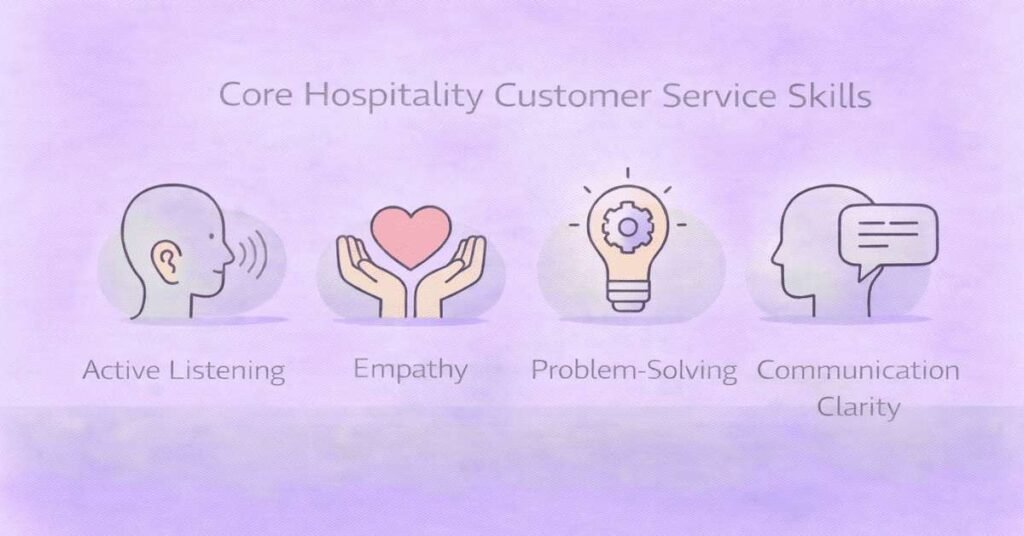
2. Empathy & Emotional Intelligence
Why It Matters:
Guests arrive with emotions—sometimes joy, sometimes frustration. Empathy—understanding and acknowledging their feelings—creates connection and diffuses tension.
How to Develop:
- See From Their Perspective – Imagine the guest’s experience. Flight delays, family stress, work pressures—guests bring baggage.
- Validate Emotions – Never dismiss feelings: “I understand this is disappointing. Your concerns are valid.”
- Avoid Defensiveness – If a guest complains, don’t defend the hotel. Acknowledge the issue first.
- Show Genuine Care – Your tone, facial expressions, and body language communicate whether you genuinely care.
Real Example:
Situation: A guest discovers their reservation was cancelled due to a system error, forcing them to find another hotel.
Low Empathy Response: “That’s unfortunate. Here’s our cancellation policy…”
High Empathy Response: “I completely understand your frustration. This is unacceptable—your reservation should have been honored. Let me immediately find you a comparable room tonight, and we’ll credit your account for the inconvenience.”
3. Problem-Solving Under Pressure
Why It Matters:
Hospitality problems happen constantly—and often during busy, stressful periods. Your ability to find solutions quickly while maintaining composure defines your value.
Problem-Solving Framework:
- Acknowledge Immediately – Don’t make guest wait or feel ignored.
- Understand the Problem – Ask clarifying questions to fully understand the issue.
- Offer Options – “Here are three solutions. Which works best for you?”
- Implement Immediately – Don’t make guests wait while you think. Take action.
- Follow Up – Ensure the solution actually resolved the issue.
Real Example:
Problem: Guest arrives to discover their reserved room isn’t ready (housekeeping delay).
Quick Solution: “I sincerely apologize for this. Your room will be ready in 20 minutes. Please enjoy complimentary refreshments at the lounge. I’ll personally ensure your room is perfect and deliver your key.”
This acknowledges the problem, provides a solution, offers compensation, and personal accountability.
4. Communication Clarity
Why It Matters:
Misunderstandings lead to guest dissatisfaction. Clear communication prevents problems and manages expectations.
Clarity Principles:
- Use Simple Language – Avoid jargon, complex terms, or industry-specific language guests won’t understand.
- Speak Slowly & Clearly – Especially important with international guests.
- Confirm Understanding – Have guest repeat back understanding or confirm via email: “Just to confirm, you need early checkout at 7 AM tomorrow?”
- Provide Written Confirmation – For complex requests or bookings, provide written details.
Real Example:
Unclear: “Your room is 340. Breakfast is in the dining area, 6 to 10 AM.”
Clear: “Your room is 340, located on the third floor. To reach it, take the elevator down the corridor to the left. Breakfast is served in the dining area from 6 to 10 AM daily. Would you like your newspapers at your room or prefer digital?”
5. Service Recovery—Turning Problems Into Loyalty
Why It Matters:
Problems happen in every business. Service recovery—how you handle problems—often determines whether guests become loyal advocates or leave negative reviews.
Recovery Framework:
Step 1: Apologize Sincerely – Not “I’m sorry you feel that way,” but genuine: “I’m truly sorry this happened. You deserved better.”
Step 2: Take Responsibility – Don’t blame others or systems. “This is my responsibility. Let me fix it.”
Step 3: Explain What Happened – Briefly explain the cause (without making excuses).
Step 4: Provide Solution – Offer a solution that exceeds the original problem. If they lost a room booking, offer upgraded room plus room credit.
Step 5: Prevent Recurrence – Explain how you’ll prevent this in future: “I’ve flagged your reservation with our manager to ensure this doesn’t happen again.”
Step 6: Follow Up – Call or email later to confirm guest satisfaction: “I wanted to ensure everything worked out well for you.”
Real Example:
Situation: Hotel overbooked, guest was turned away.
Recovery: “I’m genuinely sorry. We made an error, and you’ve been inconvenienced. We’ve arranged accommodation at a comparable hotel across the street, covered all costs including the difference if higher, provided free dinner and breakfast vouchers, and given you a room credit for your next stay with us.”
This transforms a negative into a recoverable situation.
6. Upselling With Authenticity
Why It Matters:
Upselling—offering upgrades or additional services—increases revenue while giving guests better experiences. But it only works if it’s authentic and benefits guests, not just the hotel.
Authentic Upselling:
- Understand Guest Needs First – What matters to this guest? Business travelers want quiet efficient rooms. Families want spacious rooms.
- Recommend Genuinely – Only suggest what would genuinely enhance their experience.
- Present as Benefits, Not Sales – “For a small upgrade, you’d have a corner room with city views and late checkout, which gives you more time to explore tomorrow.”
Respect Decisions – If guest declines, don’t push. Accept gracefully.
Guest Satisfaction Metrics You Should Understand
Modern hospitality tracks satisfaction through specific metrics:
- Net Promoter Score (NPS) – Would you recommend us? (Scale 0-10)
- Customer Satisfaction Score (CSAT) – Rate your satisfaction (Scale 1-5)
- Customer Effort Score (CES) – How easy was it to resolve your issue? (Scale 1-5)
- Online Reviews & Ratings – Directly impact bookings and reputation
Your service directly impacts these metrics. Exceptional service creates promoters (9-10 rating). Mediocre service creates passives (7-8). Poor service creates detractors (0-6).
Customer Service Training for Your Career
Formal Training Programs:
- Hospitality Service Certifications – Many institutes offer service excellence certifications
- Online Courses – Platforms like Coursera offer customer service courses
- Brand Training – Each hotel chain has specific service standards and training programs
Self-Directed Learning:
- Observe Excellence – Watch exemplary servers, front desk staff, and managers. Understand what they do differently.
- Practice Deliberately – Role-play scenarios with colleagues
- Seek Feedback – Ask your manager how you’re doing and what to improve
- Learn From Mistakes – Each customer interaction teaches something
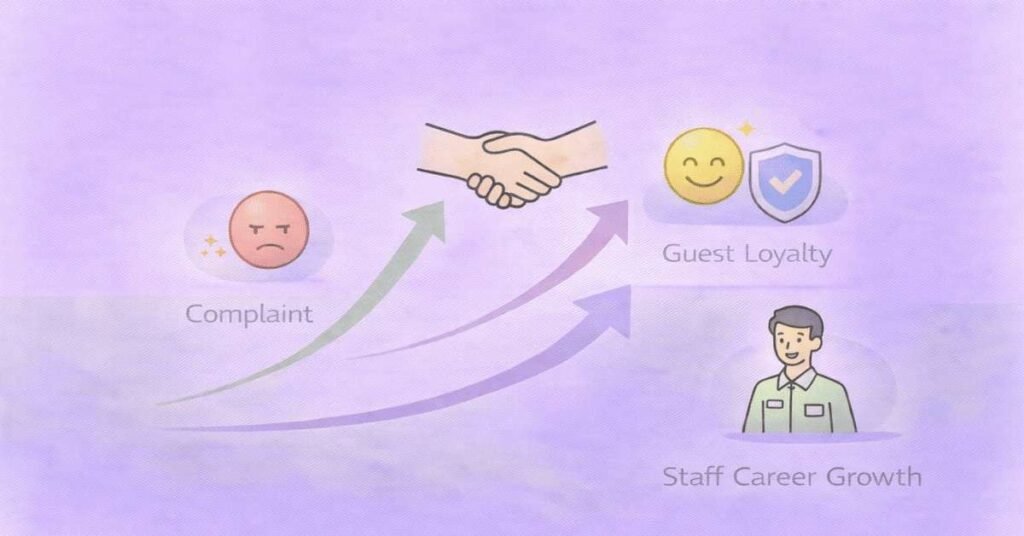
Why Customer Service Excellence Accelerates Your Career
because:
- Direct Revenue Impact – Great service increases bookings, reviews, and revenue
- Staff Efficiency – Satisfied guests create fewer complaints, reducing workload elsewhere
- Brand Loyalty – Exceptional service creates repeat customers and referrals
- Leadership Potential – Service excellence demonstrates all qualities needed for management
A front desk executive delivering exceptional service gets promoted to shift manager. A server with outstanding service becomes a restaurant manager. This is why service skills are your most valuable career asset.