
Teaching Jobs Abroad: How to Take Your Education Career International
Table of Contents

Part 1: Understanding International Teaching Opportunities
Introduction
Imagine teaching in a classroom overlooking Bangkok’s skyline, earning in foreign currency while building international experience, and living in a vibrant global community. For Indian teachers, teaching abroad isn’t just a vacation—it’s a legitimate career move that offers financial growth, professional development, and personal adventure.
India produces millions of competent teachers annually, but international schools and English teaching centers globally face teacher shortages. This creates a golden opportunity: countries from Southeast Asia to Middle East to Europe actively recruit Indian educators, offering salaries 2-4 times higher than India, along with housing, healthcare, and visa sponsorship.
The international teaching market isn’t random. It follows predictable patterns. Countries with high demand (Middle East, Southeast Asia) offer premium salaries but shorter contracts. Developed nations (USA, UK, Canada) offer stability but require specific certifications. Emerging destinations (Vietnam, Thailand) offer flexibility and adventure with reasonable pay.
For teachers seeking international experience, career advancement, financial growth, or simply a change of scenery, this guide maps the complete pathway.
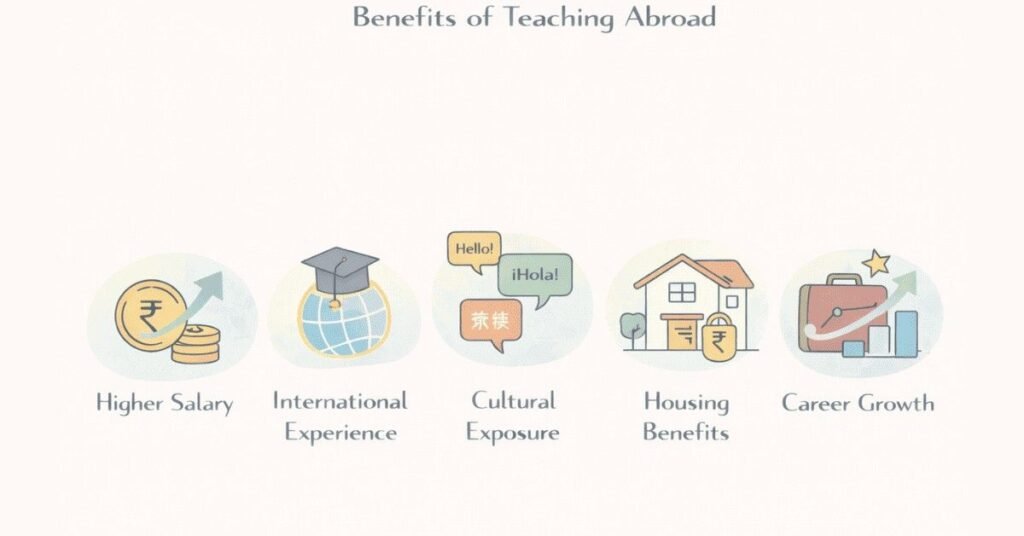
Why Teach Abroad? Real Benefits Beyond Salary
- Significant Income Increase

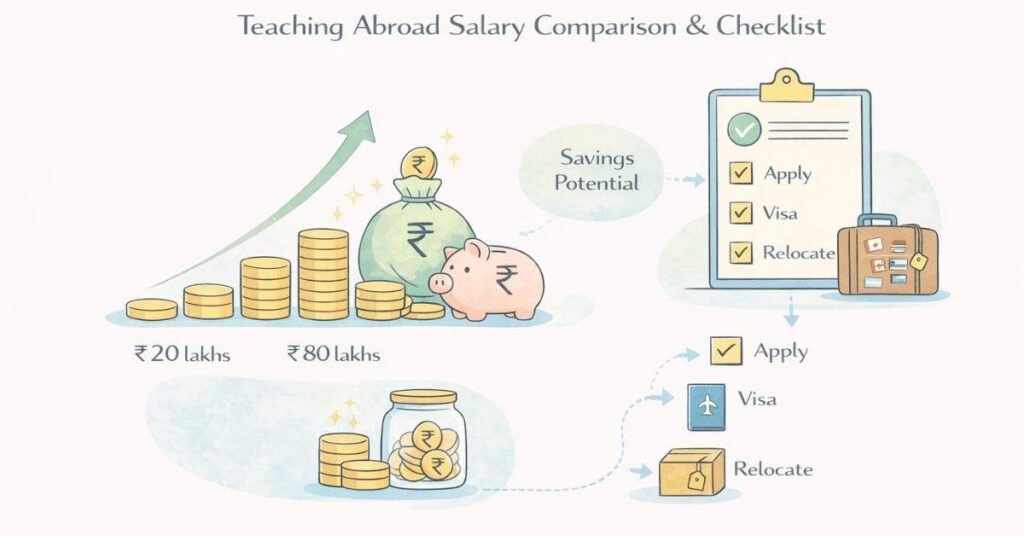
Real scenario: A teacher earning ₹5 lakhs in India can earn ₹20 lakhs abroad, while saving 80% (free housing, food provided). This means ₹16 lakhs saved yearly = ₹80 lakhs in 5 years.
- Career Acceleration
International experience accelerates career growth:
- In India: Climb 1 position in 5 years
- Abroad: Return with senior position credentials, international exposure, and expanded network
After 2-3 years abroad, teachers often return to India as:
- International School Leaders (₹30-50 lakhs salary)
- Curriculum Consultants for EdTech (₹25-40 lakhs)
- Training Directors (₹20-35 lakhs)
- Professional Development
- Work with diverse student populations (develops adaptability)
- Access world-class training programs
- Network with international educators
- Build cross-cultural teaching competencies
- Exposure to innovative curricula
- Personal Growth
- Live independently in new country
- Learn new languages/cultures
- Build international friendships
- Develop resilience and adaptability
- Create lifelong memories
- Minimal Risk
- Employer-sponsored visas (no visa costs)
- Housing provided (no housing costs)
- Clear contracts (know exactly what to expect)
- Easy return option (if not working, return to India)
Who Should Teach Abroad?
Ideal Candidate Profile:
✅ You have 2+ years teaching experience
✅ You’re comfortable with change and uncertainty
✅ You have decent English (especially for English teaching)
✅ You’re open to learning new systems
✅ You have basic digital skills
✅ You can commit to 1-2 year contracts
✅ You’re flexible with cultural differences
Not Ideal If:
❌ You need to stay in India (family commitments)
❌ You’re looking for permanent settlement abroad (most contracts are 1-2 years)
❌ You’re highly specialized in rare subjects (limits opportunities)
❌ You’re risk-averse or need predictability
❌ You can’t learn new teaching methodologies
Common Misconceptions About Teaching Abroad
Myth 1: “You need perfect English accent”
Reality: Most international schools want clear communication, not accented perfection. Many hire Indian teachers specifically.
Myth 2: “It’s permanent settlement”
Reality: Most contracts are 1-2 years renewable. Many teachers return to India after experience.
Myth 3: “You need specific certifications”
Reality: TEFL/CELTA help, but experience matters more. Many get certified after landing job.
Myth 4: “Salary isn’t reliable”
Reality: International schools are established organizations with secure payments. Less risky than Indian coaching centers.
Myth 5: “It’s only for English teachers”
Reality: International schools hire Math, Science, History, and other subject teachers. Demand varies by location.
Part 2: Certifications & Qualifications
Do You Need Certifications to Teach Abroad?
Short answer: For English teaching—yes. For subject teaching—not always, but helps.
Why certifications matter:
- Employers (especially international schools) prefer certified teachers
- Certification demonstrates you understand global teaching standards
- Visa requirements in some countries demand certifications
- Salary increases with recognized certifications
Top Certifications for Indian Teachers
TEFL (Teaching English as a Foreign Language)
What it is: Certification in teaching English to non-native speakers
Cost: ₹5,000-₹30,000 (online), ₹20,000-₹50,000 (in-person)
Duration: 120-150 hours (4-6 weeks online, 2-4 weeks intensive)
Top Providers:
- International TEFL Academy (Premium quality, globally recognized)
- TEFL Course.com (Budget-friendly)
- Udemy TEFL (₹500-₹1,000 on sale, basic but acceptable)
- IATEFL-affiliated centers
Recognized by: Most English teaching positions globally
Salary impact: +₹2,000-₹5,000 monthly salary increase
Effort: Low—doable while working
Best for: English teachers or career switchers interested in English teaching
CELTA (Certificate in English Language Teaching to Adults)
What it is: More rigorous than TEFL, focused on adult learners
Cost: ₹50,000-₹1,00,000
Duration: 4 weeks intensive (120 hours)
Providers:
- Cambridge-accredited centers across India
- Online + teaching practice requirement
- Centers: New Delhi, Mumbai, Bangalore, Chennai
Recognized by: Premium international schools, universities
Salary impact: +₹5,000-₹10,000 monthly increase
Effort: High—requires practice teaching and assignments
Best for: Serious career changers wanting premium positions
TESOL (Teaching English to Speakers of Other Languages)
What it is: Similar to TEFL but American standard
Cost: ₹10,000-₹25,000
Duration: 100-120 hours
Recognized by: USA, Canada, Middle East
Salary impact: Similar to TEFL
Best for: Teachers targeting USA/North America positions
Specialized Subject Certifications
For Math, Science, History teachers:
International Baccalaureate (IB) Certification
- Cost: ₹30,000-₹50,000
- Duration: 3 weeks + ongoing
- Salary increase: +₹10,000-₹15,000 monthly
- Best for: Teachers in IB schools (high-paying)
Cambridge International A Levels
- Cost: ₹15,000-₹25,000
- Duration: 2-3 weeks
- Best for: Schools following Cambridge curriculum
IGCSE Certification
- Cost: ₹10,000-₹20,000
- Best for: British-curriculum schools
Certification Timeline Recommendation
If you have time before applying:
text
Month 1-2: Choose certification type based on target country
Month 2-3: Enroll and complete TEFL/TESOL (do online while working)
Month 4: Get certificate, update resume
Month 5: Start applying
Month 6-8: Interview process
Month 9-10: Visa processing
Month 11: Move abroad
If you want to move quickly:
text
Month 1: Start applying with Bachelor’s degree + teaching experience
Month 2-4: Interview process with employer
Month 5: Get job offer, employer may provide TEFL sponsorship
Month 6-8: Complete TEFL after securing position (many employers pay)
Reality: Many employers will hire you without certification if you have 3+ years experience, then support you getting certified after joining.
Which Certification to Choose?

My recommendation: Start with TEFL (affordable, quick, universally recognized) while job searching. If you secure international position, employer often pays for CELTA afterward.

Part 3: Top Countries Hiring Indian Teachers
Tier 1: Maximum Salary & Benefits (₹20-50+ lakhs annual)
United Arab Emirates (UAE)
Why hire Indian teachers:
- Large Indian expat community (understand culture)
- Proven quality and discipline in teaching
- Competitive pricing for schools
- Work ethics appreciated
Teaching opportunities:
- International schools (₹15-30 lakhs annually)
- Private schools (₹12-20 lakhs)
- English coaching centers (₹10-15 lakhs)
- Online tutoring platforms (₹5-10 lakhs part-time)
Cities with most opportunities:
- Dubai (highest salaries, most competition)
- Abu Dhabi (stable, government schools)
- Sharjah (growing opportunities)
Visa & Logistics:
- Work visa: Sponsored by employer (free)
- Duration: Typically 2-3 years renewable
- Salary: Tax-free or minimal taxes
- Benefits: Housing allowance (₹3-8 lakhs), health insurance, airline ticket
Real salary breakdown (Dubai International School example):
- Base: ₹12 lakhs
- Housing: ₹4 lakhs
- Allowances: ₹2 lakhs
- Health insurance: ₹1 lakh (value)
- Total: ₹19 lakhs (vs ₹5 lakhs in India)
How to apply:
- Direct school websites (search “Dubai international schools”)
- Recruitment agencies: Gulf Teacher Recruitment, Middle East Teachers
- LinkedIn job postings
- International Schools Review (isreview.org)
Timeline: 2-4 months from application to visa
Saudi Arabia
Why: Massive salary increase (₹20-40 lakhs), strong demand
Opportunities:
- International schools (₹18-35 lakhs)
- University roles (₹20-40 lakhs)
- Online teaching (₹8-15 lakhs)
Reality Check:
- Strict cultural rules (affects lifestyle)
- Limited social activities for non-Muslims
- No alcohol
- Dress codes enforced
Best for: Teachers prioritizing salary over lifestyle flexibility
- Qatar
Salary: ₹18-35 lakhs annually
Benefits:
- Tax-free salary
- Housing fully provided
- Healthcare covered
- Relaxed cultural environment vs Saudi
Best for: Teachers wanting high salary with lifestyle flexibility

Tier 2: Good Salary & Adventure (₹10-25 lakhs)
Thailand
Why Indian teachers succeed:
- Experienced teaching force
- English proficiency valued
- Cultural respect for education
- Growing international schools
Opportunities:
- Bangkok International Schools (₹12-20 lakhs)
- Province schools (₹8-12 lakhs)
- Private English centers (₹6-10 lakhs)
- Online teaching (₹5-10 lakhs)
Cost of living: ₹25,000-₹40,000 monthly (30-50% cheaper than India metros)
Lifestyle: Vibrant, adventurous, great food, low crime
Visa: Education visa (easy to obtain)
Timeline: 3-4 months
Real scenario: Earn ₹12 lakhs, spend ₹3 lakhs, save ₹9 lakhs yearly
Vietnam
Why popular with Indian teachers:
- High demand for English teachers
- Rising salaries as economy grows
- Friendly towards foreigners
- Low cost of living
Salary: ₹8-15 lakhs
Cost of living: ₹20,000-₹30,000 monthly
Best for: Teachers seeking adventure with reasonable earning
Timeline: 2-3 months
Reality: Small cities (Da Nang, Hanoi) better for cultural integration than Ho Chi Minh City
South Korea
Why hire Indian teachers:
- English proficiency needed
- Growing education sector
- Respect for experienced teachers
- Competitive pay
Salary: ₹15-25 lakhs annually
Benefits:
- Housing provided
- Healthcare covered
- Airfare reimbursed
- Bonus structure (₹2-5 lakhs extra)
Challenges:
- Harsh winters
- Limited English-speaking population (harder social life)
- Long working hours culture
- Competitive, stressful environment
Best for: Career-focused teachers willing to work hard
Timeline: 3-5 months
Tier 3: Developed Countries - Stability & Long-Term (₹25-50+ lakhs)
United States
Pathway:
- H-1B visa (Specialty occupations, requires Master’s + sponsorship)
- J-1 visa (Exchange program teachers)
- Teaching fellowships (Universities sponsor)
Reality: Difficult for typical school teacher without Master’s degree and US qualification
Salary: $35,000-$60,000 annually (₹29-50 lakhs)
Best for: Teachers with Master’s or willingness to study in US
Timeline: 1-2 years preparation
United Kingdom
Pathway:
- Points-based visa system
- Tier 2 skilled worker visa
- Teacher visa (new 2024, makes it easier)
Requirements:
- Bachelor’s degree
- TEFL certification
- 2+ years experience
Salary: £25,000-£40,000 annually (₹27-44 lakhs)
Cost of living: High (₹1,50,000+ monthly)
Reality: Salary often covers basic living but hard to save significant amount
Best for: Teachers seeking long-term Western experience, willing to accept modest savings
Canada
Pathway:
- Express Entry program (points-based)
- Provincial nomination (varies by province)
- Employment pathway
Requirements:
- Bachelor’s degree
- English language test
- Work experience
- Strong qualifications
Salary: CAD $50,000-$65,000 (₹32-42 lakhs)
Cost of living: Moderate
Best for: Teachers planning permanent immigration, long-term career
Tier 4: Emerging Opportunities (₹8-18 lakhs)
- Indonesia
- Salary: ₹8-12 lakhs
- Ease: Easy work visas
- Lifestyle: Affordable, island living
- Philippines
- Salary: ₹8-15 lakhs
- Ease: English-speaking, easy integration
- Lifestyle: Friendly culture, beach access
- Cambodia
- Salary: ₹6-10 lakhs
- Ease: Very easy to get jobs
- Lifestyle: Budget-friendly, emerging
- Oman
- Salary: ₹12-18 lakhs
- Ease: Work visa sponsorship
- Lifestyle: Conservative culture but good pay
Part 4: Application Process & Practical Steps
Step 1: Decide Your Priority
Before applying, answer:
What matters most to you?
- Maximum salary? → UAE, Saudi
- Adventure + reasonable pay? → Thailand, Vietnam
- Long-term stability? → USA, UK, Canada
- Fastest application? → Southeast Asia
- Best for returning to India after? → Dubai (shortest commitment, best network)
Timeline preference?
- Want to leave in 3 months? → Southeast Asia
- Can wait 6-12 months? → Middle East, developed countries
Step 2: Prepare Your Documents
Essential documents:
- Bachelor’s degree certificate
- Teaching certificate/B.Ed or M.Ed
- Passport (valid 18+ months)
- Visa-size photos (40 copies)
- Letters of recommendation (3 from previous employers)
- Resume highlighting international experience goals
- Cover letter customized for country/school
Optional but helpful:
- TEFL/TESOL certificate
- Performance evaluation letters
- Student testimonials
- Portfolio of lesson plans
- Published articles or coursework samples
Step 3: Find Positions
Best job boards:

Recruitment agencies (reputable):
- Gulf Teacher Recruitment
- Middle East Teachers
- International Schools Review (agency partner)
- British Council recruitment
Step 4: Application Strategy
Timeline: Apply 6-8 months before your target start date
Application approach:
Phase 1: Bulk applications (Month 1-2)
- Apply to 50+ positions using template resume
- Target diverse countries/roles
- Expect 2-5% response rate
Phase 2: Targeted applications (Month 3-4)
- Research 20 specific schools you want
- Customize resume/cover letter for each
- Personal connection if possible (LinkedIn message)
- Target response rate: 20-30%
Phase 3: Interview process (Month 4-6)
- Expect 3-5 video interviews
- Usually 2-3 rounds per school
- Timeline: 2-4 weeks per interview cycle
Phase 4: Offers & negotiation (Month 5-7)
- Negotiate salary, benefits, contract length
- Always get written offer
- Clarify housing, salary payment timeline
- Visa sponsorship confirmation
Sample Application Email (To School)
Subject: Experienced Teacher – [Your Subject/Grade] – [Country] Position
Dear [Hiring Manager],
I am [Your Name], a [X years] experienced [subject] teacher with proven track record of [1-2 achievements: exam results, student feedback scores, innovation].
I am writing to express interest in the [Position title] at [School name]. My background includes:
- [X years] teaching experience in Indian schools
- B.Ed/M.Ed qualification
- Proven ability to work with diverse student backgrounds
- Passion for [teaching philosophy aligned with school’s approach]
I am relocating to [country] and seeking to contribute to [School]’s mission of [their stated mission]. I am excited about the opportunity to bring fresh perspectives while learning from international best practices.
Attached: Resume, certificates, 3 recommendation letters
I would welcome discussing how my experience aligns with your needs.
Best regards,
[Your name]
[Phone]
[Email]
Interview Preparation
Common international school interview questions:
- “Why do you want to teach abroad?” (Show genuine interest, not just salary)
- “How do you handle cultural differences?” (Emphasize adaptability)
- “Describe your teaching philosophy” (Align with school’s approach)
- “How do you manage discipline?” (International schools value student-centric approach)
- “What’s your experience with [their curriculum]?” (Research beforehand)
Pro tips:
- Research school thoroughly (vision, curriculum, values)
- Ask about professional development opportunities
- Inquire about pastoral care system (shows investment in wellbeing)
- Ask about community integration support for expats
Visa & Legal Process
General timeline:
- Job offer (Day 1)
- Employer initiates visa sponsorship (Day 5-10)
- Medical tests (Day 15-20)
- Police clearance certificate from India (Day 30-45)
- Visa approval (Day 45-90)
- Arrive in country (Day 90+)
Required for most countries:
- Medical clearance (TB test mandatory)
- Police clearance certificate (from Indian police)
- Passport validity
- Employer sponsorship letter
- Employment contract
Cost typically borne by:
- Employer: Visa processing, sponsorship documents
- You: Medical tests (₹5,000-₹15,000), police clearance (₹500-₹1,000)
Part 5: First Year Abroad - Success Strategies
Before You Go
Month 1: Preparation
- Get police clearance certificate (take 15 days processing)
- Medical tests
- Emergency medical kit
- Banking setup (international transfers)
- Travel insurance
Month 2: Learning
- Learn basic phrases in local language
- Research accommodation
- Connect with expat community (Facebook groups)
- Learn about local culture, climate, food
Arriving Abroad
First week priorities:
- Settle into accommodation (usually arranged by school)
- Register with school system
- Open local bank account
- Get local phone SIM
- Health insurance registration
First month:
- Build relationship with colleagues
- Understand local curriculum/system
- Adapt lesson plans to new context
- Join expat communities
- Establish routine
Cultural Adaptation Tips
Common challenges & solutions:

Part 6: Financial Planning & Return Strategy
Savings Strategy
Example: Teacher in Dubai earning ₹19 lakhs
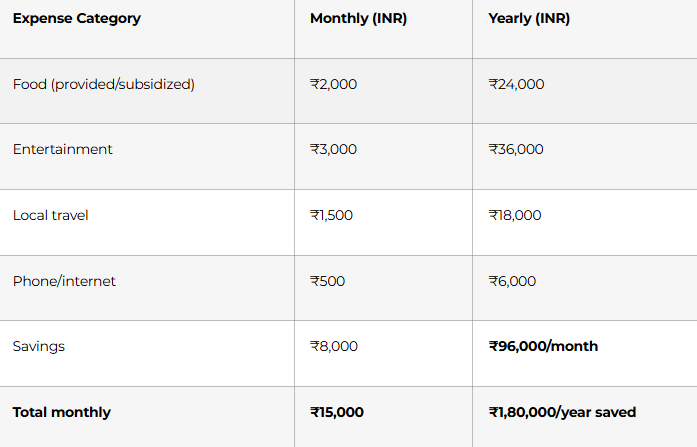
After 3 years abroad: ₹5.4 lakhs saved (vs ₹15 lakhs gross in India)
Return to India Strategy
Year 3 of contract (planning return):
Option 1: Transition to EdTech
- International experience = premium hiring
- EdTech companies hire: ₹25-40 lakhs starting
- Remote work possible initially
Option 2: Start own coaching/consultation
- International best practices + Indian context
- High demand for consulting
- ₹30-50 lakhs annual income possible
Option 3: Senior role in international school in India
- Positions in Delhi, Mumbai, Bangalore international schools
- Salary: ₹25-40 lakhs
- Familiar country, international experience
Option 4: Continue abroad
- After 3 years, renewals easier
- Opportunity for senior roles
- Build longer-term international career
Complete Journey Summary
Timeline: From Decision to Earning Abroad
text
Month 1-2: Decide destination, get TEFL certification
Month 3-4: Prepare documents, apply to 50+ positions
Month 5-6: Interview process, receive offers
Month 7-8: Visa processing, medical tests
Month 9: Move to country
Month 10-12: First 3 months abroad, adaptation
Year 2-3: Thrive in role, build experience
Year 3-4: Plan next step (stay, change, return)
Financial Projection:
text
India teaching career:
Year 1-5: ₹5 lakhs salary = ₹25 lakhs total (minimal savings)
Abroad career + return:
Year 1-3: ₹18 lakhs salary, ₹10 lakhs savings/year = ₹30 lakhs saved
Return to India Year 4-5: ₹30 lakhs senior role = ₹60 lakhs total
Total advantage: ₹30 lakhs savings + higher career position
Practical Checklist: Start Teaching Abroad
This week:
✅ Identify target countries (3-5 options)
✅ Research salary/cost of living for each
✅ Follow 5 international school job postings
This month:
✅ Get TEFL certification (if needed)
✅ Update resume with international teaching goals
✅ Gather recommendation letters from current school
Next 2 months:
✅ Apply to 50+ positions across preferred countries
✅ Join expat Facebook groups in target countries
✅ Set up better LinkedIn profile highlighting willingness to relocate
Months 3-4:
✅ Attend interviews (likely virtual)
✅ Negotiate offers when they arrive
✅ Make final decision on country/school
Months 5-6:
✅ Complete visa process
✅ Arrange travel and accommodation
✅ Connect with expat community before arrival
Resources for International Teachers
Essential websites:
- Teach Away (teachaway.com)
- International Schools Review (isreview.org)
- Dave’s ESL Cafe (eslcafe.com)
- Expat communities (InterNations, local Facebook groups)
Certification providers:
- TEFL Course.com
- International TEFL Academy
- Cambridge CELTA centers
Visa information:
- Official country immigration websites
- Expat community forums (country-specific)
- Recruitment agency consultations
Final Perspective
Teaching abroad is one of the best professional decisions Indian teachers can make. You earn 3-4x more, build international credentials, gain personal growth, and often save enough to change your life trajectory.
The process seems complex—applications, visas, cultural differences. But thousands of Indian teachers successfully make this move yearly. With systematic preparation (6-8 months), the pathway becomes clear.
The window of opportunity is now. Developing countries desperately need skilled teachers. Take 2025 to prepare, apply across 50+ positions, and you’ll likely be teaching abroad by 2026.
Your international teaching career starts with one application today.