
PhD in Education: Is It Worth It? Complete Career Benefits Analysis
Table of Contents
You’ve completed your Master’s degree, perhaps even cleared the UGC NET, and now you stand at a critical academic crossroad. The next logical step seems to be a Doctor of Philosophy (PhD), the highest academic degree one can achieve. But let’s be honest—a PhD is a monumental commitment of time, energy, and resources, often taking 3 to 5 years to complete.
So, the big question is: Is a PhD in Education truly worth it in 2025?
With the UGC’s recent rule changes making a PhD no longer mandatory for entry-level Assistant Professor positions, many aspiring academics are confused. This guide will provide a clear, data-backed analysis to help you decide. We’ll break down the tangible career benefits, salary advantages, and the doors that a PhD opens, as well as the realities of when it might not be necessary.
Part 1: The PhD is No Longer Mandatory, But Is It Still Necessary?
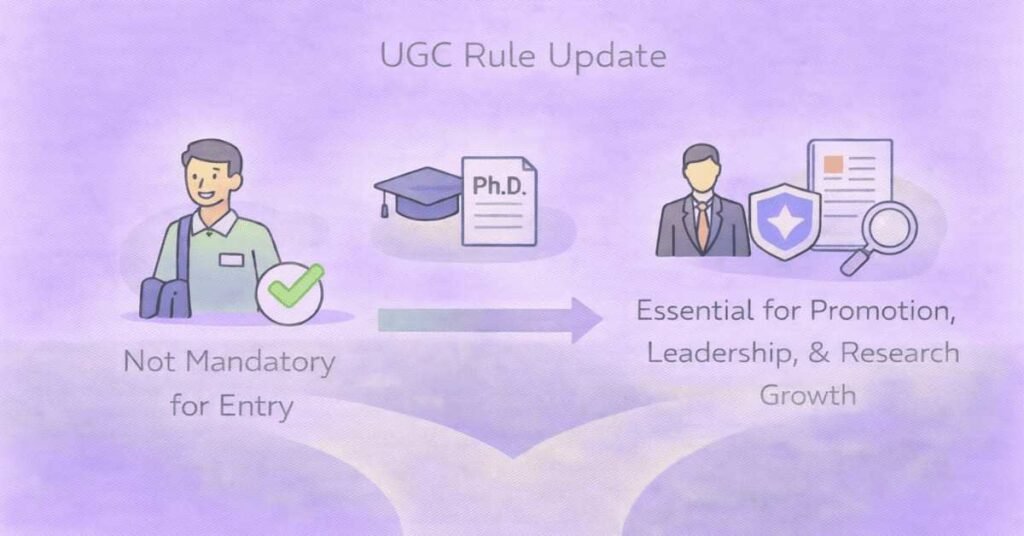
Let’s clear up the biggest point of confusion first. In July 2023, the University Grants Commission (UGC) officially announced that a PhD is no longer a mandatory requirement for direct recruitment to the post of Assistant Professor in universities and colleges. Clearing the NET, SET, or SLET is now the minimum eligibility criteria.
So why would anyone still do a PhD?
Because while it’s not mandatory for entry, it is absolutely essential for career progression.
- Promotion to Associate Professor: You cannot be promoted from an Assistant Professor to an Associate Professor without a PhD. This is a non-negotiable requirement in the university system.
- Guidance for PhD Students: You cannot officially supervise a PhD student yourself without holding a PhD degree.
- Access to Senior Roles: Positions like Head of Department, Dean, or Director are almost exclusively held by senior faculty with PhDs.
- Competitive Edge: Even for entry-level positions, a candidate with a PhD will almost always be preferred over a candidate with only a Master’s and NET qualification, especially in research-focused universities.
The takeaway: A PhD has shifted from being an “entry ticket” to a “growth accelerator.” You can enter academia without it, but you cannot grow within it.
Part 2: The Tangible Career & Salary Benefits of a PhD
Pursuing a PhD is a long-term investment that pays significant dividends throughout your career.
1. Higher Starting Salary and Faster Growth
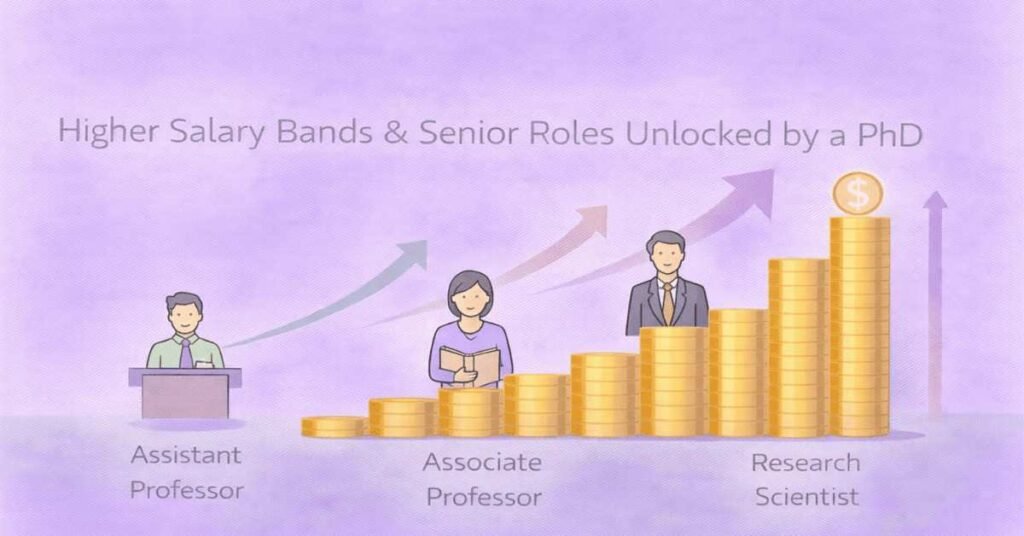
While a NET-qualified Assistant Professor starts with a respectable salary, a PhD holder often enters at a higher pay scale or receives additional increments. More importantly, their path to higher salaries is much faster.
Average Salaries in India (2025):
Job Role | Average Annual Salary | With PhD |
Assistant Professor | ₹6 lakhs – ₹8 lakhs | ₹8 lakhs – ₹12 lakhs |
Educational Consultant | ₹7 lakhs – ₹10 lakhs | ₹10 lakhs – ₹15 lakhs |
Policy Analyst | ₹6 lakhs – ₹9 lakhs | ₹8 lakhs – ₹12 lakhs |
Corporate Trainer | ₹6 lakhs – ₹8 lakhs | ₹8 lakhs – ₹12 lakhs |
Research Scientist | ₹5 lakhs – ₹7 lakhs | ₹9 lakhs – ₹16 lakhs |
Source: Data compiled from multiple sources including Shiksha, CollegeVidya, and Desh Bhagat University reports
As you can see, a PhD consistently adds a 25-50% premium to your earning potential across various roles. Over a 30-year career, this difference can amount to crores of rupees.
2. Access to a Wider Range of Prestigious Job Roles
A Master’s degree prepares you to be a teacher. A PhD prepares you to be a scholar, a leader, and an expert. This opens doors to roles that are simply inaccessible without a doctorate.
Careers Exclusive to PhD Holders:
- University Professor: The core academic role focused on teaching and research.
- Research Scientist: Working in government labs (like CSIR, ICMR) or private R&D centers.
- Academic Dean/Provost: Senior administrative roles responsible for managing entire faculties or academic affairs of a university.
- Policy Advisor: Working with government bodies (like NITI Aayog) or think tanks to shape national education policy.
- Chief Learning Officer (CLO): A senior corporate role in large multinational companies, responsible for the entire learning and development strategy.
- Historian, Anthropologist, Linguist: Specialist roles in research and preservation that require deep, original research.
Without a PhD, your career path in education largely caps out at being a school principal or a senior college teacher. With a PhD, your potential ceiling is becoming a Vice-Chancellor of a university or a director at a national research institute.
3. Intellectual Autonomy and Expert Status
A PhD is not just about learning existing knowledge; it’s about creating new knowledge. The process of writing a dissertation trains you to identify a problem, design a research methodology, collect and analyze data, and contribute an original finding to your field.
This process transforms you from a consumer of information into a producer of it.
- You become an “expert”: When media outlets, government committees, or companies need an opinion on a specific educational issue, they seek out PhDs.
- You gain intellectual freedom: As a professor, you have the autonomy to research topics that genuinely interest you, not just what’s in a textbook.
- You build a personal brand: Your publications and research give you a unique academic identity. You become known as “the person who studies X.”
This expert status is a form of professional security that goes beyond a monthly salary.
Part 3: M.Ed vs. PhD in Education – Choosing the Right Path
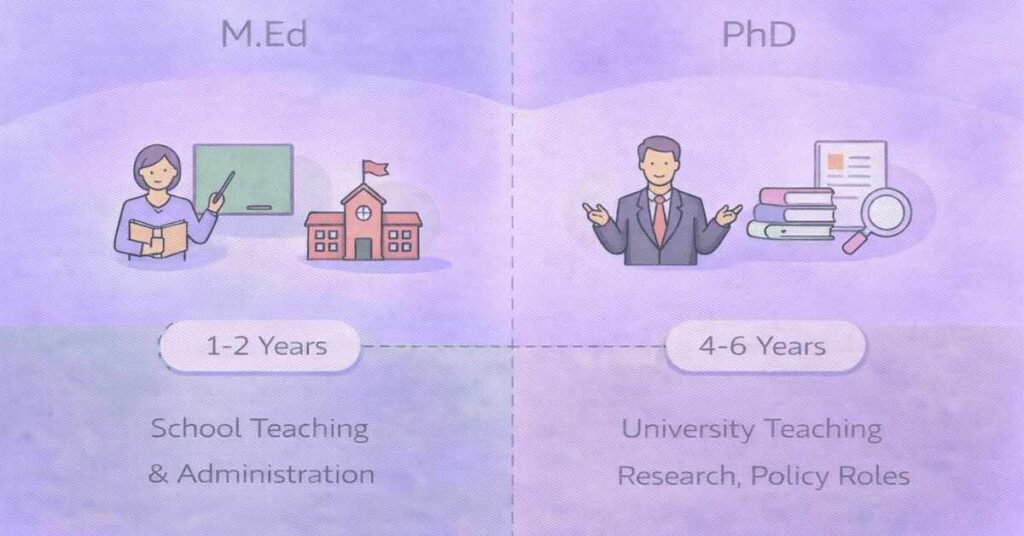
This is a common point of confusion for B.Ed graduates. Should you do an M.Ed (Master of Education) or aim directly for a PhD? The answer depends entirely on your career goals.
Choose an M.Ed if your goal is to:
- Become a senior school teacher or a school administrator (like a Vice-Principal or Principal).
- Work as a teacher educator in a B.Ed college.
- Deepen your understanding of pedagogy and classroom practices.
- Get a promotion within the K-12 school system.
An M.Ed is a professional degree focused on the practice of teaching and school management.
Choose a PhD if your goal is to:
- Become a professor in a university’s Department of Education.
- Conduct original research and publish scholarly articles.
- Become a policy analyst, a high-level educational consultant, or a research scientist.
- Lead a university as a Dean or Vice-Chancellor.
A PhD is a research degree focused on creating new knowledge in the field of education.
Simple Rule of Thumb: If your career is centered around schools (K-12), an M.Ed is more relevant. If your career is centered around universities and research, a PhD is essential.
Part 4: The PhD Journey – What Are You Signing Up For?
A PhD is a marathon, not a sprint. It’s crucial to understand the process before you commit.
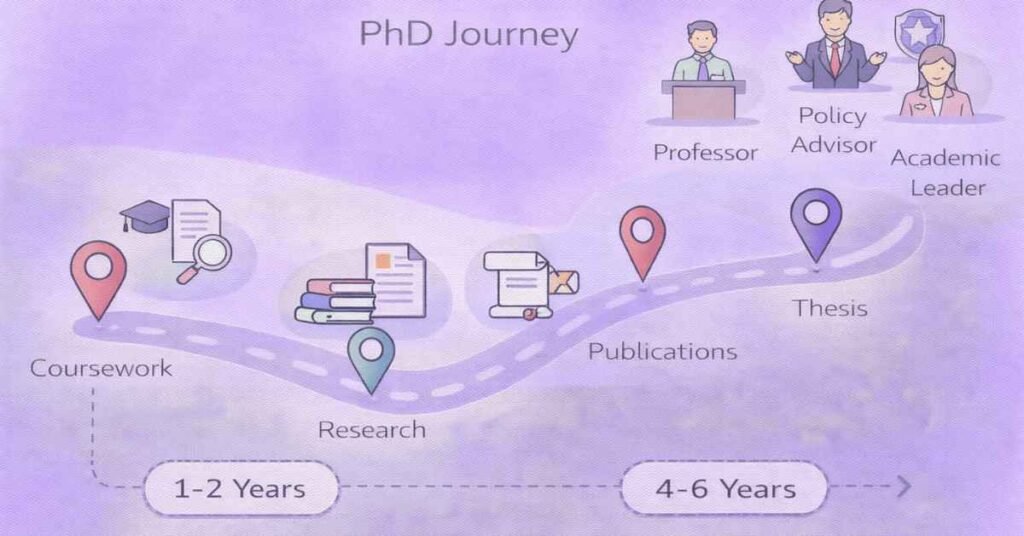
The Typical Timeline (3-5 Years):
- Year 1: Coursework & Proposal: You’ll take advanced courses in research methodology, statistics, and your area of specialization. By the end of the year, you’ll finalize your research topic and defend your research proposal.
- Years 2-3: Data Collection & Analysis: This is the core of your PhD. You will be out in the field, conducting surveys, interviews, or experiments to collect the data for your study. This is often the most challenging phase.
- Years 4-5: Writing & Defense: You will spend this time writing your dissertation (a 200-300 page document). Once completed, you will defend your findings in a final “viva voce” examination in front of a panel of experts.
Throughout this process, you will be expected to publish parts of your research in academic journals.
The Financial Aspect:
Unless you secure a fellowship like the UGC JRF (which pays a stipend of ~₹37,000/month), a full-time PhD means several years with little to no income. This is a major factor to consider.
Part 5: The Final Verdict – Is a PhD in Education Worth It for YOU?
Let’s summarize the analysis into a decision-making framework.
A PhD in Education is absolutely worth it if:
- Your ultimate goal is to become a university professor and progress to senior academic ranks.
- You are passionate about research and want to contribute new knowledge to the field.
- You are interested in high-level policy-making or consulting roles where expert status is required.
- You have the financial stability and mental resilience to commit to a 3-5 year intensive research journey.
- You want the highest possible earning potential and career ceiling in the education sector.
You might NOT need a PhD in Education if:
- Your career ambitions are within the K-12 school system (e.g., becoming a successful Principal). An M.Ed would be more direct and effective.
- You prefer practical, hands-on teaching over theoretical research.
- You are not in a position to take a 3-5 year break from full-time earning.
- Your goal is to be an excellent Assistant Professor for your entire career without the pressure of research and publications (though this is becoming less common).
In conclusion, while the UGC has made the entry into academia more flexible, the PhD remains the undeniable key to growth, leadership, and expertise within the higher education ecosystem. It is not just a degree; it is a transformative process that redefines your professional identity and unlocks the most prestigious and impactful career opportunities in the field of education.