
Success Metrics And Benchmarking
Table of Contents
Blog Content
Introduction: What Success Really Means
Success in a placement exam isn’t a single number. It’s not “I scored 75%.” Real success is a system: setting the right goals, tracking meaningful metrics, understanding what your score means, and leveraging that performance toward your career. This module teaches you the strategic framework behind achievement—how to define success for yourself, measure progress scientifically, and convert exam performance into career momentum.
Explore Training Resources →
Section 1: Defining Success - Beyond the Score
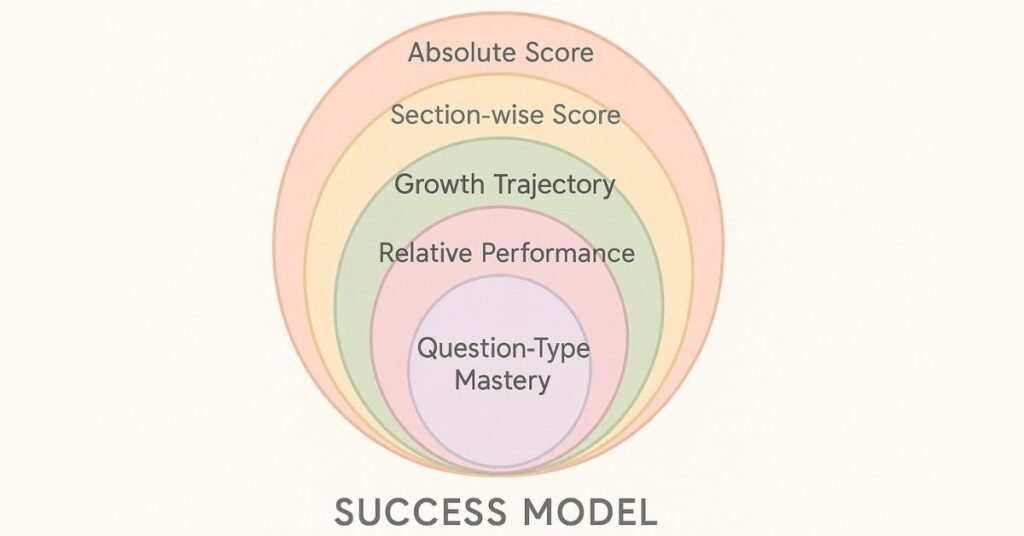
The Multi-Dimensional Success Framework
Success has multiple layers. Understanding each helps you gauge true progress.
Layer 1: Absolute Score
Your overall percentage. Important but incomplete.
- What it measures: Overall knowledge and execution
- Why it matters: Companies use this for filtering
- Limitation: Doesn’t account for section strengths/weaknesses
Layer 2: Section-Wise Performance
Breaking score into Quantitative, Logical Reasoning, Verbal.
- What it measures: Specific ability domains
- Why it matters: Reveals which skills to strengthen before interviews
- Limitation: Doesn’t show growth trajectory
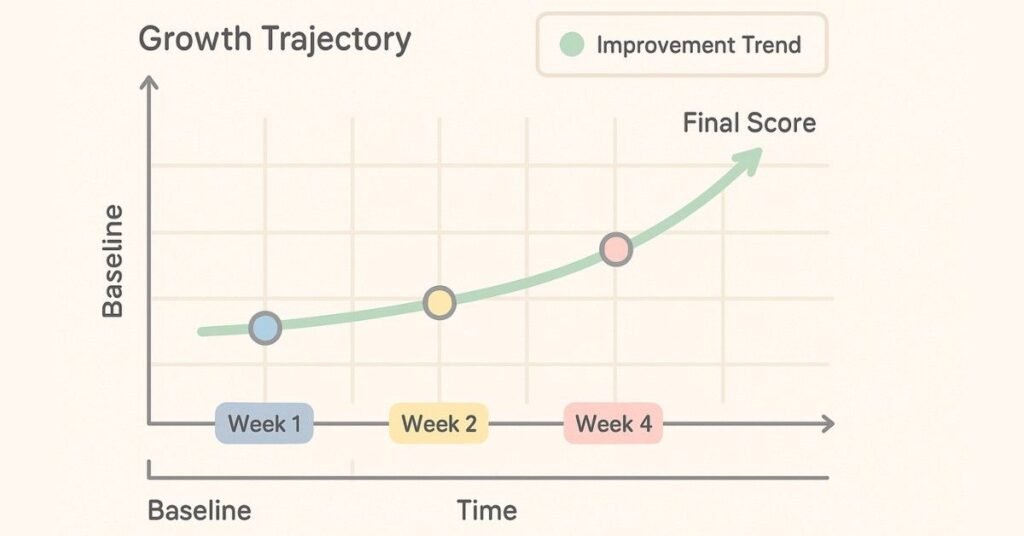
Layer 3: Growth Trajectory
Improvement from baseline to final test.
- What it measures: Learning velocity and practice effectiveness
- Why it matters: Shows coachability and determination
- Limitation: Doesn’t predict interview performance
Layer 4: Relative Performance
How you compare to peers and company benchmarks.
- What it measures: Competitiveness for specific roles
- Why it matters: Determines if you clear company cutoffs
- Limitation: External factors affect peer performance
Layer 5: Question-Type Mastery
Accuracy on specific problem types.
- What it measures: Readiness for real-world applications
- Why it matters: Shows depth of understanding, not just surface knowledge
- Limitation: Doesn’t translate directly to job performance
Your Personal Success Definition
Before the exam, define what success means for you:
Example 1 (Aggressive Target):
“Success = 80%+ overall, 85%+ in Quant, clear all company cutoffs”
Example 2 (Realistic Target):
“Success = 70%+ overall, improve from baseline by 20%, clear 3+ company cutoffs”
Example 3 (Process-Focused Target):
“Success = Complete 90% of attempted questions accurately, improve from 60% to 70%, maintain consistency across mocks”
Write your definition. Revisit it before the exam. This becomes your benchmark.
Section 2: Performance Analysis Dashboard
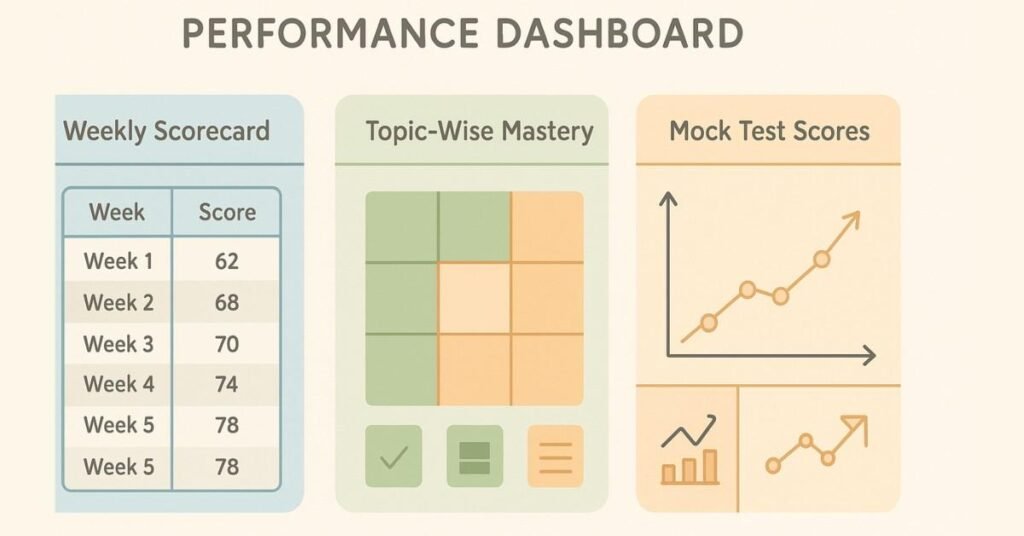
Building Your Personal Metrics System
Dashboard Element 1: Weekly Scorecard
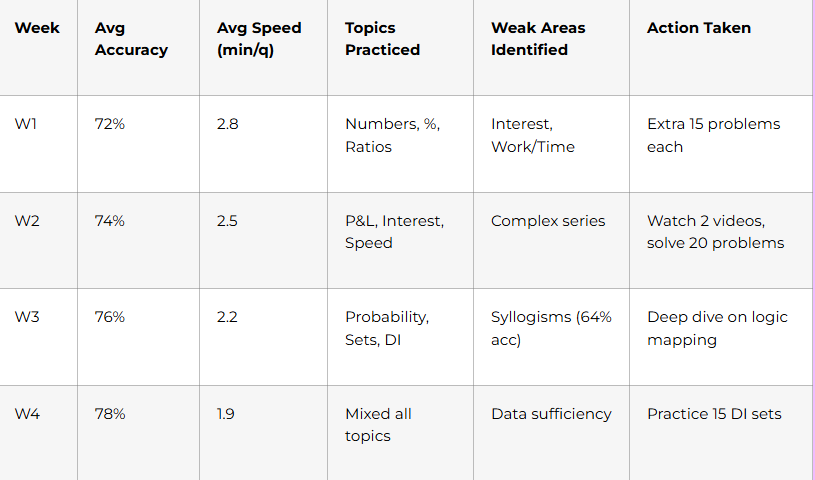
Dashboard Element 2: Topic-Wise Mastery Matrix
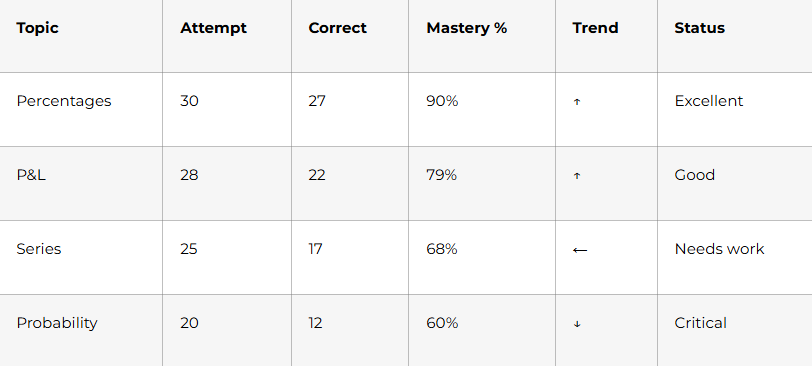
Dashboard Element 3: Mock Test Progression
text
Score Trend Over 3 Mocks:
Mock 1: 62% (Baseline)
├─ Quant: 58%
├─ LR: 65%
└─ Verbal: 62%
Mock 2: 68% (+6%)
├─ Quant: 64% (+6%)
├─ LR: 72% (+7%)
└─ Verbal: 66% (+4%)
Mock 3: 72% (+4%)
├─ Quant: 70% (+6%)
├─ LR: 75% (+3%)
└─ Verbal: 70% (+4%)
Projection for Actual Exam: 75-78%
Dashboard Element 4: Time Efficiency Index
Time Efficiency=Accuracy %Time taken (minutes)×100\text{Time Efficiency} = \frac{\text{Accuracy \%}}{\text{Time taken (minutes)}} \times 100Time Efficiency=Time taken (minutes)Accuracy %×100
Goal: > 50 indicates good balance of speed and accuracy
Example:
- If accuracy = 80% and time = 1.5 min/question
- Efficiency = (80/1.5) × 100 = 5,333 (strong)
- If accuracy = 90% but time = 3 min/question
Efficiency = (90/3) × 100 = 3,000 (accurate but slow)
Access Full Learning Library →
Section 3: Exam Readiness Assessment
Checklist: Are You Ready to Sit the Exam?
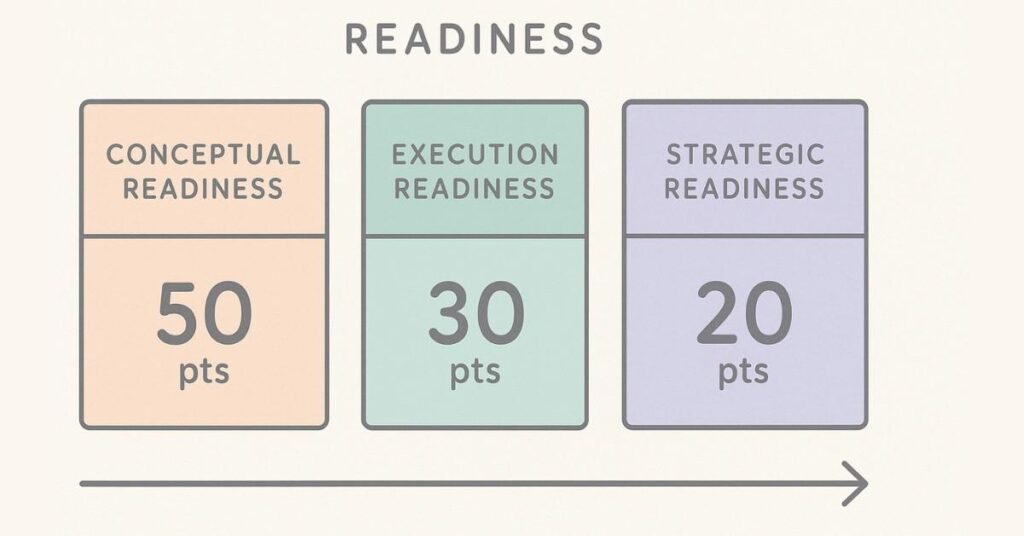
Conceptual Readiness (50 points)
- Can solve 80%+ of basic questions in all topics? (10 pts)
- Understand when to use which formula? (10 pts)
- Recognize question patterns and approaches? (10 pts)
- Explain your reasoning in solved problems? (10 pts)
- Can differentiate between similar concepts? (10 pts)
Execution Readiness (30 points)
- Consistently maintain 70%+ accuracy across topics? (10 pts)
- Can solve questions in target time (1.5-2 min)? (10 pts)
- Have practiced 200+ diverse questions? (10 pts)
Strategic Readiness (20 points)
- Understand your tier-wise prioritization strategy? (5 pts)
- Know your weak sections and have mitigation plan? (5 pts)
- Have completed 3+ full-length mock tests? (5 pts)
- Analyzed mocks and improved identified gaps? (5 pts)
Scoring:
- 90-100: Excellent readiness; proceed to exam
- 70-89: Good readiness; focus on weak areas for 1 week
- 50-69: Moderate readiness; dedicate 2-3 weeks to weak areas
- <50: Not ready; consider postponing exam
Boost Exam Readiness with Skill Programs →
Section 4: Company-Specific Score Benchmarking
Understanding Cutoff vs. Percentile
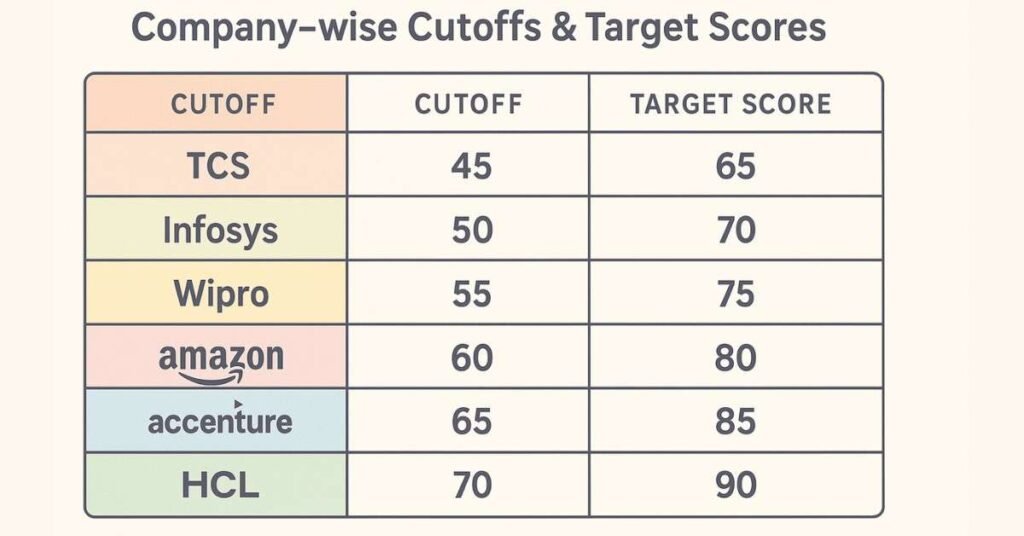
Cutoff: Minimum score needed to qualify (usually 60-70%)
Percentile: Your position relative to test-takers (e.g., 95th percentile = better than 95% of test-takers)
Company Cutoffs and Average Passing Scores (2024-2025)
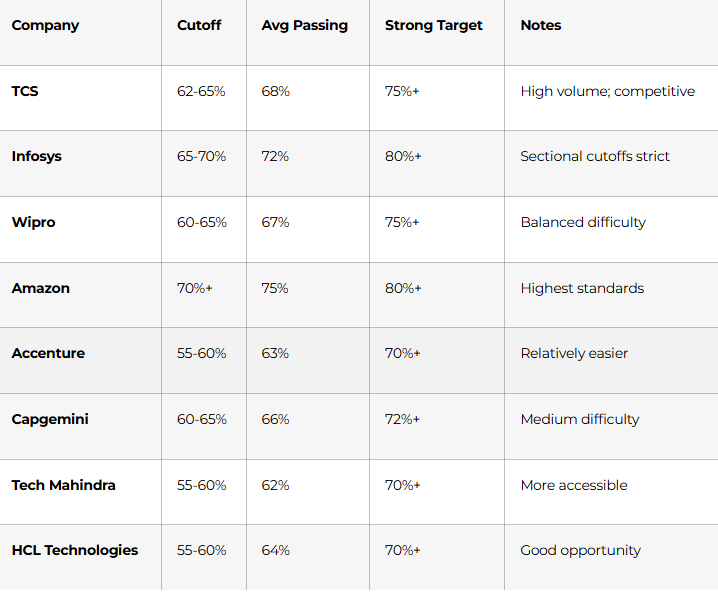
Strategic Insight: Don’t just aim for one company’s cutoff. Aim for 75%+ to maximize options across all tier-1 companies.
Section 5: Performance Categories and What They Mean
Score Range Interpretation
80%+ Excellent
- Interpretation: Among top 5-10% of candidates
- Career impact: Strong offers from tier-1 companies; choice of roles
- Next steps: Prepare for group discussions and interviews
- Reality check: Still need strong HR and technical interviews
70-79% Good
- Interpretation: Among top 25-30% of candidates
- Career impact: Clear cutoffs for most companies; some tier-1 restricted
- Next steps: Focus on specific company strategies; prepare backup options
- Reality check: Aptitude alone won’t guarantee offer; excel in interviews
60-69% Average (Passing)
- Interpretation: Among top 40-50% of candidates
- Career impact: Clear cutoffs for tier-2/3 companies; some tier-1 missed
- Next steps: Leverage interview performance heavily; consider re-attempting if critical
- Reality check: You’ve passed, but limited options; strong interview necessary
50-59% Below Average
- Interpretation: Among top 50-65% of candidates
- Career impact: Limited company options; some cutoffs missed
- Next steps: Consider retaking aptitude; focus on interviews with willing companies
- Reality check: Challenging situation; requires exceptional interview performance
<50% Poor
- Interpretation: Among bottom 35% of candidates
- Career impact: Most companies eliminate; very limited options
- Next steps: Retake aptitude within 2-4 weeks; intensive crash prep
- Reality check: Significant effort needed; career placement at risk
Section 6: Growth Trajectory Analysis
Measuring Learning Velocity
Your improvement rate matters as much as absolute score.
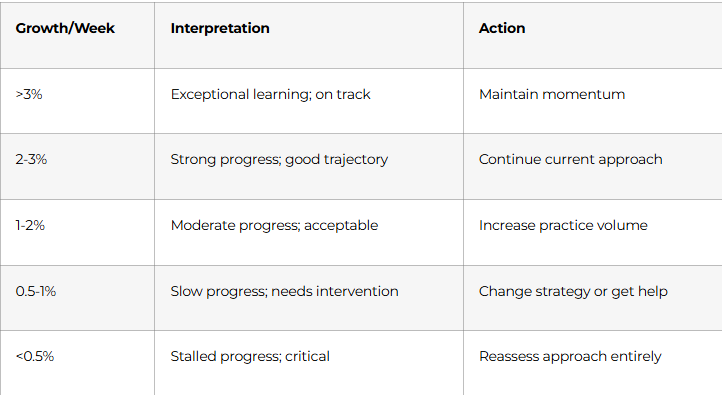
Growth Calculation:
Growth=Final Score−Baseline ScoreTime Invested (weeks)\text{Growth} = \frac{\text{Final Score} – \text{Baseline Score}}{\text{Time Invested (weeks)}}Growth=Time Invested (weeks)Final Score−Baseline Score
Example:
- Baseline (Week 1): 55%
- Final (Week 8): 75%
- Growth = (75 – 55) / 8 = 2.5% per week
What This Means:
Stagnation Pattern Recognition
If your score plateaus for 2+ weeks:
- Identify the ceiling: Which topic/question type is limiting you?
- Root cause analysis: Conceptual gap? Time management? Careless errors?
- Intervention strategy: Deep dive on that topic with new resources
Test the fix: Attempt 20+ problems on that topic; measure improvement
Section 7: Post-Exam Analysis Framework
Immediately After Exam (Within 24 Hours)
Do This:
- Score projection (5 min)
- Estimate how many questions you attempted
- Estimate accuracy on attempted questions
- Project score ±5%
- Confidence assessment (5 min)
- Which sections felt strongest?
- Which felt weakest?
- Any major conceptual blanks?
- Execution review (10 min)
- Did you follow your strategy?
- Any timing surprises?
- Questions you regret skipping?
Do NOT Do:
❌ Stress about score (you can’t change it now)
❌ Over-analyze individual questions (leads to doubt)
❌ Compare with friends’ performance (irrelevant to your journey)
❌ Make promises to yourself about next time (wait for actual results)
Section 8: When Score Doesn't Meet Expectations
If You Score Below Target:
Scenario 1: You Scored 10-15% Below Target
Root causes to investigate:
- Time management failure (didn’t complete questions)
- Strategy error (attempted wrong tier questions)
- Concept gaps in specific topics
- Careless mistakes (under pressure)
Recovery action:
- Identify which section dropped most
- Dedicate 1-2 weeks to that section
- Retake exam in 3-4 weeks
- Realistic expectation: +5-10% improvement possible
Scenario 2: You Scored 20%+ Below Target
Root causes to investigate:
- Insufficient preparation (too little practice)
- Severe concept gaps (missing fundamentals)
- Anxiety during exam (froze up)
- Misaligned mock tests (mocks were easier than actual)
Recovery action:
- Restart from Module 1 basics
- Allocate 6-8 weeks for intensive prep
- Consider one-on-one tutoring for weak areas
- Retake exam after complete revision cycle
- Realistic expectation: +15-25% improvement possible
Section 9: Converting Score to Career Advantage
Leveraging Your Performance
If You Scored 75%+:
✓ In resume: “Qualified TCS, Infosys, Amazon campus placements (75%+ in aptitude)”
✓ In interview: Show confidence; use strong score as proof of analytical ability
✓ Strategy: Fast-track interviews; choose among multiple offers
✓ Negotiation: Score strength supports better package discussion
If You Scored 65-74%:
✓ In resume: “Cleared campus aptitude screening”
✓ In interview: Emphasize interview strengths; aptitude shows you cleared hurdles
✓ Strategy: Focus interview prep heavily; excel in technical/HR rounds
✓ Negotiation: Solid foundation; demonstrate value through interview
If You Scored 55-64%:
✓ In resume: Don’t over-emphasize; focus on projects and skills instead
✓ In interview: If asked, explain strategically: “Cleared cutoff while managing other priorities”
✓ Strategy: Exceptional interview necessary; prepare thoroughly
✓ Negotiation: Prove value through technical competence and soft skills
Section 10: Long-Term Success Metrics
Beyond the Exam: Real Success Indicators
3-Month Metrics:
- Received offers from target companies?
- Joined your preferred organization?
- Outperformed interview rounds?
- Demonstrated continuous learning?
6-Month Metrics:
- Onboarding and training completion?
- Positive feedback from manager?
- Contributing meaningfully to projects?
- Building professional network?
1-Year Metrics:
- Performance rating/appraisal positive?
- Promoted or given increased responsibilities?
- Skill development beyond initial training?
- Career trajectory on track?
The Deeper Truth: Your placement exam score was just the first gate. Your real success is determined by how you perform in the role, how you grow professionally, and how you leverage this opportunity. A 75% score means nothing if you don’t excel in your job. A 60% score becomes irrelevant if you become a star performer. The exam was a filter; what happens after is the real game.
Section 11: The Mindset Framework - Success Principles
Principle 1: Score is Not Identity
Your aptitude score is data about a specific moment. It’s not a reflection of your intelligence, worth, or potential. A 70% doesn’t make you “70% capable.” It means you got 70% of questions right under time pressure.
Principle 2: Preparation Beats Talent
No one becomes excellent at placements through talent alone. Every top scorer you see went through systematic, deliberate practice. There’s no magic. There’s only consistent effort compounded over time.
Principle 3: Mistakes Are Data, Not Failures
Every wrong answer is information about your weak area. Instead of feeling bad about mistakes, view them as treasure maps pointing to where you need to improve. The student who analyzes 100 mistakes learns more than the student who solves 1000 easy problems.
Principle 4: Execution Matters More Than Knowledge
You can know every formula but still fail if you can’t execute under pressure. Conversely, you can lack deep knowledge but excel through strong execution strategies. This is why strategy (Module 4) matters as much as concepts (Modules 1-3).
Principle 5: Consistency Compounds
Missing 3 days of practice costs you 30 points of improvement over a month. Missing 30 days costs you 300 points. Small daily habits compound into massive differences. Your daily 30-minute practice session matters infinitely more than cramming the night before.
Section 12: Final Success Checklist (Exam Week)
7 Days Before Exam:
- Complete final mock test
- Analyze results thoroughly
- Identify 3 weak areas; spend 2 hours each on them
- Review formula sheet once
- Get 8+ hours sleep daily
- Avoid learning new topics
3 Days Before:
- Light practice (1 hour): 20 easy questions
- Review strategy document once
- Physical prep: arrange ID, admit card, pen
- Mental prep: visualize successful exam
- Sleep well nightly
Day Before:
- NO exam practice
- Review time allocation strategy (10 min)
- Light activity (walk, exercise)
- Early dinner; prepare for early sleep
- Arrange travel to exam center
- Go to sleep on time
Exam Morning:
- Light breakfast (not empty, not heavy)
- Leave 30 min early for exam center
- 5 min breathing exercises before entering
- Phone completely off
- Focus on strategy, not perfection
TRUST YOUR PREPARATION